

This is the last part of 4Hunger’s initial El Niño series. The ones before this followed El Niño around the world: the forecast itself, in Hunger Foretold; the rains that failed in Sudan, in El Niño Has Landed; the harvests lost in the Americas, in El Niño Crosses the Atlantic; the window still open across Asia, in El Niño Reaches Asia; and the nineteen African countries that lost a harvest alongside Sudan, with related impacts in Europe, in Nineteen African Countries Have Already Lost a Harvest. This part begins in Peru, where El Niño got its name and where the full range of its impacts is felt, and then asks the question none of the others could answer on their own. Two El Niño events of comparable strength, a century and a bit apart, produced death tolls so far apart that the second killed less than one percent as many people as the first. The ocean did much the same thing both times. This is about what determined how many people died during each El Niño and what WE can do to keep the death toll low with this 2026 - 2027 El Niño.
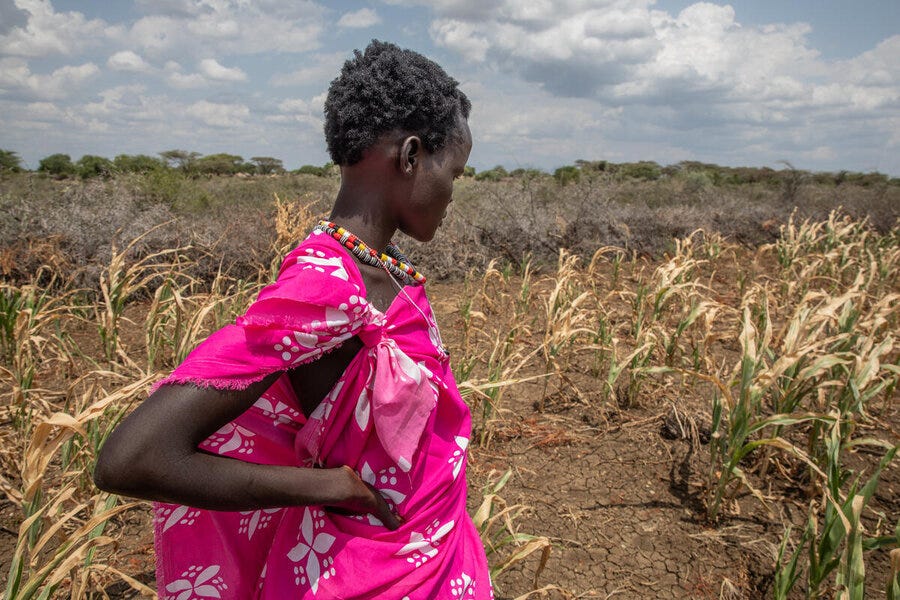
In swathes of Africa, Asia and Latin America, this year’s powerful El Niño is expected to unleash droughts, but also heavy rains and flooding. Photo: WFP/Gabriela Vivacqua
It Begins Where It Is Named
Part three of this series told how Peru’s fishermen named El Niño, and what this one is already doing to their anchoveta (anchovy) catch.1
The loss of the fishery is the gentler half of what a coastal El Niño does to Peru. The same warm water that empties the nets of anchovy loads the moisture in the atmosphere over one of the driest coastlines on earth, and the rain then arrives on ground that cannot absorb it because it is so dry. Peruvians have a word for what follows: “huaicos”, the torrents of mud and rock that come down the dry valleys and through the towns built in them. In 2017, a coastal El Niño killed around 150 people and displaced hundreds of thousands. This year’s rains have already killed at least 74, in floods and mudslides from December through March.2
So, the country that named the phenomenon lives with the full range of its impacts: a fishery that fails and a coast that floods. The name “El Niño” has traveled around the world, while the place that supplied it remains among the most exposed to what it describes.
This makes Peru the right place to ask the question this final article is about. The Pacific does what it has always done: it has formed an El Niño, this time in an ocean warmed by climate change. What varies, enormously, and what is still undecided, is how many people will die from this El Niño.
Two Droughts, One Ocean
In 1877, the monsoon failed over India. The Pacific was warm, the rains did not come, and somewhere between five and ten million people died in British India alone. Add the simultaneous famines in northern China and northeastern Brazil, driven by the same El Niño event, and the toll from that single El Niño runs into the tens of millions.3
In 1997 and 1998, the Pacific warmed again, to an intensity climatologists consider broadly comparable with the 1877 El Niño. The event was enormous. It caused roughly $36 billion in damage worldwide. However, it killed only about twenty-one thousand people.4
Set those two numbers beside each other and the conclusion is unavoidable. Between 1877 and 1997 the ocean did not change very much. What changed was everything around it. The world held far more people in 1997, but far fewer of them died in the 1997 El Niño, because of how governments and people responded.
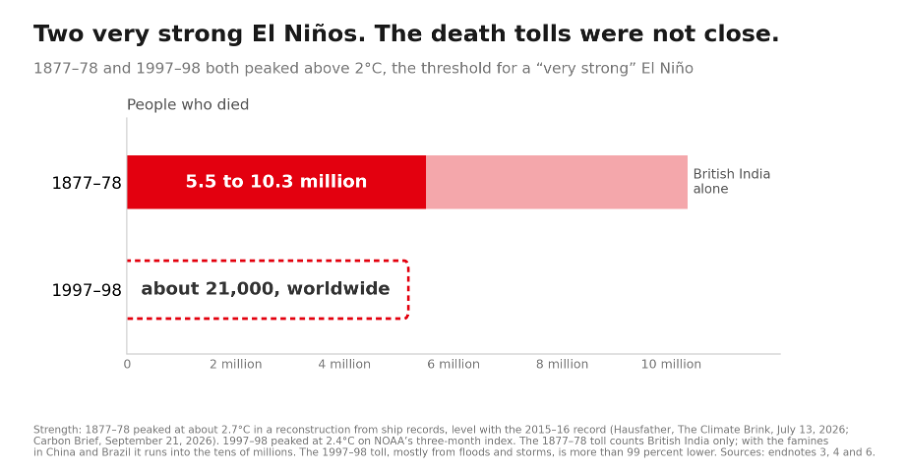
Figure 1. The 1877–78 and 1997–98 El Niños side by side. Both were very strong El Niños; the number of people who died was not comparable. The 1997–98 toll is too small to register at the scale of 1877.
This is not an argument that water is harmless. El Niño sends the droughts that destroy crops and the floods that wash them away, and there is no arguing with either. Sudan’s farmers could not plant their sorghum in July because the rain did not come, and no decision by anyone anywhere could have grown a crop without water. The Nile fell lower than farmers in their sixties can remember, and cholera followed the falling river through Sudanese camps. In Uganda’s Karamoja region, the number of people in crisis or emergency hunger has risen by more than 40 percent in a few months. Ethiopia is watching unseasonal rain threaten its main harvest, and Somalia and Kenya brace for floods this fall. In Central America’s Dry Corridor, the first harvest of the year is already gone. The second is being planted into the face of this El Niño. In Peru, forecasters put the chance of a strong or extraordinary coastal El Niño this coming summer at more than 70 percent, and the warm water has already emptied the nets that supply a fifth of the world’s fishmeal.1 India’s monsoon is heading for a deficient year, the Philippines warns it could lose as much as 700,000 tonnes of rice, salt water is forecast to push up the Mekong into Vietnam’s rice fields, and Papua New Guinea’s highlands face the drought and frost that affected 2.4 million people there in the last great El Niño. Peat smoke has already sent more than 170,000 Indonesians for treatment since August, 40,000 of them toddlers, and El Niño redraws the map of dengue and malaria. The water does the first damage, it does it directly, and it is not negotiable.
But between a failed harvest and a dead child there is a long space, and almost nothing in it is weather. Whether the household had reserves from last year. Whether it can afford to buy replacement food for crops that have been lost. Whether there is grain at an affordable price or food in the market at all, or whether the border has been closed to prevent exports. Whether anyone moved money or other aid before the lean season or after it. Whether there is a clinic left standing when the child stops eating.
That space is where the difference between 1877 and 1997 lies. The rains destroyed crops in both years. Only one of those harvest failures was allowed to become a famine.
“The temperature of the Pacific tells you where the rain will fail, and where crops will die. It tells you almost nothing about how many people will die. That number is set on land, by policy decisions made by governments around the world, most of them made before the drought and floods even arrive.”
The historian Mike Davis made this argument at length in the book Late Victorian Holocausts, and the mechanism he described is uncomfortably recognizable. India in 1877 was not short of grain. It was forced to export record quantities of grain it grew to Britain while its own population starved. The railways that could have carried food inland to the starving Indian peasants carried it to the ports for export instead. The theory given by the British at the time was that relief had to be rationed because generosity would corrupt the poor. The peasants had nothing to fall back on in the face of El Niño: British policy had pushed them into cash crops for export and into debt to pay the colonial land tax, leaving them no grain reserves of their own. The drought was real. The famine was administered by the British colonizers.5
That is the frame for everything in the previous five articles, and it is the reason this series has spent as much time on export bans, ration cuts and funding tables as on rainfall. Decisions already taken, and decisions being taken now, will set the death toll of this El Niño, too. So far there is no sign of the surge in humanitarian funding that 150 years of El Niño records say these countries around the world will need, particularly with this El Niño on course to be the strongest ever recorded.
We hope that this series will contribute to the calls for humanitarian aid to be funded now, before it turns into disaster relief.
This One Is Bigger. But That Will Not Change This Equation.
This El Niño is not merely comparable to 1997. On September 21st, the daily Niño 3.4 anomaly reached 3.11 degrees, breaking the record set in November 2015, two months before El Niños usually peak. The forecasts have climbed faster still: an era-adjusted peak near 3.0 degrees in ECMWF’s May forecast, then a 14-model median of 3.6 in July and 4.1 in September, when every one of 674 runs across fourteen forecasting systems exceeded the 2015–16 record. These are era-adjusted figures, measured against the climate of each event’s own time, and cannot be set beside the 2.6 NOAA lists for 2015–16 on its three-month index. NOAA gives a 75 percent chance this becomes the strongest event since 1950. No model has ever been tested at this intensity, but wherever the peak lands, it will be in territory no one has measured before.6
Heat alone has already killed more than 200,000 people since this El Niño began in June, and could kill 451,000 by February, according to the first projection of its death toll, published on September 23rd by the University of Chicago’s Climate Impact Lab. That number does not include a single death from hunger, flood, fire or disease. The last super El Niño shows what those can add, in 2015, smoke from Indonesia’s El Niño fires alone caused an estimated 100,000 excess deaths across Indonesia, Malaysia and Singapore in a single season. The same peat fires are burning again now.6
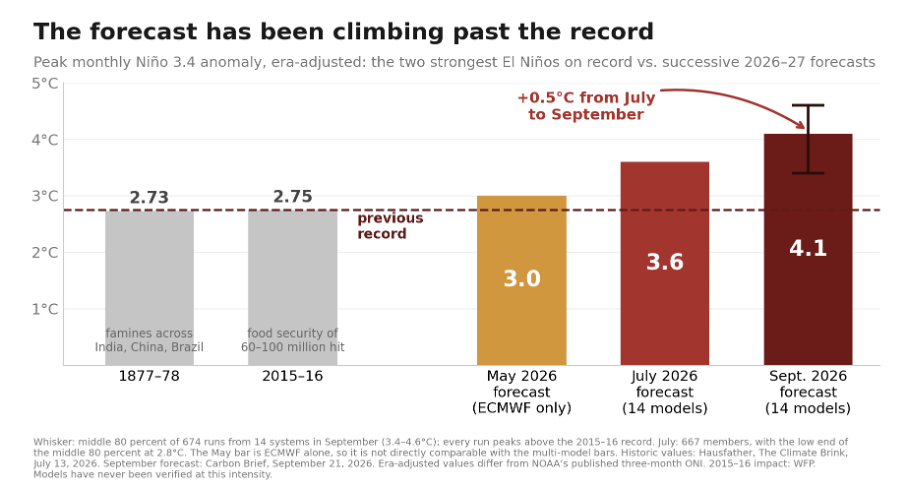
Figure 2. Peak era-adjusted Niño 3.4 anomaly for the two strongest El Niños on record, 1877–78 and 2015–16, against successive forecasts for 2026 and 2027. The whisker spans the middle 80 percent of the September ensemble. Models have never been verified at this intensity.
One quieter detail says more than any of those numbers. In February 2026, NOAA changed its ruler for measuring how big this El Niño will be. All official monitoring moved to a new “Relative Oceanic Niño Index”, which measures the central and eastern Pacific against the rest of the tropical ocean rather than against the fixed historical baseline. It had to, because the whole tropical ocean has warmed so much that the old fixed baseline had begun to make El Niños look stronger, and La Niñas weaker, than they really were.6
“If the temperature of the Pacific were the variable that decided the death toll, 2027 would be catastrophic beyond any precedent. The argument of this article is that it need not be, and that whether it will be is settled by things with no connection to the Pacific at all, above all, whether governments help the people that 150 years of El Niño records say will suffer from hunger.”
The Granary Is Also Dry
Start with the thing that turns a bad harvest into a survivable one: the ability to buy replacement food. Sudan imports about four fifths of its wheat. Egypt trades the title of the world’s largest wheat importer back and forth with Indonesia. The Philippines is covering a 700,000-tonne shortfall by importing. In every case the question is not whether the domestic harvest failed. It is what the replacement costs.
This year the replacement is short as well. As the previous article set out, drought has cut Europe’s wheat and maize, left the Rhine and the Danube too low to carry a full barge, and war has closed both ends of the Black Sea grain corridor.7, 8, 9
So is the United States. USDA now expects an American wheat crop of 1.531 billion bushels, 23 percent below last year and the smallest in more than half a century, after drought on the Southern Plains left a third of all winter wheat acres unharvested. Fertilizer adds to the risk. The closure of the Strait of Hormuz in February put roughly a third of the world’s seaborne fertilizer trade at risk, and by April urea had climbed 80 percent. Urea fell back after shipping resumed in June, but attacks on ships resumed in July, and phosphate fertilizer remains tight. A farmer who pays more to plant grows less, and the shortfall lands in next year’s price.7
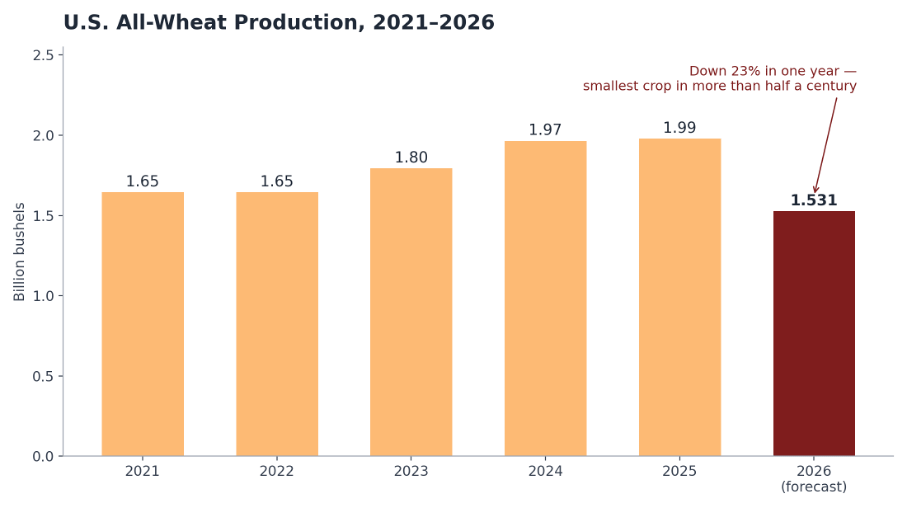
Figure 3. U.S. all-wheat production, 2021–2026, in billion bushels. The 2026 figure is USDA’s August forecast, unchanged in September. Source: USDA NASS.
None of that is El Niño. The European drought is attributed to climate change rather than the Pacific, and the Black Sea is a war. That is exactly the point. A household in Kassala cannot plant its sorghum because of an ocean cycle and then finds the replacement priced by a European heatwave and a Ukrainian port. It has not lost once. It has lost twice, and the second loss does not end when the rain returns.
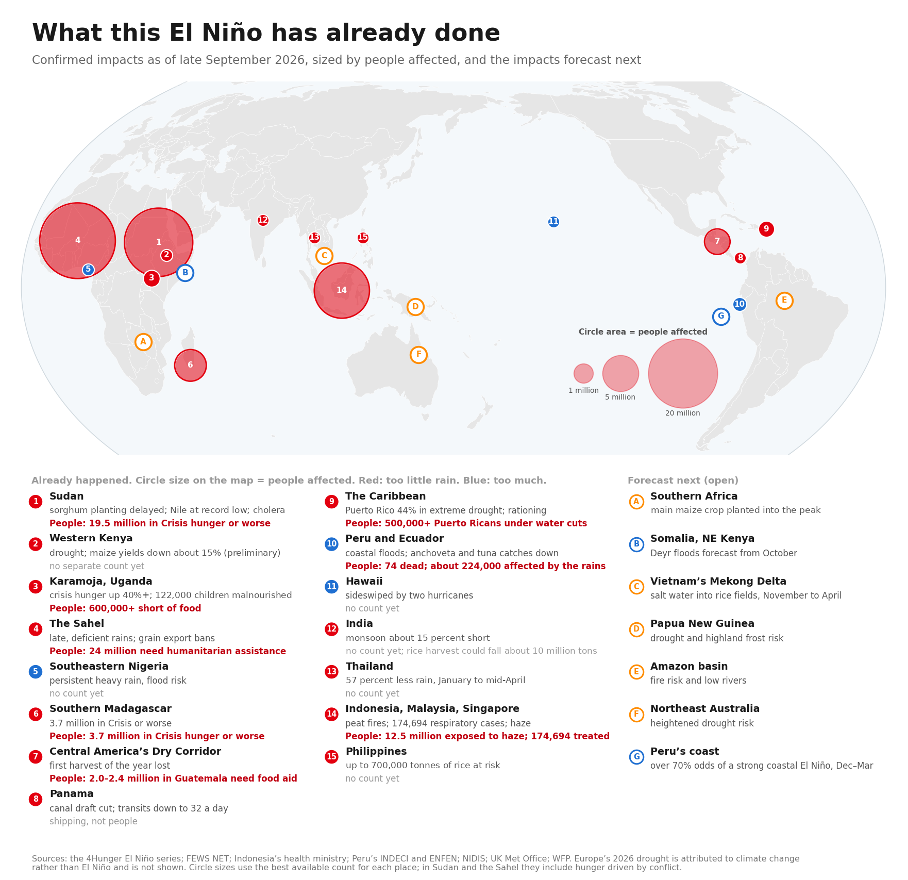
Figure 4. What this El Niño has already done. Filled circles mark confirmed impacts, sized by the best available count of people affected; open circles mark impacts forecast next. Counts are not all directly comparable: in Sudan and the Sahel they include hunger driven by conflict, and Indonesia’s figure is people exposed to haze.
“The rain has shifted exactly where the forecasts said it would, and every shift has been predicted. The droughts came. The floods came. The fires came. The only thing that has not come is the humanitarian aid. The wealthy countries of the world still have time to show that they have not lost their humanity, but only if they fund proactive humanitarian aid now.”
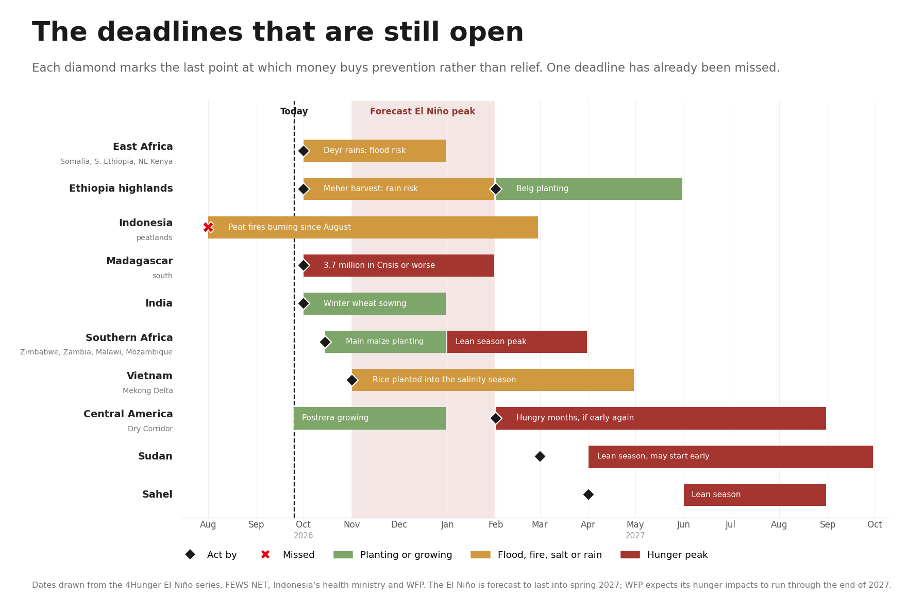
Figure 5. The deadlines that are still open. For each region, the diamond marks the last point at which money buys prevention rather than relief; the bars show planting seasons, the flood, fire, salt and harvest-rain seasons, and the hunger peaks that follow. Indonesia’s deadline has already passed.
The Deadlines Are Already on the Calendar
There is no single deadline left as this El Niño rolls out around the world. There is a complex calendar of deadlines, set by planting seasons and by hungry seasons, when people’s reserves from previous harvests run out, on four continents. Each date on this calendar marks the last point at which money can still buy prevention to save crops from droughts and floods rather than provide disaster relief for the suffering, acute hunger and famine that arrive if these crops fail. The forecasts behind every one of those dates are already free, public and regularly updated, as Hunger Foretold described.
The first deadline falls next month. The short rains in southern Ethiopia, central and southern Somalia and northeastern Kenya begin in October, and the region’s forecasters have put a ninety percent probability on wetter-than-normal rain; FAO has already warned Somalia to expect serious flooding in the “Deyr” rainy season. Flood preparedness means moving people and herds to higher ground, clearing drainage, and stocking water purification against cholera, and all of it has to be in place before the rain falls, not after. The next deadline falls in Southern Africa.
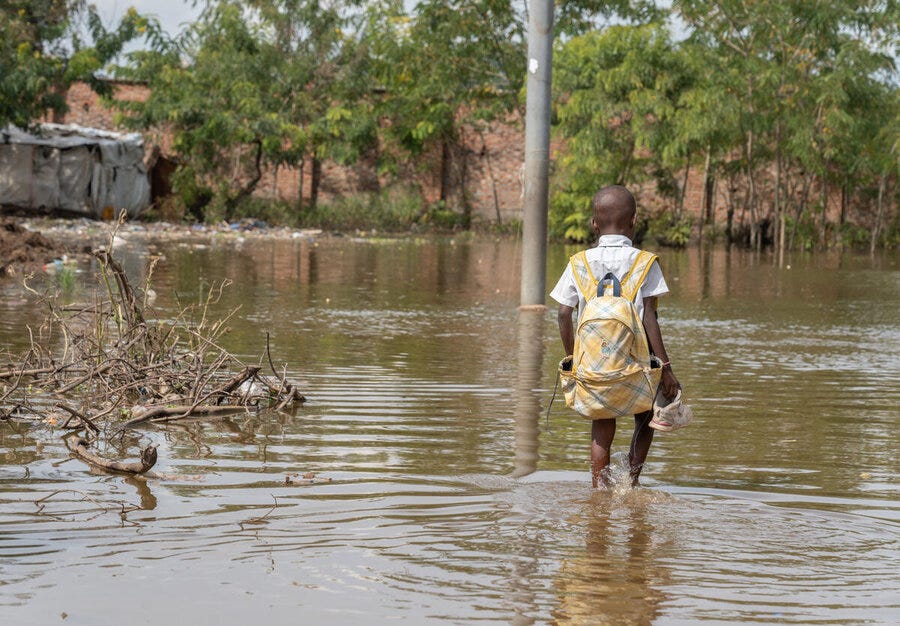
A child wades through water in Uvira, eastern Democratic Republic of the Congo, after El Niño-induced torrential rains caused Lake Tanganyika to overflow in 2024. Photo: WFP/Benjamin Anguandia
Southern Africa plants its main maize crop of the year between October and December, as the yearly rains arrive. Zimbabwe, Zambia, Malawi and Mozambique get one growing season a year, and this year, the crops will be planted into the peak of an El Niño that has already broken the record and is forecast to become the strongest ever measured, arriving in a world warmed by climate change, which makes its impacts hit harder. Everything that determines whether the harvest in Southern Africa survives is decided in the weeks before planting: do drought-resistant seeds go into the ground, are drought-tolerant varieties available and affordable, do households have the cash to buy the fertilizers and fuel they need rather than having to eat their savings, and have the irrigation systems and village boreholes and wells been repaired. The region has been warned twice in a decade. In 2015 and 2016, the maize crop failed and the money for humanitarian aid arrived only afterward, when people were suffering across the entire subcontinent. In 2023 and 2024, it happened again. Both times the forecast was public, free and made a year in advance. Both times the funding arrived after the crops failed and mass hunger appeared, rather than before, when it could have prevented the worst of it.
Asia’s deadlines run in parallel. India sows its winter wheat from October into December. Vietnam plants its winter-spring rice in November, the export crop that the Mekong salinity forecast puts at risk across more than 350,000 hectares from November through April, so freshwater storage and salt-tolerant seed varieties must be in place before planting. The driest conditions across Southeast Asia were forecast months in advance to run from late September to February. Indonesia’s peat fires did not wait: they have been burning since August, and by September 21st, Indonesia’s health ministry had recorded more than 170,000 cases of acute respiratory infection in the haze-hit provinces. This is what a missed deadline looks like. Peat fires are not ordinary fires. They burn below the surface of the ground; they are close to inextinguishable by rain alone. They produce the transboundary haze that in 1997 and again in 2015 turned into a regional health emergency, filling hospitals across Indonesia.
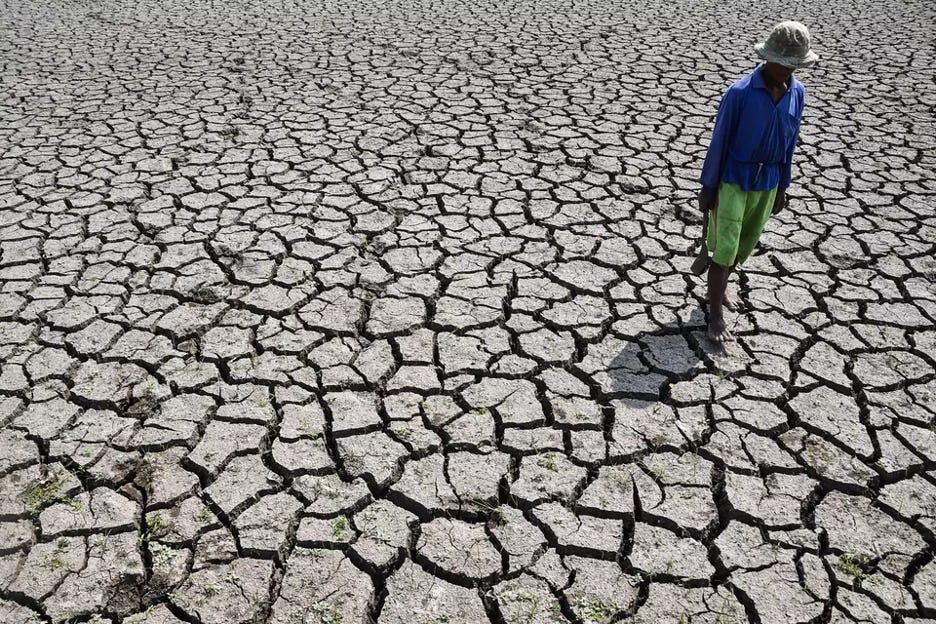
Photo credit: WFPA farmer shows a dried-up irrigated rice field fed by the Cimulu River tributary in Ciwasmandi, Sukajaya, Tasikmalaya, West Java, on Thursday, July 16, 2026. Antara Photo/Adeng Bustomi
Early 2027 brings its own deadlines. Southern Africa’s lean season peaks from January to March, and in Madagascar 3.7 million people are expected to be in Crisis or worse through January. Ethiopia’s “belg” crop, grown during the short 2026 February-to-May rains, came through this year on mostly average rains. Its main “meher” crop, which supplies 90 to 95 percent of the country’s grain, is being harvested now, and the Famine Early Warning Systems Network (FEWS NET) is predicting unseasonal rains from October to January that could flatten this meher harvest, sprout it in the head and rot it in storage. Tarpaulins, drying equipment and storage support have to reach farmers before those rains do. The next “belg” crop is planted when the rains return in February, so drought-resistant seeds, fertilizers and fuel need to be in farmers’ hands by then.
In Central America’s Dry Corridor, which runs through Guatemala, El Salvador, Honduras and Nicaragua, families usually run out of stored grain around June, when the hungry months before the next harvest begin. This year they ran out of food reserves in February, because three years of failed or poor harvests, through the last El Niño in 2023 and 2024 and a hot, erratic 2025, had left them nothing in their reserves. Now they have already lost the first harvest, the “primera” corn crop, and the second, the “postrera,” is only now going into the ground, late and into the same dry conditions caused by El Niño that already killed the “primera” crop. If it fails too, next year’s hungry months are likely to begin early, and help has to arrive before they do.
The last deadlines on the calendar fall in the middle of 2027, in the places where this series began. In Sudan, if the late-planted 2026 sorghum harvest falls short, its grain will run out sooner than it should, bringing the next lean season forward from its usual start in May 2027 and starting it from a lower base of reserves. Across the Sahel, the lean season runs from June to August. In both Sudan and the Sahel, food, cash and other humanitarian relief have to be in place before the rains close the roads, which means they have to be bought and moved by early spring.
“Every date on this calendar gives a rough deadline before which money can still buy seed, fertilizer, water, and protective measures rather than disaster relief. It is before planting in each of these countries that humanitarian relief can prevent suffering, hunger and famine. After that period passes, disaster relief is more costly and is used in a scramble to reduce hunger, disease and death. The same amount of humanitarian aid helps fewer people and arrives late.”
The Appeal Nobody Can See
This brings us back to the question that has run through this series since its first article.
On June 18th, FAO (the Food and Agriculture Organization of the United Nations) and the World Food Programme launched the first joint anticipatory action appeal either agency has made. They asked for $202 million to protect 8.8 million people across 22 priority countries, running to March 2027. The agencies said they were already positioned to reach 1.2 million people and that a further $167 million would cover the remaining 7.6 million. They also said, in the launch material, that the systems, partnerships and operational plans needed to act were fully in place and coordinated for immediate action, and that what was needed was the financing.10
The WFP projects that this El Niño could push at least 49 million more people into acute hunger across 45 countries by the end of 2027, raising the number of people in those countries who cannot meet their daily food needs to 274 million. The appeal was meant to get ahead of El Niño and provide proactive relief that would protect 8.8 million vulnerable people. It bears repeating that no El Niño this strong has ever been recorded, so the actual impacts could be greater.
More than three months after this appeal was launched there is no published figure for how much has been raised, and this publication went looking. OCHA’s Financial Tracking Service records no 2026 flows to either agency tagged to El Niño or anticipatory action in any of the 22 countries. Only one government has announced a contribution earmarked to it: on July 3rd, Norway allocated NOK 30 million, about $3 million, split between FAO and WFP. Other money is moving through other doors: CERF has offered up to $100 million, with more than $20 million allocated for anticipatory action in six countries and $6 million for southern Madagascar, and on September 17th the Novo Nordisk Foundation gave WFP $7.75 million, with a pledge to jointly promote the appeal, but none of it is counted against the appeal, and together it comes to less than 20% of the $202 million requested. FAO’s own project page, which publishes the donor and the amount for every anticipatory action contribution it receives, has posted nothing since May 29th, three weeks before the appeal launched.11 Time is getting short.
None of that is an oversight. FTS reports progress against coordinated plans, principally response plans and flash appeals, and a joint inter-agency appeal is not one of those, so it gets no funding bar. The flagship instrument for acting before a disaster sits outside the architecture built for watching humanitarian money move. It may well be better funded than it looks. There is no public way to find out, which is a finding in itself. 12
For scale, the entire previous El Niño cycle produced identifiable FAO anticipatory action funding of roughly $26 million, about half of it from Germany. The largest single line, $13.2 million, came from the Government of Somalia with the World Bank rather than from any traditional donor. This appeal seeks $202 million.13
Meanwhile the governments raising the alarm are the ones about to be hit. Uganda declared a drought in July and funded a six-month response across Karamoja from its own budget. Honduras placed eighty percent of its territory under alert. Brazil released 1.335 billion reais for El Niño - related actions. The Philippines is distributing drought-tolerant seed. These are low- and middle-income countries pre-staging what they can afford, against a forecast of a super El Niño.14
In Chad, WFP is prioritizing newly arrived people from Sudan for food assistance, for lack of resources. $167 million could help a lot.
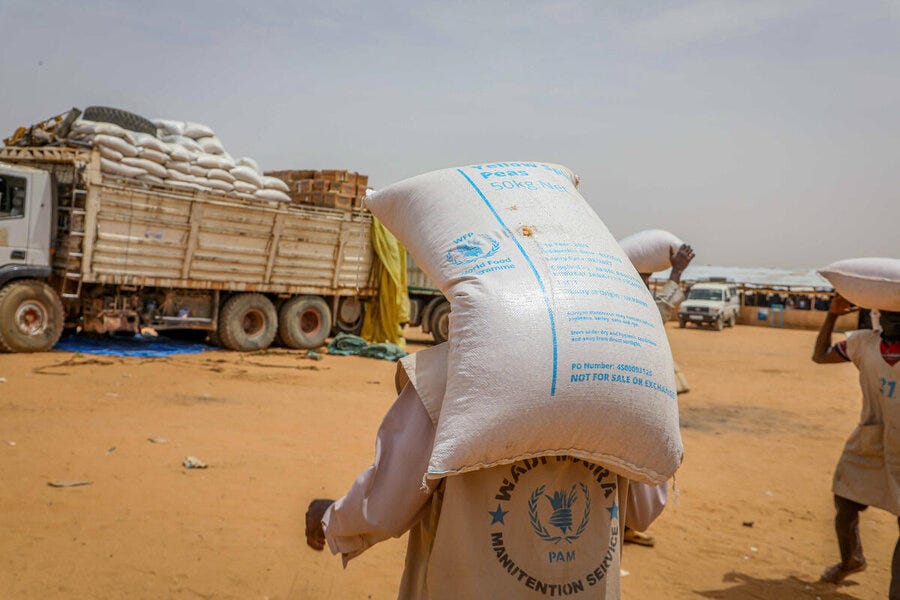
Photo: WFP/Arete/Salamon Djek
What $167 Million Buys, and What It Costs to Wait
So let this article do the thing the previous five have carefully avoided, and ask for something.
The FAO/WFP appeal is failing as far as we can see. Not struggling, not underfunded in the way every humanitarian appeal is underfunded. The gap is $167 million, and it is the difference between reaching 1.2 million people and reaching 8.8 million. That is 7.6 million people whose protection currently depends on money that, apart from Norway’s roughly $3 million, nobody has given.
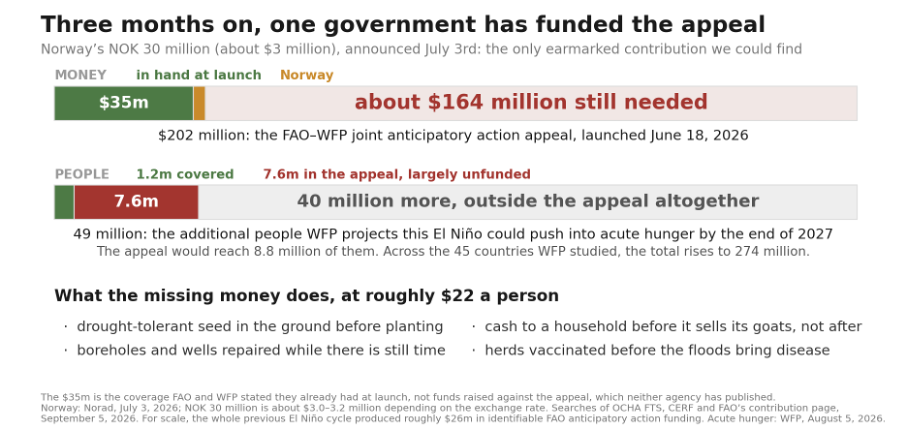
Figure 6. The $202 million appeal against what is publicly recorded as raised. The $35 million shown is the coverage the agencies stated they already had at launch, not a figure for funds received, because no such figure has been published. Searches of OCHA’s Financial Tracking Service, CERF allocations and FAO’s own contribution page on September 5, 2026 found nothing recorded against the appeal. The only earmarked contribution announced by late September was Norway’s NOK 30 million, about $3 million, which the figure shows as a thin gold band. The lower bar sets the appeal’s 8.8 million people against the 49 million more that WFP expects this El Niño to push into acute hunger by the end of 2027.
For scale, $167 million is roughly the price of two F-35 fighters. It is about a tenth of what the Panama Canal Authority is spending on one reservoir to make sure Panama Canal shipping continues uninterrupted. Using commonly cited figures, it is roughly three to four weeks of keeping one American carrier strike group at sea near the Strait of Hormuz. What the appeal is seeking comes to about $22 for each person who would benefit. This is what it costs to put drought-tolerant seed in the ground, repair a well or borehole, move cash to a household before it sells its goats or its farming tools rather than after, vaccinate herds against the diseases that follow floods, or buy animals from herders at a fair price before the pasture fails, rather than letting them be sold at a loss or die. FAO estimates that every dollar spent on anticipatory action saves up to seven in avoided losses.
The cost of not providing aid is measurable, because it was measured in Mali, in the central Sahel. In areas where food rations were cut for lack of funding, the number of people in crisis-level hunger rose 64 percent between 2023 and 2026. Where full rations were maintained, the number of people in crisis-level hunger fell 34 percent. Same region, same crisis, same years. That was ordinary food aid, delivered after the crisis had arrived. This current El Niño appeal is asking for money to fund anticipatory actions, the same money spent earlier, when it buys more and helps more people: seed instead of rations, working wells instead of water shortages, a vaccinated herd instead of dead goats and cattle.¹⁵
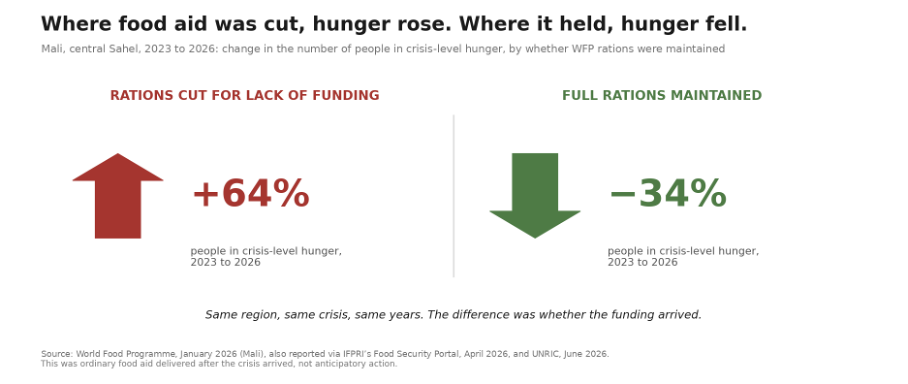
Figure 7. What happens when funding is cut: Mali, in the central Sahel, 2023 to 2026.
“This is not a request for generosity. It is a request that money already budgeted for famine relief in 2027 be spent in 2026 instead, when it buys seed rather than body bags, and when it costs a seventh as much.”
The timing is the whole argument, and it is now tight. Every deadline that passes turns the same dollar into imported grain bought at a lean-season price, delivered after the child is already acutely hungry and has stopped growing.
So, specifically. To governments around the world: fund the FAO/WFP anticipatory action appeal. The joint appeal needs $167 million, and it needs it before the first planting deadlines in October and November. To FAO and WFP: publish what you have raised for this appeal, weekly, whether or not the tracking architecture requires it, because an instrument that cannot show its own funding cannot make the case for more funding. To OCHA: give the FAO/WFP anticipatory action appeal a funding page, so that the next journalist who goes looking to see how much money has been raised finds a number instead of nothing.
None of that requires a new institution, a new fund, or a new theory of humanitarian response. The plans exist. Both agencies have said in writing that they are ready and coordinated for immediate action. The only missing input is the money, and there are only weeks left before the first of those deadlines pass.
Where to Watch All of This Yourself
• American drought, every Thursday: U.S. Drought Monitor and Drought.gov
• European drought, every ten days: European Drought Observatory
• The Pacific: NOAA Climate Prediction Center
• The crops: JRC MARS Bulletin and USDA WASDE
• The hunger: FEWS NET and WFP HungerMap Live
What the Maps Were For
This series began with a simple observation: the hunger arriving in 2027 is being forecast in public, on a schedule, by government scientists, in forecasts anyone can read for free. Five articles later, that has held up. NOAA said in May that a strong event was likely. It was. The models said the rains would fail in Sudan and in the Dry Corridor. They did.
The forecasting is not the problem. It is arguably the most successful piece of public scientific infrastructure in the world. When the hunger and famines arrive, and they will, they will be the best predicted crises in history. The question then will be who made the bad decisions, and why.
The problem is the gap between the forecast and the money needed for humanitarian aid, and that gap is not technical. It is not a modeling problem or a data problem or a capacity problem.
In 1877 the grain was there and the policies killed people. In 2026 the forecast is there, and it has been right so far about the regions it named for crop failures. The money is not being mobilized to get ready for this super El Niño. The question this El Niño will answer over the next fifteen months is whether a warning that arrives a year early is worth anything at all to a system that has rarely managed to mobilize the humanitarian aid needed to respond to an El Niño before the harvests fail and the hunger arrives.
That question does not have to be answered the way it was answered in 2015, or in 2023. Both ended in suffering, hunger and death. The question is being answered right now, and the window begins closing next month; most of it will be shut within 100 days. It is also being answered by whoever reads this and does nothing about it.
Call your Senators at: (202) 224-3121
Call your Representative at: (202) 224-3121
That number is the U.S. Capitol switchboard; ask the operator for each member’s office. To find out who your members are, go to senate.gov and house.gov. Call today, call tomorrow, the next day... Ask them to urge the State Department, which now manages most U.S. foreign aid, to fund the FAO–WFP Joint Anticipatory Action Appeal for El Niño. Ask them to promote even greater El Niño funding, because the World Food Programme projects that the 2026 - 2027 El Niño could push at least 49 million more people into acute hunger across 45 countries by the end of 2027, raising the number of people who cannot meet their daily food needs in those countries to 274 million. All of these people need aid!
If you live outside the United States, call your own elected representatives and demand the same.