

Last week this publication showed that the hunger of 2027 is being forecast in public, on a schedule, by governments that anyone can read for free. Those forecasts have started becoming reality. The rains that feed Sudan’s sorghum did not come in June and July. The Nile fell lower than farmers in their sixties can remember seeing it in August. None of it was a surprise, and the worst of the hunger it causes is still more than a year away. This is what has already happened, why the coming winter will look like recovery, and why that is the most dangerous part.
Five of these countries, together with Ghana and Guinea, have already closed their borders to cereal exports. Roughly 38 million people across Djibouti, Ethiopia, Kenya, Somalia, South Sudan and Sudan were at IPC Crisis levels of hunger or worse before this season’s crops were even at risk. None of it is a surprise, all of this was predicted and the worst of the hunger caused by these failed rains is still more than a year away.
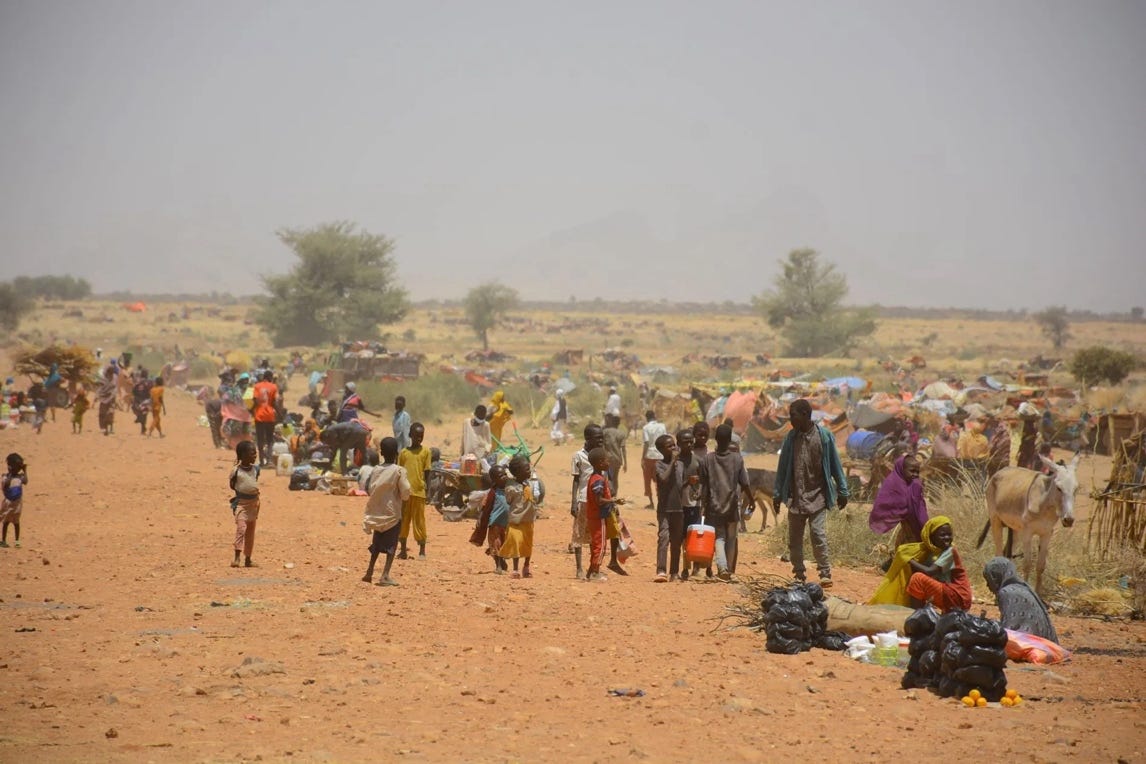
The First Part of El Niño Hunger Has Already Stopped Being a Forecast; Without Increased International Response It Will Become a Humanitarian Disaster.
Where is the Surge of Humanitarian Aid?
Last week 4Hunger.org published Hunger Foretold, which revealed one thing in detail: that the hunger arriving in 2027 is being forecast right now, in public, by government scientists, on a schedule anyone can read for free.
We also revealed the three pressures that are converging in the next eighteen months: 1) European and American droughts, one driven less by missing rain than by an atmosphere supercharged by climate change to pull water out of soil faster than rain can replace it, the other traditional, but shifting regions into a different grain exporting region; 2) the strongest El Niño ever forecast, is still building in the Pacific; and 3) a phosphate fertilizer shortage created by China and Russia’s export policies and a lack of sulfur on the global market reducing United States fertilizer production rather than by a lack of phosphate on the global market, the bill for not applying phosphate fertilizer this year will not arrive until the soil reserve of phosphate runs out, creating lasting hunger two to four years from now. Hunger Foretold set out when each of these global pressures would impact the food reaching tables around the world, argued that the lag between a failed harvest and a hungry household is a space in which humanitarian actions can still be mounted, and concluded that whatever acute hunger and famines that follow will be the result of policy decisions made by politicians in countries where the hunger lands and also in governments thousands of miles away from the hunger. 1
Hunger Foretold was about a forecast. This article is about El Niño landing, destroying crops and causing hunger, a description of the damage already caused as of September 2, 2026, and the forecast of what is yet to come in the next 18 months.
The rains that feed Sudan’s sorghum did not come in June and July, and as a result, the Nile River fell lower than farmers in their sixties can remember seeing it in August. The U.S. Climate Prediction Center reclassified southern South Sudan and swathes of northern, eastern and central Ethiopia into drought. Guatemala’s Dry Corridor went into Crisis. Honduras counted thousands of lost hectares of maize and beans. Not one of those outcomes was a surprise. All of them were predicted by the sources detailed in Hunger Foretold. Every one of the regions that have been hit by decreased rain and drought sat in the El Niño predictions months before the rains did not come. There is a difference between a projection and a harvest that has already failed, and in six countries that line has now been crossed. 2
“The models said the rain would fail in Sudan, in South Sudan, in Ethiopia, in the Dry Corridor of Central America this June, July and August. The rain has failed in Sudan, in South Sudan, in Ethiopia, and in the Dry Corridor of Central America just as predicted. What follows is not a prediction. It is the next page of El Niño already in progress and the human and environmental suffering it is causing.”
This article asks a different question from the last one. Not whether the hunger is coming, but where it will land, in what order, and what happened the last five times it landed in the same places. The El Niño map is not new. It has been drawn and redrawn multiple times since 1877, and the striking thing about it is not its complexity but its repetitiveness. The same regions fail. The same crops fail in them. The same governments are surprised. What changes from one event to the next is how many people die, and that, it turns out, has almost nothing to do with the temperature of the water in the Pacific Ocean but actions of governments around the world.
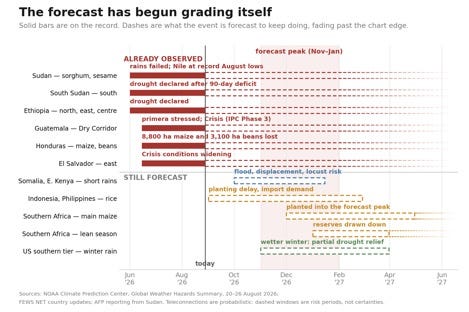
Figure 1. What the models said, and what the world has since recorded. Solid bars are outcomes already on the register: rains that failed, droughts declared, hectares counted. Dashed outlines are windows still ahead. Every bar here, solid or dashed, was drawn from forecasts issued before the season began. Teleconnections are probabilistic rather than certain, which is precisely why the top half of this chart matters.
The Same Map, Every Time
Strong El Niños do not damage the world’s agriculture at random. They damage it in a pattern documented across a hundred and fifty years of observation, and the pattern is repetitive to the point of monotony. The rain fails in the Maritime Continent (the vast tropical region in Southeast Asia and the Indo-Pacific made up of thousands of islands, peninsulas, and shallow seas), southern Africa, Central America and northeastern Brazil. It arrives differently in different parts of the world, delivering torrents of rain over the Horn of Africa and coastal Peru, where it drowns crops rather than merely watering them. India’s monsoon underperforms. Australia’s spring turns hot and dry across the wheat belt exactly during its vulnerable grain-fill window. 3
The reason this matters is not meteorological elegance. It is that the maps have been alerting governments a year in advance, which regions, which countries, which counties will be in trouble, and the map has repeatedly been right, so that being surprised by the hunger of 2027 will require a deliberate effort not to read the maps and reports of the past year or to pretend not to understand their predictions.
The pattern is old. What has changed is how hard it hits. A study published in Science this month, led by Julia Cole at the University of Michigan, finds that the strong El Niños of recent decades have themselves been made more intense by the warming caused by burning fossil fuels. The relationship runs both ways: El Niño delivers a surge of global heat, and that accumulated heat in turn makes the next El Niño stronger. Andrew Dessler of Texas A&M, who was not involved in the work, called it an important validation of what the models had predicted, and said a substantial share of the damage from the coming El Niño event should be attributed to the fossil-fuel economy. This matters for how the rest of this article should be read. The 1877 map and the 2026 map are the same map. The El Niños have become stronger. 4
The Nile River Has Not Risen
Sudan’s rainfed belt, Gedaref, Kassala, Sennar, the Blue Nile, works to a calendar with no slack in it. Sorghum and sesame go in with the rains in June and July and come out from November. The Gezira scheme, one of the largest irrigation systems ever built, draws on the Blue Nile, not dependent on direct rainfall. Both harvests depend on the same rains arriving at the same time, which is the vulnerability that matters, because in Sudan in an El Niño year, the rainfed crops and the irrigated ones do not hedge each other. They fail together.
This year they did. The rains did not come in June or July. The reservoir behind Ethiopia’s Grand Renaissance Dam stood six meters lower in July 2026 than in the same month last year, and parts of the Blue Nile basin received as little as half their normal rainfall. In Gedaref, where most of the country’s sorghum and sesame grows, fields that are ordinarily green by August were still brown last month, and farmers gathered behind their imams to pray. The agriculture ministry belatedly has advised farmers to switch to drought-resistant varieties and to delay planting. This advice is itself an admission that they ignored the El Niño reports, since neither of these options is available to a farmer who has already sown their crop. 5
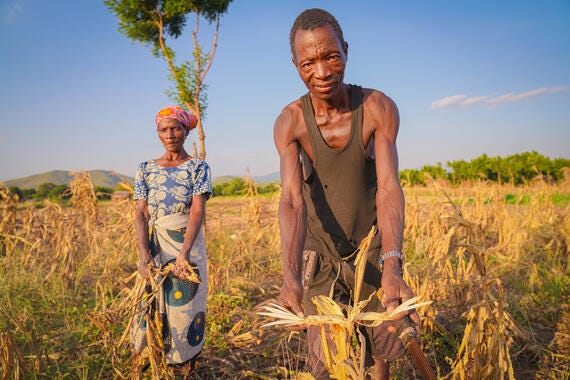
Photo Credit: WFP/Francis Thawani
Those farmers who can still plant say it costs four times what it did last year, which is where this story joins the others in Hunger Foretold. The closure of the Strait of Hormuz raised the price of fertilizer both in Iowa and in Gedaref by the same mechanism, and the Sudanese farmer has no crop insurance, no disaster programme and no balance sheet to absorb it. A farmer reported that a farm his family has held for a century, recovered from the Rapid Support Forces only last year, is being planted at four times the cost into a season the climate and El Niño prediction models condemned in spring of 2026.
The El Niño predictions did specifically predict the joint failure of these two crops. Elfatih Eltahir at MIT has spent three decades documenting the link between El Niño and the flow of the Nile, and his work shows that El Niños beginning in late spring, as this one did, carry a high probability of drought across southeastern Sudan and northwestern Ethiopia. This was not an unlucky season. It was a forecast season of failed crops, and the forecast is correct. 6
Now comes the part that will fool people and be extra cruel. FEWS NET expects Sudanese food security to improve between October and January, in parts of Gedaref, Kassala, Al-Jazirah and Sennar, as the harvest, such as it is, comes in. Hunger conditions ease. World attention leaves. Then FEWS NET predicts, almost in passing, that because the harvest is below average, the reduced household grain stocks will not actually be felt until later in 2027. The worst months of this drought will impact the people of Sudan more than a year after the rains failed to fall. This means that in Sudan there is a window this winter when everything will look as though it is getting better, but it is not. and this is exactly when international humanitarian aid could be mobilized to prevent the worst of the hunger and famine when the disappointedly small crop is eaten and there is no more food for the people of Sudan to eat. 7
What has changed is the calendar. Sudan’s lean season runs from May to September and peaks in August and September, which is to say now. The sorghum and millet harvest comes in through November and December. So, the months ahead are, in any year at all, with either a good or catastrophic harvest, the least hungry part of the Sudanese year is between October and January, when grain in the house from a family’s own fields, or bought at market with a grain new supply arriving, prices falling back from their lean-season peak, and the largest block of paid agricultural work in the annual cycle. Sorghum, millet and wheat flour prices rose between 5 and 13 percent in a single month from June to July, and stand 45 to 60 percent above where they were in February. Those prices will come down at harvest. The fall in prices will be read as recovery. 7
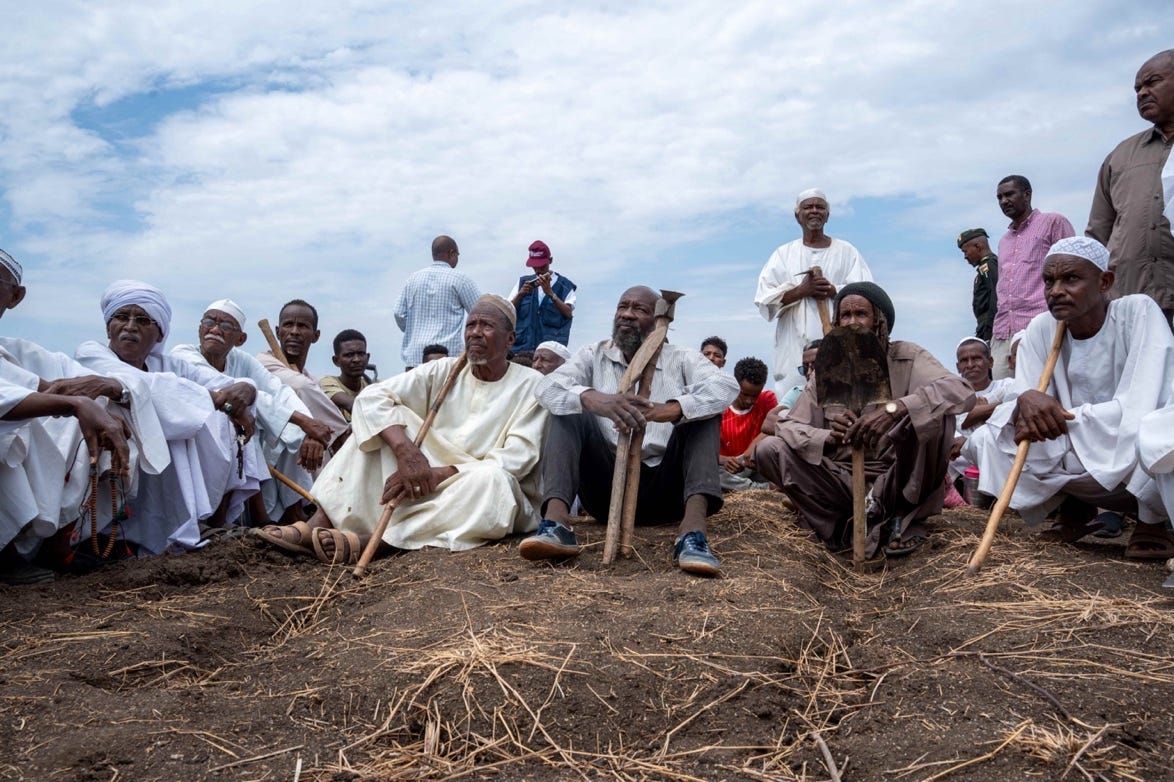
Photo credit: FAO/Mohamed Ahmed
But it is not recovery. It is the annual cycle briefly outrunning the hunger and it is measured against September rather than against a normal year. Because the harvest is small, the grain it puts in the store runs out sooner than it should, which brings the next lean season forward and starts it from a lower base, in households that have already sold whatever they had left. The improvement is real, it is temporary, and it is the reason the window of abundant food closes.
“The rain failed in Sudan in June and July 2026. The immediate hunger it causes arrives in the second half of 2027. Everything in between is the time in which humanitarian aid could be mobilized, but the harvest arriving in that window makes it the season in which it will look to outsiders as no longer necessary, but acute hunger and maybe famine is just around the corner.”

Figure 2. Why the worst month is more than a year after the rain. Sudan sows sorghum and sesame with the June rains and harvests from November, so a season that fails in July produces a harvest that fails in December. FEWS NET expects conditions to ease as that harvest arrives, and the shortfall to be felt only in the second half of 2027. The window in the middle is the one in which the emergency looks as though it is receding.
All of these El Niño impacts land on a country in the fourth year of a war that has killed more than two hundred thousand people and left nearly 19.5 million people, two out of every five Sudanese, at IPC Crisis levels of hunger or worse. That figure breaks down into 14 million in Crisis, more than 5 million in Emergency and nearly 135,000 in Catastrophe hunger, the household phase at which people starve. A risk of famine is identified in fourteen areas across North Darfur, South Darfur and South Kordofan, under a reasonable worst-case scenario of intensified conflict and further restrictions on humanitarian access. Famine itself was confirmed in El Fasher and Kadugli in September 2025. Those towns no longer meet the technical thresholds, which reflects how many people died or fled rather than any improvement. An estimated 825,000 children under five are expected to suffer severe acute malnutrition this year, seven percent more than in 2025 and 25 percent more than before the war, and close to nine million people were displaced inside Sudan by the end of March. National figures hide what is happening in particular places. Surveys in North Darfur in late 2025 found global acute malnutrition running at 52 percent in Um Baru and 34 percent in Kernoi. Thirty percent is the threshold at which malnutrition alone meets the famine standard. Across Darfur three quarters of surveys found rates above 15 percent, the level the World Health Organization calls critical.
Sudan’s food supply has two halves, and both are now exposed. It buys about four fifths of its wheat abroad, which leaves that half at the mercy of world prices and the shipping lanes. Sorghum is the half it grows to feed itself, and sorghum is what failed this summer. 8
A falling river does something else that a hunger article can forget to say. When the Nile drops, when people are pushed into camps, and when four years of war have taken the clinics with them, the water people drink gets worse at exactly the moment they are least able to survive it. Sudan declared a cholera outbreak in late June, in West Kordofan, on the line dividing the army’s territory from the paramilitaries. It is the third wave in three years, and it began ten weeks after the last one was declared over. By 10 July the World Health Organization had recorded more than 1,330 confirmed cases and 114 deaths, mainly in the Darfurs and the Kordofans, and said the true death toll was likely far higher. The Sudan Doctors Network reports over 200,000 people around Bara, among them 20,000 children, facing cholera and measles with no medicine to treat either. Those are the figures from before the rains. The WHO warned in the same briefing that Sudan’s rainy season was about to surge, and that cholera cases balloon when it does, because the water gets dirtier and the roads close at the same time. The previous wave ran from July 2024 to January 2026, reached all eighteen states, infected 124,418 people and killed 3,573. The agency has received about a third of the money it needs for Sudan this year. 9
Hunger and cholera are not two problems. A malnourished child dies of diarrheal disease at many times the rate of a fed one, and cholera kills fastest where people are already weak, crowded and drinking whatever water is left. The drought does not have to reach famine thresholds to kill. It only has to arrive where the water has gone bad and is contaminated with disease. 9
“The forecast said the rain would fail in Sudan. The rain failed. The same forecasts say the worst hunger arrives in the second half of 2027. There is no reason to think it will be wrong the second time. There is time to prepare an adequate humanitarian aid response.”
The drought does not stop in Africa, Part two: “El Niño Crosses the Atlantic” follows the impacts that have already happened in North and South America and shows how this El Niño has also impacted the Dry Corridor from Mexico to Panama, broader South America and how it will mostly benefit North America. Following that we will continue globe trotting examining how this El Niño is following the exact pattern of all El Niños since 1877. Stay tuned.
And please note this too, I shared it a few days ago: https://www.theguardian.com/environment/2026/aug/31/bhutan-first-conscious-food-summit-climate?fbclid=IwY2xjawUFhHZwZG9mAWV4dG4DYWVtAjExAHNydGMGYXBwX2lkEDIyMjAzOTE3ODgyMDA4OTIAAR5hwsxlwuODPlwpa6tl4uXpuWrYlYGorh1JCbawExlcylEGGicz4LsLTyvXXQ_aem_2PX5EDLon07PgS5r0920BQ
Dear Mark, alongside other .."news" of known events that could have been prevented; I shared again and recommended this articel; probably the best from your hand yet. Here are how I introduced it :
S T A R V A T I O N
A C O M I N G : R A I N / F A I L E D
D U E / T O / F A I L E D / P O L I T I C S !
A N D
this too, has N O T H I N G to do with El Nino, but only with
P O L I T I C S !
And still; Polticians acts surprised, yet -
S T I L L avoiding all preventive actions of changing agricultural practices, share funds - from deadly rearming into L I F E saving rescues and A I D S .
D E A T H of millions of C H I L D R E N and innocent poor people, are S T I L L the number one choise, for Politicians S T I L L in the faith that what hurts some, does not harm all.
They can A C T on facts; or - as A L L W A Y S ;
just let the poorest D I E. Alongside the possibilities to grow food for people, in fertile soil - without pesticides and fertilizers, -
not for destruction in mistreated suffering slaves; called livestock.
This article asks not
W H E T H E R the hunger is coming, but
W H E R E it will land, in
W H A T order, and
W H A T
happened the last five times it landed in the same places. On : https://www.facebook.com/profile.php?id=61565699637497