

Southern Africa plants its main maize crop from October, and that crop is at risk. In June, the UN asked for $202 million to protect these harvests before they fail. Less than a fifth of that money has been found, and no government has announced a contribution earmarked to the appeal. The United Nations General Assembly meets this week in New York, and every government able to fund that aid will be in the room.
Photo Credit: Doctors Without Borders
Nineteen African countries have already lost part or all of a harvest to this El Niño. The season that feeds most of Southern Africa has not yet been planted. It goes into the ground next month, and in August the region’s own meteorological services announced the forecast for these crops: below-normal rain across most of the subcontinent for the rest of 2026, with even less rain expected after January.
On June 18, the FAO and the World Food Programme made a joint appeal for $202 million to protect 8.8 million people from El Niño hunger before the harvests failed rather than after, based upon the arithmetic that a dollar spent early saves up to seven spent on humanitarian disaster relief afterward. Three months later, less than 20% of that sum has been found through any channel, and one of the largest contributions came from a Danish pharmaceutical company’s charitable foundation. The money requested will pay for: Cash transfers that reach households before they must start selling critical tools or breeding animals. Seeds that are drought-tolerant or flood-resistant. Livestock protection from drought and floods. Water harvesting and storage equipment. Flood defenses. Post-harvest storage. Dissemination of the El Niño forecast itself, with advice attached on what to do about it.
The crop failures in these nineteen countries were predicted before they even happened. That is what this series is about.
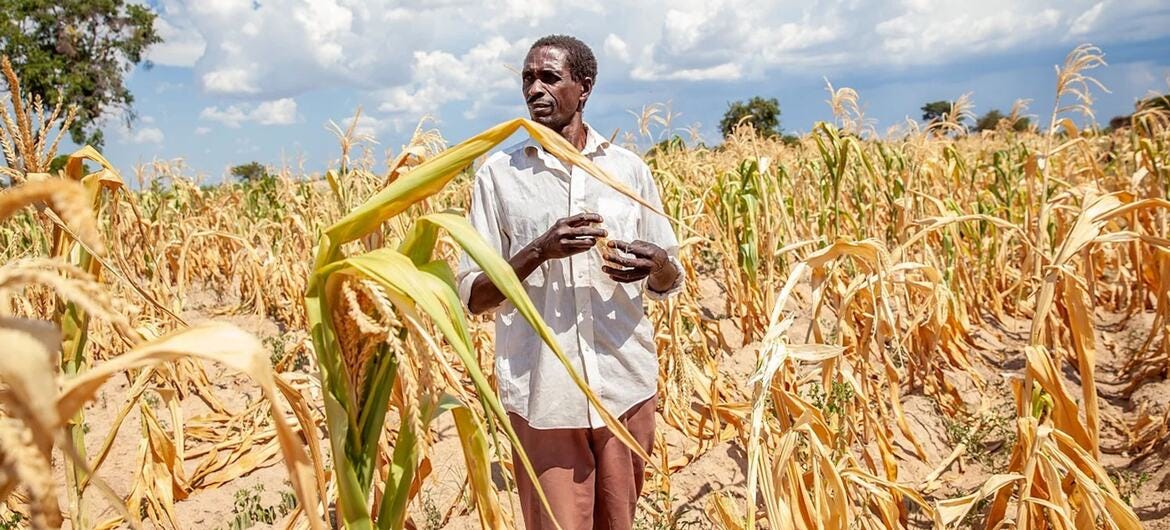
Photo Credit: WFP/Gabriela Vivacqua A farmer inspects a drought-stricken maize crop in Zambia.
Hunger Foretold showed that the El Niño hunger of 2027 is being forecast in public, on a schedule, by governments anyone can read for free. El Niño Has Landed described the rains that failed in Sudan this summer, the harvest that will fail in December, and the worst of the shortfall, which will not be felt until the second half of 2027. El Niño Crosses the Atlantic followed El Niño on the same ocean into the Americas, to the crops already lost there and those still at risk into 2027. El Niño Reaches Asia set out what is mostly still, for a few more weeks, a forecast across the half of the world where most of the planet’s rice is grown and showed the weakened monsoon and crops not yet planted at risk from this El Niño. This part returns to Africa, because Sudan did not fail alone, eighteen other countries failed with it, and because the reason these countries were so exposed was settled long before the Pacific warmed and this El Niño formed.
El Niño has already damaged crops in nineteen African countries: Burkina Faso, Cameroon, Chad, DR Congo, Djibouti, Eritrea, Ethiopia, Ghana, Guinea, Kenya, Mali, Mauritania, Niger, Nigeria, Senegal, Somalia, South Sudan, Sudan and Uganda. Egypt, whose own winter wheat had a good year, is exposed by a different route.
So where is the surge of humanitarian aid?
The appeal FAO and the World Food Programme launched on June 18 was the first joint anticipatory action appeal either agency has ever made, and it covers 22 countries.1
The items the appeal would pay for divide by the calendar. Where a season has not been planted, the seeds and the water are the interventions, because they change what comes out of the ground: a shorter-maturing variety that finishes growing before the rain stops, a tank that holds rains that fall in November for the drought in January. Where the harvest is already gone, as it is in Sudan, nothing can be done for that crop at all, and the money does something less visible and no less important. It keeps a household from selling the goat, the cattle, the tools and eventually the land in order to eat this year. Selling off vital tools and livestock needed for farming is the transaction that turns one failed harvest into five failed years. In the 2023-24 El Niño, the two agencies reached more than three million people this way, months ahead of the El Niño’s peak.1 There is little such help this year.
Three months after the appeal was launched, neither agency will say how much of the $202 million has been raised, and there is no entry against the appeal in the United Nations’ own funding tracker, because that tracker reports only against coordinated plans and an inter-agency appeal does not get a page. No government has publicly announced a contribution earmarked to the appeal itself. Money is moving, but through other doors and at a different scale. In July, the UN’s Emergency Relief Coordinator said he stood ready to disburse up to $100 million from the Central Emergency Response Fund to get ahead of this El Niño, and that more than $20 million had already been allocated for anticipatory action in six countries. In early September, that fund released a further $6 million for southern Madagascar. On September 17, the Novo Nordisk Foundation, a Danish philanthropy, put $7.75 million into WFP’s anticipatory work. The largest private contribution ever made to WFP’s anticipatory action, against an El Niño that has already tied the strongest ever measured, came from a pharmaceutical company’s charitable foundation.
Add every announced figure together, whether or not it is formally against the appeal, and the total is less than 20% of what FAO/WFP asked for. What has actually been delivered is smaller still: as of August 5, WFP’s anticipatory programs had reached half a million people with $14 million, against the 8.8 million people the appeal aims to protect. That is the “surge.”1 Set against what is coming, it is not a surge at all. WFP’s own analysis, published in August, expects acute hunger across 45 already food-insecure countries to rise from about 225 million people to 274 million people by the end of 2027, an increase of roughly 22 percent, or at least 49 million additional people suffering from acute hunger or worse. What has been raised so far will reach a tiny fraction of the people in need.2 Massive hunger and famine are coming, and not one major economy has announced a contribution to the appeal meant to prevent them.
The Season That Has Not Been Planted Yet
Begin with the part of Africa where nothing has been lost yet, because it is the only part where the outcome is still open to aid and relief. It is also the part the forecasters are most confident will be devastated by this El Niño. WFP’s own analysis, published in August, expects the largest effects of this El Niño event in parts of Central America and in Southern Africa, and the Southern African figure is the worse of the two. Southern Africa’s acutely food-insecure population is projected to rise by nearly seventy-five percent.Southern Africa has not appeared in the earlier parts of this series because its season has not yet begun. It begins with the planting that starts next month.3
The forecast is not one model’s output. It is a regional consensus, agreed at the thirty-third Southern Africa Regional Climate Outlook Forum in Swakopmund, Namibia, between August 25 and 28, by the national meteorological services of the region working with the European, American and British forecasting centers. It predicts below-normal rainfall across most of central and southern countries of the Southern African Development Community (SADC), an intergovernmental organization of sixteen member states that promotes economic integration, peace and security in the region. Below-normal rainfall is predicted from October to December, with even larger deficits from January to March 2027 across Angola, Namibia, Botswana, Zimbabwe, Zambia and parts of South Africa, with above-normal temperatures over nearly the whole region. The northern edge runs the other way, as it always does in these El Niño events: eastern DR Congo, most of Tanzania and the far north of Malawi and Zambia are expected to be wetter than usual, with flooding predicted to impact crops and livestock.3
The geography matters because of what grows in it. The dry half is rain-fed maize country, and maize is what Southern Africa eats. In the El Niño drought of 2015 and 2016, South Africa’s maize harvest fell to 7.8 million tonnes, the smallest crop since 2007, and the country became a net importer of the grain for the first time in eight years. The crop just harvested, grown in a favorable season before this El Niño reached the region, is a record 17.4 million tonnes. That is the baseline the coming season will be measured against, and the coming season is the one the forecast describes. A region that loses a large share of its principal crop does not only go hungry inside its own borders. It stops being the place its neighbors buy from. That is the mechanism the rest of this article describes: a shortfall in one exporting region becomes a higher price for every importer, and it reaches Sudan from as far away as Europe, where the Rhine, the great waterway that runs from the Swiss Alps to the North Sea, is running at record lows in the drought.3
No one has yet put a number on next year’s crop, and that is not an oversight. South Africa’s Crop Estimates Committee publishes its first indication, a survey of what farmers intend to plant, in late October. The preliminary planted area follows in January and the first production forecast in late February. Planting itself begins in the middle of October. The harvest this section is concerned with does not yet exist as a figure in any database, which is exactly why the decisions on proactive humanitarian aid that will determine how much of this crop is lost are still there to be made.
What does exist is the record of what El Niño has done to this crop before, and it is not a gentle record. In the 2023-24 season, when El Niño brought only a mild mid-summer drought, the maize harvest fell 22% to 12.9 million tonnes. The droughts of 2018-19 brought it to about 11.8 million tonnes. The 2014-15 and 2015-16 seasons averaged around 8.9 million tonnes. The clearest signal is in yields rather than totals: Agbiz’s figures show South African maize yielding 3.49 tonnes a hectare in a severe El Niño season, against more than 5.00 tonnes in La Niña years. The forecasters will not predict those numbers against the coming season until farmers have planted, which is the correct discipline. It does not stop a reader from noticing the range of the impact this El Niño is likely to have on these crops.3
Fortunately, South Africa is better placed for this El Niño than it was for the last one. The record harvest and the stocks carried over from 2025 leave roughly three million tonnes available for export in the 2026-27 marketing year, two wet seasons have left soil moisture and dam levels healthy, and FNB’s senior agricultural economist expects South Africa to need no significant maize imports in 2026 or 2027, with imports becoming a question only if El Niño runs into a second season. The danger in Southern Africa in 2027 is not mainly that South Africa fails. It is that Malawi, Zimbabwe, Zambia and Madagascar fail while the region’s supplier has a thinner surplus and more buyers bidding for it. Regional demand rises in the same season the regional surplus falls, and the countries that have just lost their own harvest are the ones who must go into that market to buy from a country that is already eating into its reserves.3
The human numbers are already on the record, before a seed is in the ground. FEWS NET (Famine Early Warning Systems Network) expects delayed and below-average rains to cut planting and seasonal farm labor in Zimbabwe, Malawi, Mozambique, Zambia and Lesotho, and deteriorating pasture to reduce livestock productivity in southern Angola. Malawi has 2.6 million people projected to face acute hunger in the 2026-27 lean season, with WFP preparing to assist 600,000 of them. Madagascar has 3.7 million people expected to be at Crisis or worse between October and January as this El Niño takes hold, and in early September the UN’s emergency fund released $6 million to get ahead of this hunger crisis in the south of the island. The African Development Bank has put the cost of this El Niño to affected African economies at up to $20 billion.4
This is the argument of this entire series at its simplest. In Sudan, as the rest of this article describes, the rains have already failed, and what is left to argue about is how fast the humanitarian aid response arrives and how much of the damage can still be prevented. In Southern Africa nothing has failed yet. The forecast is public, regional, consensus-based and a full month ahead of even planting the crops that are all at risk of failing. Seed choice, planting dates, water storage, pre-positioned relief, and the price at which a government offers to buy grain are all still open questions. Every one of them will be closed by December. If the hunger of 2027 in Southern Africa turns out badly, it will be possible to date the decisions that made it so, and they will have been taken in October and November of 2026, in public, with the forecast lying on the table and bureaucrats and politicians choosing not to act to prevent the hunger that they all know is coming.4 The UN General Assembly meets this week and all of the countries who could each provide the FAO/WFP funding will be in the room.
“The Southern African season has not even been planted. That is not a reason to wait. That is the entire opportunity.”
The rest of this article is about the places where that window has already shut. Every one of the nineteen countries that have lost part of a harvest to this event will have to buy grain to cover the gap. The price of that replacement grain is not set in Africa at all.
To Find the Drought, Start Looking at the Rivers in Europe and Africa
The European Rhine is at a record low. Through August, barges that normally carry grain and fuel through Germany were moving at about a fifth of their usual load. The Danube has dropped far enough that Hungary’s only nuclear power station came close to shutting down for want of cooling water, and far enough that Romania shut its sole working Danube-cooled nuclear reactor for the first time and sent naval engineers to detonate the riverbed to divert more water toward the intakes of the power plant. Copernicus, the European Union’s Earth observation program, recorded four of Europe’s great rivers at record lows in August: the Loire, the Po, the Rhine and the Danube. In eastern Croatia, the Drava and the Danube are at their lowest in years. None of the drought has ended. Germany’s federal hydrology institute says the rain that fell in late August bought only temporary relief and expects no real recovery before October.5
Rainfall ran below average across most of Europe between April and June, from Portugal in the southwest to southern Finland in the northeast, and the heatwaves followed. France is bringing in what its own growers expect to be a thirty percent fall in its maize crop, to 9.5 million tonnes, which would be the lowest maize harvest this century. The European Union has planted less than eight million hectares of maize for the first time since the century began, and the grain trade has cut the EU crop to its smallest since 2007. The European Commission’s crop monitors cut the soft wheat yield forecast to 5.88 tonnes a hectare in July, seven percent below last year, with maize and sunflower down six to seven percent, and the EC also warned that the heat had shortened grain-filling, so quality of these grains and seeds fell along with volume. Hot and dry conditions were forecast to persist. Romania, which has given up something like a million hectares of maize to successive dry years since 2019, got rain this season and expects a larger crop than last. The European Commission’s president called it the “summer of truth.” The EU has put the damage at about €180 billion, and the heat killed about 35,000 people in Europe alone, a bill for one summer roughly a thousand times the $202 million FAO and WFP asked for to protect 8.8 million people.6
The attribution is not in doubt. World Weather Attribution found that climate change made this drought roughly eighty times more likely in Western Europe and forty times more likely in Eastern Europe. That matches what this series reported in part one about El Niño itself: warming is making strong El Niños stronger, and this one has already tied the all-time record for Pacific warming, two months before El Niños usually peak. These climate impacts are arriving in a different hemisphere by a different route.7
This loss of grain production is not only a European story. It is the opening of an African one, because Europe and the Black Sea are where much of Africa buys wheat when its own harvests fail, and a shortfall in any major exporter raises the price for every buyer. Sudan imports roughly four-fifths of the wheat it eats. Egypt buys more wheat abroad than almost any country on earth, trading the title back and forth with Indonesia. Almost every nation in 4Hunger.org’s articles has lost part of a harvest this year, and every one of them will try to buy its way out of the shortfall on a market that has less grain than normal at the same time. A failed harvest is survivable if you can replace it. What is happening in 2026 is that the places people replace their food from are all failing together.7
Forty Years of Taking the Water Away
Before going country by country in Africa, it helps to say plainly what this region is, because the usual description of Africa is misleading. The conventional account runs: “here is a group of African countries with long-running wars and chronic hunger, and now a drought has arrived on top of them.” That framing makes the conflict the background, and climate change and this super El Niño the event that lands on top of the conditions already caused by civil strife. That framing gets the sequence backwards.
In much of this group of African countries, the wars are the result of loss of water due to climate change and overuse. Not entirely, and not simply, but enough that the line between a climate story and a conflict story stop being useful.
Take Lake Chad. In the 1960s, it covered roughly 9,700 square miles. It has since lost perhaps 90% of that surface area, and with the loss of the lake, lost the fishing and irrigated farming economy of a basin of countries that support tens of millions of people across Chad, Niger, Nigeria and Cameroon. What replaced that economy in the worst-affected areas was an insurgency recruiting from precisely the young men for whom the lake stopped feeding and providing a livelihood. The Lake Chad Basin is now one of the largest displacement crises in the world. The lake receded first.8
Or take Darfur in Sudan. The conflict that began there in 2003 is widely described, including by a former Secretary-General of the United Nations, as the first modern war with climate change among its root causes. Decades of declining rainfall pushed pastoralists south into cultivated land causing competition over water and grazing lands that turned violent. The violence was then organized and armed along ethnic lines. Sudan’s present catastrophe is the direct descendant of that war and of a loss of water driven in part by climate change. So, when this article reports that the rains failed in Gedaref, Sudan, this July, it is describing the third time in forty years that failing rain has helped redraw the lines of who lives where in Sudan.9
Take another fault line that is running through the Sahel right now. As the desert edge moves south, herders move with it, onto land that farmers have been cultivating for hundreds of years. That competition, over water rights and grazing corridors, both of which used to be sufficient for both ethnic groups, is among the drivers of violence across Nigeria’s Middle Belt, central Mali and Burkina Faso. FEWS NET (The Famine Early Warning Systems Network) counted 9,856 conflict events in the region between January and June, 41 percent of them in Nigeria. Those events get reported as security news. A good share of them are arguments about water and land that were settled peacefully when there was more of both water and useable land.10
This needs one qualification, because the research is contested. Many scholars argue that governance, marginalization and the politics of land tenure are the primary drivers, and that climate is an aggravator rather than a cause. They have good evidence. But notice what both accounts have in common. Lake Chad shrank partly through declining rainfall and partly through water drawn off upstream for irrigation and held behind dams. Herding corridors closed through land law as much as through the advancing desert. Rain-fed smallholders were moved into cash crops for export earnings and debt service. Whichever cause you weight most heavily, somebody decided how to respond to it, and for forty years the answer was to do very little while doing something was still cheap. Calling the result a long-running conflict makes it sound like terrain. The conflict was built by both climate change and governance errors.11
“The usual telling is that El Niño has arrived on top of conflicts. In most of the countries in Africa, the more accurate telling is that the water left first due to climate change and overuse, the conflict then followed it, and El Niño is the third visitor to a house that has already been emptied twice.”
This is why the aid withdrawal described later in this article is not a separate subject. Remove the water over forty years. Let the farmland and the herding corridors go with it. Let the conflict that follows displace twenty million people. Cut the humanitarian funding that was barely allowing the population to barely survive in these countries. Then send an El Niño that has already tied the strongest on record into what is left. Africa is not a continent that happens to be gripped by civil conflict. It is a continent where the loss of water helped build the conflict, and withholding aid now penalizes the people who had the least say in climate change or any of it.
The fact that Sudan did not fail alone changes the shape of this story. Sudan sits inside a belt of countries that El Niño dries as a single unit: southern South Sudan, western and central Ethiopia, northern Uganda, Eritrea, Djibouti and Sudan itself. The belt’s rains all failed together in June and July, as the El Niño models predicted they would. Roughly 38 million people across the six IGAD (the Intergovernmental Authority on Development, a trade bloc and regional organization in East Africa and the Horn of Africa, with seven member states since Eritrea withdrew in December 2025) states of Djibouti, Ethiopia, Kenya, Somalia, South Sudan and Sudan, an overlapping but not identical group of countries, were already at IPC Crisis levels of hunger or worse before El Niño caused these rains to fail.12 Crisis falling upon crisis.
Take the smaller members of that Sudanese belt first, because they will not make the headlines. In northern Uganda the rains came early in February, stopped, returned too weak to carry a crop and were gone by the end of May. Crop losses across Karamoja run between 50 and 70 percent, more than 600,000 people are short of food, and Kampala declared a drought in July. The same authorities now forecast near-normal to above-normal rain from September through December. In Uganda, months of sun on bare soil bake the surface into a crust, and then heavy rain on that crust runs off rather than soaking in, so Karamoja may lose one season to no rain and the next to too much.12
Djibouti imports almost everything it eats, so the failure of the regional rains reaches its households as a price increase rather than a harvest. Eritrea is the one country here that cannot be seen at all due to government policies. Satellites show the drought: ICPAC, the IGAD Climate Prediction and Applications Centre, a specialized climate center for the Greater Horn of Africa, records rainfall deficits from May through July with vegetation stress, and places most of Eritrea inside the belt of below-average rain. What cannot be seen is what it has done to people. Eritrea is not a FEWS NET country; it is absent from the IPC system, and the Global Report on Food Crises records simply that no data were available. Every other country in this article can be counted. Eritrea can only be observed from a satellite in orbit.12
South Sudan is the closest thing we have to a country already over the line into Emergency. FEWS NET (The Famine Early Warning Systems Network) expects Emergency or Phase 4 levels of hunger to remain widespread from October 2026 through January 2027. At the household level, an Emergency or Phase 4 Hunger designation means one of two things: 1) either the household already has large food consumption gaps showing up as very high acute malnutrition and excess mortality, people are visibly starving and dying; or 2) the household is avoiding starvation only by emergency measures such as selling their breeding animals, their tools, their land, pulling their children out of school, or taking on debt that they can’t afford.
Harvests in Greater Upper Nile are expected to be minimal at best. FEWS NET (The Famine Early Warning Systems Network) lists the causes in order, and the order is worth reading: 1) insecurity, 2) displacement, 3) below-average rainfall linked to El Niño during the main agricultural season, 4) flash flooding, and 5) renewed conflict in the dry season. Three of those five are human decisions. One arrived from the Pacific. The flooding is both climate and human decision: water that fell upstream in another country is released through a dam in Uganda and is leaving standing water on fields the people of South Sudan were driven onto because the fighting left them nowhere else to go.
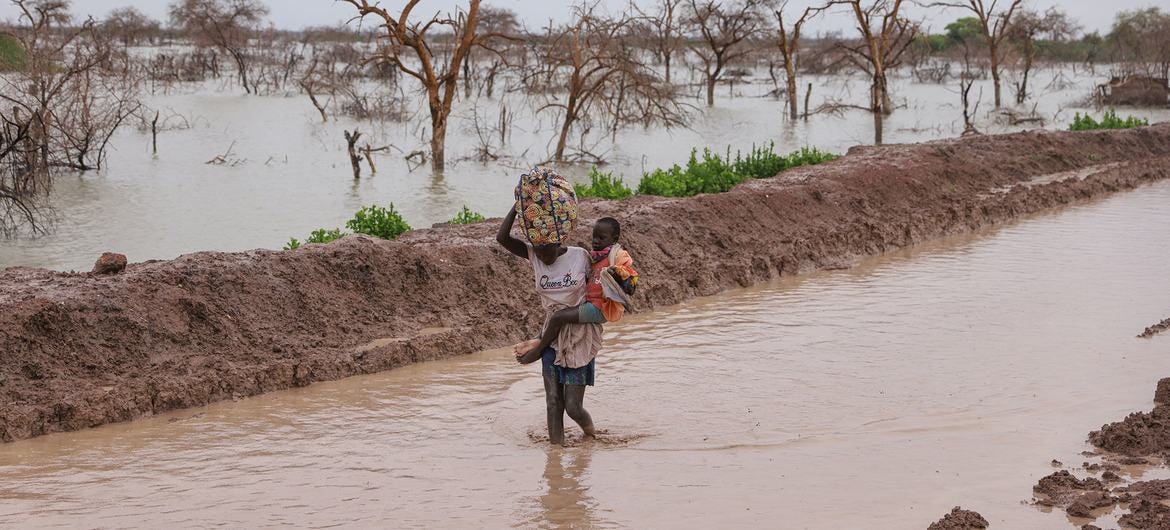
Photo Credit: UNHCR/Tiksa Negeri
The flash flooding in that list is not a contradiction of the failed rains, and it needs explaining, because it is the clearest case in this article of damage arriving from somewhere else. The water is not local, and it is not new. The water causing the flooding today fell in the Lake Victoria basin, some six hundred miles south, during the exceptionally wet years that began in 2019, and that have been working their way north through Lakes Kyoga and Albert ever since, and which are periodically released through a dam in Uganda. The Sudd sits in a depression on impermeable clay, so once the water arrives it cannot drain or flow into a river; it leaves mainly through evaporation. By 2022, years of excess water had swollen the Sudd to roughly 63,000 square miles, about the size of Tunisia. People are being flooded off their fields in South Sudan by rain that fell six years ago, in another country.13
A risk of Famine is formally identified in four counties of South Sudan: Akobo, Nyirol, Nasir and Ulang. FEWS NET is explicit that Famine would occur there if conflict re-escalated and humanitarian access closed. That is not a remote scenario. It is a description of the past two years.14
Ethiopia has the largest population of any country in this belt, and El Niño has taken two harvests from it rather than one. The first was the “belg” harvest. The belg is Ethiopia’s shorter rainy season, running from February to May, and in belg-dependent areas it governs both crop planting and livestock water, setting the yields for barley, wheat and maize. Those rains came late and were followed by prolonged dry spells. Belg production came in 35 percent below average in West Hararghe and 31 percent below in East Hararghe, both in Oromia, and yields fell across the belg highlands of Amhara and Tigray. By July, headline inflation had reached 15.3 percent, its highest level in a year, in a country where the poorest households already buy most of what they eat. Higher prices, higher rates of hunger.15
The second was the “meher” harvest, Ethiopia’s main growing season, which accounts for more than 85 percent of the country’s crop production, and it matters more. The “kiremt” rains that are most important to a successful meher harvest arrived late as well, and then largely failed. FEWS NET’s August update finds rainfall deficits of more than 50 percent across much of the country and expects the June to September kiremt rains across most of Ethiopia to rank as the driest in the historical record. That shortfall is landing on households that had already lost the belg harvest.15
Rain did return in late July, but it did not rescue the season. FEWS NET’s August update finds rainfall still significantly below average and erratic, and expects the kiremt rains to stop early, by mid-September. It now expects the national meher harvest to be below average, possibly by as much as 30 percent, with little to no meher production at all in the lowlands of East and West Hararghe, central and eastern Tigray and northeastern Amhara, where maize has wilted, sorghum is severely stunted and some farmers have replanted twice. A late reprieve is not a full harvest, and a full harvest is what prevents acute hunger and famine.15
Then the sequence turns, in the way that should be the most alarming thing in this section. FEWS NET expects unseasonal rain across central and northeastern Ethiopia from October to December. It will bring some relief to pasture and water, but it will arrive exactly when what crop there is is being cut and dried. Rain at this time flattens the stalks so they cannot be cut, makes the grain germinate in the head before it is harvested, and puts the rest into storage too wet, so it molds. Sun is the only drying technology most Ethiopian smallholders have. At the same time the October to December rains over the southern and southeastern pastoral lowlands are forecast above average, bringing flash flooding to areas still recovering from the last drought. One country, one season, ruined twice by opposite weather: drought and flood in the same year.
The Rain That Failed Over Ethiopia Is Also a River
The rain that failed over the Ethiopian highlands this summer does not only fail as a harvest. It fails as a river. Roughly two-thirds of the water in the main Nile River comes off the Ethiopian highlands by way of the Blue Nile, and something close to eighty percent of the Nile River’s total flow originates in Ethiopia and the eastern basin. This is the one place in this article where the El Niño signal can be read as a number on a gauge rather than inferred from a field.16
The relationship is old and carefully measured. Work by Elfatih Eltahir and colleagues at MIT puts the El Niño-Southern Oscillation at about a quarter of the year-to-year variability in Nile flow and finds that eighty-three percent of El Niño events beginning between April and June have produced drought in the upper catchment of the Blue Nile. This El Niño began in late spring. That is not a coincidence noticed after the fact. It is the specific condition their work identified as the dangerous one, published years in advance, and it is why part one of this series could report that the failure of Sudan’s rains was forecast rather than unlucky. The same team has also shown that a warming climate should widen the swing in Nile flow from year to year by about half again, which is the Nile version of the finding this series reported in part one about El Niño itself.16
Downstream, the river now runs through a piece of infrastructure that did not exist during the last comparable El Niño. The Grand Ethiopian Renaissance Dam was inaugurated on September 9, 2025, and it can hold about 74 billion cubic meters of water. Part one of this series reported its reservoir standing about 20 feet lower in July 2026 than a year earlier, with parts of the Blue Nile basin receiving as little as half their normal rain. A dam is a buffer in a normal year and a question in a dry one, and the question is who absorbs the shortfall of rain. There is no agreement between Ethiopia, Sudan and Egypt that answers it. Egypt has spent fifteen years asking for a binding rule on releases during multi-year drought and has not got one. In August, Ethiopia’s water minister said his country needs nobody’s permission to develop its own rivers, and Egyptian ministers replied that Cairo would not permit further dams on the Nile.16
Egypt is the country at the end of the pipe, and its exposure is not the one this article has been describing everywhere else. Its own harvest was good. The 2026 wheat crop came in near ten million tonnes, about seven percent above the five-year average, and the state bought a record 4.72 million tonnes of it for the subsidized bread program. Egypt’s problem is that a good harvest is nowhere near enough. It eats roughly twice what it grows, buys something close to thirteen million tonnes abroad each year, and runs a bread subsidy that about seventy million people depend upon. Ninety-seven percent of its fresh water comes from the Nile, and water availability has fallen to about five hundred cubic meters per person per year, half the level at which the United Nations calls a country water scarce. On August 1, as the flood season opened, the Egyptian irrigation ministry declared a state of maximum emergency and put its Nile inflow committee on round-the-clock watch.17
So, Egypt meets this El Niño twice, from opposite directions, and neither arrival is a failed harvest of its own. First, less water is reaching it from an Ethiopian highland rainy season that failed nine hundred miles upstream, through a dam it does not control and cannot negotiate over. Second, the grain it must buy to cover the gap between what it grows and what it eats is priced on a world market that El Niño has tightened for reasons that have nothing to do with Egypt. A country can irrigate its way out of a drought, but it cannot irrigate its way out of both of those unrelated problems.17
“Sudan’s rain failed in July due to El Niño. Egypt will feel it in the flow of the Nile River, and it will feel El Niño again in the price of grains needed to make many loaves of bread, and in neither case will anything have gone wrong inside Egypt.”
Then there is the direction nobody thinks to look. Sudan’s drought has already caused a food crisis in Chad, because a million and a quarter people have crossed the border since the war in Sudan began and are eating Chadian harvests. The Cadre Harmonisé, the unified regional tool used to identify, analyze and classify acute food and nutrition insecurity in the Sahel and West Africa, put three million Chadians, almost fifteen percent of the population, at Crisis or Emergency levels of hunger for the lean season now ending, and two million Chadian children under five are expected to suffer acute malnutrition this year, nearly 484,000 of them severely. Severe acute hunger in childhood permanently alters brain development and metabolic health, leading to lifelong cognitive impairments, reduced physical capacity, and a significantly higher risk of chronic adult diseases like Type 2 diabetes and hypertension. A drought in one country becomes a food crisis and long-term health crisis in the next by way of the people who walked out of it.
Photo Credit: Doctors Without Borders
Across West and Central Africa nearly twenty million people are now forcibly displaced or stateless, more than fourteen million of them displaced within their own countries, driven by the wars in the Sahel, Sudan, the Lake Chad Basin and the DRC, and by climate shocks on top of those civil conflicts. The displacement crisis across West and Central Africa is a regional system collapse rather than an isolated national event. A failed harvest in Gedaref, Sudan, is therefore not one country’s emergency. It is arithmetic performed on host communities several countries away, who did not plant the crop and will not eat it either.18
“A drought does not stay where it falls, since much of Sudan’s population has already moved. Sudan’s failed sorghum will be eaten in advance, in eastern Chad.”
The Sahel is drying on the same signal due to El Niño. The Africa Climate Outlook expected El Niño to suppress the West African Monsoon through June to August, and that season has now run. It delivered rains unevenly, which is what the forecasters said it would do. FEWS NET (The Famine Early Warning Systems Network) records below-average rainfall observed across much of the Sahelian band, with moderate to severe deficits in western Senegal, southwestern Mauritania, central and southeastern Mali, central and southeastern Niger, northeastern Nigeria and much of Chad, and vegetation conditions below average in all of them. Crops in Mali, Niger and Chad are short of water. Temperatures are the amplifier: the models project above-normal heat across the region with confidence, and heat pulls moisture out of soil that is already short of it. The split of El Niño weather runs here too. While the Sahelian band dries, persistent heavy rain has put southeastern Nigeria under an elevated risk of flooding. FEWS NET’s (The Famine Early Warning Systems Network) regional read is more mixed than that list of deficits suggests: the agency records the shortfalls as concentrated in central Mali and eastern Chad, expects average to above-average rainfall across much of the Sahelian band over the season as a whole, and treats flooding rather than drought as the nearer risk in parts of Niger and Nigeria. Both pictures are true at once, and which one a household lives through depends on where it farms. In the Sahel, El Niño is a contributor rather than the cause of food insecurity.19
In West Africa, El Niño is arriving on the largest hunger crisis in this article. The Cadre Harmonisé analysis put 41.8 million people across West Africa and the Sahel in acute food insecurity at the end of 2025 and projected that 52.8 million people would be in acute hunger during the June to August lean season. Watch what happened to that projection as the season ran. By July, FAO and WFP had revised it up to 54.8 million people in acute food insecurity. The number expected to reach Emergency levels this year, more than three million, is more than double the 1.5 million of 2020. In Borno State in Nigeria, the updated Cadre Harmonisé projected about 10,300 people in Catastrophe during the lean season, the phase at which people starve. At the launch of the 2026 Sahel Humanitarian Overview in June, the UN reported 24 million people needing humanitarian assistance across Burkina Faso, Chad, Mali, Niger, northern Cameroon and northeast Nigeria. These are numbers larger than the eastern belt this article has spent much time describing, in a region most readers will not have seen mentioned in connection with El Niño at all.19 This hunger is due to a compounding mix of conflict, economic instability, climate shocks, and severe humanitarian funding shortages.
What moved that number? The rains were not the only thing that changed between January and July. This is the region where the World Food Programme went from assisting 1.3 million people in Nigeria during the 2025 lean season to having funding to help only 72,000 people by February 2026. That is ninety-four percent of an operation gone in a single year, in the country carrying the largest share of this region’s conflict. It is also where Mali ran the only controlled version of this experiment that anyone has. Rations were cut in some areas because the funding was cut and maintained in others. Where humanitarian aid was cut, crisis-level hunger rose 64 percent against 2023 levels; where full rations were maintained, crisis-level hunger fell 34 percent. Same country, same war, same year, and the only variable was whether humanitarian aid money was available so that the food arrived. Every other case for acting early in this article is a forecast or a cost ratio. This one is a record of what withdrawing the money has already done, and to whom. The revision from 52.8 million people affected to 54.8 million people affected is a forecast catching up with the withdrawal of aid as much as with the drought: in 2025 every one of the five largest donors cut its aid, all at once. The United States cut its aid by nearly 57 percent, alongside cuts by Germany, the United Kingdom, Japan and France.20
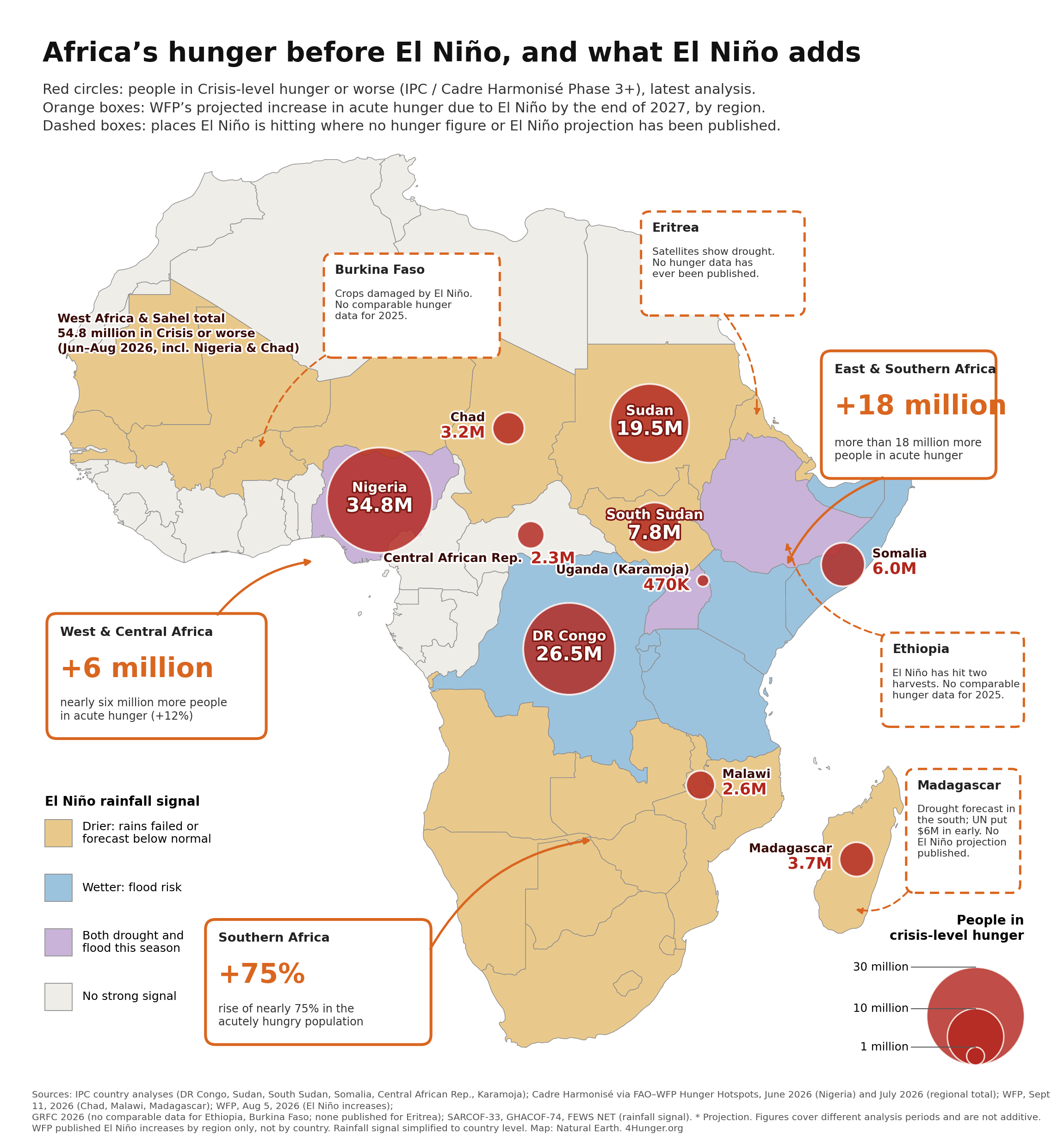
The 41.8 million baseline that all of this is measured against is itself the product of the forty years described earlier in this article: the lake that receded, the land corridors that closed, the farmland that went to desert. El Niño did not build that number. It is only the most recent thing to be added to it.
The mechanism that turns a shortage into a famine is already at work here, and it is not a forecast. Cereal exports are currently banned in Chad, Niger, Mali, Burkina Faso, Cameroon, Ghana and Guinea, with Niger and Burkina Faso adding livestock and Burkina Faso adding cowpea. Most are standing measures, some dating to 2022, which is the point. This region has spent four years with its internal grain trade partly closed, so the mechanism that turned a shortage into a famine in 2008 is not something West Africa might resort to under pressure. It is the condition it is already in. The bans also do a second damage rarely counted. Since the grain cannot leave, staple prices have fallen to atypically low levels, which sounds like relief and is not: the farmers who grew it cannot earn from selling it. One policy, two harms.19
East of those countries living in drought, El Niño does the opposite. The regional climate forum that met in August put a ninety percent probability on wetter-than-normal October to December rains over southern Ethiopia, central and southern Somalia and northeastern Kenya, reinforced by a positive Indian Ocean Dipole, a climate pattern marked by an east-west temperature contrast across the tropical Indian Ocean, where the western side becomes unusually warm and the eastern side becomes unusually cold, making seasonal rainfall totals likely to pass about 16 inches in places in these parts of Africa. The FAO has already warned Somalia to expect serious flooding in the “Deyr” season. The rain will fall on pastoral areas still classified in Crisis, and the forecasters’ own warning list runs past drowned crops and drowned herds to washed-out roads and outbreaks of water-borne disease. They are still recovering from the drought of October 2020 to early 2023, when five consecutive rainy seasons failed across the region, the worst in forty years. What drove it was a rare triple-dip La Niña, which UNDRR rates the most severe such event in seventy years, alongside a persistently negative Indian Ocean Dipole. Both drivers held for three years without a break.21
One warm ocean, one region, drought in the west and flood in the east in the same weeks. That is exactly what was predicted, and exactly what El Niño has always done.
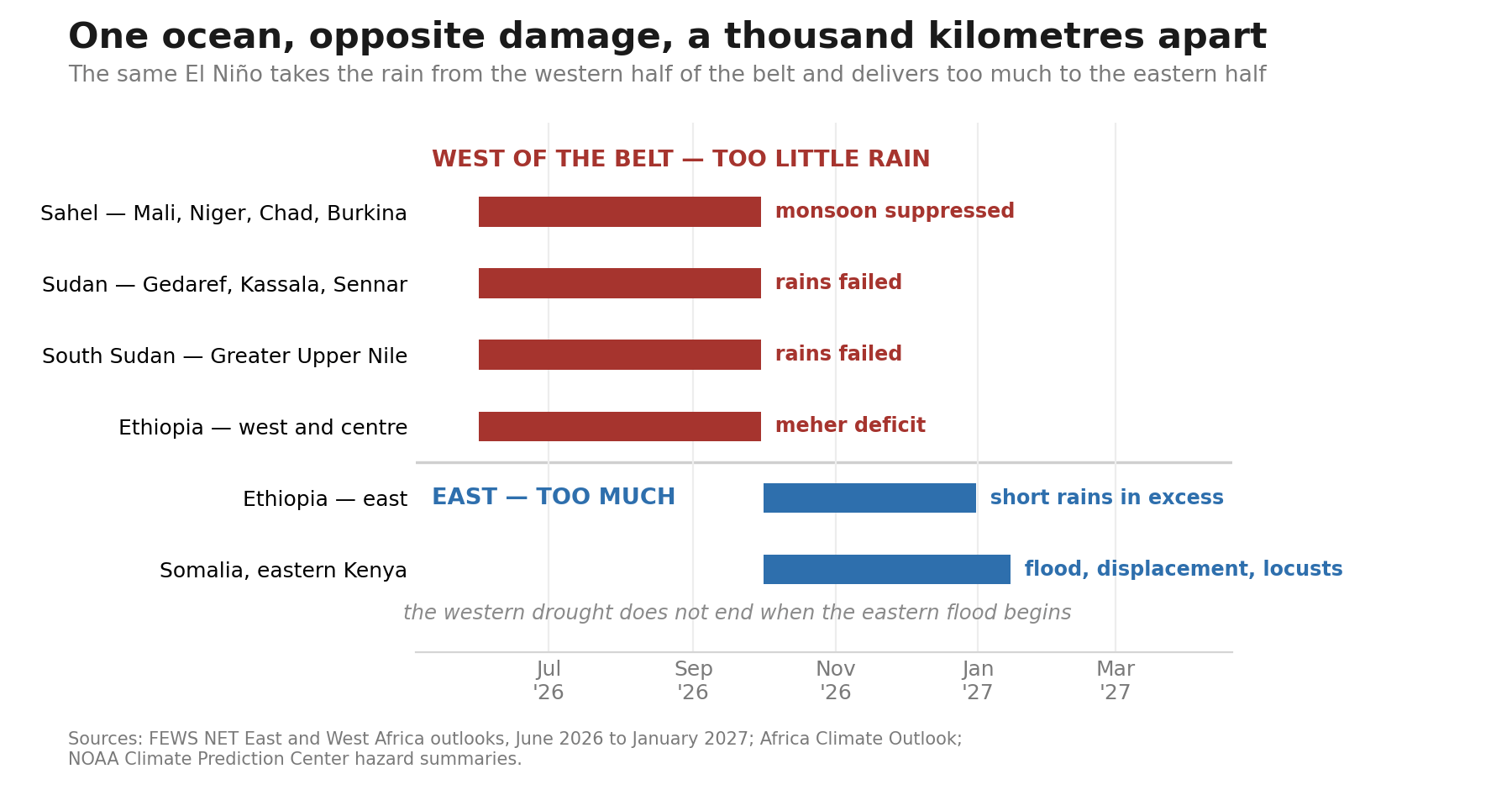
Figure 3. The belt fails as one unit, but not in one direction. From the Sahel through Sudan and South Sudan to western Ethiopia, El Niño suppressed the June to September rains. Across the same belt’s eastern edge it is forecast to deliver too much between October and December. The western drought does not end when the eastern flood begins; the two overlap in the countries between them.
Three times in this article a shortage in Africa has become a quarrel between governments rather than a problem inside one. Seven West African states have closed their borders to cereal exports. Water released from a dam in Uganda stands on fields in South Sudan, and nobody downstream has a say in when it comes. The flow of the Nile is set in Ethiopia and argued over in Cairo, with no agreement governing what happens in a dry year. El Niño does not create these disputes. It removes the surplus that made them unnecessary, and it removes it from every one of them, all at once.
The Other Critical Deadline
Southern Africa’s deadline is a planting date. The deadline for everywhere else in this article is quieter, and it has already started running. Food aid is not a transfer of money; it is a purchase, a shipment and a delivery, and the purchase cannot begin until the money is actually in hand. WFP’s own procurement rules say so plainly: buying may only start once the required funds are available. Conventional international purchase and shipping runs to three or four months, and longer when a commodity has to be sourced across an ocean. Where WFP has been able to position stock in advance, against money committed early, the same delivery has taken an average of nine days.22
Put that against the calendar this article has described. Sudan’s sorghum harvest fails in December. The shortfall is felt from the middle of 2027. Money committed this autumn becomes food on a truck in time. Money committed in March 2027, when the joint appeal expires, becomes food in the summer, which is to say after the hunger it was meant to prevent has already started and disaster aid rather than proactive aid is needed to prevent starvation. The appeal does not fail on the day it closes unfunded. It fails about four months earlier, silently, on the day the last purchase that could have arrived in time was not made.22
That is the whole argument of anticipatory action, and it is why the difference between one dollar and seven is not really about money. It is about when the dollar shows up. Every week that the $202 million goes unfunded is not a week of delay. It is a week subtracted from the far end, from the months in 2027 when the food would have been arriving. It is a week more of suffering by people in crisis levels of hunger.
Consider what all of that means for a household in Kassala or Kordofan, Sudan. Its own sorghum was lost when the rains failed in July. The wheat it would ordinarily buy instead comes mostly from Russia, through a Black Sea corridor where both ends are now closed at once, and it is priced on a world market that Europe’s poor harvest and low rivers have already tightened. Russian strikes have cut Ukraine’s expected farm exports roughly in half. Ukrainian strikes have taken more than ninety percent of Russia’s Azov and Black Sea export capacity offline, leaving Russia sitting on a grain harvest of about 140 million tonnes of grain that it cannot move. The prices have already responded to these circumstances. In August the FAO cereal index reached its highest price level since May 2024, with wheat fifteen percent above where it stood a year ago, and sorghum, the crop that has just failed in Gedaref, up again in the same month. A country that loses its harvest and then finds the price of the replacement has risen has not lost once. It has lost twice, and the second loss is the one that lasts, because the price increases do not end when the rains return.23
“Nothing about the hunger in Africa began with the 2026-27 El Niño. Water has been leaving Africa for more than forty years. The grazing lands and the farmland went as the water disappeared. What changed this year is that the money holding hunger down across the continent was withdrawn. In 2025, official development assistance fell by a record 23%, humanitarian aid by 36%, and for the first time every one of the five largest donors cut aid at once. In the same months, the forecast for a super El Niño arrived. The response to this El Niño is the one part of this that can still be changed, and the funding can still be found. It will be cheapest if it arrives before the hunger disaster hits, rather than after the hunger and famine have begun.”
This is a devastating series of events. We need to collectively wake up!