

The Ocean That Puts Food on the Table
The July forecast runs are in, and they describe something no working forecaster has ever seen. According to 667 ensemble members from 14 seasonal prediction systems, the multi-model median now puts this winter’s El Niño at a peak of 3.6°C in the Niño 3.4 region of the tropical Pacific. This is roughly 0.8°C beyond the strongest El Niño event in a century and a half of observation. ¹ Ninety-one percent of the ensemble members predicted that this El Niño will exceed the all-time record. The ocean itself is not waiting for the models: daily sea surface temperatures in the region are already running around 2°C above their era-adjusted average in mid-July, warmer at this date than in 1997 or 2015, the two most explosive El Niño onsets ever measured, and by a margin that is not close. ²
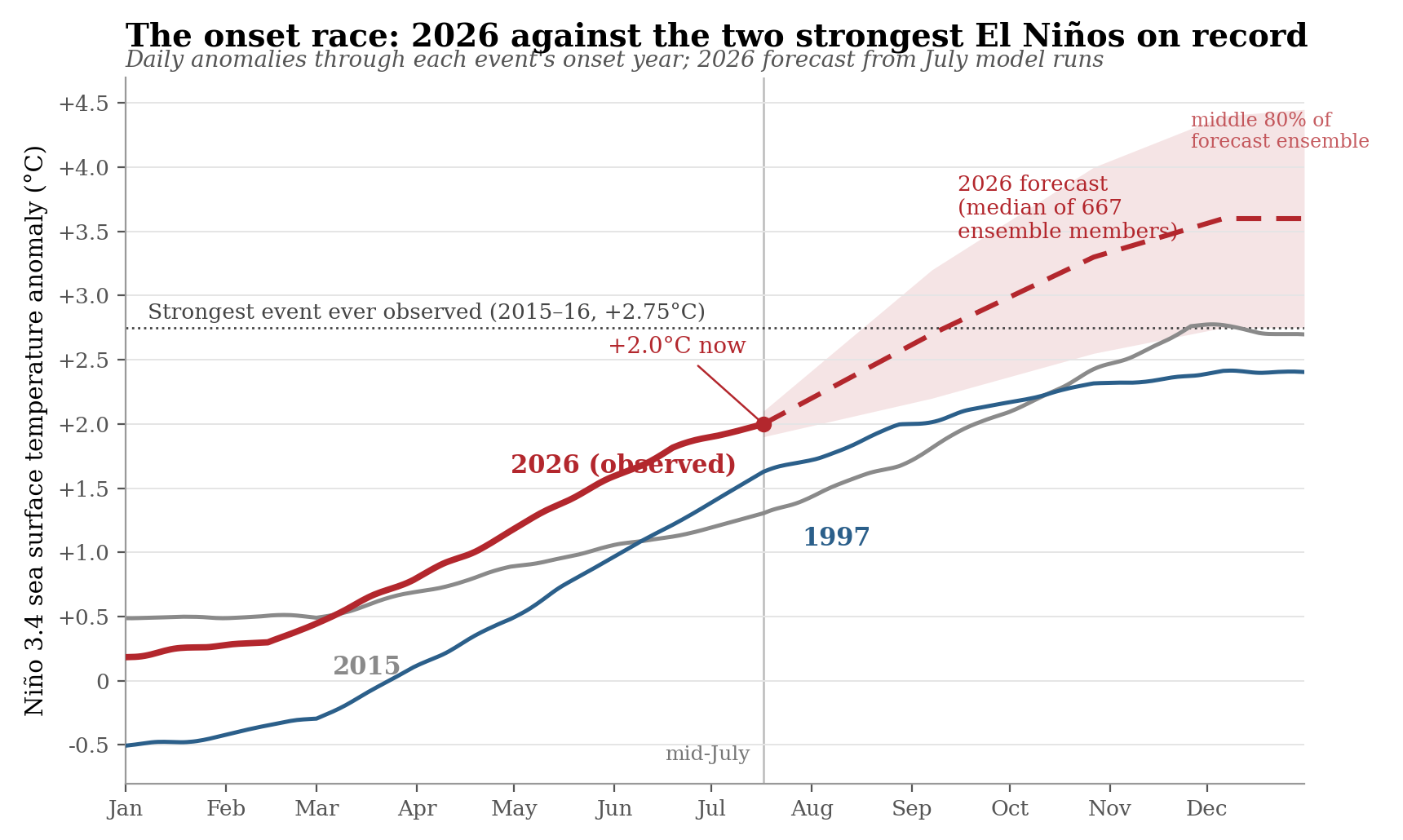
The onset race: daily sea surface temperature anomalies in the Niño 3.4 region for 2026, against 1997 and 2015, the two most explosive El Niño onsets previously measured. The dashed line is the multi-model forecast median; the shading spans the middle 80 percent of the 667-member ensemble.
The temptation will be to file this under meteorology. File it instead under food, and under hunger.
An El Niño is not a storm. It does not arrive with wind and fury and then recede. It is a reorganization of where rain falls on Earth, a slow, hemisphere-spanning transfer of moisture away from the croplands of Southeast Asia, southern Africa, Central America, and northeastern Brazil, and toward places that cannot use the rain to produce food such as the open Pacific, the deserts of coastal Peru, the flood plains of the Horn of Africa. The warm water is only the mechanism; the failed harvests are what people will actually live through. Since the global food system runs on a handful of staple crops grown in a handful of climate-exposed regions, a sufficiently large El Niño is not a weather anomaly at all. It is going to be a global food shock on a twelve-month fuse. ³
“An El Niño does not destroy one harvest in one place. It reorganizes the rain over half the planet, on a schedule the world’s croplands were never meant to adapt to.”
4Hunger.org has spent the past several months documenting the two crises already squeezing the food system: the fertilizer supply shock that followed the closure of the Strait of Hormuz in February (see Fertilizer Famine), and the two-year drought that has driven the American cattle herd to its smallest size since 1951 and the U.S. wheat crop to its smallest since 1972 (see Parched Ground). The forecast now on the table is the third shock, and it is aimed squarely at the harvests of the next eighteen months all around the world.
A Map of What Comes Next
Strong El Niños do not damage the world’s agriculture randomly. They damage it in a pattern that has been documented across 150 years of El Niño events, and the pattern is brutally consistent. ⁴ To understand the geography of what is now forecast, start with where previous events did their damage, because they do it in the same places again and again.
Indonesia, the Philippines, and mainland Southeast Asia sit first in the line of fire, and the impacts are already arriving there. Strong El Niños suppress the rains across the Maritime Continent. Rice planting is delayed, reservoir levels fall, and the drained peatlands of Sumatra and Kalimantan become tinder: the 1997–98 El Niño event burned millions of hectares of Indonesian forest and peat and forced the largest rice imports in the country’s history. ⁵ Indonesia and the Philippines are, respectively, the world’s first- and second-largest rice importers in a bad year. Their bad year has already started.
India’s southwest monsoon which is the single most important weather system for human food security on Earth, watering the kharif rice, pulse, and oilseed crops on which 1.4 billion people depend is statistically reduced in strong El Niño years. The relationship is probabilistic, not mechanical; monsoons have defied El Niños before. But the monsoon now underway is running against the strongest Pacific heat forcing ever forecast, and the last time an El Niño of merely ordinary strength developed, in 2023, India’s response to a modest monsoon shortfall was to ban the export of non-basmati rice within weeks which sent shockwaves through the global rice supply. ⁶ India alone accounts for roughly 40 percent of the world’s traded supply.
Australia’s wheat belt faces its canonical El Niño outcome: a hot, dry austral spring landing precisely on the grain-fill and harvest window of the 2026–27 crop, in a year when the world has no American surplus to fall back on.⁷
Southern Africa is where the arithmetic turns cruelest. The region’s single maize season grows from December through March, the exact months of the forecast peak of the El Niño event. In 2015–16, a far weaker event than the one now projected, the drought that followed was southern Africa’s worst in 35 years: 40 million people became food-insecure, national disaster declarations were issued across the region, and maize harvests in Zimbabwe and Malawi fell by nearly half.⁸ The 2023–24 event repeated the pattern and again Zambia, Zimbabwe, and Malawi all declared national drought disasters.⁹ The season that begins this December will be planted by farmers who, thanks to the Hormuz fertilizer shock, are applying less nitrogen than at any time in a decade, into soil that the models say the rain will not reach.
Central America’s Dry Corridor including Guatemala, Honduras, El Salvador, Nicaragua loses its primera and postrera maize and bean seasons to El Niño droughts with grim regularity; the 2015 event left 3.5 million people there needing food assistance and helped drive a wave of northward migration.¹⁰ Northeast Brazil’s smallholder belt faces the same equation on a different calendar.
In contrast, El Niños cause other places to drown rather than to burn. The Horn of Africa’s October–December short rains typically come in torrents in El Niño years that cause flooding that destroys standing crops, drowns livestock, displaces communities, spreads cholera, and creates the wet breeding grounds from which desert locust outbreaks have historically erupted. Coastal Peru and Ecuador face the floods that gave El Niño its name, it also causes the collapse of the Peruvian anchoveta fishery, the largest single-species fishery on Earth and the anchor of the global fishmeal supply that feeds farmed fish, poultry, and hogs. When the anchoveta disappear, as they did in 1997–98, feed costs rise everywhere.¹
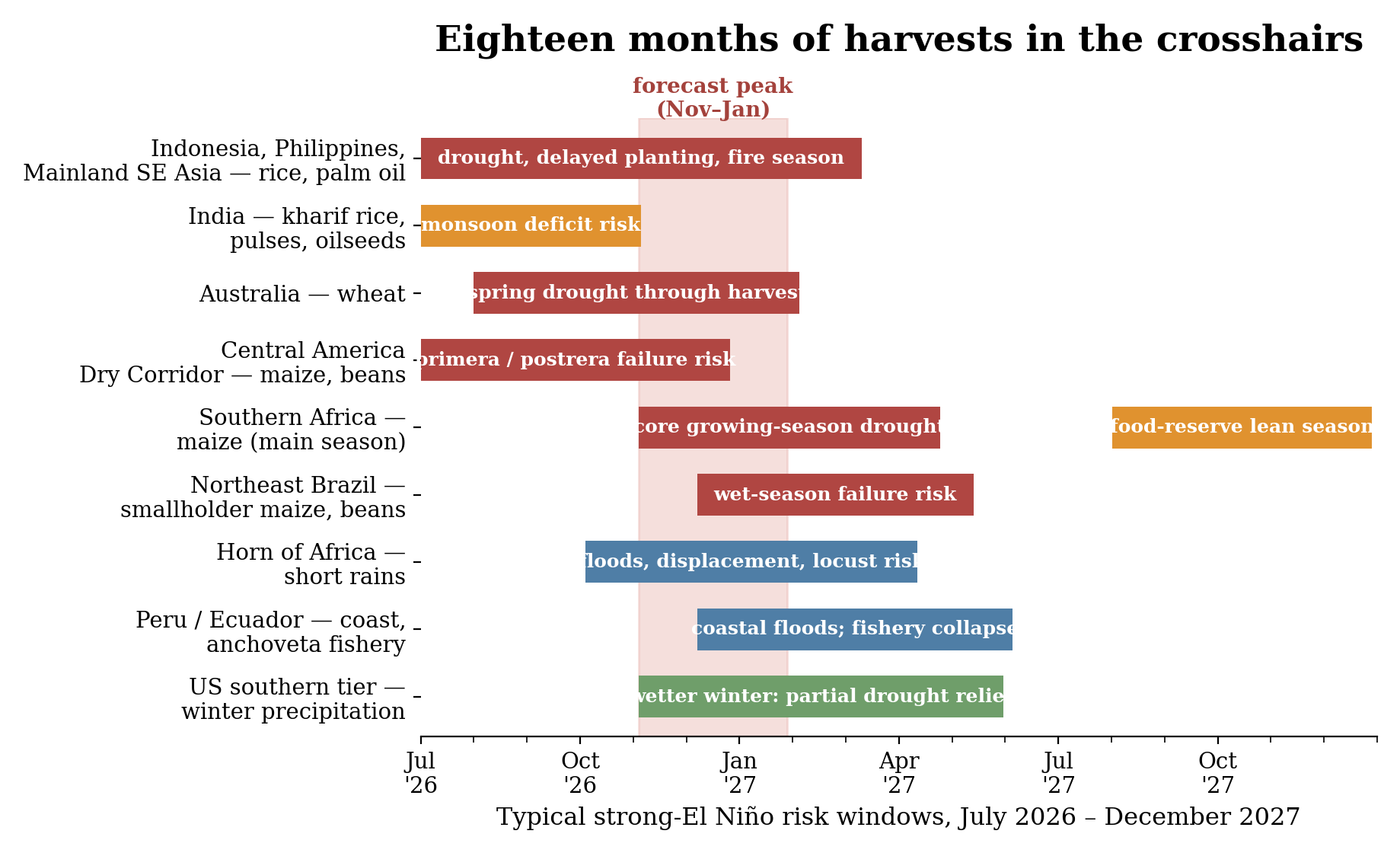
¹Figure 1. The harvest calendar in the crosshairs: canonical strong-El Niño impact windows for the world’s most exposed food-producing regions, July 2026 through December 2027, against the forecast November–January peak. Teleconnections are probabilistic, not certainties — but this is the pattern every major event since 1877 has broadly followed.
The Rice That Won’t Be Planted
Every staple has its own exposure to the effects of El Niño, but rice is where El Niño’s geography and humanity’s geography overlap most completely. Rice is the primary calorie source for more than 3.5 billion people. It is grown, overwhelmingly, in precisely the monsoon Asia that El Niño dries out. Unlike other crops only about a tenth of production is traded across borders as most rice is consumed is consumed in the country where it is grown. This means small production shortfalls produce large price increases, and large increases in price can produce panic. ¹²
The panic has a playbook, and the world has already experience rice market panic twice this century. In 2007–08, export restrictions cascading from one rice producer to the next tripled world prices in six months without any global production shortfall at all. In 2023–24, a moderate El Niño was enough to trigger India’s export ban and push rice prices to fifteen-year highs. The event now forecast is not moderate. If the El Niño causes the monsoon to be less than average or fail, and Southeast Asia’s rice paddies get late or insufficient monsoons, the question is how fast and what happens to Indonesia, the Philippines, Bangladesh, and the import-dependent nations of West Africa when they do.
In a global food system where a handful of export prices set the reference for everyone, having countries issue export bans will impact prices all over the world.
Three Shocks, One Table
What makes 2026 different from 1997 or 2015 is not only the size of the forecast. It is what the forecast is landing on.
The first shock came through a 21-mile strait. The closure of Hormuz in February severed a fifth of the world’s traded nitrogen fertilizer from its markets, sent urea prices up more than 60 percent, and guaranteed that farmers from Iowa to Uttar Pradesh would apply less nitrogen this year which will cause yield losses that arrive, on roughly a one-season lag, exactly as El Niño’s droughts do.¹³ A smallholder who cannot afford fertilizer loses 40 to 60 percent of her yield in a normal rainfall year.¹⁴ The models say this will not be a normal rainfall year.
The second shock is already in the ground. Sixty-one percent of the contiguous United States is in drought. The U.S. winter wheat harvest is only 1.561 billion bushels, the smallest since 1972. The American cattle herd is the smallest it has been since 1951 mean that the country that has served as the world’s agricultural shock absorber for eight decades is entering this event with no slack of its own.¹⁵ World grain reserves are the buffer between a bad harvest and a hungry year, and they are being drawn down even before the El Niño harvest failures begin.
The third shock is the ocean. Each of these crises would be manageable alone. The fertilizer shortage could be absorbed by a good growing year. The American drought could be offset by strong harvests abroad. An El Niño could be cushioned by full granaries and cheap inputs. Instead, each has arrived to find the others already there.
“A food system already starved of fertilizer and parched of rain is about to be struck by the strongest ever El Niño forecast. Any one of these is a crisis. All three at once is something the modern food system has never had to survive.”
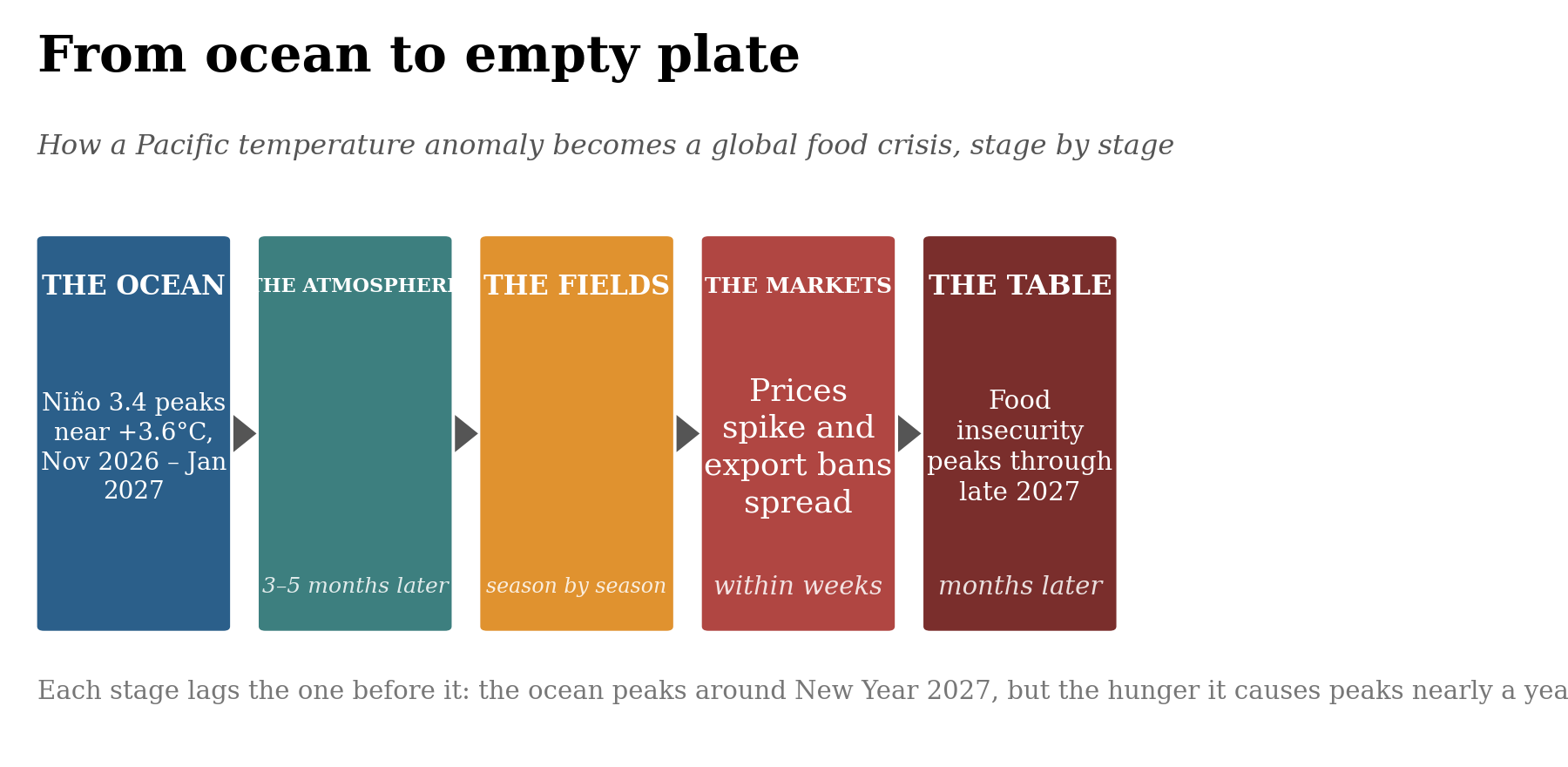
Figure 2. The transmission chain from sea surface temperature to food insecurity. Global temperature lags the Pacific by three to five months; harvests lag by a season; prices lag harvests; hunger lags prices. The worst of what is now forecast lands on the world’s tables in 2027 and the lean seasons of early 2028.
What It Means in America
Honesty requires a complication here, and this publication has never shied from one: for parts of the drought-stricken American Southwest and Southern Plains, El Niño is not the villain of this story. A strong event typically shifts the winter storm track south, delivering above-normal cool-season precipitation across the southern tier from California to Texas. After six years of drought stress in the Southern Plains, a wet winter would be an unambiguous mercy that will recharge soil moisture ahead of the 2027 winter wheat crop and offering rangeland its first real drink since 2024. Credit where credit is due: if the pattern holds, some American farmers will owe this El Niño a debt.¹⁶
But no American eater should mistake regional rainfall for national immunity, for three reasons.
First, the price of food in an American grocery store is set in a global market. When Australian wheat fails and India restricts rice and southern Africa’s maize collapses, U.S. commodity prices rise regardless of the weather in Kansas, not because American grain is scarce, but because American grain traders sell into world prices. That transmission chain does not move at the speed of a headline. It moves at the speed of a growing season. But it moves, reliably and historically, to the consumer’s receipt.¹⁷
Second, the inputs. The anchoveta collapse and a global feed-grain squeeze land on a livestock sector already at a 75-year inventory low, with ground beef already migrating from staple to luxury. Beef prices were projected to rise 6.3 percent in 2026 before this forecast existed. And El Niño winters, for all their southern rain, raise flood risk across California’s Central Valley, the source of a third of America’s vegetables, where the line between drought relief and levee failure has always been thin.
Third, and most important: the Americans with the least room to absorb any of this. The United States entered 2026 with 47.4 million people, that is one in eight Americans already food-insecure, with the lowest-income fifth of households already spending nearly 30 percent of their budgets on food, and with Congress still weighing more SNAP cuts that would strip benefits from up to 8 million people.¹⁸ Every percentage point of El Niño-driven food inflation that arrives in 2027 will land on families who did not cause a war in the Gulf, did not cause a megadrought, and did not warm the Pacific.
What the Last Great El Niños Did
If the forecast holds, 2026–27 will join a short and terrible list, and it is worth remembering what the previous entries on that list actually did.
The 1877-78 El Niño was until this year, arguably the strongest ever observed caused the collapse of the monsoons of India and the rains of northern China and northeastern Brazil simultaneously. The famines that followed, amplified catastrophically by the colonial and market policies of the era, killed tens of millions of people. Historians call them the Late Victorian Holocausts. ¹⁹ The 1982-83 El Niño brought Australia’s worst drought of the century and Peru’s worst floods. The 1997-98 El Niño killed an estimated 23,000 people, caused some $40 billion in losses, set Indonesia’s forests alight, and broke the anchoveta fishery. ²⁰ The 2015-16 El Niño left 60 million people in need of humanitarian assistance across four continents which was the largest El Niño response operation ever mounted, and one the UN itself judged to have started too late.²¹
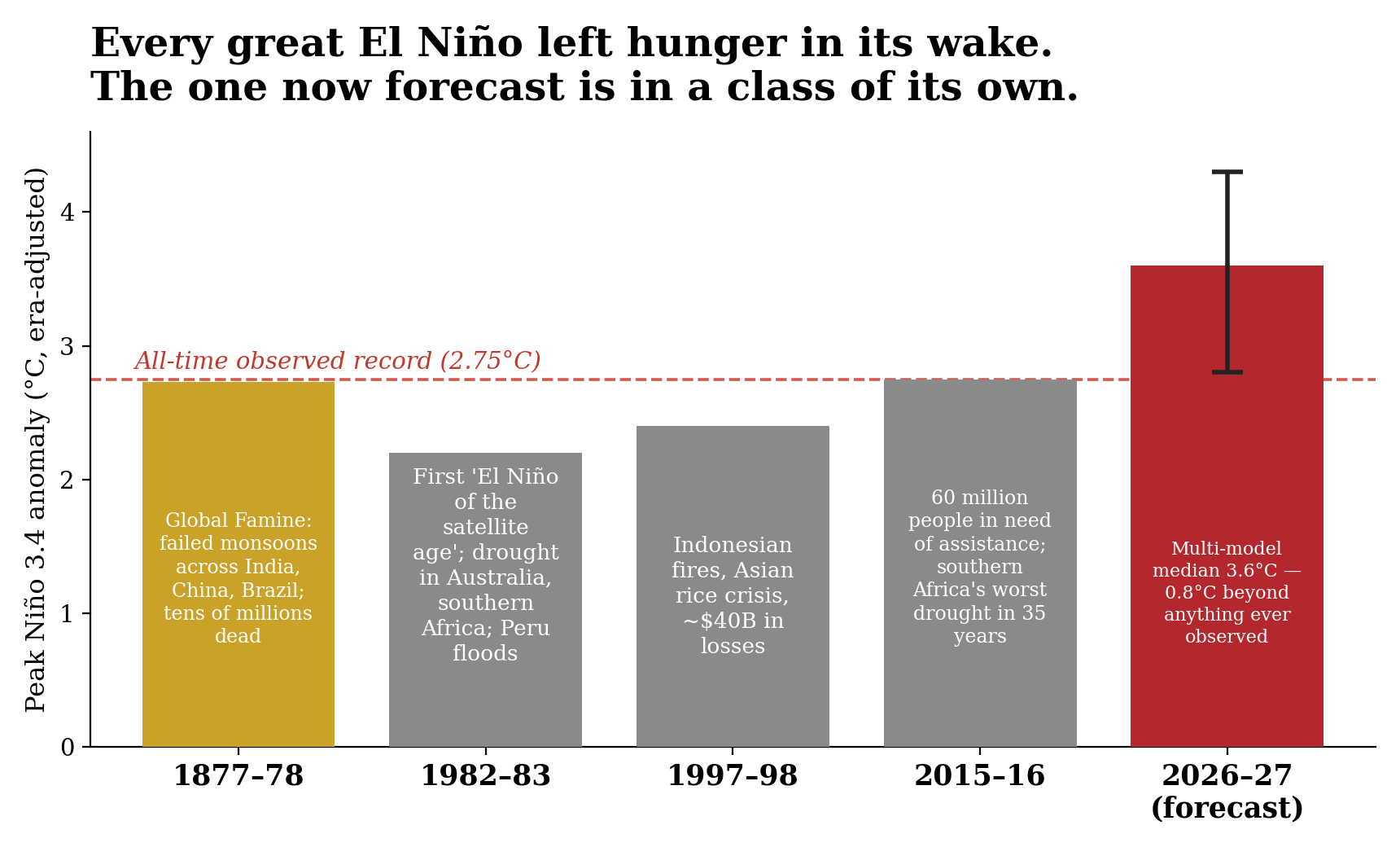
Figure 3. Peak intensity of the great El Niño events since 1877 (era-adjusted Niño 3.4 anomaly) and their human consequences, against the 2026–27 multi-model forecast median of 3.6°C. The whisker spans the middle 80 percent of the 667-member forecast ensemble — the bottom of which grazes the all-time record.
Two things must be said about the above chart, and the first is a caveat this publication insists on: the models have never been verified with an El Niño of this magnitude. No seasonal forecast system has ever predicted, and then been graded against, a 3.5°C El Niño, because one has never happened. Fourteen models agreeing is reassuring; it is not proof. ²²
The second thing is that the caveat cuts both ways, and offers less comfort than it appears to. The deaths in that history did not scale gently with the temperature of the water. They scaled with the poverty, the debt, the conflict, and the policy failures the water found when it arrived. By that standard, a world with 333 million people already in acute food insecurity before this year began, humanitarian funding in generational collapse, fertilizer severed and food reserves very low, this El Niño is arriving to more dry tinder and much less of a cushion than El Niños found in 1997 or 2015.²³
The Window That Is Still Open
There is one merciful fact buried in this forecast: El Niño is the most predictable large-scale climate shock on Earth. A hurricane gives you days. A flash drought gives you weeks. This event has given the world six months of warning before its peak and nine to twelve months before its worst food-security impacts arrive. Based on 150 years of history we have a likely schedule of where the rain will fail and when and where the harvests will miss. Famine after El Niño is the most foreseeable disaster in the humanitarian catalogue. Which means that every escalation from hunger to famine in 2027 will be, quite literally, a policy choice made in 2026.
“The cruelest thing about the hunger now forecast is that it is forecast. Every famine that follows an El Niño is a disaster the world watched coming for a year and chose not to proactively respond to.”
What is required is not incremental adjustment. It is dramatic, coordinated action on four fronts, taken while the window for action is open before the widespread hunger and famines occur.
First, fund the response before the failure, not after it. Anticipatory action including cash, seeds, drought-tolerant inputs, and pre-positioned food released on forecast triggers rather than on famine declarations, cost a fraction of late-stage emergency response and saves lives an emergency response cannot. The 2015–16 event proved the cost of lateness; the World Food Programme and FEWS NET have spent the decade since building the trigger systems to do better. Those systems now sit inside a U.S. humanitarian budget that has collapsed from roughly $14 billion to $3.7 billion in a single year. ²⁴ That collapse must be reversed, this budget cycle, with El Niño anticipatory financing explicitly funded for southern Africa’s planting season which begins in December, not in some comfortably distant fiscal year.
Second, protect and expand SNAP and domestic nutrition programs. The food-price wave from this El Niño arrives in American grocery stores in 2027, stacked on the fertilizer, fuel and drought inflation already in the pipeline. Cutting the primary safety net between price volatility and hunger for the 42 million Americans now in need and the millions more who will be in need during the same eighteen months is not fiscal discipline; it is a decision to transfer the cost of a Pacific Ocean climate event which we now is coming onto the households least able to pay it.
Third, pass a 2026 Farm Bill built for volatility. American farmers will plant the 2027 crop, the one the world will desperately need, facing record input costs, exhausted balance sheets, and an El Niño winter that may deliver drought relief and flood damage in the same season. Disaster programs that pay two years late, and insurance built for Big Agriculture’s monocrops rather than the diversified farms most able to adapt, are not equal to the coming crisis. The Farm Bill must deliver for both farmer and the poor and working classes in America.
Fourth, keep the grain moving. The lesson of 2007–08 is that export bans are contagious and that hoarding, not harvest failure, turns shortage into famine. The G20’s Agricultural Market Information System was created after that crisis precisely so that governments could see real stocks and resist panic. ²⁵ Using it and pressing the major exporters, publicly and early, to commit against blanket bans will do more to contain a surge in crop prices and protect America’s and the world’s poor in 2027 than any single tonne of aid.
How to Watch It Come
This event will unfold in public, in real time, in open data. The same forecasts and monitors cited throughout this article are free to anyone. If you want to watch the ocean, the models, and the food system respond and use this information to hold our elected officials to account, these are the places to look:
• The ocean, daily: NOAA’s Climate Prediction Center ENSO page publishes the official weekly Niño-region SSTs and the ENSO Alert System status, and Climate Reanalyzer maps daily sea surface temperature anomalies as they happen.
• The forecasts, monthly: the IRI ENSO forecast page at Columbia University compiles the multi-model plume; the NOAA ENSO Blog translates each month’s diagnostics into plain English; and Australia’s Bureau of Meteorology issues its fortnightly Climate Driver Update.
• The seasonal rainfall outlook: the Copernicus C3S seasonal forecast charts show where the world’s models expect the rains to fail, three to six months ahead.
• The crops: USDA’s Crop Explorer tracks global crop conditions from satellite; the GEOGLAM Crop Monitor issues monthly consensus maps of crop stress; and the Agricultural Market Information System reports world grain stocks and export policies.
• The hunger: FEWS NET, the U.S.-created Famine Early Warning Systems Network, publishes country-by-country food-insecurity projections; FAO’s GIEWS tracks food prices and harvest alerts worldwide; and WFP’s HungerMap Live estimates acute hunger in near-real time.
• At home: the U.S. Drought Monitor updates every Thursday, and USDA’s monthly WASDE report is where global harvest failures first become official American numbers.
A 3.6-Degree Warning
The Strait of Hormuz is 21 miles wide, and its closure taught this country how much hunger can flow through a gap that small. The Pacific Ocean is 12,000 miles wide, and it is about to teach a larger version of the same lesson: that the abundance on which the wealthy world congratulates itself rests on rain falling where it has always fallen, on inputs arriving when they have always arrived, and on reserves that exist only until three shocks to global food supplies arrive in the same eighteen months.
The smallholder in Malawi planting unfertilized maize into a season the models have already condemned did not warm the Pacific. Neither the rice farmer in Luzon watching the paddies crack, the rancher in Oklahoma finally getting rain after he has already sent his herd to slaughter, the mother in Houston watching the price of ground beef chose this. But all of them are downstream of the same warm water, and all of them will pay for it in the currency the poor always pay in: skipped meals, sold assets, mounting debt, the quiet emergency that hunger always is.
What separates this crisis from every previous large El Niño event is that it is being forecast in public, in detail, by fourteen independent modeling systems, half a year before its peak begins. The 1877 famines arrived without warning. The 2015 response started late, and the UN has now said so. This El Niño is different. The heating water in the Pacific has delivered its warning and it has been evaluated with a precision no disaster in history has matched. Whether tens of millions of people go hungry and many people die in 2027 or whether the most well predicted catastrophe on Earth becomes the first one the world actually responds to on time, belongs as it always does to those in power. Whether they can be made to act while the ocean warms and before hunger unfold around the world is the question. You and we must act. Call your elected officials both state and federal today and tomorrow and demand action before the impacts of this El Niño cause hunger in your state, America and around the world.
Excellent, thorough article. It aligns with my understanding of the coming/underway El Niño and adds much from your expertise on food and famine issues. Last I looked, the US had around 650,000 homeless. Now the SNAP cuts alone threaten to increase that number. There won't be any sensible, proactive action as you sensibly recommend coming from America. We're in a multi-pronged storm of agricultural collapse.
And under the present American leadership the world's political systems are least prepared to develop a comprehensive preventive approach to mitigating the oncoming humanitarian disaster 🙄.