

From the wheat that stops growing at 27 degrees; to the dairy cow that simply stops making milk due to the heat; to a French cornfield cooked in a two-week heat dome; to a way-high grocery receipt in Ohio; why the one climate driver that arrives without a forecast, in hours, not seasons, has quietly become the single most devastating climate variable standing between the world and its next hunger crisis.
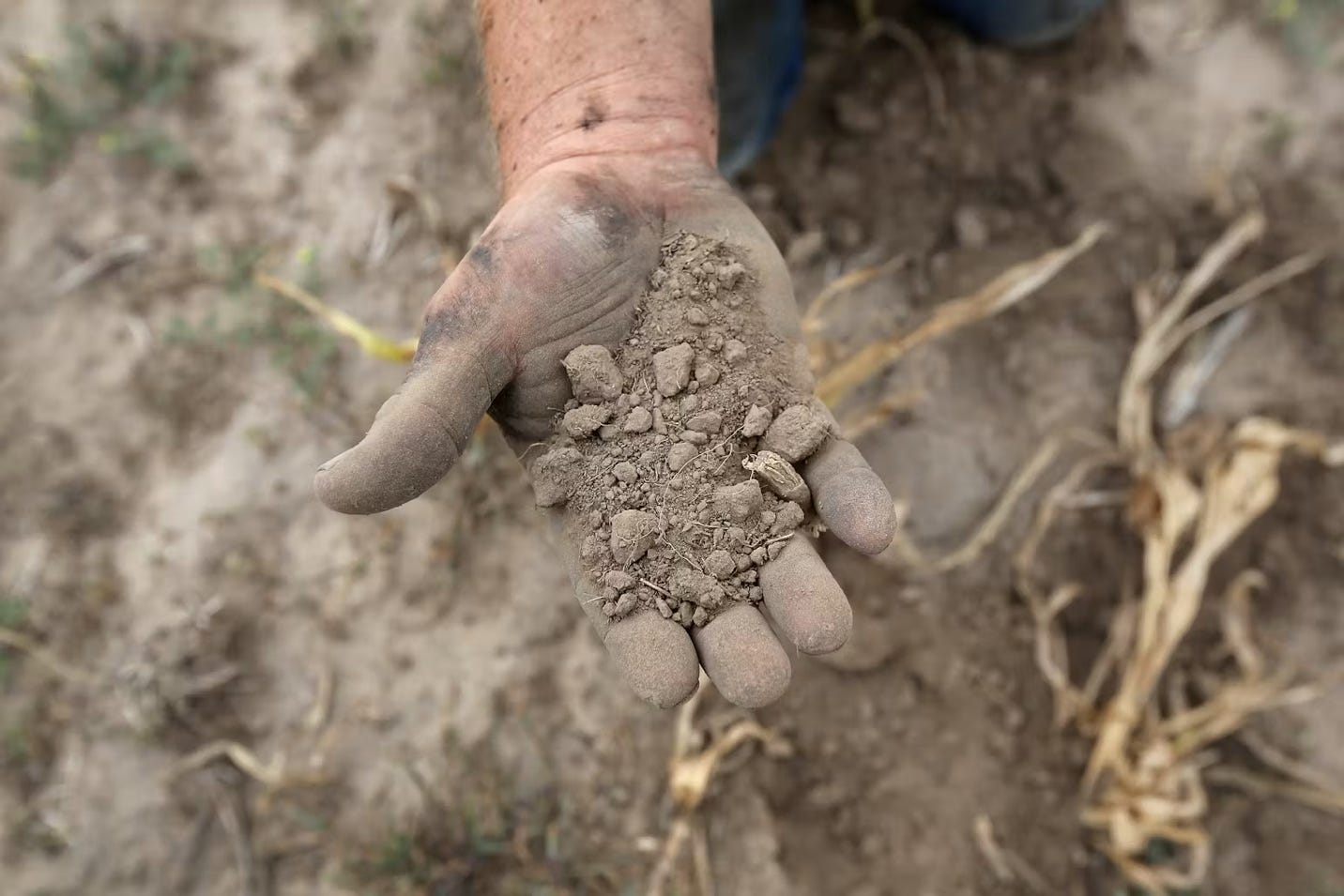
A flash drought in 2012 dried out soil, harming crops in Kansas and several other states. John Moore/Getty ImagesThe Crop Hazard That Skips the Forecast
The last time this publication described a climate driver reshaping the world’s food supply, the story was measured in months. In Scorched Harvest, we wrote about an El Niño building in the tropical Pacific on what we called a twelve-month fuse: a slow, hemisphere-spanning reorganization of where rain falls, its worst harvest failures a year out. Extreme heat is the opposite kind of threat. It gives no fuse, no warning at all.
2024 was the hottest year in the instrumental record, the first full calendar year more than 1.5°C above the pre-industrial baseline, and the capstone of the hottest ten-year stretch ever measured in the history of humankind.1 2025 came in second or third (depending on how temperatures around the world are measured), cooler than 2024 only in the sense that one burning furnace runs slightly cooler than another. The rolling three-year average has now crossed 1.5°C for the first time, and the heat waves that swept Europe, Asia, and North America were, by the reckoning of the scientists who study them, the deadliest weather events of the year and, in several cases, roughly ten times more likely than they would have been only a decade ago.2 A single European summer put land temperatures past 46°C on the Iberian Peninsula and is estimated to have killed on the order of sixteen thousand people.3
The temptation will be to file this under weather. File it instead under food, and under the speed at which that whole crops can now be lost.
Drought creeps. Floods arrive and recede. An El Niño telegraphs its intentions half a year in advance. Heat is the driver that collapses the warning window to nothing, and just as importantly, it does its damage not at one stage of food production but at every stage at once: in germination, in flowering, in the field as it grows, in the barn, in the soil, in the river, and, on a lag of a single growing season, in prices of the food on your grocer’s shelf.
“A drought you can see coming for months. A heat wave you can see coming only for days. By the time you can feel it, the pollen is already dead, the milk has already stopped, and the forecast of food production for the season has already dropped precipitously.”
The Season That Fails Before It Begins
Every impact to grains that follows, begins with a seed. Heat can reach the crop before the crop even exists. A seed is a living thing running on a slow clock, and the warmth of the new season winds that clock forward toward its birth and growth. The relationship is regular enough that seed scientists have reduced it to a “rule of thumb” nearly a lifetime ago: Within ordinary limits, a seed’s viable life is cut roughly in half for every one per cent rise in its moisture content and then halved for every ten degrees Fahrenheit of storage heat above normal.4 The seed held over for next season’s planting does not wait patiently in a warm storeroom. When exposed to high heat before it is planted, the seed ages in fast-forward, its reserves burning down through accelerated respiration and the oxidation of its own oils, until, when it finally goes into the ground, there may be too little of it left for it to wake. It is the same ten-degree arithmetic that will later govern the grain in the storehouse (Figure 5): heat halves the usable life of the seed at the start of the season and then dictates how long grains can be stored at the end of the harvest.
“A seed kept too warm is a seed already spending itself and reducing its viability. By planting time, if too much of it has already been used up a seed may not be able to bring forth a live plant.”
If seeds have been exposed to too much moisture or too high a temperature, the loss shows in the field as thin growth and patchy gaps that a farmer must either replant, at cost and delay, or simply accept as a smaller crop. This loss occurs due to excessive heat even before the first leaf has unrolled. The seed’s ordeal is not confined to the storage bin. Too much heat during the weeks that a seed ripens in the Fall on the mother plant, can leave it weak and short-lived even before it is ever gathered as seed. Drying the seeds after they are harvested at too high a temperature does further, invisible harm. The next risk is that if there is too much heat in the Spring at the time of germination, germination itself can falter in soil that is too hot or too dry, precisely the ground conditions that a heat wave creates.5
For a commercial grower, heat impact to seed production through germination is merely a cost and an aggravation, absorbed in part by paying a higher price for a certified seed bought fresh each year. For the many millions of smallholders who save their own seeds and keep them in whatever warmth the season provides, with no cold room and no dehumidifier, the seeds are at risk. The hotter the year, the less of their saved seeds survive to plant the next season. This means that a punishing season leads to a smaller harvest and also reduces the viability of the very seed needed to be used to begin the recovery the next year. Heat, in other words, does not wait for a crop to grow before it begins subtracting from it. It is already at work in the seed bag, and the season can be diminished before the seeds are ever sown.
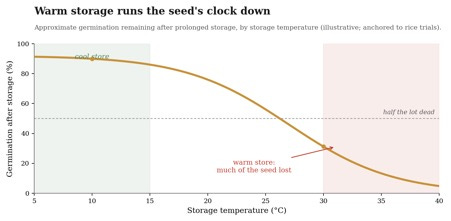
Figure 1. Warm storage runs the seed’s clock down. Germination remaining after prolonged storage falls sharply as storage temperature rises, so seed held over in a hot storage container loses much of its viability before it is ever planted. The same ~10°F rule that governs the grain in the bin (Figure 5) applies to how many seeds will be viable. The curve is illustrative, anchored to reported rice-storage trials.
Every Agricultural Crop Has a Fertilization Number at Risk in a Heat Dome
Start with the grains, because the grains are the least forgiving part of our food system. Every staple cereal has a temperature above which its reproduction simply fails, and those numbers are lower, and closer to being exceeded, than most people who eat the grain in a bowl of cereal, in bread, in pasta, in a rice bowl or on a cob of corn will ever guess. We truly were in a “Goldilocks” climate before we started burning fossil fuels and emitting CO2 into the atmosphere.
For the three crops that feed most of humanity, agronomists have measured the critical thresholds for seed set at flowering with unsettling precision: roughly 37.2°C for rice, 37.9°C for maize and just 27.3°C for wheat.6 When agronomists talk about “seed set at flowering,” they are specifically looking at the critical pollination window when the crop blooms. During this short phase, if temperature thresholds are exceeded, the extreme heat damages the flower’s delicate reproductive organs rendering pollen sterile or preventing fertilization.
Read the wheat number in that figure again. Wheat, the crop the temperate world treats as its dependable staple, begins to lose fertility at a temperature that a spring afternoon now routinely surpasses in Kansas, Punjab, or the Australian wheat belt. Rice yields begin sliding once the season sits above about 33°C.6
What happens to crop production above those set temperatures is not a gentle taper. Flowering is the crop’s single most heat-sensitive hours or days, and heat sabotages fertilization mechanically: it dries and closes the flower, it kills or sterilizes the pollen, it arrests the pollen tube before it can reach the ovule. In maize, the most heat-vulnerable of the three, only a few hot days landing precisely when pollen is going down the silk to the kernels can stall pollen-tube growth and abort kernels wholesale, so that an ear which looked healthy in July fills only halfway by September.7 Almost everyone has peeled the husks off an ear of corn only to find many kernels have not filled out. The cruelty of it is the timing: a crop can be perfectly watered, perfectly fertilized, and still be rendered barren by a two-day heat spike that happens to coincide with the wrong week of the life of the wheat, rice or corn plant. The grain is not lost to scarcity of anything. It is solely lost to a thermometer reading above its critical threshold.
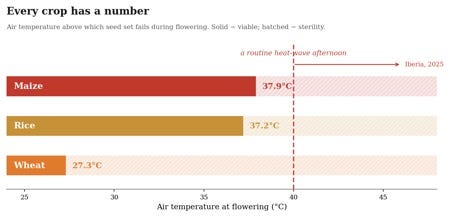
Figure 2. Every crop has a number. The air temperature at which seed set fails during flowering (27.3°C for wheat, 37.2°C for rice, 37.9°C for maize) set against the 40°C afternoons a modern heat wave now clears routinely. Solid bars mark viable temperature; hatched zones, sterility. Thresholds from the reproductive-stage heat-tolerance literature.
Interfering with reproduction is not the only way heat causes dramatic crop loss. The heat wave does not need to come during the fertilization period to steal the vitality of the grains. Heat also cuts into crop yield in three slower ways that are just as devastating and just as predictable.
1) The first is haste. Grain fills the corn, rice and wheat kernels during a fixed window between flowering and maturity, and a plant that is exposed to high temperatures that speeds up its growth processes is a plant that matures too fast: high temperatures accelerate development, shorten that grain-fill window, and rush the crop to a premature, lightweight maturity. Exposed to excess heat, the plant checks every growth hallmark on the calendar but still delivers less, because it spent fewer days pouring starch into each kernel. A field that looks like it ripened early did not ripen. It surrendered.
2) The second is thirst, not the crops being thirsty, but the atmosphere and soil’s thirst. Every degree of additional heat widens the vapor-pressure deficit, the gap between how much moisture the air can hold and how much it actually does hold, and that gap is the engine that pulls water out of soil and the plants’ leaves. This is why a heat wave can hollow out a harvest even where the rain gauge reads normal. The rain fell; but the heat simply took back the rain before the roots could use it, evaporating soil moisture and forcing the plant to close its pores and stop growing to keep from desiccating. Rainfall near average is no defense against an atmosphere that is poised to evaporate soil moisture faster than the rain can fall.
3) The third is the water demand that no one can create out of thin air. Extreme heat drives irrigation demand to its annual peak at the exact moment water is already being drawn down from the reservoirs, aquifers, rivers, and snowpack that irrigation depends on. Demand spikes hit as supply falls, and the two curves cross at the worst possible time which causes the farmer with a well or a pump to discover that due to the excess heat, the season now asks for more water than the snowfall, landscape and aquifer have to give.
The preview to the damage extreme heat can cause is already on the record. Europe’s farm sector has been losing an estimated €28 billion a year to extreme weather, only a fraction of it insured, and the summer of 2025 alone extreme heat reportedly damaged a large share of France’s corn crop, took roughly half of some regions’ carrots, and killed poultry by the flock.8 9
The record has a human face. In Punjab, Gurjinder Singh watched the March heat of 2022 rush his wheat to a premature, hollow ripeness; his land, which normally gives 23 to 25 quintals an acre, yielded 14 to 15, what he called “a substantial 40 percent loss.”10
The Flash Droughts That Destroy a Crop in a Fortnight
There is now a name for the fast version of what the last section described, and it belongs almost entirely to the vocabulary of this century. Scientists call it a “flash drought.” This is something different from the slow, seasonal deficit that creeps across a landscape over years. A flash drought is a drought that ignites and matures in the space of a few weeks, when a run of extreme heat, wind, and cloudless sun drives the atmosphere’s thirst so high that it pulls moisture from the soil faster than normal rain can replace it. The term only was coined in 2002, and for a decade it sat as a specialist’s curiosity; monitoring it now means watching not the rain gauge but the rate at which the air is drying, a jump of half again in evaporative demand over two weeks is enough to declare one.11
The fast droughts appear to be winning and being the prominent kind of drought. The first global study to settle the question, published in Science in 2023, found that over the past sixty-four years droughts have begun to intensify measurably faster across nearly three-quarters of the world’s land regions, with a clear statistical shift from the slow-onset kind of drought toward the flash kind, a transition the authors trace directly to human-caused warming, through the very amplification of evaporation and rainfall deficits that a hotter atmosphere produces. The slowest of the old climate disasters is learning to sprint. The acceleration is sharpest over Europe, northern and eastern Asia, the Sahel, and the western coast of South America, and it is projected to spread across most of the planet’s land if warming continues.12 The old kind of drought is still happening as well.
“A slow drought is a thing you watch approach for a season. A flash drought is a thing you discover has already happened in a matter of weeks.”
The bill for a drought that moves this fast is steep, precisely because speed removes the time in which anyone might have adapted. The 2012 event that first seized the country’s attention carved more than thirty billion dollars from the American economy in a single summer; a 2017 flash drought across the Dakotas and Montana took an estimated $2.6 billion from agriculture alone, and the frequency of flash droughts is set to climb. On the high-emissions path, the annual risk of flash drought on North American cropland is projected to rise from roughly a third today to about half by the end of the century, and the increases are projected to be higher still in Europe.13
These are not projections waiting on the future; the events are already arriving in series. In June 2023 a flash drought spread across the U.S. Midwest until it covered close to two-thirds of the nation’s corn, catching the crop just as it entered pollination; by that October the Mississippi River had fallen to record-low stages, halting barge traffic and drawing saltwater upstream into the drinking water of southern Louisiana. That same autumn a second flash drought seized the Southeast, wilting newly planted wheat, rye, and hay and forcing so many ranchers onto bought feed that the USDA paid its largest livestock-forage disaster relief on record, concentrated in Mississippi, Tennessee, and Alabama. The following summer heat settled over the mid-Atlantic, the rain stopped, and corn from the Carolinas to Pennsylvania shriveled in a matter of weeks.14
Each of these droughts matured too quickly for the farmers to do anything to prepare, which is the whole of the danger. The speed and regional impacts of these droughts are the reason flash droughts belong at the center of this account rather than its margins. It is heat’s signature written into the water cycle itself: the same argument as every section before it, arriving from a different direction. The hazard that once granted a season’s warning now grants only a fortnight to prepare.
Behind the numbers are the people who watched it happen. Greg Lee, a North Dakota farmer who had worked the same ground for forty years, lived through that 2017 Northern Plains flash drought; asked what it did to his fields, he put it in one flat sentence: “The crops just didn’t come out of the ground.”15
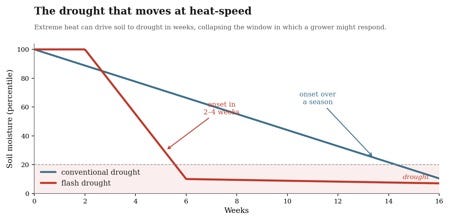
Figure 3. The drought that moves at heat-speed. A conventional drought lowers soil moisture to drought levels over a season or more; a flash drought, driven by extreme heat and evaporative demand, can do it in two to four weeks, collapsing the window in which a farmer might respond. The curves are a schematic of the two onset regimes; one gives no chance of survival.
Animals Cannot Sweat Off Extreme Heat When It Comes
Then there is what happens in the barn, where heat is a matter of animals in distress.
A dairy cow is a walking furnace: a high-producing animal generates enormous metabolic heat, and unlike a human, a cow sweats at only about a tenth the rate, far too little to shed the heat it makes. Cows begin to suffer heat stress at temperatures that feel merely warm to the people milking them. The cows that produce the greatest amount of milk can begin to experience reduced milk production if temperatures in the barn reach even the mid-60s Fahrenheit (17-19 degrees Celsius). As the combined heat-and-humidity load climbs, cows will eat less, stand more, and give less milk. Mild heat stress alone can cut milk by a couple of pounds per cow per day; a hard summer with weeks of high heat can pull daily yields down by double digits.16 17 If the heat-humidity index in the barn is raised past the high 80s Fahrenheit for even several hours, with no cool night for the cows to recover in, vulnerable milking cows do not merely produce less, they die, in the barn, in the feedlot and in the pasture, too.18
The losses are not hypothetical and not small. Heat stress already costs U.S. livestock producers on the order of $2.9 billion a year in today’s dollars, the majority of the losses borne by the dairy industry.17 A heat wave, in other words, does not wait for the harvest to translate itself into less food, it takes the milk that afternoon and it takes the beef of the cow later that week if the high temperatures hold. The heat wave that enveloped northern India in 2022 reportedly cut milk output by as much as 15 percent at the same time it reduced wheat yields by anywhere from a tenth to a third across several Indian states. A single excess heat event depletes the food system at both ends at once.8The same arithmetic runs in American barns. In Fremont, Wisconsin, Jacob Hoewisch, who milks a fifth-generation herd, loses three to ten pounds of milk from each cow on the hottest days, and watches the heat reach past the milk to the animal itself: a cow whose “body overheated for too long of a period”, he says, can lose the calf she is carrying.19
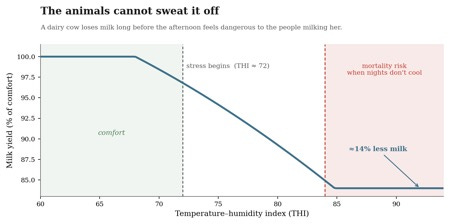
Figure 4. The animals cannot sweat it off. Milk yield falls as the temperature - humidity index climbs, well before the barn feels dangerous to the people in it, and above roughly THI 84, with no cool night to recover in, vulnerable cattle begin to die. The curve is illustrative of the measured response; anchor values are drawn from dairy-science field studies.
The barn is not only a dairy barn. Birds have no sweat glands at all; they shed heat only by panting, and a fast-growing broiler runs so hot inside that a single bad afternoon can kill it. Chickens, turkeys, and ducks are all exposed, and turkeys, the largest of the three, are among the most heat-fragile birds on any farm; ducks cope only where they can reach the water, they use to cool themselves. When a heat wave swept France in the summer of 2026, poultry sheds turned into ovens and birds died by the million, with turkeys taking the heaviest toll. It was not the first time. A comparable heat wave in 2003 killed an estimated four to five million French chickens and turkeys, about two percent of the national flock.20 Sheep and goats aren’t much better off, because they cool by panting instead of sweating, and heat and drought wipe out both their grazing pastures and the lamb and kid crop that herding families in the Global South live on. Because chicken is now the most-eaten meat on Earth, a bird engineered to fatten fast and left without any way to sweat sits close to the center of the food supply, not at its edge.
The Harvest Lost After the Harvest
Every section so far has followed heat into the field and the barn and then stopped at the moment of harvest, as though a crop once cut was a crop secured. It is not. Heat keeps working on food after it leaves the ground, and the losses it inflicts in the bin, the barn, and the cold chain are large, accelerating, and almost entirely absent from the public conversation about climate and hunger.
Begin in the grain bin, where a harvest is supposed to be safe. Stored grain is not inert; it breathes, and warm, damp grain breathes hard, generating its own heat and moisture until pockets of it form “hot spots” that bloom with mold, draw insects, and cake into spoiled, unsellable crust. The governing rule is unforgiving: for every roughly ten degrees Fahrenheit that grain temperature rises, the safe storage time is cut about in half.21 It is the very rule that governs the viability of the seed at the other end of the season, too (Figure 1). Insects that lie dormant in cool grain breed freely between 70 and 90°F, precisely the range a warming climate now delivers for much of the year. The mold that follows does not merely reduce weight; it strips nutritional value and, worse, can leave behind mycotoxins, and mycotoxins, once formed, are heat-stable, surviving the milling and cooking that kill the fungus that made them.21
The most dangerous of those toxins is now migrating with the heat. Aflatoxin, the most acutely toxic and most tightly regulated of the mycotoxins, and a known liver carcinogen, is made by a fungus that flourishes on heat- and drought-stressed crops in the field and on warm, humid grain in storage. For most of history it was a problem of the tropics and the American South. That is changing: a landmark 2016 study projected that just two degrees of warming, a level now expected between roughly 2030 and 2050 rather than in some distant future, would make aflatoxin a genuine food-safety problem in European maize, driving its contamination index up more than ninety per cent and pushing its range northward into countries that had never had to reckon with it.22 The projection is now being met by observation. Aflatoxin-producing fungi, once rare in temperate Europe, are established across the south and center of the European continent; and a 2026 analysis of more than seventeen thousand samples in China found contamination measurably higher than a decade earlier, with temperature alone explaining nearly half of the increase.22
The barn tells the same story in a different crop. Hay baled even slightly too wet when baled or stored is a constant hazard when heat and humidity compress the drying window, the hay begins within days to mold and ferment, its sugars and proteins are consumed by microbes and locked, through the browning of the Maillard reaction, into forms livestock cannot digest. A bale of hay can shed much of its feed value while still smelling sweet. Push the internal temperature past about 170°F, as dense wet bales can, and the same microbial heat that spoils the forage causes spontaneous combustion and sets the barn on fire.23 Rice, the staple of half the planet, most of it warehoused in the hottest, most humid corners of the world, deteriorates faster the warmer it is held, turning rancid, yellowing, shedding milling yield and cooking quality, and, above about sixteen per cent moisture, growing the very molds that make aflatoxin.24
Then there is everything that must stay cold. Roughly a third of all the food the world produces is already lost or wasted, and about a seventh of it has gone bad before it ever reaches a retailer and much of that for want of refrigeration that a hotter climate makes necessary.25 Meat, dairy, fish, and fresh produce spoil in hours, not weeks, when a heat wave overwhelms a cold chain, or when the refrigeration or the power that runs it fails for any reason. Without refrigeration, warmth speeds the bacteria that turn spoiled food dangerous and is a driver behind hundreds of thousands of deaths from foodborne illness each year.
The newest evidence closes the loop, identifying the rest of the crop losses caused by climate-driven heat. A 2026 study found that heat stress raises the share of the crop lost at the moment of harvest itself, a direct climate channel into food loss that had simply gone unmeasured.25 It was the first study to show, with data, that high temperatures sharply increase food loss during harvest, finding that heat-induced losses are three to four times greater in manual than in mechanical harvesting. This means smallholder farms across the Global South are at greatest risk of crop spoilage during a hot harvest.
None of this shows up in a yield statistic. A crop can be grown, survive the flowering heat and the flash drought and the exhausted river, be cut and counted as a good harvest and still be halved while it is being transported to market and sold to people who need food, by the same warmth that menaced the crop in the field. It is the last stage heat attacks, and the most invisible, and it arrives at the same counter, in the same currency, as all the rest of the attacks heat mounts on food production around the world.
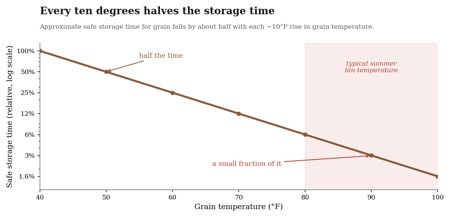
Figure 5. Every ten degrees halves the storage time. Grain in storage is not inert; it self-heats, and the time it can be held safely falls by roughly half for each ~10°F rise in grain temperature, so a hot summer bin turns a season’s reserve toward spoilage far faster than a cool one; this is the same clock that governs seed viability at planting (Figure 1). The curve is a schematic of that rule of thumb.
Why Heat is Different Than Other Climate Shocks
Put the pieces together and the argument writes itself. Heat is not one hazard on a list of climate hazards. It is the master variable, the climate driver that attacks the field, the soil, the water, and the animals over wide areas simultaneously, and does it faster than any warning system was built to detect and sound the alarm.
Consider what separates heat from every other climate shock this 4Hunger.org tracks. The fertilizer crisis we documented in Fertilizer Famine moves on a one-season lag. The American megadrought in Parched Ground took many years to form. The El Niño in Scorched Harvest announces itself half a year ahead with the worst impacts predicted a year in advance. Every one of those is a slow emergency you can, in principle, prepare for.
Heat is the fastest climate impact. The pollen in wheat, corn and rice can die within hours if heat hits during the days when the flower is open. The production of milk drops in cows the same week the barn overheats. The soil gives up its moisture across a single scorching fortnight. There is no season of grace between the forecast of heat domes and the loss, because for a crop at flowering, or at other stages of growth, the forecast of extreme heat can become an unstoppable loss.
That speed is precisely why heat has become the biggest climate driver of agricultural loss right now. In a food system already stripped of its buffers, with reserves drawn down, fertilizer in short supply, and with the American food production shock absorber running on empty, the hazard that can erase a harvest in an afternoon is the one the world is least equipped to catch. Heat is the climate impact that is arriving most often, on a planet that has now made 40°C afternoons a routine feature of the growing season on four continents.
“Every other threat to the harvest gives you time to act. Heat only gives you a chance if you have already acted. That is the whole of the difference, and it is the difference between a hungry year prevented and a hungry year explained only afterward.”
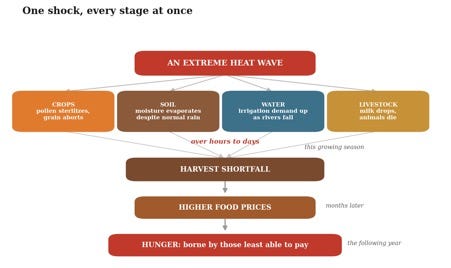
Figure 6. One shock, every stage at once. Unlike a drought or an El Niño, extreme heat strikes crops, soil, water, and livestock simultaneously and within days and then travels downstream to the harvest that season, to prices in the months after, and, on a lag of roughly a year, to hunger.
What It Means at the Checkout Line
No American eater should mistake a cool morning for immunity from the consequences of a heat wave. The price of food in an American grocery store is set in a global market, and when wheat bakes in Australia, when heat sterilizes rice across Asia, when Europe’s corn and dairy come in short, U.S. commodity prices rise regardless of the weather in Kansas. This is not because American grain is scarce, but because American grain sells into world prices. The damage from a heat dome does not travel at the speed of a headline; it moves at the speed of a growing season, and it moves, reliably and predictably, to the consumer’s receipt everywhere in the world.
The people that the price increases from heat damage moves toward, are the ones least able to pay. Roughly one in four American adults now lives in a food-insecure household, with the lowest-income fifth of households spending a third of their income on food.26 Congress has made cuts to the very safety net that stands between price volatility and hunger for tens of millions of Americans. Every percentage point of heat-driven food inflation that lands in 2027 will land on families who did little to warm the planet and can least afford the rising prices.
Gurjinder Singh, the Punjab wheat farmer, watching his crop shrivel in a March that arrived with temperatures not normally seen until May; Jacob Hoewisch, the Wisconsin dairyman, running fans on electricity he cannot afford over cows that have all but stopped giving milk; the shopper in Ohio staring at the price of ground beef at $6.82 a pound, none of them chose this. But all of them are downstream of the same warming air that is traveling around the world. All of them will pay for the excess heat in the currency the poor always pay in: skipped meals, skipped medicine, sold assets, mounting debt; the quiet emergency that hunger always causes.
This is not a forecast. As of the summer of this writing, excess heat has already carved into the 2026 harvest across the Northern Hemisphere, Western and Central Europe’s maize, the United States’ spring wheat and barley, China’s corn and rice, while a developing El Niño pushes heat and drought into the crops of South and Southeast Asia and Australia (Figure 7).27 The losses are still regional rather than systemic, cushioned by a record 2025 harvest and full reserves; but they are exactly the kind that travel, one growing season later, to the prices on the supermarket shelf.
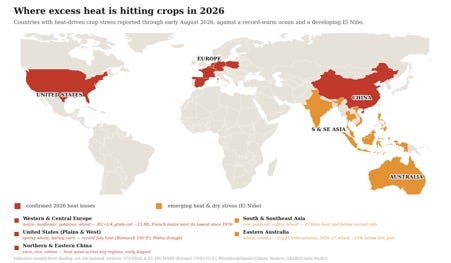
Figure 7. Where excess heat is hitting crops in 2026. Countries shaded where heat-driven crop stress was reported through early August: confirmed losses (red) across Western and Central Europe, the United States, and China; emerging El Niño heat-and-dry stress (orange) across South and Southeast Asia and Australia. Country-level and indicative, not sub-national.
How Can the Impacts of Extreme Heat Be Mediated?
Heat’s speed is its cruelest trait, but it is also, perversely, its weakness: because heat maps onto the calendar of the crops it threatens, we know in advance which weeks of which growing seasons carry the most risk. What is required is not incremental adjustment. It is deliberate action on four fronts, taken before the season that fails, not after. This means taking action to protect the poor and working classes around the world at a time when all of the major food donors are cutting back both internationally and at home. This will make hundreds of millions of people suffer if it is not reversed.
First, fund heat adaptation and anticipatory relief before the harvest, not after it. Cash, drought- and heat-tolerant seed, and pre-positioned food released on forecast triggers rather than on famine declarations cost a fraction of late-stage emergency response and save lives that late response cannot. Those trigger systems already exist. However, they are being defunded at exactly the moment the heat is intensifying, and that reversal is a choice this budget cycle can still unmake.
Second, protect and expand SNAP and other domestic nutrition programs. The food-price wave from a hot growing season reaches American shelves the following year, stacked on inflation, missing fertilizer and impact of tariffs already in the pipeline. Cutting the primary safety net standing between people dealing with price volatility and hunger, in the same eighteen months that volatility is set to spike, is not fiscal discipline; it is a decision to hand the bill for a warming atmosphere to the households least able to pay it. It is a war on the poor and working classes.
Third, pass a 2026 Farm Bill built for heat volatility. American farmers will plant the crop the world will need facing record input costs and a climate that now delivers a season’s worth of damage in a single week. Crop insurance designed for gradual bad luck, and disaster programs that pay two years late, are not up to responding to a hazard that strikes in an afternoon. Build the farmers safety net for extreme heat explicitly, and build it to reward the diversified, heat-resilient farms most able to survive it - not only the monocrops which are most vulnerable to heat’s disasters.
Fourth, protect the people and the water that grow the food. The same heat that sterilizes the pollen makes the field lethal to the workers standing in it. Enforceable farmworker heat standards are food-security policy, not merely labor policy. The water that irrigation leans on hardest in a heat wave is the water heat is draining fastest, which makes serious investment in water storage, efficiency, and shared drought planning a frontline defense of America’s breadbasket and our harvests, not an afterthought. Rivers, lakes, dams and aquifers that are being used for agriculture have to be protected and their use sustainably divided so that they do not go dry and create humanitarian disasters.
The Emergency That Arrives in an Afternoon
The great climate disasters of the past announced themselves slowly enough that the world could at least pretend to be surprised. Heat has taken away that excuse. We know the thresholds now, crop by crop and degree by degree; we know which weeks of the calendar carry the greatest danger; we can watch the temperature climb toward the number that ends a season in real time, in open data, free to anyone who cares to look.
That knowledge is either a warning or an indictment, and which one it becomes will be decided by whether anyone acts on it. The heating air has delivered its message with a precision no disaster in history has matched. Whether the next hot summer becomes a harvest quietly protected or hunger and famines loudly regretted; belongs, as it always does, to those in power and to the pressure the rest of us are willing to put on them before the thermometer rises again, not after.
So put pressure on your elected officials now, while the window is still open.
Call your elected officials, state and federal, today, tomorrow and the days after that; and demand that the food safety net be restored, the Farm Bill be passed with measures to protect against the impacts of climate change for farmers and for the poor and working classes in America, and the domestic and international food aid budgets be built for the fastest-moving threat that the food system faces before the next heat wave writes another season’s hunger in a single afternoon, in your state, in this country, and across the world.
Thanks Sean, I will. There are solutions, but diversifying and scaling up will be difficult as will getting finance and distribution for the Global South and small farmers in the Global North as well.
This post should be the final wake-up call for climate deniers:
"Every staple cereal has a temperature above which its reproduction simply fails, and those numbers are lower, and closer to being exceeded, than most people who eat the grain in a bowl of cereal, in bread, in pasta, in a rice bowl or on a cob of corn will ever guess. We truly were in a “Goldilocks” climate before we started burning fossil fuels and emitting CO2 into the atmosphere."
I will cross-post.