

Part 1 of 2: Why the money for this El Niño came late, and why it always does
“Donors were warned months ahead. They have paid a fifth of the bill.”
By Mark W. Roberts | November 3, 2026
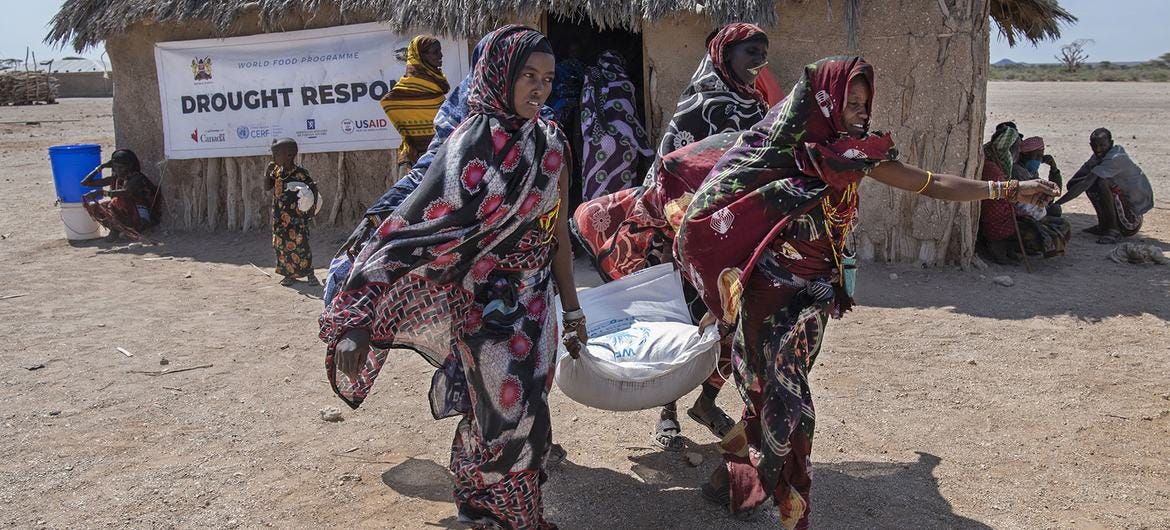
A WFP official urges continued support for millions suffering in drought-stricken East Africa and the Horn of Africa. © WFP Women carry food from a WFP distribution point in Marsabit County, northern Kenya.
In Kotido District, in northeastern Uganda, the rains stopped in late May and never came back. By October, a five-month drought had destroyed about 98 percent of the crops across the Karamoja region, and local officials had verified starvation had begun to occur. On October 20, a delegation from the U.S. Mission, the World Food Programme and the Food and Agriculture Organization went to see conditions on the ground.¹ What they found, failed crops and spreading hunger, had been forecast months earlier.
The world knew months ahead that this El Niño was coming. Forecasters knew where the rain would fail, where the floods would hit and when the planting deadlines would fall, as I described in “Hunger Foretold.” This super El Niño’s crop losses are arriving in a world where 645 million people already faced chronic hunger in 2025 and 2.1 billion, about one in four people, faced moderate or severe food insecurity.² The World Food Programme estimates that this El Niño could push almost 49 million more people into acute hunger by the end of 2027, raising the total in the 45 countries it studied to 274 million.³ Famine is now a real risk. The UN-backed hunger monitor has warned that famine risk is growing in Sudan’s Darfur and Kordofan,⁴ and FEWS NET sees a risk of famine in southern Somalia if the floods are severe.
The worst of the hunger is still ahead, in 2027, long after the rains fail.⁵ Against that, the UN’s food agencies asked in June for just $202 million to act before the damage, and by late September only about a fifth of it had arrived.⁶ ⁷ Hunger is already bad. It will get far worse, and the governments with the means to prevent it have barely moved. The shortfall is built into the way humanitarian money is raised. A treaty solved this problem once before. Climate negotiators meet next week at the UN climate summit, COP31, in Antalya, Türkiye. They could borrow that design and act before crops fail and hunger takes hold.
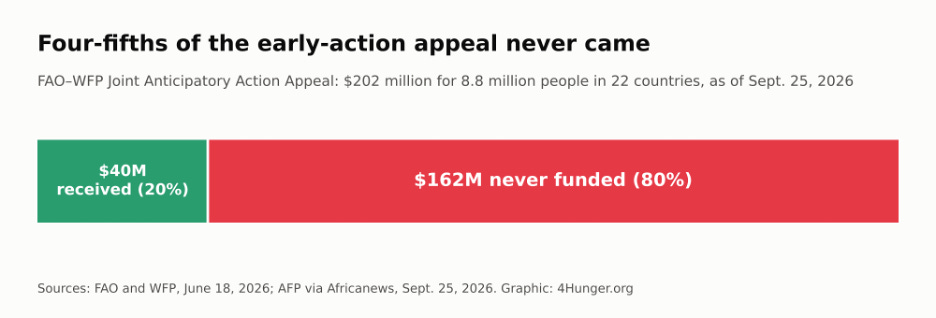
The FAO–WFP early-action appeal had received about a fifth of its $202 million by late September.
On June 18, the Food and Agriculture Organization of the United Nations (FAO) and the World Food Programme (WFP) launched their first joint appeal for action ahead of this super El Niño. It asked for $202 million to protect 8.8 million people in 22 countries. By September 25, it had received about $40 million, roughly a fifth of what was needed.⁶ ⁷ On October 22, Oxfam counted only about $450 million available worldwide to prepare for and respond to this El Niño. The last comparable event, in 2015-16, prompted a $5 billion appeal, and even then, donors raised only about $2 billion of the $5 billion needed.⁸ On October 21, UN relief chief Tom Fletcher released more than $50 million from the UN’s emergency fund for 11 countries, including Chad, El Salvador, Ethiopia, Somalia and South Sudan. He called the next two weeks “the critical window to act.”⁹ That window closes this week. Any step to protect crops from flood or drought that is not taken after that will come too late.
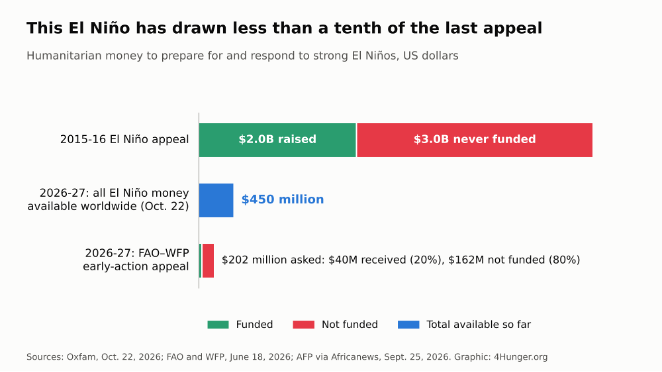
Money available for this El Niño, against the last comparable appeal and the FAO–WFP early-action appeal. Sources: Oxfam, FAO, WFP.
“The current El Niño event could be unprecedented in strength - literally, off the monitoring charts that we have used for the past four decades.” Celeste Saulo, Secretary-General, World Meteorological Organization, October 21, 2026⁹
Honduras shows what happens next. Its anticipatory action plan, backed by $4 million set aside in advance by the UN’s emergency fund, was triggered by the forecast in March and built to protect up to 65,000 people in two departments. By August the government had declared a state of emergency in 75 municipalities. The primera, the spring crop, had already failed almost completely across the Dry Corridor. On September 22, with the postrera, the year’s second planting, failing too, the UN and its humanitarian partners in Honduras launched a $60 million emergency appeal for 538,000 people in 103 municipalities on red alert. The early-action plan did what it was designed to do, but it was designed for a small fraction of the need. Honduras is also one of the 22 countries in the FAO–WFP appeal, which is still about four-fifths unfunded.¹⁰ ⁷
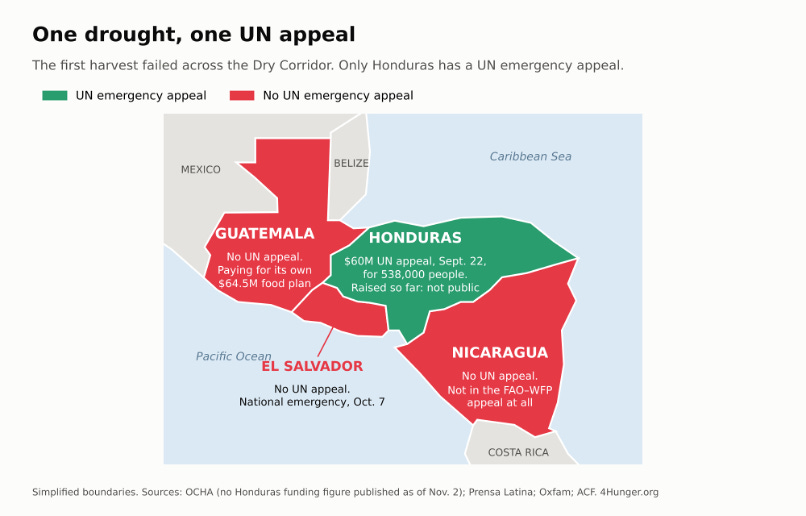
The drought crosses every border in the Dry Corridor, but only Honduras has a UN emergency appeal.
This raises a question nobody has answered. Why have the UN and its humanitarian partners launched an emergency appeal for Honduras alone? The drought does not stop at the border. In the 354 Dry Corridor communities that Oxfam and Action Against Hunger assessed in July and August, nearly every maize-growing household lost this year’s first harvest, with near-total failure in eastern El Salvador and eastern Guatemala as well as southern Honduras. El Salvador declared a nationwide red alert for drought on August 25, and on October 7 declared a national state of emergency.¹¹ ¹² Nicaragua sits in the same corridor and is not among the 22 countries in the FAO–WFP appeal at all. Yet Honduras is still the only country in the corridor with a UN emergency appeal. Guatemala is paying for a $64.5 million food-aid plan of its own.¹² When help depends on each government asking, and on each appeal being written one at a time, the people who go without are the ones whose governments have not yet acted.¹¹
The same arithmetic is playing out wherever the El Niño forecast said it would. During the 2022-23 drought, WFP reached 10 million Somalis with food and helped stave off famine. This time it has the money to reach only 670,000 hungry people.¹³ Somalia’s October-to-December rains are forecast to be above normal, and its disaster agency estimates that 2.5 million to 3.5 million people could experience flooding.¹⁴ In Southern Africa, the UN counts 84 early actions planned across 13 countries at a cost of $111.3 million. About 80 percent of them are unfunded, just as farmers plant their only maize crop of the year.¹⁵ Where the international money has not come, governments are trying to pay for it themselves, as Guatemala is. Papua New Guinea, which declared a National Humanitarian Crisis in October, has approved a 1.65 billion kina (about $370 million) El Niño package.¹⁶ Zimbabwe plans a $500 million cash and grain reserve.¹⁷ The plans exist. The money is what is missing.
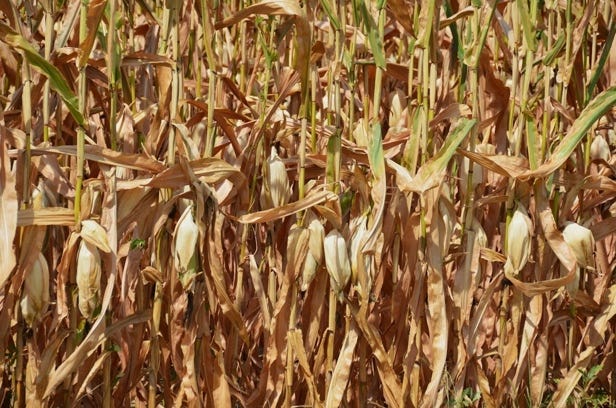
A joint Oxfam and Acción contra el Hambre survey found severe maize damage in more than 36,000 Guatemalan households after a drought that cut rainfall by a third nationally, with Chiquimula and Jalapa farmers saving less than 3 percent of what they planted. Photo: The Fourth Plate
The Harvests Already Lost
Some of the damage is already done. The first harvests of this El Niño have failed or shrunk in Central and South America, Asia and Africa, and the hunger they cause will peak months later, in 2027. FEWS NET expects hunger to be most severe across much of East and West Africa between March and September 2027, and in Southern Africa not until the lean season that begins in November 2027.⁵ The world as a whole is not short of grain. FAO still expects global cereal production to stay close to record levels.¹⁸ The losses fall on families and countries that grow their own food and cannot afford to buy more.
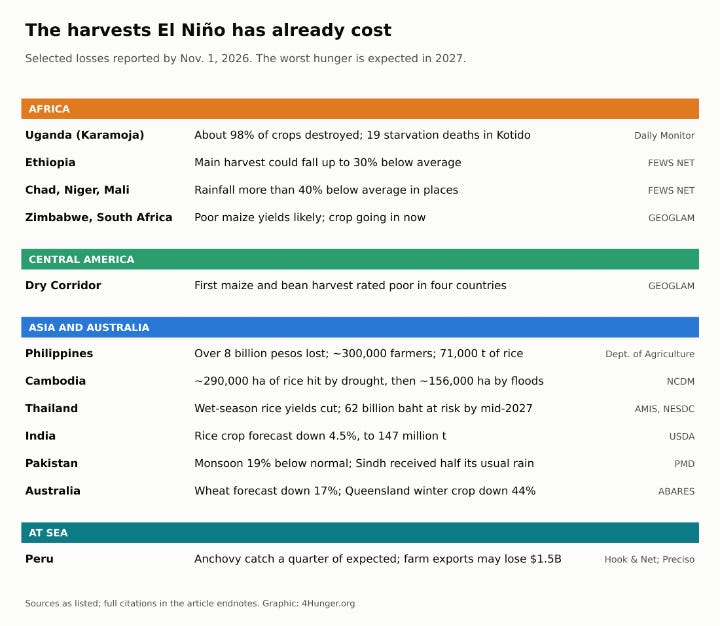
Selected crop losses reported by November 1, 2026.
crop_losses_map_datawrapper.csv
In Africa, the June-to-September rains failed across a broad belt north of the equator. In Uganda’s Karamoja region, the drought described at the top of this article destroyed about 98 percent of crops, worth some 56 billion Ugandan shillings.¹ Ethiopia’s kiremt rains, which grow more than 85 percent of its crops, were among the poorest on record. FEWS NET warns the main harvest could come in as much as 30 percent below average, with Tigray, eastern Amhara, Afar and eastern Oromia hit hardest.¹⁹ Across the Sahel, rainfall fell more than 40 percent below average in parts of Chad, Niger and Mali.⁵ In Sudan, the IPC, the UN-backed hunger monitor, warned on October 12 that famine risk is growing in Darfur and Kordofan as drought compounds the war.⁴ In Somalia, FEWS NET expects river floods to destroy crops, drown livestock and displace families.⁵ In Southern Africa, the maize is only now going into the ground, so the damage has not begun. Even so, the crop-monitoring group GEOGLAM already rates poor yields likely in Zimbabwe and South Africa.²⁰
In Central America, the year’s first maize and bean harvest failed. GEOGLAM rated first-season maize and beans poor in Guatemala, El Salvador, Honduras and Nicaragua, and reports below-average yields across the main seasons of both Central America and East Africa.²⁰ In Honduras, FAO says the drought has cut the second planting as well and expects the country to import more cereal than usual to make up the shortfall.²¹
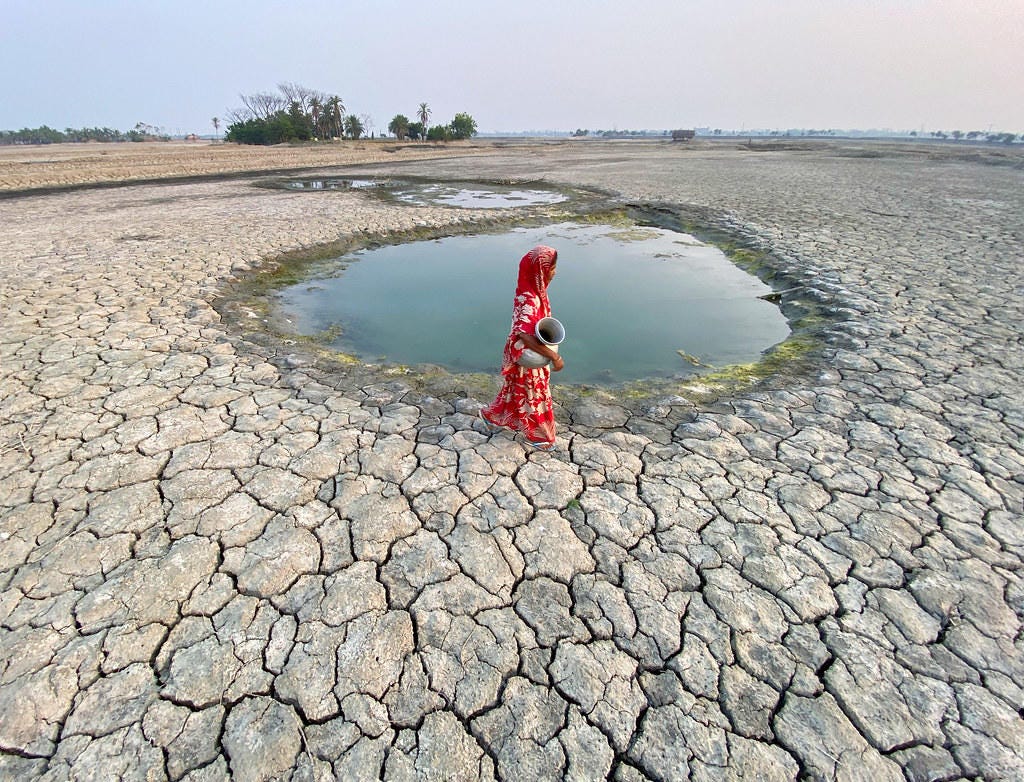
A very strong El Niño is building. Asia and the Pacific cannot afford to wait. Photo credit: UNDP Bangladesh/AB Rashid
In Asia, the losses are mostly in rice. In the Philippines, damage to farms passed 8 billion pesos by October 21 and affected almost 300,000 farmers. Rice alone lost about 71,000 tonnes on 113,000 hectares.²² In Cambodia, drought hit nearly 290,000 hectares of rice in eight provinces by September, and floods then damaged about 156,000 hectares across 10 provinces, the kind of whiplash El Niño can bring.²³ Drought has cut Thailand’s wet-season rice yields, and its national planning agency, citing a bank study, warns El Niño could cost Thai farms 62 billion baht by mid-2027, about two-thirds of it in rice.²⁴ After a weak monsoon, USDA expects India’s rice crop to fall 4.5 percent, to 147 million tonnes.²⁵ Pakistan’s monsoon brought 19 percent less rain than normal, and Sindh, a main rice and cotton province, received half its usual rain.²⁶ Australia’s wheat crop is forecast to fall 17 percent, and Queensland’s winter crop 44 percent.²⁷
The sea is losing too. Off Peru, warm water has driven the anchovy, the world’s largest single-species fishery, out of reach of Peru’s fishing fleet. Landings in the first anchovy fishing season came in at about a quarter of what was expected.²⁸ On land, analysts expect Peru’s 20 leading farm exports to lose about $1.5 billion in value across 2026 and 2027.²⁹
Those are the losses so far, and most of the bill is still to come. The rest of this article is about why the money to prevent the next losses is not coming. Part 2, on Thursday, will look at what a proper response to this super El Niño would take.
The Failure Is Built In
Humanitarian money in its current form is voluntary, is raised one appeal at a time, and is released only after the damage becomes visible. Each of those three features is reasonable on its own. Together they guarantee that money for prevention arrives after people are already hungry.
Voluntary means no government is obliged to pay anything, so every appeal starts from zero and competes with every other crisis on the evening news. Appeal by appeal means there is no standing pot of money waiting for a forecast to cross a threshold. Someone has to write the appeal, circulate it, and wait for pledges. Since money is released only after crops fail and hunger sets in, the system responds to pictures. A failed harvest photographs well. A forecast of coming hunger does not.
That is why a system that can raise billions for a famine struggles to raise $202 million to prevent one. No government sets out to pay several times as much later. FAO and WFP estimate that every dollar spent on anticipatory action can save up to seven in avoided losses and response costs.³⁰ The trouble is that no government has agreed in advance to pay anything at all, and no rule releases the money when the forecast turns red. By the UN’s own count, less than 1 percent of humanitarian funding goes to acting before a disaster.³¹ This year, the traditional donors are not even responding to photographs and reports of major crop losses. The pledges so far are modest. The UK has given £15 million, Norway NOK 30 million (about $3 million) and the Novo Nordisk Foundation $7.75 million. The UN’s emergency fund has added more than $50 million, drawn from money donors gave it in advance. Against the $5 billion appeal for the last comparable El Niño, these sums barely register.
There is sound evidence that proactive aid works. During the 2015-16 El Niño, WFP tried forecast-based support in one Zimbabwe district. Thanks to the early help, food consumption there dipped only 2 percent after the drought, against a 35 percent drop in the neighboring district.¹³ I set out more of that evidence, and what waiting costs, in last week’s article, “The Strongest El Niño Ever Recorded Is Here. Who Goes Hungry Is Still a Choice.”
The timing of this El Niño makes raising money even harder. Official development assistance fell by a record 23 percent in 2025, and humanitarian aid by more than a third. It was the first year on record in which all five of the largest donors cut their humanitarian aid at once. The United States led the way, cutting its aid by 57 percent.³² Voluntary money is the first money cut. Governments are cutting just as the need is rising. Even the money that is given for acting early is hard to track. We could find no public page tracking what the FAO–WFP appeal has received, on the UN’s Financial Tracking Service or anywhere else. The only figure we can find is one an FAO official gave a news agency in September.⁶ ⁷
The largest donor is leaving the table. The United States closed USAID in July 2025, and its share of government funding to the humanitarian system fell from about 40 percent to 23 percent.³³ The U.S. withdrawal from the UN climate convention takes effect on February 27, 2027, three months after Antalya, and the United States sent no delegates to last year’s summit in Belém.³⁴ Whatever is agreed in Antalya will have to be paid for without the help of the United States.
“What the system lacks is an obligation, a pot of money waiting in advance for natural disasters and those fueled by climate change, and a rule that says when to spend it.”
Without money in place and rules for releasing it, hunger that is already bad will get far worse. No government has yet agreed in advance to pay for preventing the crop losses this El Niño is causing. Those three flaws have been fixed before, by a treaty that worked.
That treaty is the Montreal Protocol, the 1987 agreement that saved the ozone layer. I know its design from the inside. For eight years at the Environmental Investigation Agency, I worked to bring HFCs, the potent greenhouse gases that replaced ozone-destroying chemicals in refrigerators and air conditioners, under the Protocol’s controls. In October 2016, in Kigali, Rwanda, its nearly 200 parties agreed to phase them down, a step the UN estimates could avoid up to 0.4°C of warming by 2100.³⁵ That deal was possible because the treaty already had what humanitarian funding lacks. Since 1991, its Multilateral Fund has been paid for by mandatory contributions from developed countries, set on an agreed scale. The fund covers developing countries’ costs of meeting deadlines that everyone knows in advance. It has approved about $4 billion in grants across 144 countries.³⁶ The moment that the final vote was taken filled me with joy because it meant that the Montreal Protocol would not save the ozone layer by making the climate crisis worse.
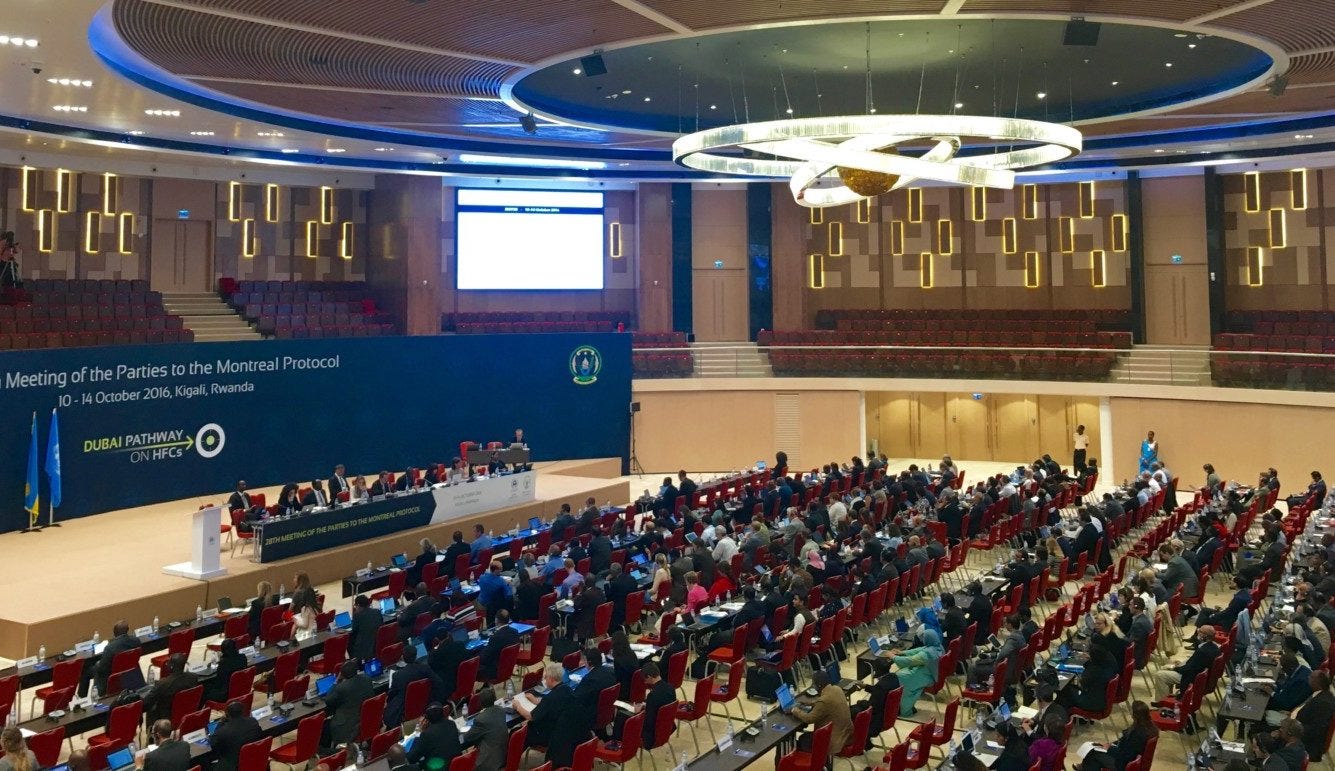
Delegates at the Montreal Protocol meeting in Kigali, Rwanda, October 2016. Photo: IGSD
The fight over money in Antalya has already begun. African negotiators have asked for formal agenda items on tripling adaptation finance and on the Green Climate Fund, setting up a possible clash over the agenda even before the talks open.³⁷ Part 2 will look at how the Montreal Protocol’s fund works. It will also ask what the negotiators who meet in Antalya from November 9 could borrow from it to pay for the damage this super El Niño is doing and for the climate disasters still to come.
What you can do. Call your members of Congress and ask them to restore emergency international food aid and to back money for early action at COP31 in Antalya, Türkiye. The U.S. Capitol switchboard, (202) 224-3121, will connect you to your senators or your representative.
If this piece was useful, please give it a like and restack it so it reaches more readers. Every share puts this crisis in front of people who are not hearing about it anywhere else.
Part 2 arrives Thursday. It looks at how the Montreal Protocol’s fund works and what the negotiators in Antalya could borrow from it. Subscribe free so it comes straight to your inbox, and forward this to anyone who works on climate, food or aid.
It's time to reverse the tax cuts to the wealthy and return funding to America's safety net and international humanitarian aid! Europe has the same problems, but likely different solutions. However, it is clearly time to TAX the RICH!
Stupidly, wealthy nations are broke. The US debt burden is $40 trillion. France is dragging down Europe with nearly $4 trillion in debt. Average people that may have dependably given to organizations like Oxfam in the past are struggling. Of course, the fact that it comes down to citizens to defeat hunger is a dereliction of governance to begin with when there is always money for bombs and war. Feeding people should not be a GoFundMe situation.