

MAY 8, 2026
318M PEOPLE FACING INCREASE IN ACUTE HUNGER BY 2026
5X PROJECTED RISE IN CLIMATE-DRIVEN CRISES SINCE 2020
77% INCREASE IN WHEAT YIELD LOSS FROM HEAT BY 2090
PART ONE
A. Grain of Warning
Merrill Nielsen has been farming in north-central Kansas for fifty years. His great-grandfather established the family’s 2,500-acre operation in 1871, and through every drought, every freeze, every bad year the Plains can offer, the farm has survived. This spring, Nielsen watched his wheat crop fail entirely. A crop insurance adjuster told him his fields would yield, at best, two bushels per acre - against the normal upper-40s to mid-50s. His text to a reporter was four words: “Crop will be terminated.”
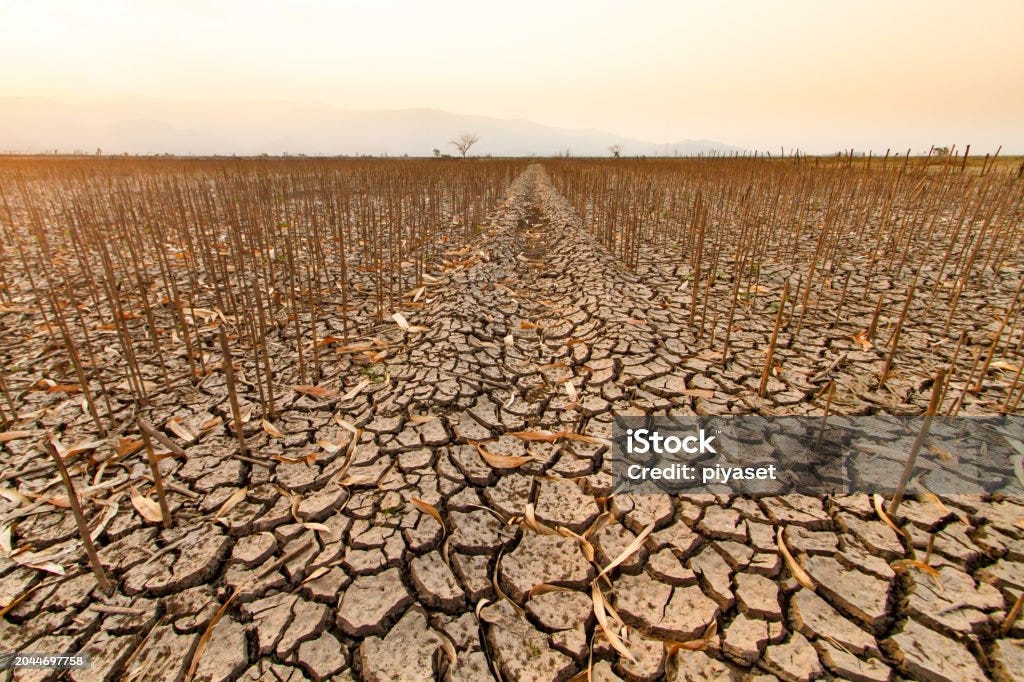
The weather that killed Nielsen’s crop followed a pattern that is becoming horribly familiar across the American heartland. An abnormally warm and dry winter gave way to wild temperature swings — days pushing 70 to 80°F, nights plunging into the teens — during the critical winter-to-spring transition. Nielsen describes his wheat as not knowing “whether or not to have its Bermuda shorts and sunglasses on and bake in the sun… or to have its winter coat on.” It is a farmer’s joke, but it describes something lethal. The volatility destroyed the crop’s ability to regulate itself, and the harvest was lost before summer even arrived.
The Guardian’s May 2026 report from Kansas is not simply a farming story. It is a dispatch from the front line of a collision between two of the defining crises of our era — climate breakdown and hunger. That collision is no longer a future scenario to be modelled and debated. It is happening, season by season, in fields that feed billions of people.
“Heat stress at flowering emerges as a serious threat to global wheat yields under climate change — substantially increasing the vulnerability of wheat.”
CLIMATIC CHANGE, ROTHAMSTED RESEARCH, JANUARY 2026
Nielsen is not alone. Across Kansas and Oklahoma, which had their second-warmest year on record from March 2025 to March 2026, the 2026 winter wheat crop is one of the poorest in recent memory. March temperatures ran 10 to 11°F above normal. USDA crop condition reports rated 44% of Kansas wheat and 49% of Oklahoma wheat in very poor to poor condition. Romulo Lollato, the wheat and forages professor at Kansas State University, estimates state output may come in at 200-220 million bushels. This is far below the 10-year average of 317 million. Gregg Ibendahl, also at Kansas State, puts total US wheat production down 15% from last year. US wheat acreage is on track to be its lowest since 1919.
Shel Winkley, a meteorologist at Climate Central, is direct about the cause. The extreme March heat “would be rare or almost virtually impossible at that time of the year in the central Plains, without an influence of climate change.” This was not a statistical oddity, it was the climate crisis made visible in a Kansas wheat field.
Wheat is the world’s third-largest crop and one of the most politically and nutritionally consequential grains on the planet. Roughly two billion people depend on it as a primary calorie source. Bread, pasta, flatbread, noodles, the foods that anchor diets from Lahore to Lagos, from Kyiv to Kansas City, all trace back to a single amber grain that is, it turns out, uniquely fragile at the moment of reproduction.
Research published in January 2026 by scientists at Rothamsted Research in the UK, using state-of-the-art climate projections and crop models, found that while drought has historically been the dominant threat to wheat at flowering, the balance is shifting. Heat stress losses are projected to rise by 32% by 2050 and by 77% by 2090 under high-emission scenarios. Drought losses, by contrast, are expected to decrease modestly as warming shifts rainfall patterns, but this is cold comfort when heat becomes the new executioner. The cumulative effect is a crop increasingly under siege from both sides.
Ben Palen, a fifth-generation farmer near Lawrence, Kansas, who works 15,000 acres and expects to yield only about 30% of his normal crop, put it plainly: “Climate change is an increasing concern… because you try to plan as best you can with your management decisions, but it was a wild card, when you got that cold for two nights in a row at just exactly the worst time for the wheat.” He has noticed rainfall becoming less consistent, making it ever harder to manage around the changes. Vance Ehmke, farming 11,000 acres in south-west Kansas, saw 90°F temperatures in early January followed by a hard freeze. “We’re so far behind that it’s not even funny,” he said after a late-April rain brought marginal relief.
This is the narrow, agronomic end of a story that widens, as we will see, into questions about geopolitics, poverty, colonial history, and what it means to be hungry in a world that produces, in theory, enough food for everyone.
PART TWO
The Numbers That Should Shame Us
Before examining the mechanisms of climate-driven food insecurity, it is worth sitting for a moment with the scale of what is already happening. The 2026 Global Report on Food Crises was published jointly by the United Nations, the European Union, and dozens of partner agencies, found that 266 million people across 47 countries experienced high levels of acute food insecurity in 2025. Acute food insecurity is an acute, crisis-level hunger, with nearly 3 billion people are unable to afford a healthy diet. That figure represents nearly a quarter of the population assessed and is close to double the share recorded in 2016. Hunger, the report concluded, is no longer a series of short-term emergencies. It has become a structural and consistent problem.
The World Food Programme’s 2026 Global Outlook puts the figure of people facing crisis-level hunger or worse even higher, at 318 million which is double pre-pandemic levels. Two famines were confirmed in 2025: in Gaza and in parts of Sudan. It is the first time in recorded history that famine has been declared in two countries simultaneously. A famine is a widespread scarcity of food[1][2]caused by several possible factors, including, but not limited to: war, climate change caused natural disasters, crop failure, widespread poverty, an economic catastrophe or government policies. This phenomenon is usually accompanied or followed by regional malnutrition, starvation, epidemic, and increased mortality(deaths).
WHAT THE DATA SHOWS
266 million people in 47 countries faced acute food insecurity in 2025, per the 2026 Global Report on Food Crises.
35.5 million children were acutely malnourished in 2025, including nearly 10 million suffering life-threatening severe acute malnutrition.
Climate shocks now affect 87.5 million people across 16 countries, which is up from 15.7 million in just 15 countries in 2020, roughly a five-fold increase in affected population in five years.
Funding for humanitarian food response has fallen to levels last seen nearly a decade ago, even as the crisis deepens.
Conflict remains the single largest driver of these numbers, accounting for roughly 69% of acute hunger. But climate shocks such as droughts, floods, erratic rains, and extreme heat have grown with remarkable speed as a co-driver. According to the 2026 Food Crises report, weather extremes grew from affecting 15.7 million people in 15 countries in 2020 to affecting 87.5 million people in 16 countries by 2025. That is a roughly five-fold increase in the affected population in just five years.
The children bear the heaviest burden. In 2025, 35.5 million children were acutely malnourished across 23 nutrition crisis countries. Nearly 10 million of them were suffering severe acute malnutrition, a condition so extreme that it dramatically raises the risk of death even from otherwise minor childhood illnesses. These are not abstractions. They are children who will not reach their potential height, whose cognitive development will be permanently stunted, who may not survive infancy.
Somalia provides one of the starkest recent illustrations. After four consecutive seasons of failed rains that were a product of climate variability compounded by the La Niña weather pattern, the Somali federal government declared a national drought emergency in November 2025. By early 2026, nearly 5.9 million people were projected to face severe food insecurity, that is almost a quarter of the country’s population.
PART THREE
The Chain from Field to Famine
To understand how a heatwave in France or a drought in the American Midwest becomes hunger in Mogadishu or Kabul, it is necessary to trace the chain of consequence that links climate events to empty plates. That chain has many links, and each one is a point of vulnerability.
The first link is the crop itself. As the Rothamsted Research data makes clear, extreme heat at the moment of flowering even if it lasts only a few days can devastate an entire season’s yield. Wheat pollen dies rapidly above 35°C. Grain filling stops. A farm that would have produced a thousand tons yields two hundred. Multiply that across a region, and you have a supply shock.
Drought and extreme heat together are projected to cause net decreases in US wheat and maize production of 6–8% under high-emission scenarios by 2100.
EARTH’S FUTURE JOURNAL, 2025
American research published in the journal Earth’s Future in 2025 added another dimension to the picture: the problem is not just yield per hectare, but the “harvestable fraction” meaning the ratio of land actually harvested to land planted. Heat and drought do not merely reduce productivity on fields that survive; they wipe out entire fields, persuading farmers not to harvest at all because the crop is not worth the cost of running the machinery. Under high-emission projections through 2100, net US wheat and maize production could fall by 6 - 8% from these combined effects alone.
CROP FAILURE: Extreme heat or drought destroys yields at critical growth stages. Harvestable area shrinks. Farmers absorb losses directly.
SUPPLY SHOCK: Regional and global grain stocks tighten. Commodity prices spike on futures markets within days of a harvest report.
PRICE TRANSMISSION: Elevated global prices flow through to local markets. In import-dependent countries, bread and flour prices rise faster than incomes.
DEMAND DESTRUCTION: Poor households, who spend 50–70% of income on food, cut meals first. Children and women bear disproportionate impacts of the decrease in food.
ACUTE CRISIS: Malnutrition rises. In fragile states, food stress intersects with conflict, displacement, and collapse of basic services.
The second link is trade. Most of the world’s staple grain supply is traded through a handful of commodity markets in Chicago, London, and Paris where price swings in one country’s harvest can instantly reshape what a baker in Cairo pays for flour. Egypt, the world’s largest wheat importer, felt this acutely after Russia’s invasion of Ukraine disrupted Black Sea grain supplies in 2022. The lesson of that episode was that global food systems are deeply interconnected and shockingly fragile has not been learned quickly enough.
The third link is poverty. A wealthy household facing higher bread prices buys cheaper bread. A household in Ethiopia or Afghanistan or Haiti, where food already consumes the majority of income, faces an immediate crisis. It is the cruelest arithmetic of the food system: those who did least to cause climate change are positioned most directly in the path of its hunger consequences.
PART FOUR
Who Bears the Weight
Climate change is not democratically distributed. Its agricultural consequences fall with a grim specificity on the places and people least equipped to absorb them. This is not accidental, rather it reflects patterns of historical development, geographic accident, and the enduring structures of global economic inequality.
Sub-Saharan Africa provides the sharpest illustration. The continent’s agricultural systems are among the most exposed in the world to climate volatility: smallholder farmers working rain-fed plots with few inputs, little access to irrigation, and no insurance against catastrophic loss. At the same time, Africa as a whole has contributed only a marginal share of the cumulative greenhouse gas emissions that are now raising temperatures across its farmlands. The injustice of this, that those emitting little are suffering the most, sits at the heart of every serious conversation about climate and food.
South Asia faces its own version of the same exposure. Pakistan, a country acutely vulnerable to both extreme heat and seasonal flooding, saw the 2025 monsoon follow devastating droughts with catastrophic floods that wiped out crops and displaced millions. In Myanmar, which was newly classified as a very severe nutrition crisis in 2026, both insufficient and erratic rainfall have combined with political collapse to push food systems to the brink.
The farmer
Smallholder farmers, who produce roughly 70% of the food consumed in developing countries, face the most direct exposure. A failed harvest means not just a loss of income but of the household’s food supply. With little access to credit or insurance, a single climate shock can be permanently impoverishing.
The urban poor
City dwellers who spend the largest share of income on food absorb crop failures through price rises. In import-dependent cities across the Middle East and North Africa, a global grain price spike can double the cost of bread within weeks, triggering social instability alongside malnutrition.
Children in the Horn of Africa, women in the Sahel, landless agricultural workers in South Asia, these are the populations whose faces belong on the front page when we report a heatwave over European wheat fields. The distance between a farm in France and a malnourished child in Yemen is shorter, through the commodity chain, than we are comfortable acknowledging.
And yet the people most likely to be reported upon in stories like the Guardian’s are farmers in wealthy countries - farmers who, while genuinely experiencing real losses and genuine distress, have access to crop insurance, government support programs, alternative income sources, and food systems robust enough to absorb shocks that would be catastrophic elsewhere. This is not an argument against reporting on those farmers. It is an argument for the journalism — and the policy attention — to then follow the chain to its most devastating ends.
PART FIVE
A Fork in the Road: What Can Still Be Done
The picture sketched in the preceding pages is dark and it will remain dark for as long as emissions continue rising and adaptation funding remains inadequate.
But it is not a picture without exits. The choices made in the next decade, both in agriculture and in energy systems, will determine whether the collision between climate and hunger becomes a catastrophe or a managed, if painful, transition.
The most fundamental intervention is also the most obvious, and the most persistently avoided: cutting the greenhouse gas emissions that are driving the warming. Every fraction of a degree of warming avoided represents crop yields preserved, droughts shortened, growing seasons protected. Agricultural researchers at Rothamsted were explicit in their conclusions: developing wheat cultivars tolerant to both drought and heat during flowering is critical, but it buys time, not indefinite immunity. The window for stabilization is still open but narrowing.
“Acute food insecurity today is not just widespread — it is also persistent and recurring.”
FAO DIRECTOR-GENERAL QU DONGYU, APRIL 2026
In parallel, the architecture of global food systems needs redesign. The hyper-concentration of grain production in a small number of exporting nations and the hyper-dependence of import-reliant countries on those few sources creates fragility that climate shocks mercilessly exploit. Regional food reserves, diversified trade relationships, investment in domestic production in food-importing nations, and genuine technology transfer to smallholder farmers in vulnerable regions are all parts of a more resilient alternative.
The funding picture is alarming in both directions. On one hand, the 2026 Global Report on Food Crises noted that humanitarian and development financing for food and nutrition responses has fallen to levels last seen nearly a decade ago even as the crisis has grown to record proportions. The richest nations are, in effect, spending less on the consequences of their emissions even as those consequences intensify. On the other hand, research investment in heat- and drought-tolerant crop varieties is accelerating, offering the possibility that agriculture can adapt faster than temperatures rise - if the political will and the money follow.
WHAT RESILIENCE LOOKS LIKE
Breed seeds for heat tolerance. New wheat cultivars capable of producing viable grain even during brief heatwaves at flowering are urgently needed and scientifically within reach.
Diversify staples. Over-reliance on wheat, rice, and maize makes food systems brittle. Investing in drought-tolerant crops like sorghum, millet, and cassava expands the buffer.
Fund adaptation where it matters most. The smallholder farmers of sub-Saharan Africa and South Asia need irrigation, insurance, and agronomic support and not just emergency relief after harvests fail.
Reform food aid financing. Global humanitarian food funding has fallen even as need has risen. Reversing this requires political commitment from the nations most responsible for the greenhouse gas emissions that are driving the climate crisis.
Close the data gaps. The number of countries able to produce reliable food security assessments has dropped to a decade low. Without data, responses to food security disasters are blind.
What the Guardian’s report from May 2026 on wheat farmers ultimately illustrates and what every such report illustrates, if we let it, is the deeply human texture of a crisis that statistics alone cannot convey. A farmer watching a field of wheat turn brown is losing a livelihood, a year’s work, a sense of control over a future that increasingly feels beyond control. Multiply that moment by millions of farmers, in dozens of countries, year after year, and you have a civilizational shift underway in humanity’s relationship with the land that feeds it.
The question is not whether climate change will continue to reshape food systems. It will. The question is whether the world’s institutions, governments, and citizens will choose to take the agricultural crisis seriously enough, early enough, to prevent it from becoming a permanent feature of life for hundreds of millions of people who had nothing to do with causing it.
✦ ✦ ✦
Data in this essay draws on the 2026 WFP Global Outlook, the 2026 Global Report on Food Crises (FAO/WFP), research published in Climatic Change by Rothamsted Research (January 2026), a 2025 study in Earth’s Future on US crop production under climate stress, the 2025 Global Hunger Index, and Action Against Hunger’s 2026 Global Hunger Hotspots report.
Climate & Society Review · Published May 2026 ·