

November 5, 2026 · Mark W. Roberts
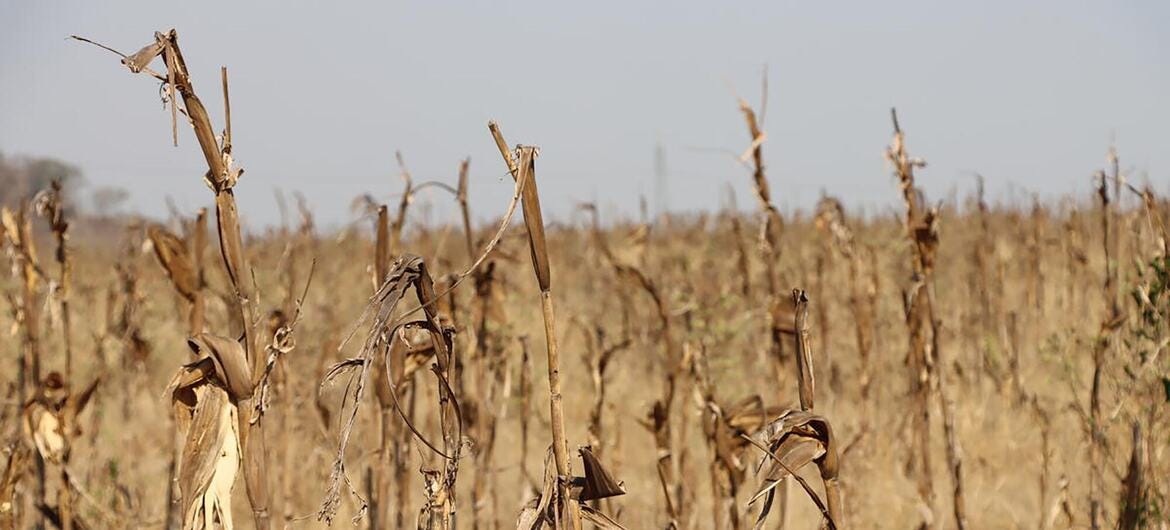
Impact of 2026 El Nino induced drought in Manica province.© WFP/Ana Mato Hombre Mozambique.
On Tuesday, American voters handed control of both houses of Congress to the Democrats. On the same calendar, El Niño is moving toward its peak, and the hunger it causes will build through 2027. Those two facts are now linked by a deadline. Federal agencies are running on a stopgap spending law that expires on December 11. The Congress that ends in January must decide what happens next, including how much the United States spends on emergency food aid in its next spending law.
The new Democratic majorities do not take their seats until January 3, 2027. By then, Southern Africa’s main maize crop will be planted. Zimbabwe tells its farmers to plant in December and to switch to short-season crops if the rains push them into January (The Herald). Seed and fertilizer that arrive after that are of little use. The question for this lame-duck session is whether it treats El Niño as an emergency forecast to act on, or as a disaster that will not strike until 2027 and can be paid for later.
What the Election Decided
Democrats won majorities in both chambers. The Associated Press called the Senate late Tuesday and the House early Wednesday. As of Wednesday, Democrats had won 54 Senate seats and Republicans 44, with two races still undecided (Forbes). Both were still open on Thursday. In Mississippi, Democrat Scott Colom led Sen. Cindy Hyde-Smith by about 1,100 votes with ballots still being counted (WDAM; Time). In Alaska, Sen. Dan Sullivan and Democrat Mary Peltola were separated by less than a percentage point, and the state will run its ranked-choice count on November 18 (Straight Arrow News).

The outgoing Congress has until December 11 to decide how much the United States spends on emergency food aid. Photo credit: Wikipedia
Democrats flipped seven Republican-held Senate seats, in Kansas, Iowa, Texas, Ohio, Maine, North Carolina and South Carolina (Northeastern Global News; CNBC). As of 3 p.m. Eastern on Thursday, Democrats had won 251 House seats and Republicans 155, with 29 races still to be called (Yahoo News). That is the most House seats for Democrats since 2008. Hakeem Jeffries is in line to become speaker, and Chuck Schumer to become Senate majority leader.
International food aid is not on the Democrats’ list of first priorities. Their 100-day plan for the House centers on domestic living costs, health care, tariffs and oversight of the administration (AP via WLOX). Schumer has told Senate Democrats to focus on the cost of health care, housing, food and energy (Axios). We could find no public statement by either party’s leaders linking El Niño to U.S. food aid.
Foreign aid has still been a live fight since the Trump administration froze it in its first days and then shut down USAID, which closed on July 1, 2025. In 2025, Democrats sought to restore about $5 billion in foreign aid money the administration had let expire (FactCheck.org). Individual Democrats have pressed for food aid in particular. Rep. Rosa DeLauro moved this year to restore Food for Peace to its 2026 level. Sen. Jeanne Shaheen, the top Democrat on Foreign Relations, backed a Senate bill that would have given Food for Peace $1.5 billion for 2026 (Shaheen). Republicans led the rescue of the program itself. Sens. Jerry Moran and John Boozman pushed to keep Food for Peace alive by moving it to USDA (Agri-Pulse).
Voters in both parties lean the same way when it comes to foreign aid. A Rockefeller Foundation survey in June 2026 found that 54 percent of Americans view foreign aid favorably. Eight in 10, including 83 percent of Republicans, said aid should be reformed and strengthened rather than ended (Foreign Service Journal). The crop losses that have already occurred around the world and the forecast of massive acute hunger and even famine give both parties a reason to put El Niño on their lists for early action.
None of that changes who writes the budget for the next eight weeks. The current Congress, with Republican majorities, stays in session until the new one is sworn in on January 3, 2027. Trump’s 2027 budget would end Food for Peace, arguing that its food takes four to six months to arrive and costs too much to ship (Agri-Pulse). It would end McGovern-Dole school meals as well (DTN). Yet his own USDA runs Food for Peace as “America First international food assistance” and buys only U.S. crops (Oklahoma Farm Report). Republicans in Congress have mostly defended the program. Sens. Jerry Moran, John Hoeven and John Boozman and Rep. Tracey Mann led the effort to move it to USDA (Sen. Moran; KMA Land), and Congress has ignored the President’s calls to end it (farmdoc daily). However, the current House Republican bill cuts its budget by $300 million, to $900 million.
What the Election Results Mean for El Niño Food Aid
The first test comes on December 11, 2026, when the stopgap spending law runs out. That law keeps agencies operating at roughly last year’s levels. To date, no final fiscal 2027 agriculture bill has been enacted (CRS, Overview of Continuing Appropriations for FY2027; CRFB).
Food for Peace is the main U.S. program that ships American-grown food to international hunger emergencies. Its rules come from the Farm Bill, but its money comes from the yearly agriculture spending bill. Congress gave it $1.2 billion for fiscal 2026, and USDA took over running it in February after USAID was dismantled (CRS, U.S. International Food Assistance: A Primer). That budget is about 30 percent less than the $1.716 billion Congress provided for Food for Peace in fiscal year 2016, the last budget before President Trump took office (Senate Appropriations Democrats). Through his first term, Congress kept the program near $1.7 billion a year even as the President’s budgets repeatedly proposed ending it (CRS, International Food Assistance: FY2020). The House agriculture spending bill for fiscal 2027 proposes to cut the Food for Peace budget to $900 million (House Appropriations Committee summary). The administration’s budget request would have eliminated it (CRS, Agriculture and Related Agencies: FY2027 Appropriations). House Democrats proposed restoring it to the 2026 level (House Appropriations Democrats). The Senate has not yet marked up its version of the bill.
The Senate does not need a markup to act. In 2022, Senate appropriators held no markups for fiscal 2023 (Roll Call). The final bill was introduced on December 19 and became law on December 29 (CRS). Food aid does not divide the Senate’s agriculture spending panel, led by Sen. John Hoeven, R-N.D. Last year the full committee approved its agriculture bill 27 to 0 (Senate Appropriations Committee).
The Senate’s speed is not the main obstacle to getting American funding to respond to El Niño hunger. The bigger danger is that Congress delays again. Holland & Knight calls another stopgap “a realistic outcome” (Holland & Knight). A stopgap would keep Food for Peace at last year’s $1.2 billion rate, better than the House’s $900 million. But it would add nothing for El Niño and would release money only in slices. It would also push the real decision to the new Congress, after Southern Africa and many other regions have planted, so most new aid would be disaster relief rather than early help to protect harvests.
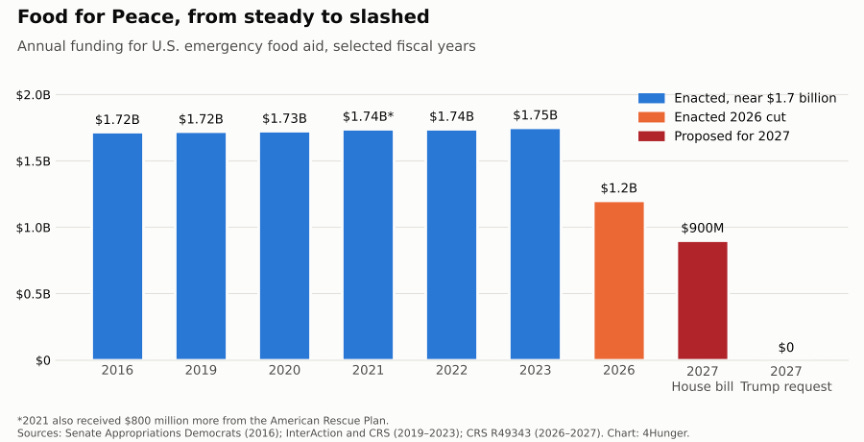
Food for Peace held near $1.7 billion a year for most of a decade before Congress cut it to $1.2 billion for 2026. The House bill would cut it to $900 million for 2027, and the President’s request would end it.
Food for Peace has supporters in both parties. Farm-state Republicans back it because it buys American commodities, and the House Farm Bill would move it permanently to USDA (House Agriculture Committee). That Farm Bill passed the House 224 to 200 on April 30 (Clerk of the House; CRFB). The Senate Agriculture Committee approved its own version in September on a party-line vote (KATV), but it needs 60 votes on the Senate floor, and Democrats oppose its terms on SNAP (CRS). Congress has not passed a full Farm Bill since 2018 and has extended the old one three times (CRS). Another extension is the likelier result this year (Bloomberg Government).
The Calendar Congress Is Racing
El Niño’s deadlines do not wait for the swearing-in. Between now and January 3, these dates fall in order:
1. Now: the UN’s first joint El Niño early action appeal seeks $202 million to protect nearly 9 million people in 22 countries (Daily Maverick). That money works only if it moves before the hazards hit.
2. November 6: the Montreal Protocol parties close their meeting in Kigali, where they are setting the next three years of their fund.
3. November 9–20: the UN climate conference meets in Antalya.
4. November 12: NOAA issues its next El Niño forecast (Smart Water Magazine).
5. November: Indonesia’s rainy season starts about a month late, which delays rice planting (Reuters via The Star). Madagascar begins planting its main rice crop (FAO GIEWS).
6. November–December: Southern Africa plants its main maize crop under forecasts of a late, dry start (FEWS NET). Seed and fertilizer have to reach farmers before planting (NewsDay).
7. Early December: the UN usually launches its yearly global humanitarian appeal. It did so on December 8 last year (Humanitarian Action).
8. December 11: U.S. stopgap funding expires.
9. December: the loss and damage fund’s board meets in Manila to make its first funding decisions (Kathmandu Post).
10. Around December: WMO expects El Niño to reach its peak (WMO via PreventionWeb). Its effects on harvests will run through 2027.
11. January 3, 2027: the new Congress is sworn in.
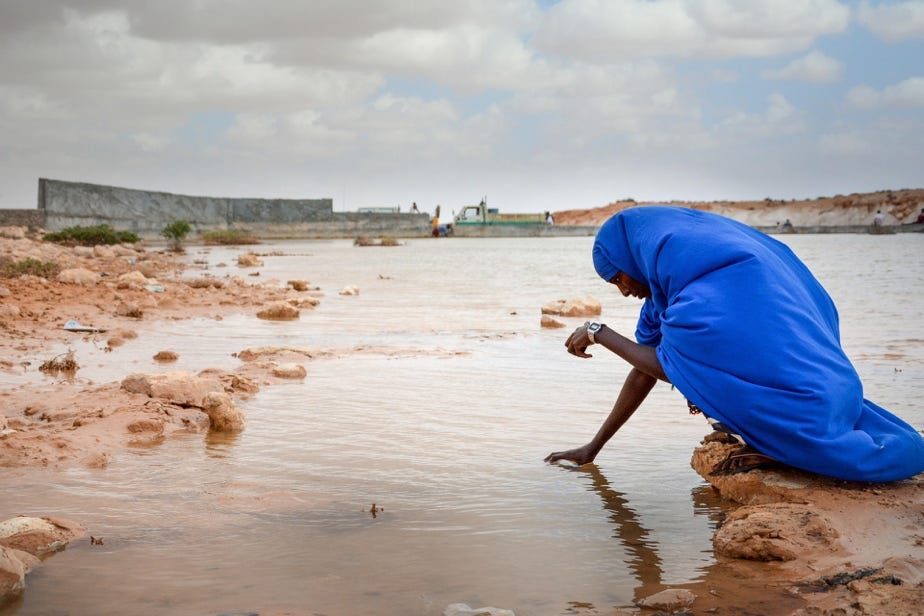
In the Horn of Africa, From Drought to Deluge: Preparing Eastern Africa for El Niño’s Double Hit. Needs peak before the new Congress is sworn in. Photo credit: UNDP
FEWS NET, the U.S. famine warning network, released its El Niño outlook on October 6. It names Southern Africa and the parts of East Africa with a single rainy season as the regions of highest concern. In both, it expects El Niño to be the main cause of high food aid needs in 2027 (FEWS NET). The worst hunger comes in the lean months after the rains fail. FEWS NET expects needs to peak at these times.
• East Africa, March to August 2027. Needs peak from March to June in Uganda’s Karamoja region, from May to September in South Sudan, and from June to September in Sudan. Ethiopia’s highest needs come from June to August.
• The Sahel, March to September 2027. Needs peak from June to August in Burkina Faso and from June to September in the farming areas of Mali and Niger. In Chad, they peak from March to June in herding areas and from June to August in farming areas.
• Southern Africa, November 2027 to March 2028. The 2027 maize harvest depends on the rains from December to February. FEWS NET expects the worst hunger in the lean season after that harvest, with widespread Crisis (IPC Phase 3) conditions. In some areas, the lean season could start early.
• Kenya and Somalia, now. Here the danger is flooding from heavy rains this fall, and needs peak by December 2026. FEWS NET warns of a risk of famine in southern Somalia, though it does not call famine the most likely outcome.
Food aid is slow even when Congress is fast. USDA’s own funding notice says it takes 45 to 90 days from an award until Food for Peace commodities leave the United States, and up to six more months to reach the country (World Hunger News). Food bought with money approved in December could arrive as late as September 2027. That would land in the middle of East Africa’s peak. For Southern Africa, the worst months start in November 2027, so food approved this winter can still arrive in time if it moves quickly.
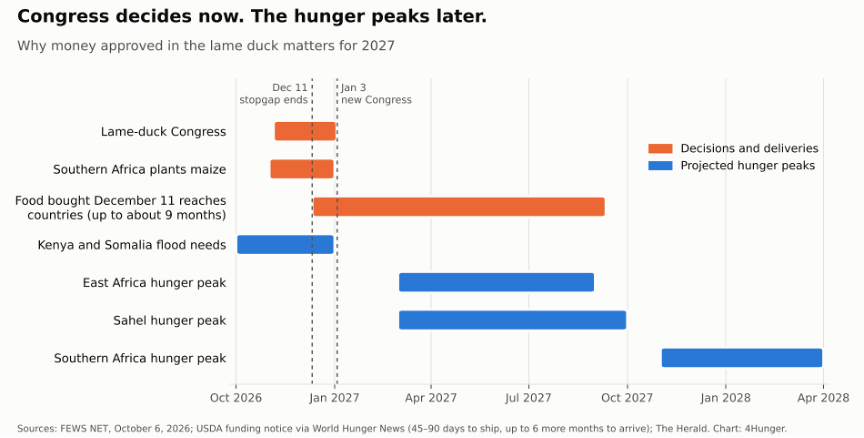
Food bought in December could take until September 2027 to arrive, in the middle of the hunger peaks in East Africa and the Sahel. Southern Africa’s worst months start later, in November 2027.
What Congress Can Do Before and After January 3
A new joint report from the UN’s food and weather agencies shows why the timing matters. Extreme Heat and Agriculture, from FAO and the World Meteorological Organization, finds that yields of maize and wheat have fallen 7.5 and 6.0 percent for each 1°C of warming. When heat and drought strike together, as they often do in El Niño years, observed yield losses top 30 percent in the affected areas. Each year, heat stress costs poor households 5 percent more of their income than it costs better-off ones. Its remedy is the one this series has argued for. It calls early warnings tied to action before the losses “a key opportunity.”
The outgoing Congress has three choices on December 11. It can pass a full-year agriculture bill, extend the stopgap into 2027, or let funding lapse. A full-year bill would let lawmakers set Food for Peace at a level that matches the forecast, and the gap between $900 million and $1.2 billion is $300 million. A longer stopgap would freeze the program at last year’s rate while hunger peaks. Even then, Congress can add a provision that lets USDA spend food aid money faster than the stopgap normally allows.
The Fastest Ways to Make the Money Flow
Food aid takes months to ship, so speed matters as much as size. The steps below run from fastest to slowest. The first five need no new law.
Now, with no vote
1. USDA awards the money it already has. Federal budget records list the Food for Peace account as one whose money does not expire at year’s end (OpenOMB). In May, USDA opened an emergency round worth $357 million (World Hunger News). Getting those awards out now, aimed at the countries whose lean seasons start first, would buy the months that shipping takes.
2. Lawmakers of both parties press USDA in writing. Leaders of the agriculture and foreign affairs committees in both chambers can ask which El Niño countries will get the $357 million and when the food will ship. They can also ask whether the Emerson Trust holds anything. A letter from both parties carries more weight.
3. USDA taps its farm credit corporation. In 2022, USDA used $388 million from the Commodity Credit Corporation to cover shipping and handling for emergency food aid (Feedstuffs). The Agriculture Secretary controls the corporation, though its money also pays for aid to farmers.
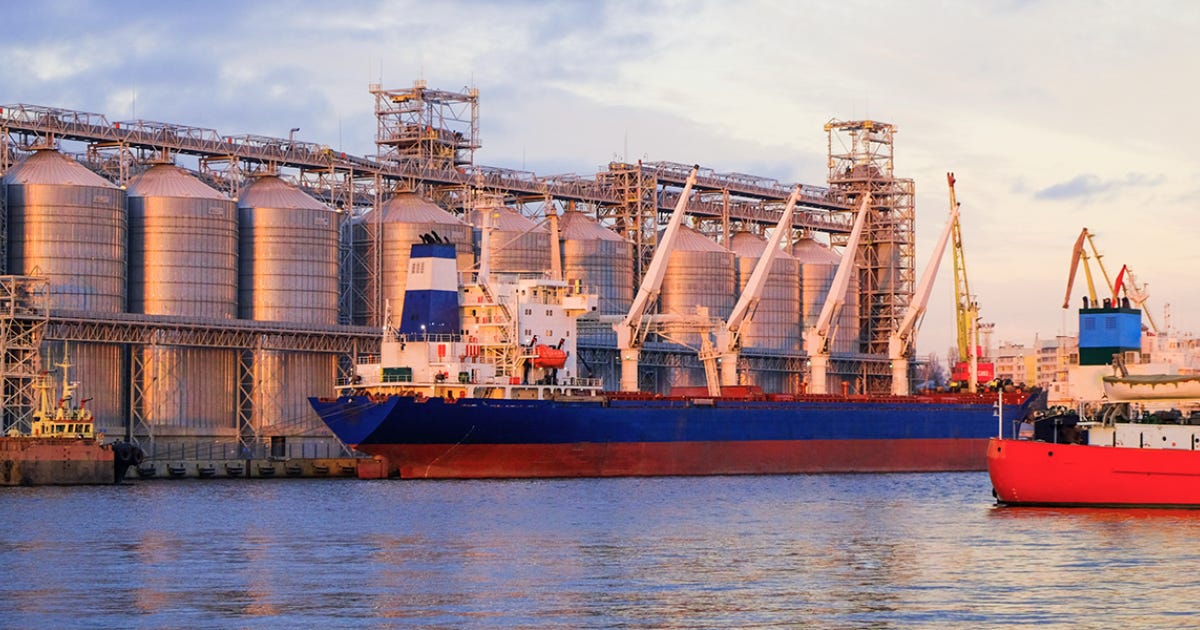
Food for Peace buys American crops and ships them overseas. Shipping alone can take three months. Photo Credit USDA
4. USDA releases what is left in the Emerson Trust. USDA can release the trust without a new appropriation once officials find that regular Food for Peace funds fall short (7 U.S.C. 1736f-1). The government drew down its full $282 million in 2022 (USAID), so it may now hold little or nothing.
5. The President draws on the refugee emergency fund. This fund lets the President move money quickly for unexpected refugee and migration needs. Congress gave it $100 million for fiscal 2026, and budget records showed about $291 million available in September (RCUSA; OMB). It could help people displaced by drought in Sudan, South Sudan or Chad, but it is not a general food aid fund.
Before December 11, by vote
6. Pass a small emergency food aid bill on a fast track. The House can pass a bill quickly if two-thirds of members vote for it, skipping the usual procedural steps. Food aid has enough Republican support to make that possible, though the Senate would still have to agree. The bill could tell USDA to use its farm credit corporation for Food for Peace, as the 2021 American Rescue Plan did with $800 million (Taxpayers for Common Sense). That money counts as mandatory spending, so it would not squeeze other programs.
7. Add an El Niño famine fund to the December package. In May 2017, during President Trump’s first term, both parties added $990 million in emergency famine relief to that year’s spending bill. At least $300 million went through Food for Peace, to Nigeria, Somalia, South Sudan and Yemen (Senate Appropriations Committee). This time Congress has months of warning.
8. Fund Food for Peace at $1.2 billion and McGovern-Dole at $240 million. The House agriculture bill has $900 million for Food for Peace (CRS). Rep. Rosa DeLauro, the top Democrat on House Appropriations, has proposed restoring the 2026 level. The administration asked for nothing for McGovern-Dole school meals, and the House kept that program at last year’s level.
9. If Congress passes another stopgap, add a food aid exception. A stopgap normally lets agencies spend only a slice of a full year’s money for the weeks it covers. Congress can add an exception, called an anomaly, that lets USDA commit Food for Peace money now.
10. Hold humanitarian aid at $5.4 billion and drop the $1 billion cut. The House State Department bill provides $5 billion, $400 million below 2026, and would cancel $1 billion in humanitarian money approved earlier (USGLC). Dropping that cut keeps money already in hand available for this crisis.
11. Protect the famine warning system. In August, FEWS NET stopped posting on Afghanistan, Somalia and Yemen. The State Department told NPR that reporting would resume in September (NPR). The year-end package can direct the department to keep full coverage through the El Niño peak.
12. Renew the food aid laws and fix the Emerson Trust. The last Farm Bill extension ran through September 30, 2026, and the current stopgap did not broadly renew the authorities left over (Holland & Knight). The trust’s legal status after that date is unclear (7 U.S.C. 1736f-1, notes). The law’s authority to refill it ended in 2023, and its old refill cap was $20 million a year. The House Farm Bill would renew refills but would not raise that cap (Alliance to End Hunger). The House passed its Farm Bill in April, and the Senate Agriculture Committee reported Sen. Boozman’s bill, S. 5526, on September 24. The main dispute is over who pays for SNAP, but other issues such as aid tied to climate change also remain in dispute.
After January 3
13. Move an El Niño package early in the new Congress. Once Rep. Jim McGovern chairs the Rules Committee, he will control which bills reach the floor and when. The new House could pass an El Niño package in its first weeks, ahead of East Africa’s March to August peak. It would still need 60 Senate votes and the President’s signature. The new committee chairs can also ask at their first hearings how much U.S. food aid reached El Niño countries before harvests failed, and how much arrived after.
Food for Peace has drawn votes from both parties for 72 years. The forecast gives both parties a reason to fund it on time.
Who Will Hold the Gavels on Hunger
The people who will run the committees that matter most for hunger are mostly longtime allies of food aid. The odds of action are best where those allies come from both parties.
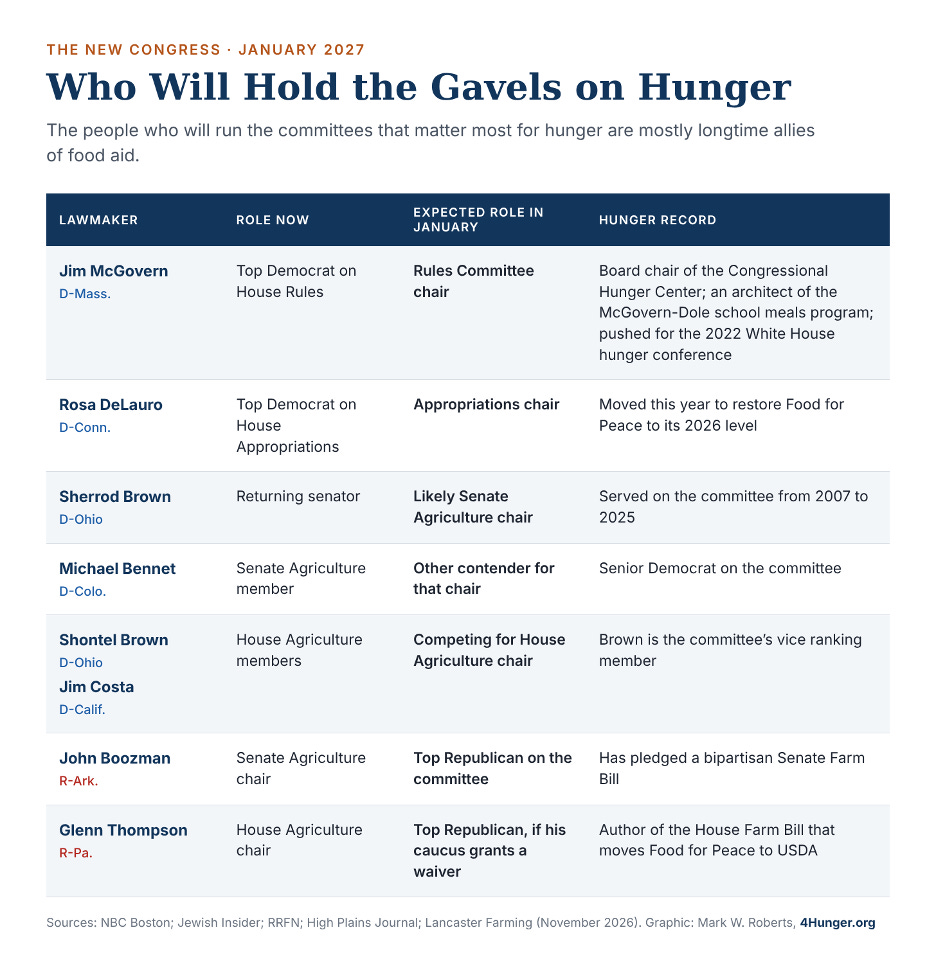
McGovern’s new post gives hunger an unusual advantage. “Every bill, every amendment, everything that goes to the floor goes through me,” he said after Tuesday’s vote, and he has pledged to bring bills on high costs and hunger to the floor.
International food aid has the best odds. Food for Peace buys American crops, so farm-state Republicans like Boozman and Rep. Tracey Mann of Kansas defend it alongside Democrats like DeLauro and McGovern. The fight is over how much it gets and who runs it.
Domestic hunger programs face harder math. Democrats will control both chambers, but they will not have 60 votes in the Senate or two-thirds of either chamber to override a veto. Reversing last year’s cuts to food assistance would need either bipartisan votes or the President’s signature. Until January 3, the Republican majorities still decide what passes.
What You Can Do
Call your representative and both senators before December 11. Ask for three things.
1) Fund Food for Peace at no less than last year’s $1.2 billion.
2) If Congress passes another stopgap, let USDA spend that money now.
3) Renew the Emerson Trust and the other food aid laws left hanging when the last Farm Bill extension ended on September 30.
The U.S. Capitol switchboard, (202) 224-3121, will connect you.
If your district elected someone new on Tuesday, call their transition office too. They will vote on next year’s budget. No time like the present to get them up to speed on the crises that this El Niño is causing.