

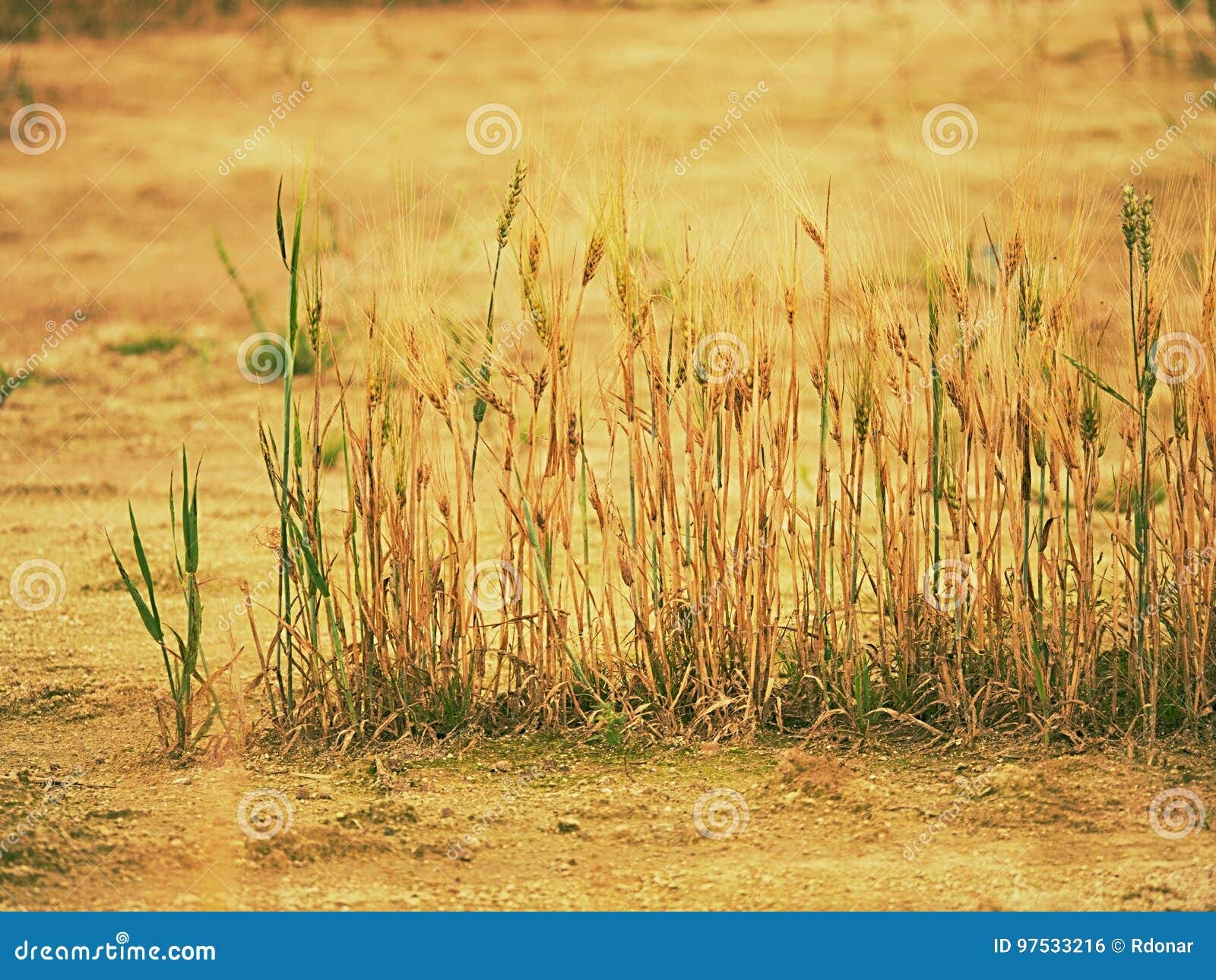
The 2026 winter wheat crop that failed around the world.
The Hungriest Year This Century
In 2025, for the first time in the twenty-first century, famine was confirmed in two countries at the same time: the Gaza Strip and parts of Sudan.1 Famine is the most extreme classification on the international scale of hunger, reached only when starvation, destitution, and death have already begun. That two of them arrived in the same year was described by the United Nations Secretary-General as an unprecedented development.2 It was also a symptom of something larger.
By the start of 2026, an estimated 318 million people faced acute hunger, roughly double the level recorded before the COVID-19 pandemic, with some 41 million of them at emergency levels of food insecurity or worse.3 In the most recent global accounting, more than 266 million people across 47 countries were in crisis or beyond, nearly a quarter of every population that analysts were able to measure.4 The number of people at the very edge, at emergency-levels of hunger, has nearly tripled since 2016.5 More than 85 million people have been driven from their homes inside these food-crisis countries, and the displaced are consistently hungrier than the communities that host them.6
Ask the humanitarian officials who track this catastrophe what is causing it, and the answer compresses, almost universally, into three words: conflict, climate change, and economic shocks.7 Call them the three C’s: conflict, climate, and cost. They are not three separate emergencies that happen to be occurring at once. They are three strands of the same rope, each pulling the others tighter. A drought raises the price of bread; the price of bread brings people into the streets; the unrest becomes a war; the war burns the next harvest. Hunger is rarely the product of one cause. It is the product of the three C’s braiding together.
Hunger on this scale is not a natural disaster. It is a man-made one, assembled from three forces we understand, can measure, and could choose to confront.
But we are not.
The Many Faces of Hunger
Before tracing the forces behind this emergency, it helps to be precise about what the word hunger means, because it covers several very different things. The 318 million people in acute crisis3 are the part of the problem that reaches the headlines, but they sit at the sharp end of a much larger structure. Hunger is best understood as a set of nested measures — each broader category containing the narrower, more severe one — all within the wider umbrella of malnutrition. The figures for 2024, drawn from the UN’s annual State of Food Security and Nutrition in the World, describe that structure.8
Nutrition in the World, describe that structure.8
Cannot afford a healthy diet - 2.6 billion people nearly 1 in 3 people on Earth don’t have enough to eat
Moderate or severe food insecurity - 2.3 billion people don’t know where their next meal is coming from and ran out of food, skipped meals, or cut the quality and quantity of food for lack of money or access.
Chronic hunger (undernourishment) 673 million people (8.2%)
Habitually insufficient dietary energy, sustained over roughly a year; modeled at the population level.
Acute hunger (food crisis, IPC/CH Phase 3+) 318 million people.
Shock-driven food emergencies severe enough to threaten lives and livelihoods now — the focus of this article.
Famine / starvation (IPC Phase 5) ~1.4 million people.
Catastrophe: starvation, destitution, and death already under way. A separate, acute scale.
Hidden hunger cross-cutting. Micronutrient deficiency (iron, iodine, vitamin A, zinc); can coexist with adequate calories and even with overweight.
All major grains are storing fewer important nutrients due to climate change. The measures deepen with severity and are roughly nested within malnutrition in all forms; hidden hunger cuts across every tier, and into the well-fed. The nesting is only approximate, because each measure uses a different method, calorie modeling, experience surveys, and diet-cost calculations, so a person can fall into one category without another. in the World, describe that structure.8
These broader categories describe hunger as a standing condition: chronic, structural, and shaped over years by poverty, farm productivity, and the price of food. The crisis at the center of this article is something narrower and sharper. Acute hunger, and its catastrophic extreme, famine, are measured on a separate, shock-driven scale, and they are largely what the three C’s produce. Climate, conflict, and cost are the forces that tip people out of the broad structural categories and into emergency, turning chronic vulnerability into acute crisis and, at the extreme, into the starvation the famine classification records.9 Seen this way, the 2.6 billion who cannot afford a healthy diet are the reservoir; the 318 million in acute crisis are those the three C’s have pushed over the edge; and the roughly 1.4 million at famine’s core are those for whom the fall has already turned fatal.
Famine is not a different disease from everyday hunger. It is the same condition at its end stage, it is what happens when the three C’s finish what poverty began.
The First C: Climate
Climate may be the fastest-growing driver of all. Since 2018, the number of people whose hunger is driven primarily by weather extremes has tripled, from about 29 million to roughly 96 million.10 Drought is now the leading single cause of agricultural production loss on the planet, and the warming that is making droughts longer and deeper is making floods, cyclones, and erratic rainfall more frequent at the same time.11 The seasons that farmers have read for generations are becoming unreliable, and a missed planting window cannot be reopened.
The effect is already visible. In Afghanistan, repeated drought and flooding have destroyed crops and pushed farming families off their land and onto aid.12 In Syria, crop production has fallen by more than half.13 A single hurricane tore through Jamaica, Haiti, and Cuba and erased harvests in a matter of hours.13 And the trajectory points down: climate models project that, compared with a world without warming, climate change could push somewhere between 1 million and 183 million additional people into the ranks of those at risk of hunger, in part by driving cereal prices upward across the coming decades.14
The transmission works the way every climate-to-hunger transmission works. A flood or a drought cuts the harvest. A smaller harvest means tighter supply. Tighter supply means higher prices. Higher prices price the poorest out of the market, and the poorest are concentrated precisely in the regions where the climate is turning most hostile.15 The global rate of undernourishment has inched downward in recent years, but the gains are wildly uneven, and much of sub-Saharan Africa has been left behind by them entirely.16
The atmosphere does not check a passport. But the hunger that a changing climate produces falls almost entirely on
the people who did the least to change it.
The Second C: Conflict
If climate is the fastest-growing driver, conflict is the largest, and it is not close. It is the primary cause of food insecurity in 14 of the 16 hunger hotspots that the Food and Agriculture Organization and the World Food Programme are watching most closely, and it sits behind roughly two-thirds of all acute hunger.17 The six places of highest concern including the Sudan, the Gaza Strip, South Sudan, Yemen, Mali, and Haiti, are, with one exception, defined by violence.18 Since 2018, the number of people whose hunger is driven primarily by conflict has nearly doubled, from about 74 million to roughly 140 million.19
The mechanism is brutally direct. War empties fields and kills the people who would have planted them. It severs roads and markets. It displaces farmers into camps where they consume food rather than grow it. And, increasingly, it is waged deliberately against the food system itself when combatants block convoys, besiege cities, and starve populations as a method of war. Nigeria, the Democratic Republic of the Congo, and Sudan alone accounted for tens of millions of acutely food-insecure people in 2025, the wreckage of overlapping insurgencies and civil wars.20 Gaza has been in famine since the summer of 2025; Sudan’s famine was first confirmed in August 2024 and has only spread.21
And What Causes the Conflict
Here the arrow turns around. Conflict produces hunger, but hunger also produces conflict, and the two trap each other in a loop. Researchers reviewing more than a hundred studies for the World Food Programme concluded that food insecurity is a “threat multiplier” for violent conflict: when people cannot eat, especially when a sudden spike in food prices is to blame, the risk of riots, civil conflict, and the breakdown of governments rises sharply.22 A separate review of sixty peer-reviewed studies traced a dozen distinct drivers of food insecurity to eight different forms of instability, from protests and riots to outright civil war.23
What converts hunger into violence is rarely hunger alone. It is hunger layered on top of grievance: economic desperation, an inflamed pre-existing wound, inequality between different tribes or races of people, a collapse of trust in a government that cannot or will not feed its people.23 Young people excluded from work and from a political voice are the most combustible fuel of all.24 The pattern is old. The bread riots that helped ignite the French Revolution in 1789 ran on the price of flour; the global food-price spikes of 2007–2008 set off unrest across dozens of countries; in the Syrian war, the price of staples in some places multiplied many times over as production collapsed and transport costs soared.25 Food insecurity does not light every fire. But it dries the kindling, and a sudden jump in the price of a loaf of bread can be the spark.
Hunger and war are not two problems. They are one problem wearing two faces, and each face feeds the other.
When the Drought Comes First
There is a second arrow, and it runs straight from the first C into this one. Climate does not only starve people; it sets them against each other. Security analysts have a name for it, climate is a “threat multiplier,” and the mechanism is depressingly simple. When drought shrinks the water, the grazing land, and the arable soil, groups that once shared those resources begin to compete for them, and competition among the desperate has a way of curdling into violence.26Syria is the case most often cited. From 2006 to 2010 the country endured the worst drought in its instrumental record, one that climate scientists estimate human warming made two to three times more likely, which collapsed harvests and drove perhaps a million and a half rural Syrians into the cities, where the newcomers met unemployment, overstretched services, and a government indifferent to their plight. Researchers are careful not to call the drought the cause of the war that erupted in 2011, but many regard it as a contributing accelerant that helped load the conditions for revolt.27
It is not an isolated case. Darfur is often called the world’s first climate-change conflict: as the Sahara crept south by roughly a mile a year and rainfall fell by 15 to 30 percent, Arab herders and African farmers were forced into the same shrinking commons, and a quarrel over water and pasture hardened, and it happened under a government willing to weaponize it into genocide.28 Around Lake Chad, which has lost the great majority of its surface area, vanishing water has pushed herders, farmers, and fishers into open conflict and handed extremist groups such as Boko Haram a steady supply of dispossessed recruits.29 Similar fault lines run through the wider Sahel, the Horn of Africa, and South Sudan. The honest reading of this evidence is not that a warming climate reliably produces war, but governance, ethnicity, and inequality always do the deciding. It is that climate change loads the gun those other forces fire, and a hungry, displaced, resource-starved population is exactly the tinder that turns a local dispute into a civil war, and a civil war back into famine.
Climate change rarely fires the first shot. It loads the chamber and turns drought into scarcity, scarcity into grievance, and grievance into war.
The Third C: Cost
The third C is the quietest and, in proportional terms, the most explosive. Since 2018, the number of people whose hunger is driven primarily by economic shocks has risen sixfold, from about 10 million to roughly 59 million.30 This is the hunger of people who live where the bombs are not falling and the rain is still coming, but who simply cannot afford to eat. It is a crisis of price and of debt, not of supply.
The numbers are staggering at the household level. Food-price inflation in Haiti reached 34 percent in a single month of 2025; in Sudan it ran above 60 percent; Nigeria has endured ten consecutive years of double-digit inflation.31 Behind those figures sits a weak global economy growing at around 3 percent, developing nations buckling under unsustainable debt, currencies losing value, and governments imposing austerity that strips away the very purchasing power households need to buy food.31 In Haiti where more than five million people are now acutely food-insecure, the principal driver is not a battlefield or a drought. It is economic collapse and the price of a meal.32
This is the C that most directly reaches the grocery aisle in wealthy countries too, because food is traded on global markets and prices set in one place ripple to another. But its sharpest edge is in the poorest economies, where families already spend the largest share of their income on food and have the least room to absorb a single bad month. For them, every percentage point of food inflation is not an inconvenience. It is a meal removed from the table.
In the poorest households on earth, hunger is not always a question of whether the food exists. It is a question of whether the family can afford it.
When the Three C’s Converge
The reason the three C’s are so dangerous is that they almost never arrive alone. They compound. The chain runs like this. A changing climate cuts the harvest. The smaller harvest drives prices up. Higher prices deepen the economic squeeze on families who were already stretched. Economic desperation hardens into grievance, especially where people have lost faith in their government. Grievance, in the wrong conditions, becomes conflict. And conflict destroys the next harvest, blocks the roads, and turns away the aid — which makes the hunger worse, which feeds the next round of grievance. Each C is an accelerant for the others, and the loop, once it is turning, is very hard to stop.
This is why the worst-hit places are almost always suffering from all three at once. Sudan is a war, but it is also an economy in freefall, with inflation above 60 percent. Afghanistan is a climate catastrophe of drought and flood, but it is also an economy hollowed out by isolation and the forced return of more than a million and a half people with nothing.12Haiti is an economic implosion, but it is also gang violence and displacement. The three C’s do not take turns. They stack.
The Fourth Failure: A Safety Net Pulled Away
There is a force that can interrupt this loop, and the world has spent decades building it: humanitarian food assistance. At the precise moment the three C’s are intensifying, that buffer is being dismantled. The Trump Administration gutted USAID in a single day which by some estimates will cause up to 25 million deaths. By late 2025, barely a quarter of the global appeal for humanitarian funding was financed, Approximately, $11.5 billion dollars of the needed $45 billion was given by the wealthy countries of the world. This is the largest shortfall ever recorded.33 Humanitarian funding has fallen back to levels last seen a decade ago, and agencies have been forced to cut food from the hungry to keep the starving alive.34
The largest single cause of the collapse is the retreat of the United States, traditionally the world’s biggest food-aid donor. After the dismantling USAID and congressionally approved cuts, U.S. contributions to the World Food Programme fell from roughly 4.5 billion dollars to about 1.5 billion in a single year.35 The consequences are immediate and arithmetic. In Kenya, rations for hundreds of thousands of refugees fell to barely a quarter of a standard portion; in Uganda, monthly support per refugee was cut from 16 dollars to 5; in northeastern Nigeria, an operation that reached 1.3 million people during the 2025 lean season was projected to reach just 72,000.36 These are not market forces. They are decisions, made in capitals far from the camps to let the poor die.
A harvest can fail because of the weather. A food ration fails only because someone decided to stop paying for it.
What Must Change: Treating the Three C’s as One System
The first imperative is to stop the bleeding. Humanitarian food funding must be restored and protected, because the alternative is widespread irreversible childhood stunting and preventable death. The economics here are not even close: anticipatory action meaning getting assistance to people before a crisis fully lands is far cheaper than emergency response after the fact, and resilience investments such as land restoration in the Sahel have been shown to return as much as 30 dollars for every dollar spent.37 Cutting food aid during a compounding crisis is not fiscal discipline. It is the transfer of a manufactured risk onto the people least able to bear it.
The deeper imperative is to stop treating the three C’s as three separate problems. Climate adaptation, conflict prevention, and social protection are routinely funded, staffed, and argued over in different rooms, yet on the ground they are a single, interlocking system. Social protection is the clearest example: a reliable safety net does not only feed people through a sudden shock; it rebuilds the trust in government that makes a person less likely to choose conflict over peace when the food runs short.24 Investing in resilience is, simultaneously, climate policy, anti-hunger policy, and conflict-prevention policy. The silos are an administrative convenience. The crises do not respect them.
And the framing must change. Food security has been shown, repeatedly, to underwrite political stability, and instability is what closes borders, severs supply chains, and pulls great powers into regional wars.38 Protecting the world’s ability to feed its poorest is not charity. It is a strategic necessity. It is the cheapest insurance policy against the conflicts the wealthy world will otherwise pay for many times over.
The Arithmetic of a Warning
Three hundred and eighteen million people. Two simultaneous famines. A hunger crisis that has doubled in the space of a few years. These are not the statistics of an unlucky season. They are the readout of three forces, climate, conflict, and cost that we can name, that we can measure, and that, unlike a meteor or a plague, are very largely of human making.
The families in Sudan and Gaza living through confirmed famine did not warm the planet. The smallholder in Afghanistan watching a third failed harvest did not start the war next door. The mother in Haiti who cannot afford a sack of rice did not design the debt that hollowed out her currency. They did not cause the three C’s. They are simply the ones paying for it in skipped meals, in stunted children with life-long health problems, in the quiet, grinding emergency that hunger always is.
That the crisis is man-made is the bleak part. It is also the hopeful part, because what was assembled by choices can be disassembled by them. The climate can be adapted to and slowed. The conflicts can be prevented, mediated, and starved of the grievances that feed them. The economic shocks can be cushioned by the safety net we have already built and are now, inexplicably, taking apart. The three C’s have delivered their warning, in the plainest arithmetic there is. Whether to heed it belongs, as it always does, to those with wealthy nations and people who have the resources to act. It also depends on whether they understand that profound hunger, left to compound, has a way of arriving eventually at every door. Even the 1% are not safe from the crises they are creating.
The three C’s are man-made. That is the tragedy. It is also the only reason for hope.
Endnotes
1. World Food Programme (2026). WFP 2026 Global Outlook. WFP, Rome. Famine (IPC/CH Phase 5) confirmed in the Gaza Strip and parts of Sudan in 2025, the first time this century that famine has been confirmed in two contexts simultaneously.
2. Food Security Information Network / Global Network Against Food Crises (2026). Global Report on Food Crises 2026 (10th edition). Foreword by UN Secretary-General António Guterres, characterizing the simultaneous emergence of famine in two conflict-affected areas as unprecedented.
3. World Food Programme (2026). WFP 2026 Global Outlook. WFP, Rome. An estimated 318 million people faced acute hunger — approximately double pre-pandemic levels — with about 41 million at Emergency levels (IPC Phase 4) or worse.
4. Global Network Against Food Crises (2026). Global Report on Food Crises 2026. More than 266 million people across 47 countries faced high levels of acute food insecurity (IPC/CH Phase 3+) in 2025, approximately 22.9% of the analysed population.
5. World Food Programme / EU / partners (2026). Statement on the 2026 Global Report on Food Crises, 24 April 2026. More than 39 million people faced Emergency levels of food insecurity across 32 countries in 2025 — almost triple the 2016 level.
6. FAO & WFP (2026). Global Report on Food Crises 2026. More than 85 million people were forcibly displaced across food-crisis contexts in 2025; displaced populations consistently face higher levels of acute hunger than host communities.
7. Quoted framing of “conflict, climate change and economic shocks” as the drivers of the global hunger crisis appears throughout the 2026 Global Report on Food Crises and accompanying donor statements; see WFP (2026), press materials accompanying the 10th-edition GRFC launch.
8. FAO, IFAD, UNICEF, WFP & WHO (2025). The State of Food Security and Nutrition in the World 2025 (SOFI 2025). Rome. Figures for 2024: approximately 2.6 billion people could not afford a healthy diet; roughly 2.3 billion experienced moderate or severe food insecurity on the Food Insecurity Experience Scale (FIES); and an estimated 673 million people (8.2% of the world’s population) were chronically undernourished.
9. Integrated Food Security Phase Classification (IPC) and Global Report on Food Crises (GRFC), 2024–2025; and SOFI 2025 on micronutrient deficiency. Famine (IPC/CH Phase 5) affected roughly 1.4 million people at the 2025 peak across six countries and territories. The acute scale (IPC/CH Phase 3 and above) is shock-driven and measured separately from the chronic undernourishment count, so the categories are nested only approximately. “Hidden hunger” — deficiency in micronutrients such as iron, iodine, vitamin A, and zinc — cuts across every tier and can coexist with adequate calories and even with overweight or obesity.
10. FAO (2026). Global Emergency and Resilience Appeal 2026. Since 2018, the number of people whose hunger is driven primarily by weather extremes tripled, from approximately 29 million to 96 million.
11. Nature Communications (2025). “Impact of drought on global food security by 2050.” Drought is identified as the leading single cause of agricultural production loss; historical droughts (1961–2014) reduced maize and soybean yields by single-digit to low-double-digit percentages in top-producing countries.
12. Wikipedia / Associated Press / ReliefWeb (2025–2026). 2025–2026 hunger crisis in Afghanistan. Severe drought, flooding, and irregular rainfall destroyed crops and displaced farming families; in 2025 more than 1.5 million Afghans were returned from Iran and Pakistan, often with no resources.
13. World Food Programme (2025–2026). WFP Global Outlook and operational reporting. Syria’s crop production is reported down approximately 60%; Hurricane Melissa devastated agriculture in Jamaica, Haiti, and Cuba.
14. IPCC (2019). Special Report on Climate Change and Land, Chapter 5: Food Security. Across Shared Socio-economic Pathways, models project increases of 1–183 million additional people at risk of hunger compared with a no-climate-change scenario, alongside projected cereal-price increases driven by climate change.
15. Headey, D. & Fan, S. (2010), and IPCC (2019), on the climate-to-yield-to-price-to-hunger transmission mechanism by which reduced production raises prices and constrains access for the poorest consumers.
16. State of Food Security and Nutrition in the World (SOFI) 2025; Council on Strategic Risks review (2025). The global prevalence of undernourishment edged down from 8.5% (2023) to 8.2% (2024), but gains were uneven across regions, with much of sub-Saharan Africa left behind.
17. FAO & WFP (2025). Hunger Hotspots: FAO–WFP Early Warnings on Acute Food Insecurity, November 2025 to May 2026 Outlook. Rome. Conflict and violence are the primary drivers of hunger in 14 of the 16 identified hotspots; WFP analysis attributes roughly 69% of acute hunger to conflict.
18. FAO & WFP (2025). Hunger Hotspots, Nov 2025–May 2026. Six contexts of “highest concern” — Sudan, Palestine (Gaza Strip and West Bank), South Sudan, Yemen, Mali, and Haiti — face or risk Catastrophe (IPC/CH Phase 5) conditions.
19. FAO (2026). Global Emergency and Resilience Appeal 2026. FAO, Rome. Since 2018, the number of people whose primary driver of acute food insecurity is conflict almost doubled, from approximately 74 million to 140 million.
20. Joint Research Centre, European Commission / GRFC Mid-Year Update (2025). Nigeria (30.6 million), the Democratic Republic of the Congo (27.7 million), and Sudan (24.6 million) were among the worst-affected countries by total number of acutely food-insecure people in 2025.
21. Joint Research Centre (2025). GRFC Mid-Year Update. The Gaza Governorate was classified in famine from July 2025; famine in Sudan was first confirmed in August 2024.
22. Brinkman, H.-J. & Hendrix, C. S. (2011). Food Insecurity and Violent Conflict: Causes, Consequences, and Addressing the Challenges. WFP Occasional Paper, Policy, Planning and Strategy Division. Reviewing more than 100 sources, the authors describe food insecurity as a “threat and multiplier” for violent conflict, raising the risk of democratic breakdown, civil conflict, protest, and rioting — particularly when caused by higher food prices.
23. World Food Program USA (2023). Dangerously Hungry: The Link Between Food Insecurity and Conflict. Reviewing 60 peer-reviewed studies published since 2017, the report links 12 drivers of food insecurity to 8 forms of instability and conflict, grouping drivers into climate, resource competition, and economic shocks; conflict becomes more likely when a driver combines with economic desperation, a pre-existing grievance, or loss of trust in government.
24. von Braun, J. et al. / IFPRI and related literature on conflict and food insecurity. Food insecurity combined with socio-economic and political inequalities — particularly the exclusion of youth from economic activity and political participation — can fuel civil unrest; strengthening social protection improves trust in government and reduces the likelihood of conflict.
25. Stability: International Journal of Security and Development (2013), “Food Insecurity and Conflict Dynamics”; and National Geographic Education, “Hunger and War.” Historical examples include the 1789 French Revolution and the 2007–2008 global food-price riots; in wartime Syria, staple prices in some areas rose several-fold owing to lost production and higher transport costs.
26. On climate change as a “threat multiplier” for conflict: UN Environment Programme, Livelihood Security: Climate Change, Migration and Conflict in the Sahel (2011); ACCORD (2022); and the UN Security Council’s 2018 debate on climate-related security risks. The scholarly consensus holds that climate change rarely causes conflict on its own but intensifies competition over water, land, and pasture where governance is weak and grievances pre-exist.
27. Kelley, C. P., Mohtadi, S., Cane, M. A., Seager, R. & Kushnir, Y. (2015). “Climate change in the Fertile Crescent and implications of the recent Syrian drought.” PNAS 112(11): 3241–3246. The 2006–2010 drought was the worst in the instrumental record; the authors estimate anthropogenic warming made a drought of that severity 2–3 times more likely, and link crop failure and the rural-to-urban migration of roughly 1.5 million people to conditions preceding the 2011 uprising. The thesis is contested — see Selby, J. et al. (2017), “Climate change and the Syrian civil war revisited,” Political Geography 60: 232–244 — but both sides treat the drought as a contributing factor rather than a sole cause.
28. Ban Ki-moon (2007) and subsequent analyses (e.g. Think Global Health; World Food Program USA, “The First Climate Change Conflict”) describe Darfur as an early climate-linked conflict: in the decades before the 2003 war the Sahara advanced roughly one mile per year and median rainfall fell 15–30%, intensifying competition between Arab pastoralists and African farmers over land and water. Critics caution that the “first climate war” label understates the role of state manipulation of ethnic divisions.
29. Council on Foreign Relations, “As Lake Chad Shrinks, Conflict Grows”; and “Shifting sands: the geopolitical impact of climate change on Africa’s resource conflicts” (2024). The contraction of Lake Chad has driven herders, farmers, and fishers into competition and aided recruitment by Boko Haram; comparable climate-stressed resource conflicts affect the wider Sahel, the Horn of Africa, and South Sudan.
30. FAO (2026). Global Emergency and Resilience Appeal 2026. Since 2018, the number of people whose hunger is driven primarily by economic shocks rose sixfold, from approximately 10 million to 59 million.
31. Global Network Against Food Crises (2025). Hunger Hotspots 2025. Haiti food inflation reached 34% in August 2025; Sudan inflation exceeded 60%; Nigeria has experienced ten consecutive years of double-digit inflation; global growth was projected at approximately 3% amid heavy debt, currency depreciation, and austerity.
32. World Food Programme (2025). “Funding cuts: six critical WFP operations at risk.” More than 5.7 million people in Haiti — over half the population — face acute food insecurity, with economic shocks the primary driver.
33. FAO (2026). Global Emergency and Resilience Appeal 2026. By November 2025 the Global Humanitarian Overview was roughly a quarter funded — about USD 11.5 billion of USD 45 billion required — the largest gap ever recorded.
34. Council on Foreign Relations (2025). “The Great Aid Recession: 2025’s Humanitarian Crash in Nine Charts.” Total humanitarian funding fell to 2016 levels, forcing agencies to cut food rations to preserve resources for the most acutely starving.
35. Associated Press / U.S. News (2025). “UN’s World Food Program warns donor cuts are pushing millions more into hunger.” WFP received approximately USD 1.5 billion from the United States in 2025, down from nearly USD 4.5 billion the prior year, following the dismantling of USAID and congressionally approved cuts.
36. UNRIC (2025), “Humanitarian aid: the most vulnerable already severely impacted by budget cuts”; WFP West and Central Africa (2026). Refugee rations in Kenya fell to roughly 28% of a standard ration; per-refugee support in Uganda was cut from USD 16 to USD 5 per month; WFP projected reaching about 72,000 people in northeastern Nigeria in February 2026, down from 1.3 million during the 2025 lean season.
37. World Food Programme (2026). Operational reporting on anticipatory action and resilience. Land restoration in the Sahel is reported to generate up to USD 30 for every dollar spent; anticipatory action is substantially more cost-effective than delayed crisis response.
38. Center for Strategic and International Studies (2024), “Dangerously Hungry: The Link Between Food Insecurity and Conflict.” Food insecurity is increasingly recognized as a national-security concern, with hunger emergencies capable of metastasizing into large-scale security threats if left unaddressed.