

By Mark W. Roberts | October 28, 2026
A record “super” El Niño lands on the world’s poor already hit by two wars choking the world’s food, fuel and fertilizer, and what the UN called the “deepest funding cuts ever” are converging into a hunger crisis for the world’s poorest families, months before the worst droughts and floods caused by El Niño are set to arrive.
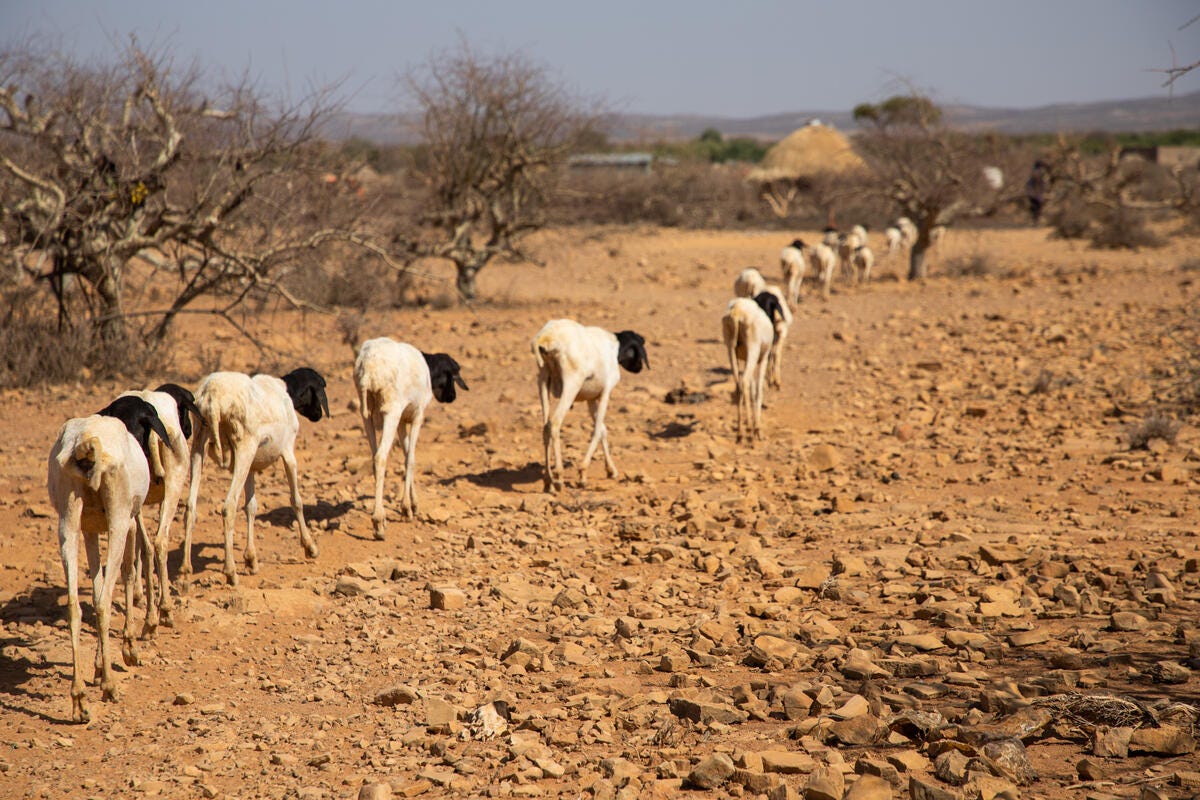
When El Niño-linked weather extremes hit agrifood systems, the damage can be counted in failed crops, dead livestock, flooded fields and lost income. July 20, 2026. Photo Credit: FAO
The World Food Programme (WFP) estimates that this El Niño could push almost 49 million more people into acute hunger by the end of 2027.1 The money to prevent that has not come. By the UN’s own count, less than 1 percent of humanitarian funding goes to acting before predictable disasters like this one.2 The joint early-action appeal by the Food and Agriculture Organization (FAO) and WFP asks for just $202 million to help 8.8 million people prepare before the worst arrives.3 By late September it had received about $40 million, roughly one-fifth.4
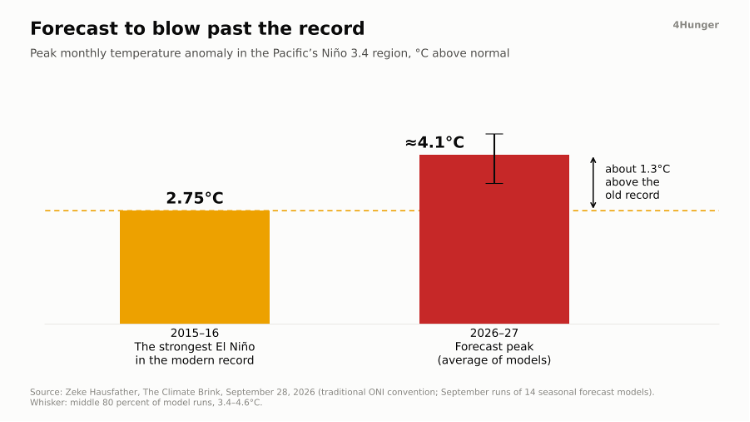
The El Niño that 4Hunger.org has tracked since spring is now the strongest ever recorded by the most widely watched measure, and it has not yet peaked. NOAA has put the odds of a very strong event above 90 percent since September. In its October 8 update, it gave this El Niño an 83 percent chance of becoming the strongest since its records began in 1950, measured over October through December, up from 75 percent a month earlier.5 On September 20, the daily reading in the Niño 3.4 region of the Pacific passed the previous record of 3.08°C above normal, set in November 2015.6 By mid-October it had reached about 3.4°C above normal, and on October 5 the surface there passed 30°C (86°F) for the first time on record.7
The latest runs of the 14 forecast models Hausfather tracks put the peak around 4.1°C, with the middle 80 percent of runs between 3.4°C and 4.6°C. That is far above the 2015-16 record, which was about 2.6°C as a three-month average and 2.75°C for its peak month.8,7 The World Meteorological Organization’s latest outlook, published October 26, forecasts that the central Pacific may run 3.8°C above average from November through January, with the peak toward the end of 2026 and effects lasting well into 2027.9 No one can say exactly what an El Niño this large will do. No forecast model has been tested against one, because nothing in the record comes close.
El Niño reshapes the weather in many places at once. It shifts rain and heat across the tropics and, through the jet streams, far beyond them, moving storm tracks across North America and raising global temperatures. It is the only major climate pattern known to cause crop failures and floods on several continents in the same season.10 This article sets out what the evidence says this El Niño will do, what it is already doing, what it means for the world’s food supply, and who will go hungry, or starve, if help does not arrive before the harvests fail.
The forecast came months early. The money to prepare for the droughts and floods that follow has been slow to come, and that gap, along with decisions made in capitals around the world, will decide how many people go hungry, face famine and starve.
Reading the Odds: What Past El Niños Tell Us
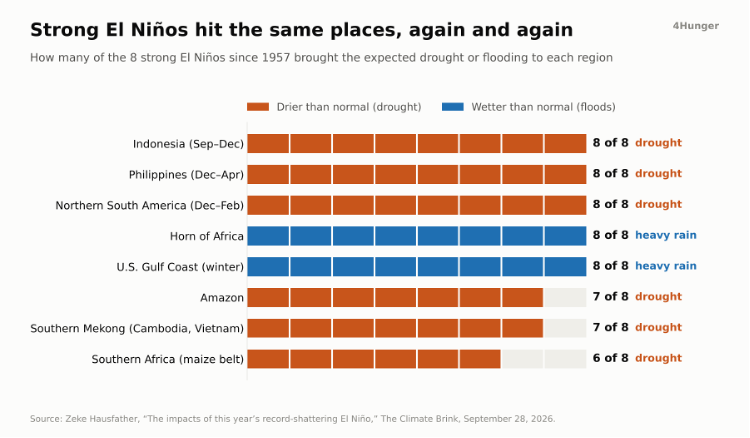
El Niño shifts the odds rather than guaranteeing an outcome, and those odds are well documented. Climate scientist Zeke Hausfather checked 26 regions against the eight strongest El Niños since 1957 and found that 86 percent of the time, a region saw the impact the research predicted. The two strongest past events, 1982-83 and 1997-98, delivered the expected impact in every region. This year’s El Niño looks most like those two, but it is much stronger.10 That means we know, with unusual confidence, where droughts and floods are most likely to destroy crops, and aid could be staged there in advance. Yet very few of those preparations are under way.
The most reliable impacts have shown up in nearly every strong El Niño on record. Indonesia was drier than normal from September through December in all eight. So were the Philippines from December through April, and northern South America from December through February. The Horn of Africa was wetter than normal in all eight, and so was the U.S. Gulf Coast in winter. “Wetter” does not mean gentle rain. Falling on drought-baked ground, it means downpours, flash floods and mudslides. The Amazon and the southern Mekong in Cambodia and Vietnam went dry in seven of eight. Southern Africa, where tens of millions depend on the maize harvest, was drier than normal in six of eight.10
The caveat is that nothing in the record looks like this event. All eight past El Niños were strong; this one is forecast to be far bigger than any of them. Larger impacts are likely where the signals are most reliable, but forecasters are working beyond anything they have seen.10 NOAA makes the same point: with an event this large, impacts are more likely but not guaranteed.5 Even strong signals can miss. In 1997-98, Southern Africa’s expected drought never came. In 2015-16, Southern California got about two-thirds of its normal rain despite a near-unanimous forecast for a wet winter.10 Those forecasts missed, but nothing rules out impacts more severe than any seen before. Nor is every flood or drought this year El Niño’s doing; the Pan American Health Organization, for one, notes that not all of the events it tracks in the Americas have been directly attributed to it.11
Climate Change Made a Hotter Planet, and El Niño Will Make a Hotter 2027
Global temperatures peak a few months after the Pacific does. Hausfather gives 2027 a 95 to 96 percent chance of being the warmest year on record.10 El Niño’s droughts and fires in the tropics also weaken the forests and soils that absorb carbon dioxide. After the last El Niño, the growth of carbon dioxide in the atmosphere hit a record in 2024, and a similar spike is likely in 2027.10
The fires have already started. Indonesia’s forestry ministry counted more than 200,000 hectares burned by the end of July, more than double the total for all of 2025, and the smoke closed schools across the border in Malaysia’s Sarawak state.12 By September 21, Indonesia’s health ministry had recorded more than 170,000 cases of acute respiratory infection in haze-hit provinces, more than 40,000 of them in toddlers.13 NASA scientists call what comes next a cascade: El Niño’s fires start in Indonesia and then move to the Amazon. That second wave has arrived. Since September, satellites have recorded a sharp rise in fires across the central and eastern Amazon, and on October 12 smoke blanketed Manaus, a city of more than 2 million.14 Brazil’s space agency counted 9,045 fire hotspots in the Brazilian Amazon in the first half of October, 62 percent more than a year earlier.15 The heat itself also kills. The University of Chicago’s Climate Impact Lab projects that El Niño’s heat could cause up to 451,000 additional deaths worldwide through February 2027, most of them in the Global South, led by Nigeria, Indonesia, Sudan and Brazil.16
The link to climate change needs careful handling. There is no scientific consensus that climate change makes El Niño more frequent or more intense. But it can amplify the impacts, because a warmer ocean and atmosphere hold more energy and moisture for heat waves and heavy rains.17 For every 1°C of warming, the air can hold about 7 percent more water vapor, which is why the heaviest downpours are getting heavier.18 This El Niño is landing on the hottest oceans ever measured. On August 22, the global average sea-surface temperature hit 21.1°C (about 70°F), the highest daily reading on record.19
Big El Niños are often followed by La Niña, which tends to reverse the pattern: drought where there were floods, and floods where there was drought.20 For farmers, that can mean two bad seasons in a row. Rain that falls on drought-baked soil runs off as floods instead of soaking in, and a dry spell that follows a waterlogged planting season can kill the crop. Two bad harvests means a spike in acute hunger and even famine.
Who Goes Hungry
This El Niño arrives when more communities are living in food crises than ever, with less money to help them.21 Across Sub-Saharan Africa alone, about 149 million people already face crisis levels of food insecurity.22 Worldwide, the Global Report on Food Crises counted about 266 million people in 47 countries and territories facing high levels of acute food insecurity in 2025, nearly double the number in 2016.23
WFP’s climate lead, Richard Choularton, says two kinds of places worry him most. The first are places already in crisis, like Somalia. During the 2022-23 drought, WFP reached 10 million Somalis with food and helped stave off famine. This time, it has the money to reach only 670,000. After a severe drought, Somalia could now face intense floods.21 Somalia’s needs are greater this time. What has shrunk is the international humanitarian funding.
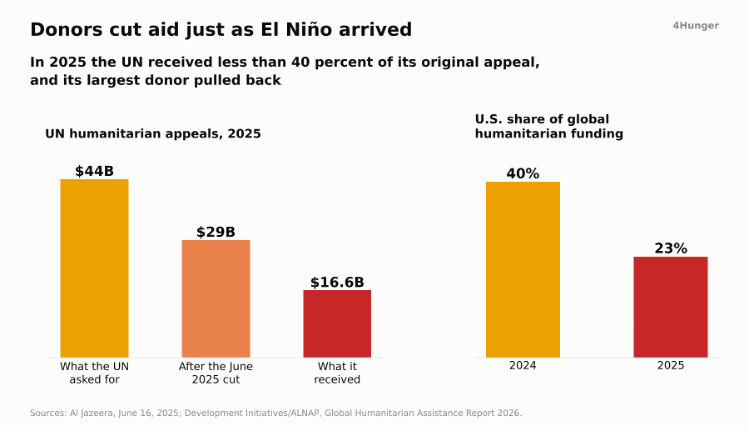
The money is missing because the wealthiest donor countries cut it. The United States closed USAID in July 2025, and its share of government funding to the humanitarian system fell from about 40 percent to 23 percent.24 Congress gave the main U.S. food aid program, Food for Peace, $1.2 billion for 2026, about a quarter less than the year before, and moved it to the Department of Agriculture.25 Germany, the United Kingdom, France and Japan are cutting their aid budgets as well; the UK is reducing aid to 0.3 percent of national income by 2027.26 In June 2025, the UN cut its global appeal from $44 billion to $29 billion, blaming what it called the “deepest funding cuts ever.” For the year, UN-coordinated appeals raised $16.6 billion and met only 35 percent of what was needed, the largest gap on record. International humanitarian funding fell 20 percent in 2025 alone.24 The donor countries that historically stepped up when forecasts warned of disaster have this year stepped back.
The second kind of place is one that has not finished recovering from the last disaster, like Southern Africa, still recovering from the 2015-16 and 2023-24 El Niño droughts.21 In 2023-24, the region had its driest season of any strong El Niño on record.10 Its governments appealed for $5.5 billion to help more than 61 million people, and by August 2024, with 68 million people in need, they were still appealing for help.27
Now the same forecast is back. In August, the Southern African Development Community’s (SADC) regional climate forum predicted below-normal rain from October through December across much of Angola, southern Zambia, Zimbabwe, Mozambique, Namibia, Botswana, most of South Africa, Eswatini and Lesotho, with the dry signal persisting into early 2027.28 The exact time for their single maize crop.
In southern Madagascar, 1.9 million people were already projected to face crisis-level hunger or worse before the rainy season began. Across 13 Southern African countries, the UN counts 84 planned early actions costing $111.3 million, and about 80 percent of them are unfunded.29 SADC governments met in Johannesburg on October 20 to update their contingency plans.30
The damage has already begun in Central America, where the first growing season has failed. In the 354 Dry Corridor communities assessed by Oxfam and Action Against Hunger, nearly every maize-growing household lost its first harvest.31 Many of the region’s hungriest people buy up to three-quarters of their food with wages from work on other farms. When farmers expect a bad year, they plant less and hire fewer workers, so hunger spreads well beyond the farms that lose their crops.21
Honduras declared a drought emergency in August, El Salvador declared a national emergency on October 7, and Guatemala launched a $64.5 million food-aid plan for more than 1.2 million families.32 Honduras has also paid for cloud-seeding flights, a tactic many meteorologists doubt, while one village the AP visited received its first food aid only in October.33 Across the Americas, PAHO counts more than 5.2 million people affected by, exposed to or facing acute hunger from El Niño’s impacts, and eight countries or territories have issued emergency declarations or alerts.11
In some places, the hunger has already arrived. In Papua New Guinea, about 1.2 million people are estimated to need direct food relief, and in October the government declared a National Humanitarian Crisis and approved a 1.65 billion kina (about $370 million) El Niño package.34 In Uganda’s Karamoja region, a five-month drought has destroyed about 98 percent of crops; local officials report at least 19 starvation deaths in Kotido District alone, and food-security analysts expect 122,100 young children to need treatment for acute malnutrition through February.35 In South Sudan’s Kapoeta North, a mother of four told WFP: “There is no sorghum. Everything has dried up.”36 In Cambodia’s Siem Reap province, rice is dying in the fields. “This year is definitely a loss. It’s all scorched,” farmer Sokhoeun Chhut told the FAO. The FAO expects about 127,300 hectares of Cambodian farmland and pasture to be affected.37
In Ethiopia, the June-to-September rains that grow more than 85 percent of the country’s crops were among the poorest on record. FEWS NET warns that the main harvest could come in as much as 30 percent below average, with Tigray, eastern Amhara, Afar and eastern Oromia hit hardest. In Tigray alone, regional planners count more than 3.7 million people facing drought and a $623 million funding gap.38
In Sudan, El Niño is bringing heat and drought to a country at war. On October 12, the IPC, the UN-backed hunger monitor, warned that famine risk is growing in conflict-affected parts of Darfur and Kordofan, with El Niño-induced drought compounding already dire conditions. WFP expects 350,000 more people to face severe hunger by the end of 2026 and 1.2 million more by August 2027, and says it needs an extra $134 million to respond.39 In South Sudan, where 7.8 million people already face high levels of acute food insecurity, WFP says drought has hit the most fertile farming areas.40
Across the West African Sahel, rain this season fell more than 40 percent below average in some places, with the worst deficits in Chad, Niger and Mali. FEWS NET expects El Niño to add most to hunger in Chad, where needs will peak between March and August 2027. In Pakistan, monsoon rain was well below average across much of Sindh, Balochistan and southern Punjab, and FEWS NET expects hunger there to peak from January through March.41
Across Asia and the Pacific, the drought is already costing harvests. In the Philippines, El Niño had damaged 8.57 billion pesos’ worth of crops by October 21, affecting more than 288,000 farmers on 291,000 hectares, and more than 100 cities and towns have declared a state of calamity. The agriculture department expects losses to reach 20 billion pesos, and the government is weighing a national state of calamity as forecasters warn the dry-season rice crop could lose up to 1 million tonnes.42 In the Pacific, Tonga declared drought across all of its major islands in October, Vanuatu declared drought in its northern provinces in July, and Fiji has put dry-weather water plans into effect as remote islands ask for drinking water.43
The floods have started, too. In Peru, where a coastal El Niño arrived early in the year, the government placed more than 700 districts under a state of emergency in February.44 Between December 2025 and August 2026, heavy rain, floods and landslides there killed 70 people and damaged 633 health facilities, PAHO reports.11 On September 30, seven rivers burst their banks in Ecuador’s Esmeraldas province, affecting about 1,500 people in a single canton, although Ecuadorian scientists disagree on how much of that rain El Niño caused.45 By October 20, Ecuador’s risk agency had counted more than 23,000 people affected by rain and related emergencies across 22 provinces since it declared a national red alert on August 29.46
In mid-October, rivers swollen by El Niño rains flooded parts of northeastern Argentina, southern Paraguay and western Uruguay. More than 2,000 people were evacuated in Argentina, where two died, and the Iguazú River ran at ten times its normal flow.47
Mogadishu flooded in April and again in mid-September, when heavy rain disrupted a clinic supported by the International Rescue Committee.48 Somalia’s October-to-December rains are forecast to be above normal. Its disaster agency estimates that 2.5 million to 3.5 million people could be exposed to flooding, and aid agencies project that close to 875,000 could be displaced. In 2023, under similar conditions, floods displaced 1.2 million.49 In Kenya, the Red Cross warns that more than 2 million people in 46 of the country’s 47 counties could be affected by the same rains.50
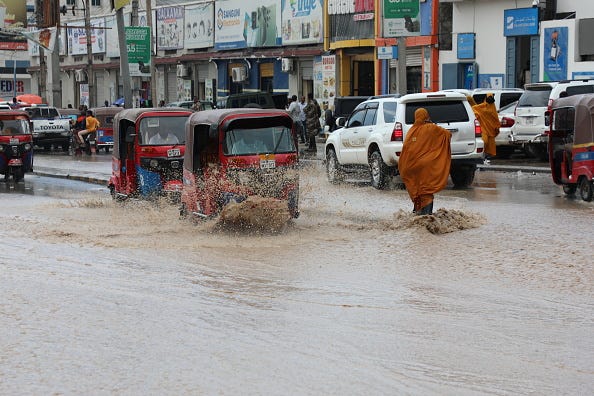
People try to cross flooded streets following heavy rain in Mogadishu, Somalia, on April 28, 2026. Photo Credit: Abuukar Mohamed Muhidin/Anadolu via Getty Images
The worst is still to come. In Malawi, 2.6 million people are projected to face crisis-level hunger in the October-to-March lean season, and that projection only partly accounts for El Niño.29 The Famine Early Warning Systems Network (FEWS NET) expects flooding along Somalia’s Shabelle and Juba rivers to destroy crops, drown livestock and displace families, with needs peaking from October through December.51
Children bear the heaviest risk. UNICEF counts more than 40 million children in eight Eastern and Southern African countries living where October-to-December rains are forecast to be unusually wet or dry because of El Niño.52 (An earlier UNICEF figure of 162 million counted children in the region exposed to drought or flooding from all weather patterns, not El Niño alone.53) Another 25.8 million children are exposed to its most severe droughts and floods in Latin America and the Caribbean.54 Worldwide, UNICEF counts more than 347 million children in nearly 100 countries living in areas expected to see unusually wet or dry conditions from October through December 2026.55
Disease is following the weather. Peru has recorded nearly 79,000 dengue cases this year, 122 percent more than at the same point in 2025, and on October 21 its health authorities issued a national alert warning that El Niño could drive a second wave. Indonesia, where major dengue outbreaks have followed each recent El Niño, expects cases to climb from November. The World Health Organization warns of rising cholera, malaria and dengue where floods hit, and of heat stress and malnutrition where drought does.56 The damage can last for years. A study published in Nature Climate Change in January found that the 1982-83 and 1997-98 El Niños cut life-expectancy gains across high-income Pacific Rim countries by about half a year and 0.4 years, respectively, with mortality improvements still weaker five years later.57
Breadbaskets at Risk: The Harvests in the Wrong Places
For the first half of 2027, the evidence points to drought risk for maize in Southern Africa, rice in the Philippines and Southeast Asia, and a range of crops in northern South America.10 The last time a strong El Niño struck, in 2015, maize and rice output fell in major producing countries and prices rose.58
India has already lost part of its harvest. Its monsoon ended on September 30 about 13 percent below normal, the weakest in more than a decade. East and northeast India had their lowest monsoon rainfall since 1901, and the weather service expects below-normal rain to continue through December.59 In late September, citing El Niño, India’s farm ministry cut its foodgrain production target for 2026-27, and paddy planting fell by about 1.6 million hectares.60 The U.S. Department of Agriculture now projects India’s rice crop at 147 million tonnes, down 4.5 percent and its first decline in a decade. India is the world’s largest rice exporter, so a smaller crop there is felt far beyond its borders.61
The next test for India is its winter wheat crop. The country’s weather service expects below-normal winter rain and above-normal temperatures across most of India, and agricultural scientists warn that summer-like heat could arrive as early as February, when wheat is filling its grain.62 Water to irrigate it is running short. On October 15, storage in India’s 178 major reservoirs stood more than 16 percent below the 10-year normal, and a week later it had fallen to about 67 percent of capacity.63 Andhra Pradesh has declared drought in 388 of its 688 mandals (sub-districts), Telangana reports severe drought in 320 mandals, and Karnataka has declared drought in 101 taluks.64 South India’s October-to-December monsoon is forecast to bring normal rain, but El Niño years have brought extreme rain there before: in 2015, floods in early December left Chennai declared a disaster zone.65 Prices are already moving. The Reserve Bank of India’s inflation forecasts are above 5 percent for every quarter through mid-2027,66 and an Indian rice exporter expects prices to rise 10 to 15 percent in the last quarter of 2026. For now, large government stocks are keeping India’s rice exports flowing.67
Australia shows that a smaller harvest is not the same as a failed one. Its wheat crop is forecast to fall 17 percent, to 29.9 million tonnes, but a wet winter in the south should still leave it above the 10-year average.68 The losses are concentrated in Queensland, where the winter crop is forecast to drop 44 percent.68 Even so, the International Grains Council expects wheat production to fall across most major exporters, which would push world prices up.69
Not all of the harvest grows on land. Off Peru, the national El Niño commission (ENFEN) said on October 16 that the coastal El Niño is likely to stay at “extraordinary” magnitude, its highest category, through January 2027.70 Peru’s anchovy fishery, the largest single-species fishery in the world and a main source of the fishmeal that feeds farmed fish and livestock, has been hit first.71 Warm water has driven the anchovy deeper and out of reach. Landings in the first fishing season of 2026 came in at about a quarter of what was expected,72 and in August Peru canceled the rest of its North-Central season with more than a million tonnes of quota uncaught.73 Global fishmeal production fell 49 percent in the first seven months of 2026 compared with a year earlier.74 Artisanal fishers are traveling farther for smaller catches, and some families have left fishing for construction work.75
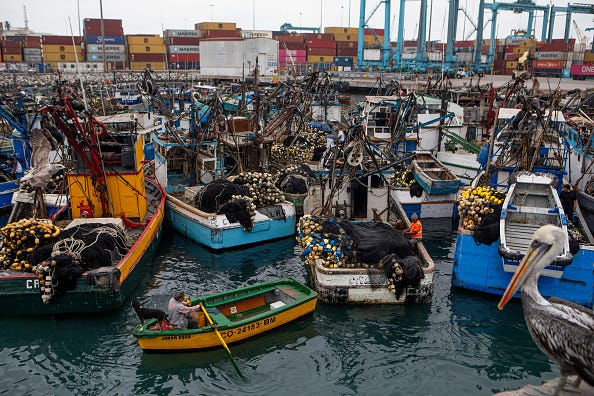
Fishing boats at the Port of Callao in Callao, Peru, on Wednesday, July 22, 2026. Photo Credit: Marco Garro/Bloomberg via Getty Images
The world as a whole is not short of grain. FAO forecasts 2026/27 cereal production to stay historically high, though below last year’s record, with ample stocks to cushion supply. But FAO warns that the outlook depends on El Niño and on energy and fertilizer markets disrupted by conflict.76 History supports that view. FEWS NET finds that global maize, wheat and rice output has changed little, on balance, in strong El Niño years since 1980, because losses in some exporters are offset by gains elsewhere. It also warns that the worst hunger usually comes in the following lean season, months after the rains fail.41 The danger of hunger, and even famine, lies in failed harvests in the places that grow their own food and cannot afford to import more.
This El Niño is also arriving on top of the price shocks of two wars, in Iran and in Ukraine. Conflict has disrupted the Strait of Hormuz, the Red Sea and the Black Sea, what WFP calls the “triple chokepoint,” driving up food, fuel and fertilizer prices.21 Before the war, about a third of the world’s traded urea, the most widely used nitrogen fertilizer, passed through the Strait of Hormuz.77 The World Bank projects fertilizer prices 31 percent higher on average in 2026, the least affordable since 2022.78 In October, the UN Development Programme warned that high fuel prices, El Niño and rising borrowing costs are hitting developing countries at once, leaving many governments little room to protect their poorest people.79
The drought is also squeezing the routes and power grids that move food. The Panama Canal, which carries about 5 percent of world maritime trade, has cut the maximum draft for its largest ships five times this year as Gatún Lake falls, so each vessel carries less cargo.80 Colombia, which gets most of its electricity from hydropower, came close to power rationing on September 28 and 29; river inflows are running at about 60 percent of normal, and the grid operator warns rationing could come in March and April.81 In Panama, the government authorized extra rice imports in June after El Niño delayed harvests and cut yields.82 Vietnam has told its Mekong Delta provinces to plan for saltwater intrusion as severe as the record 2019-20 season, with about 350,000 hectares of winter-spring rice at risk when salinity peaks between January and April.83 Cocoa and robusta coffee, two of the crops most exposed to El Niño’s heat and drought, are also at risk; USDA already expects Indonesia’s coffee crop to fall 8 percent.84
Fertilizer that was never applied this year will show up as smaller harvests next year. WFP describes how this plays out in Southern Africa: higher fuel makes plowing more expensive, so less land is plowed and fewer seeds and less fertilizer go into the ground. Add an El Niño drought, and WFP expects very serious food security impacts in 2027.21
Southern Africa does have one buffer. Its 2026 cereal harvest was about 10 percent above the five-year average, which FAO says may help cushion a poor maize crop next year.22 That buffer is unlikely to survive a second bad season.
American readers will feel this too. When India banned most white rice exports in July 2023, during the last El Niño, FAO’s rice price index jumped nearly 10 percent in a single month to a 15-year high.85 For now, India is holding more than 38 million tonnes of rice in government stocks, well above its buffer target, though USDA expects its exports to fall 4 percent in 2027.61 If India restricts exports again, on top of war-driven fuel and fertilizer prices, the effect would reach U.S. grocery shelves and the food banks already absorbing higher costs at home.
El Niño is already reaching U.S. shores in other ways. A Kelvin wave, a pulse of warm water pushed north from the tropics, was forecast to raise sea levels along the California coast by up to a foot by mid-October, adding to the damage from high tides and winter storms.86 Hawaii has been brushed by two hurricanes, Lala in August and Lowell in September, which brought damaging wind, flooding rain and the first tornado watch ever issued for the islands. The Atlantic, by contrast, set a record for the latest start to its hurricane season in the satellite era.87
The Forecast Worked. The Money Has Been Slow.
The tools to soften this El Niño exist, and they are cheap compared with what follows if they go unused. Anticipatory action means acting on the forecast before the drought or flood arrives: cash to families before prices spike, drought-tolerant seed before planting, water storage, livestock protection and flood defenses. FAO and WFP estimate that every dollar spent this way can save up to $7 in avoided losses and response costs.3 Doing nothing is far more expensive. One study in Science estimated that the 1997-98 El Niño cost the world $5.7 trillion in lost income over the following five years; another, in Nature Communications, put the losses at $2.1 trillion for 1997-98 and $3.9 trillion for 2015-16. The models differ, but both find damage that outlasts the event by years.88
It has been tested. During the 2015-16 El Niño, WFP tried forecast-based support in one Zimbabwe district. Food consumption there dipped only 2 percent after the drought, compared with a 35 percent drop in the neighboring district.21
Something similar is working in Cambodia now. Through FAO’s PEARL project, more than 4,000 farmers receive weather bulletins and farming advice by phone. Sokhom Kha, who farms in Preah Vihear province, knew 10 days ahead that the rain would not come, so she closed her field dikes and stored water in time.37
In June, FAO and WFP launched their first joint appeal for anticipatory action: $202 million to protect 8.8 million people in 22 high-risk countries. Systems were already in place for 1.2 million people; the rest depends on new money.3 By September 25, the appeal had received only about $40 million.4 Norway, one of the few governments to step forward, gave about $2.8 million in July.89 The United Kingdom has made up to £15 million available for El Niño early action through its own humanitarian fund.90 Private donors are stepping in too: on September 17, the Novo Nordisk Foundation gave WFP $7.75 million for anticipatory action, the largest private contribution WFP has ever received for this work.91 WFP also has anticipatory action plans in more than 50 countries,92 and UNICEF is seeking $173 million for children in 13 countries in Eastern and Southern Africa.53 None of these appeals is close to fully funded: in October, the FAO-WFP appeal and a $110 million appeal from the International Organization for Migration were each only about one-fifth funded.93
Added together, it is not much. On October 22, Oxfam counted about $450 million available worldwide to prepare for and respond to this El Niño. In 2015-16, the last comparable event prompted a $5 billion appeal, and donors raised nearly $2 billion of it.93
On October 21, the heads of the UN’s weather and humanitarian agencies made a joint call for urgent early action. “This is literally off the monitoring charts that we have used for the past four decades,” said WMO Secretary-General Celeste Saulo.9 UN relief chief Tom Fletcher called this El Niño a “wrecking ball,” said the next two weeks would be critical, and released more than $50 million from the UN’s Central Emergency Response Fund to help 11 countries prepare, including Chad, El Salvador, Ethiopia, Somalia and South Sudan.94 That money is welcome, but it is small against the gigantic need. Almost all humanitarian aid still arrives after harvests have failed and children are already malnourished, when help costs more and does less.2
The Calendar
The dates below are when the forecast becomes a harvest, and when each chance to act closes.
• Now through early November: The two-week window UN relief chief Tom Fletcher called critical on October 21.94
• October–December 2026: Heavy rain and flood risk in the Horn of Africa; drought in Indonesia;10 below-normal rain and planting across much of Southern Africa.28
• October 30, 2026: Peru’s El Niño commission issues its next update.70
• November 9–20, 2026: The UN climate summit, COP31, in Antalya, Türkiye.
• November 12, 2026: NOAA’s next monthly El Niño update.5
• Now through January 2027: Greatest risk of an “extraordinary” coastal El Niño, with flooding, in Peru.70
• December 2026–February 2027: Drought risk across Southern Africa’s main maize season and northern South America.10
• December 2026–April 2027: Drought risk in the Philippines.10
• January–April 2027: Peak risk of saltwater intrusion in Vietnam’s Mekong Delta.83
• January–March 2027: Peak hunger in Pakistan after a failed monsoon.41
• February–March 2027: Heat risk for India’s wheat crop as the grain fills.62
• March 2027: The FAO-WFP anticipatory action appeal period ends.3
• March–May 2027: Drought risk peaks in the southern Mekong, Cambodia and southern Vietnam.10 In Cambodia, the drought has already begun.37
• March–August 2027: Peak hunger needs in Chad, first in pastoral areas and then in farming areas.41
• November 2027–March 2028: FEWS NET’s expected peak of hunger needs in Southern Africa, long after the rains fail.41
Four Choices Before the Harvests Fail
Months of warning, a record forecast and a clear map of where the harvests are most at risk have given the world something it rarely gets: TIME. How many of WFP’s 49 million actually go hungry now depends less on the temperature of the Pacific than on decisions made in donor capitals over the next few weeks.
Fund the appeal before the seed goes in the ground. FAO and WFP asked for $202 million to protect 8.8 million people and, as of late September, had received about a fifth of it. Southern Africa’s rains and planting season begin now. Seed and cash that arrive after planting come too late to protect anyone. Then expand the appeal: it covers 8.8 million of the almost 49 million people WFP expects this super El Niño to push into acute hunger.
Reverse the aid cuts before they become a death toll. International humanitarian funding fell by a fifth in a single year, just as the strongest El Niño on record arrives. Congress, and the governments of Germany, the United Kingdom, France and Japan, can restore emergency food and early-action funding now, at a fraction of what famine response will cost later.
Make anticipatory finance the rule at COP31. When the climate summit opens in Antalya, Türkiye, on November 9, governments should commit a fixed share of humanitarian and climate adaptation funding to action before disasters, not after. Putting less than 1 percent of humanitarian aid into prevention is not a strategy.
Treat the chokepoints as a hunger emergency. Higher fuel and fertilizer prices are already shrinking next year’s harvests before El Niño’s droughts arrive. Keeping fertilizer and food moving to the most exposed countries is as much a part of preparing for El Niño as cash and seed.
El Niño will decide where the rain falls. It will not decide who goes hungry. That decision is still ours and our political leaders’, and the deadline is the planting season, not the famine declaration. The money needs to be disbursed in the next two to four months, depending on the country, or it will be too late. If it is not sent by then, it will be spent on body bags instead of seed and flood protection.
Call your members of Congress and ask them to restore emergency international food aid and fund early El Niño action now, before El Niño’s forecast becomes a famine.
U.S. Capitol switchboard (House and Senate): (202) 224-3121. The operator will connect you to your senators or your representative.
Your representative: find your representative by ZIP code at house.gov or ask the House switchboard operator at (202) 224-3121.
Your senators: find your senators’ direct office numbers at senate.gov or ask the Senate switchboard operator at (202) 224-3121.
Great report, thank you, Mark! How are the Rich nations supposed to fund world hunger issues when they are required to arm up for imaginary threats?
Dear Mark; I wept like ... one who can read behind the numbers when reading. My extract - above the share of your article; ended like this. Its a marvellous and so solid and valid piece of work. Again. I pressed " followers too".
" A / T E S T I M O N Y
O / F / A I L U R E !
C A U S I N G / H U N G E R / A N / D / E A T H !
Due to a global, especially American - withdrawel of funds;
to W A R s and the El Nino F U E L L E D by W A R S for real, and the ongoing war on climate and nature.
This fine and in depth study by Mark Roberts is confirmed by all posts and reportswe shared today; from Oxfam, The Lancet report and the latest El Nino alarm by World Meteorological Organization .
It ends like this; in a global warning and
A P P E A L: this is a H U M A N caused
H U N G E R - E M E R G E N C Y ;
Reverse the A I D cuts, before they become a deathtoll.
Children bear the heaviest risk.
UNICEF counts more than 40 million children in eight Eastern and Southern African countries living where October-to-December rains are forecast to be unusually wet or dry because of El Niño.52
An earlier UNICEF figure of 162 million counted children in the region exposed to drought or flooding from all weather patterns, not El Niño alone.53.
Another 25.8 million children are exposed to its most severe droughts and floods in Latin America and the Caribbean.54 Worldwide, UNICEF counts more than 347 million children in nearly 100 countries living in areas expected to see unusually wet or dry conditions from October through December 2026.55
W H A / T / O / D O : T O / S A F E / L I F E S !
Four Choices Before the Harvests Fail
Months of warning, a record forecast and a clear map of where the harvests are most at risk have given the world something it rarely gets: TIME. How many of WFP’s 49 million actually go hungry now depends less on the temperature of the Pacific than on decisions made in donor capitals over the next few weeks.
Fund the appeal before the seed goes in the ground. FAO and WFP asked for $202 million to protect 8.8 million people and, as of late September, had received about a fifth of it. Southern Africa’s rains and planting season begin now. Seed and cash that arrive after planting come too late to protect anyone. Then expand the appeal: it covers 8.8 million of the almost 49 million people WFP expects this super El Niño to push into acute hunger.
Reverse the aid cuts before they become a death toll. International humanitarian funding fell by a fifth in a single year, just as the strongest El Niño on record arrives. Congress, and the governments of Germany, the United Kingdom, France and Japan, can restore emergency food and early-action funding now, at a fraction of what famine response will cost later.
Make anticipatory finance the rule at COP31. When the climate summit opens in Antalya, Türkiye, on November 9, governments should commit a fixed share of humanitarian and climate adaptation funding to action before disasters, not after. Putting less than 1 percent of humanitarian aid into prevention is not a strategy.
Treat the chokepoints as a hunger emergency. Higher fuel and fertilizer prices are already shrinking next year’s harvests before El Niño’s droughts arrive. Keeping fertilizer and food moving to the most exposed countries is as much a part of preparing for El Niño as cash and seed.
El Niño will decide where the rain falls. It will not decide who goes hungry. That decision is still ours and our political leaders’, and the deadline is the planting season, not the famine declaration. The money needs to be disbursed in the next two to four months, depending on the country, or it will be too late. If it is not sent by then, it will be spent on body bags instead of seed and flood protection.
Call your members of Congress and ask them to restore emergency international food aid and fund early El Niño action now, before El Niño’s forecast becomes a famine. https://www.facebook.com/profile.php?id=61565699637497