

The forecast is public, the numbers are published, and the appeal meant to prevent the worst of it covers fewer than one person in five at risk of El Niño caused acute hunger. The General Assembly has to change that during this meeting.
“Man’s inhumanity to man makes countless thousands mourn.” Robert Burns
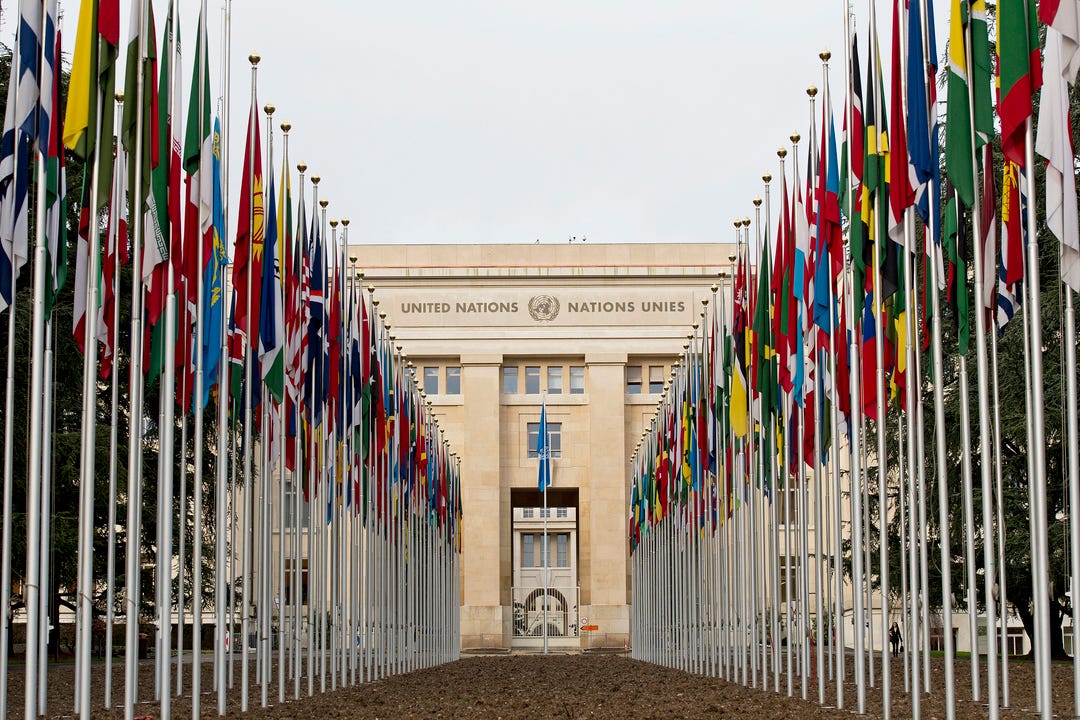
Photo Credit: United Nations
One hundred and fifty years ago, the tropical Pacific warmed to what remains, by most reconstructions, the most extreme El Niño in the instrumental record. Rain that should have fallen as the monsoon on Asia fell into the ocean instead. Between 1876 and 1878 drought struck India, northern China, Brazil, Egypt, Morocco, Southern Africa and Australia all at once. Tree rings suggest Asia’s drought was the worst in eight hundred years. Somewhere between thirty and sixty million people died, roughly 3% of the human population, and in India the colonial government went on exporting record tonnages of wheat while the people of India starved.
Nobody in 1876 knew why the failed monsoon was happening. The word El Niño had not entered the scientific literature; the Southern Oscillation would not be described for another forty years. The rains simply stopped, and then people died, and the connection between Peru’s warm water and the Deccan’s failed harvest was invisible to everyone it killed.
That is the only thing about this year that is different. Everything else is the same physics. All of the physics and whether projections are reported widely, weekly and can be read by everyone.
What the hundred and fifty years of records now tell us
El Niño does not create or destroy rain. It moves it. Warm water in the eastern Pacific shifts the convection that drives global circulation, and the rain that falls reliably in one place falls somewhere else instead. The result is not one disaster but a pattern of them, and after a century and a half of observation the pattern is well enough mapped that the affected regions can be named in advance: drought through southern Africa, parts of the Horn, Indonesia, the Philippines, northeastern Brazil and Central America’s dry corridor; flood through eastern East Africa, coastal Peru and Ecuador, and parts of the Southern Cone.
On September 10, the United States Climate Prediction Center put the probability of a very strong El Niño developing through this autumn and winter above 90 percent, with a 75 percent chance of exceeding the strength of any event recorded since 1950. Sea surface temperature anomalies in the eastern equatorial Pacific already run an unprecedented more than three degrees Celsius above normal. In August, the Meteorological Services of Southern Africa agreed in regional consensus that rainfall will run below normal across most of the subcontinent from October, getting even worse from January. The Regional Forum for the Greater Horn put a ninety percent probability on the opposite for other parts of Africa: rain well above normal, with flooding across southern Ethiopia, central and southern Somalia and northeastern Kenya during the same months.
That is the 1876 pattern, repeated many times, now forecast, published, and free for any government to read.
The projections
The World Food Programme published its estimate in August. Across 45 countries that are already food insecure, and where El Niño will materially shift rainfall and temperature, the number of people in acute hunger is projected to rise from roughly 225 million to 274 million by the end of 2027. That is an increase of at least 49 million people, about 22%. The largest effects are expected in parts of Central America and southern Africa, with significant impacts in eastern Africa and South and Southeast Asia. The African Development Bank estimates the event could cost affected African economies up to $20 billion in lost output.
Nineteen African countries have already lost part of a harvest. Malawi has 2.6 million new people projected to suffer from acute hunger this lean season; Madagascar has 3.7 million expected at crisis levels or worse between October and January. Rice sowing has already been delayed across the Philippines, Cambodia, Thailand and Vietnam.
An appeal sized to what donors might give, not to the Hunger that is coming
On June 18 the Food and Agriculture Organization and the World Food Programme issued the first joint anticipatory action appeal either agency has ever made. They asked for $202 million to protect 8.8 million people across 22 countries, running to March 2027.
Read that appeal to help 8.8 million people against the 49 million people who are projected to suffer from El Niño induced acute hunger. The appeal covers eighteen percent of the expected additional caseload. The other eighty-two percent have no humanitarian aid pointed at them at all.
This was not an oversight. It was an appeal written by people who had watched the funding collapse of the preceding year. In 2025 official development assistance fell 23% in real terms, the largest annual decline on record; humanitarian assistance fell nearly 36%; bilateral aid to sub-Saharan Africa fell 26%; and for the first time every one of the five largest donors countries cut humanitarian aid simultaneously. The agencies asked for what they thought they might plausibly be given. They did not ask for what the forecast actually requires.
Even that has not been funded. Three months on, neither agency will say how much of the $202 million has been raised, and there is no entry against the appeal in the UN’s own financial tracking service, because that service reports against coordinated plans and an inter-agency appeal does not get a page. What has moved came through other doors: an offer of up to $100 million from the Central Emergency Response Fund with more than $20 million already allocated, $6 million released for southern Madagascar in early September, and $7.75 million committed on September 17 by the Novo Nordisk Foundation, the largest private-sector investment in anticipatory action ever recorded. A pooled fund and a pharmaceutical company’s charity. No donor government has publicly announced a funding commitment earmarked to the appeal or to El Niño relief.
What the whole problem would cost
Nobody has to estimate what this El Niño will cost, because the estimate exists. In July the Peterson Institute for International Economics published a costing of this event, built on a 2023 study in Science that attributed $4.1 trillion and $5.7 trillion in global income losses to the El Niños of 1982-83 and 1997-98. PIIE puts first-year losses at roughly $986 billion in 2027, about 0.8 percent of global GDP, and cumulative six-year losses at $17.6 trillion, and calls those assumptions conservative. The burden falls where it always does: $353 billion of the first-year loss lands on fifty-one countries, a hit of 3.6 percent of their combined GDP. And PIIE is explicit that while the first-year losses are largely baked in, the $6.2 trillion that follows is not. It represents crops not planted and clinics not stocked, all of it sensitive to whether help arrives in time.
Its recommendations are that development banks pre-position credit before the peak rather than after, and that humanitarian pre-positioning begin now, noting that WFP desperately needs capitalization after the United States cut its contribution by 54 percent in 2025. A Washington economics institute has arrived independently at the case the humanitarian agencies have been making since June.
So set the humanitarian appeal against the potential damage. The objection is always that the sums are unaffordable. They are not, and the agencies’ own figures settle it. The appeal protects 8.8 million people for $202 million, about $23 a head. WFP’s 2024 performance report puts the average cost of feeding someone already in crisis at $51 a year, or forty-five cents a day.
Protecting all 49 million people at risk of acute hunger in advance, at the appeal’s own unit cost, comes to roughly $1.1 billion. Feeding them afterward, at WFP’s own average, costs about $2.5 billion a year, and that is a floor, since emergency rations in hard-access countries run above the global average. For scale: WFP has received $3.7 billion this year from every donor in the world for every operation it runs, so the additional caseload alone would consume two-thirds of the WFP’s entire budget. Against the African Development Bank’s $20 billion, $1.1 billion of prevention is five percent of the damage on a single continent. Based upon the agencies’ own ratio of one dollar early to seven late, acting ahead of all 49 million stands against something near $8 billion in avoided losses.
Now hold those numbers against PIIE’s. The $202 million appeal is about one fiftieth of one percent of the losses this event is expected to inflict in 2027 alone. For every thousand dollars the world economy is about to lose, the two agencies have asked for twenty cents, and have not been given it. The $1.1 billion that would cover everyone forecast to move into acute hunger due to this El Niño is about one dollar and ten cents per thousand dollars of financial loss, roughly a tenth of one percent of the first-year damage.
Divide that where it belongs. The World Bank counts eighty-seven high-income countries, and not one of the twenty-two countries named in the appeal is among them. Spread across those eighty-seven high income countries, the $202 million already requested is $2.3 million each. The $1.1 billion that would cover everyone this El Niño event is forecast to push into acute hunger is about $13 million each, one mid-sized government contract, once. It is not a burden on anybody. It is a rounding error with a body count attached.
Why Does The Humanitarian Funding Have To Be Mobilized Starting This Month?
Southern Africa’s primary maize growing season is planted from October to December and harvested from April to June, straight into the forecast of the peak of El Niño. India’s “rabi” crops are sown October to December. In Brazil, soybean and maize planting opened this month in Mato Grosso, the country’s largest producing state, where El Niño is expected to bring heat and drought. Southeast Asia’s dry-season rice runs into the first quarter of 2027, and Central America’s “primera” maize crop is not sown until around May. So the decision window is October through December for most of the affected world, extending into the first half of 2027 for parts of Asia and the Americas, which is also, near enough, when the appeal expires.
Photo Credit: Oxfam South Africa
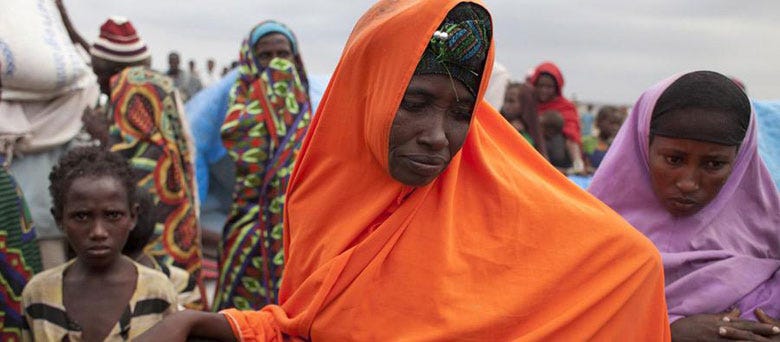
Within that window, the money has to arrive earlier still, because food aid is a purchase rather than a transfer. WFP’s own procurement rules state that buying may only begin once funds are actually in hand. Conventional international purchase and shipping runs three to four months. WFP also runs a fund that buys food before donors pay and stores it close to where it will be needed. When countries draw on those stocks, delivery has averaged nine days instead of months. Money committed this autumn becomes seed and food in time for the planting and the lean seasons that follow. Money committed in March arrives in the summer, after the hunger it was meant to prevent.
The appeal will not fail on the day it closes unfunded. It will fail months earlier, silently, on the day the last purchase that could have arrived in time is not made.
People who do the verification code thing aren't getting anymore comments. Nobody has time for that. Great presentation, thank you! Forwarded to the govt ppl. The amount of food needed is less than the food waste of the rich countries.
Thanks for laying this out so clearly.