

At its peak last summer, a heat dome settled over the United States and refused to move. More than 255 million Americans were placed under what meteorologists called “dangerous, life-threatening” conditions with triple-digit temperatures, punishing humidity, and nights that never cooled. It was not a freak event. It was not a statistical anomaly. It was the new baseline, arriving earlier and staying longer than the one before it and it is predicted to be worse this year.
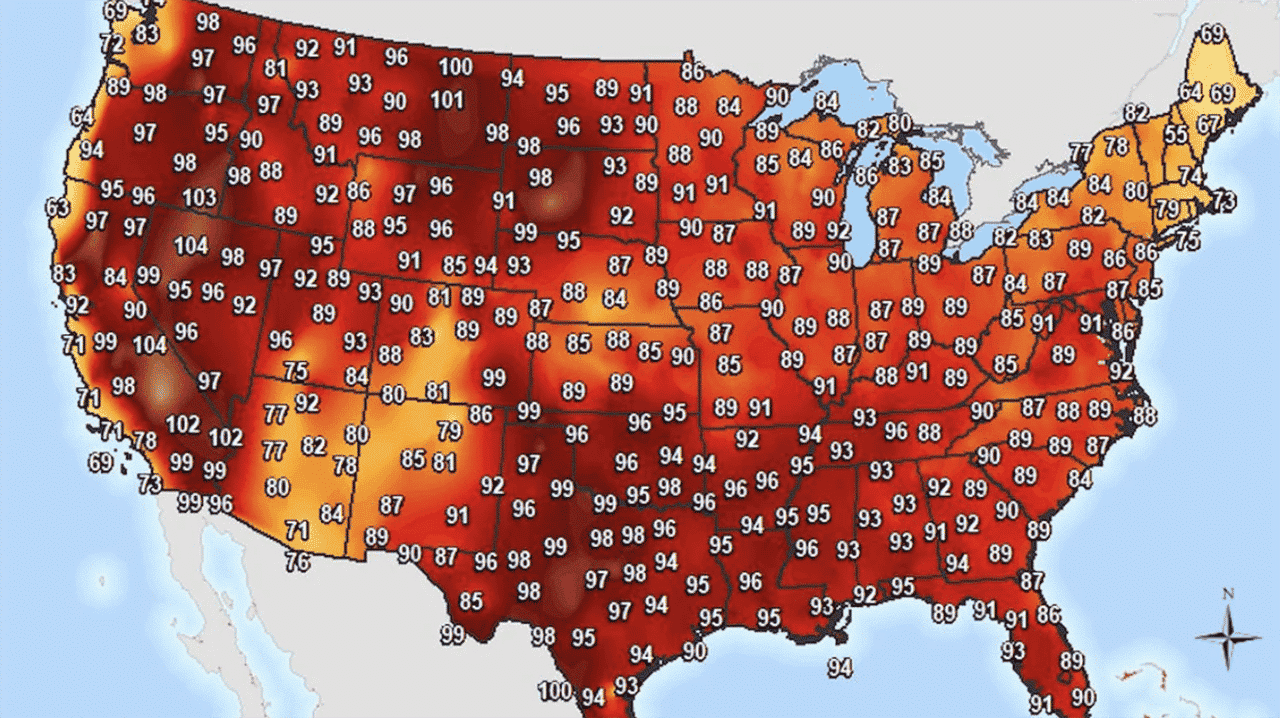
Photo Credit: EcoWatch
Extreme heat is now the deadliest form of weather in the United States. It kills more Americans every year than floods, tornadoes, and hurricanes combined. Climate induced extreme heat is destroying crops, straining the bodies of outdoor workers, triggering psychiatric emergencies, and driving food insecurity deeper into communities that had no cushion left to absorb another blow. And the people bearing the greatest weight of this crisis are low-income families, Black and Latino households, agricultural workers, the elderly, the disabled and veterans are the people who contributed the least to creating climate change, but who are suffering the most.
This is not a future problem. It is the present emergency hiding in plain sight and being totally ignored by the federal government!
🌡️ Not Just Hotter — Fundamentally Different
The first thing to understand about the new heat is that it has changed in character, not just in degree.
Heatwaves are no longer releasing their grip at night.
High-pressure heat domes now trap hot air for days or weeks at a stretch, eliminating the overnight cooling that allows the human body and the existing infrastructure keeping us alive to recover. When temperatures stay above 90°F at 2 a.m., the cumulative physiological toll is categorically different from a hot afternoon followed by a cool night. with these new heatwaves, the body never catches up.
They are arriving earlier.
Record-shattering temperatures hit Western North America in March 2026, catching populations, agricultural cycles, and public health systems unprepared before anyone had a chance to acclimatize. The heat season is no longer summer, it is most of the year.
Heatwaves are compounding the other symptoms of climate change.
Extreme heat arrives alongside stagnant air and drought, degrading air quality and drying out water reserves simultaneously. It does not arrive in isolation. It arrives on top of the flood that preceded it, the wildfire smoke still in the air, and the farm already stressed by years of moisture deficit.
The numbers tell the story of an acceleration that should alarm everyone. In cities across the United States, the average rate of extreme heat events increased from two per year in the 1960s to ten per year between 2010 and 2020. Record highs now occur twice as often as record lows across the continental US. The last 11 years have been the hottest 11 years ever recorded! Think about that for a second. Scientists have documented that there is a clear acceleration in warming beyond anything the previous 50-year trend would predict. The summer of 2025 was likely the coolest summer many Americans alive today will ever experience again.
“American families are being asked to absorb a climate shock they did not create, on bodies that were never designed for this heat, without the infrastructure or the safety nets that a crisis of this scale demands.”
🏥 What Extreme Heat Does to the Human Body
Extreme heat is the leading cause of weather-related death in the United States and the gap between heat fatalities and deaths caused by the next-closest weather category is not small, it is enormous.
The direct toll is staggering.
More than 21,000 deaths in the United States from 1999 to 2023 were heat-related, with mortality rates beginning to rise most sharply from 2016 onward. Between 2000 and 2025, heat deaths increased by more than 50% above historic baselines. In 2023 alone, high temperatures caused 28,000 additional injuries. By the 2090s, projections put cumulative additional deaths from extreme heat in major US urban areas at roughly 28,000 per year that means a 9/11 catastrophe every four months, every year, caused by the weather. The terrorists behind these deaths are the fossil fuel companies, their banks and the politicians who they have bought off and convinced not to take action on climate change.
Physiology is unforgiving.
Heat stress occurs when the body cannot cool itself effectively through sweating. When humidity is high, sweat evaporates more slowly, or not at all, pushing the body toward heat exhaustion and heat stroke. When extreme heat persists through the night, the cumulative stress builds without relief. For people without air conditioning, without the ability to leave work, without the means to pay a utility bill that has doubled, that cumulative stress actually kills.
Heat induced illnesses are not just a summer heart attack.
Research published in 2026 has increasingly identified chronic recurrent heat exposure as a driver of kidney disease, even in previously healthy outdoor workers. High heat and heatwaves exacerbate cardiovascular disease, respiratory conditions, and diabetes. For people already living with high blood pressure, COPD, or chronic illness, who are mostly people concentrated in lower-income communities, heatwaves don’t create new medical emergencies so much as accelerate existing ones catastrophically into hospitalizations and deaths.
Heat waves degrade the air.
Extreme heat traps pollutants, raising concentrations of ozone and fine particulate matter across urban areas. The same weather event that overheats the body also poisons the air being breathed by the children, the elderly, and the people with asthma or heart conditions who can least afford another physiological insult.
The mental health toll is real and undercounted.
Sustained extreme heat is linked to increases in anxiety and psychiatric emergencies. These psychiatric conditions are exacerbated by the stress of financial pressure from soaring utility bills, the displacement and disruption of extreme weather events, and the breakdown of social networks during prolonged crises. A 2026 study of Boston specifically found that citywide heat interventions measurably changed rates of psychiatric emergency services use. The connection between rising temperatures and mental health distress is not speculative. It is documented, and it is getting worse with every successive year of hotter conditions.
🎯 The Inequality Hidden Inside Every Heatwave
The heat does not fall equally. It never has.
Nearly 210 million Americans live in counties vulnerable to health threats from unexpectedly high summer temperatures. But within that vast exposure, vulnerability is not distributed by chance. It is distributed by race, income, housing, and the presence or absence of tree canopy. The urban heat island effect that makes a block in Chelsea, Massachusetts, feel like a desert while a leafy suburb three miles away stays ten degrees cooler is real and it is a result of the growing inequality in America.
Black, Latino, and Indigenous households experience heat-related illness and death at rates that reflect generations of disinvestment in the neighborhoods they were redlined into. The 1995 Chicago Heatwave, which killed over 700 people, acts as a case study that should have long ago transformed policy. In the fifteen community areas with the highest death rates, ten had populations that were 94–99% African American. Social isolation, poverty, and the absence of air conditioning were as much a cause of death as temperature. Thirty years later, the same structural vulnerabilities remain. Only the temperatures are higher and the length of heatwaves and their severity have also grown worse.
Projections now show that the largest increases in heat-related death over the coming decades will fall on older, Black, and Hispanic populations. These are not projections about people in far-off places. They are projections about Americans in American cities these deaths will happen in Phoenix, in Houston, in Miami, in the communities of the Mississippi Delta and the Southern Plains. Are we going to do anything to prevent them?
“The heat does not care whether you caused it. It finds the people who can least afford to survive it and it stays there longest.”
Outdoor workers, including the agricultural laborers, construction workers, and delivery drivers who keep the country fed and functioning face the threat at its most direct. Triple-digit temperatures are arriving earlier and more frequently, and for workers who cannot choose to go inside, that is not an inconvenience. It is an occupational death risk. In 2023 alone, high temperatures caused 28,000 additional workplace injuries across the United States.
🌾 From the Body to the Table: Heat, Crops, and the Coming Food Price Wave
The connection between extreme heat and hunger runs through two channels at once. One is the direct physiological channel: bodies stressed by heat need more nutrition to recover, while the mental health burden of heat reduces the capacity to manage household food security. The other is the agricultural and economic channel: heat destroys crops, disrupts supply chains, and drives food prices higher in ways that fall hardest on households with the least ability to afford these price increases.
Heat is devastating American agriculture.
Most major staple crops, from corn, to wheat, and soybeans, experience significant yield declines when temperatures exceed 86°F. Extreme heat disrupts pollination, weakens plant structures, and can cause total crop failure during critical growth stages. A major heatwave across North America in 2021 led to significant fruit crop losses. Heat and drought in the Southwest have become near-permanent features of the agricultural calendar. The Southern Plains, now in its sixth consecutive year of drought, where more than 95% of the region was experiencing some level of drought or abnormal dryness at the start of the 2026 planting season, with Texas, Oklahoma, and Colorado reaching nearly 100%, is both the breadbasket of America and the front line in the fight to maintain America’s status as one of the breadbaskets of the world.
Livestock are not spared.
Pigs and poultry suffer heat stress that reduces growth, lowers productivity, and in severe cases causes mass die-offs. Marine heatwaves reduce oxygen levels in coastal waters, putting intense pressure on fisheries and aquaculture that millions of Americans depend on for affordable protein. The avian influenza crisis that killed more than 120 million laying hens between 2022 and early 2025 was worsened by the heat conditions that stress commercial flocks and compromise biosecurity.
The cold chain breaks in the heat.
A significant portion of food loss occurs after harvest, when inadequate refrigeration infrastructure meets a spike in demand during extreme heat events, which occurs precisely when the power grid is already strained. Spoilage rises. Food waste rises. Effective food production falls. And the price of what remains on the shelf goes up and more people become food insecure.
The price transmission is reliable and cruel.
Higher production costs, tighter supply, and logistics failures translate into higher retail food prices. They do so with a lag of one to two growing seasons. The delayed impact is slow enough that the connection goes unnoticed in political debate, fast enough that it hits the grocery bill within a year. American consumers were already paying 6.8% annual grocery inflation for the twelve months to June 2025. The compounding effects of climate-driven heat are a primary driver of that number and the continuing increase in food prices does not look like it’s going to stop.
For families in the bottom income 20% of the economic spectrum who already spend nearly a third of their entire budget on food, every percentage point of food price inflation driven by a climate crisis they played no part in creating is a meal skipped, a bill unpaid, a child going to school hungry.
🍽️ The Hunger That Hides in the Heatwave
The United States entered 2026 with 47.4 million people, 13.5% of the population, already living in food-insecure households, a sharp increase from the decade-low of 10.2% recorded in 2021. Feeding America’s nationwide network was already reporting record demand at food pantries in Houston, Phoenix, Atlanta, and Chicago through 2025. More than one in eight people in the wealthiest nation in human history does not know where their next meal is coming from. Climate-driven heat is arriving into a food security landscape already at crisis levels.
Here in Massachusetts, the numbers are stark. A record 40% of Massachusetts households, approximately 1.1 million people, experienced food insecurity in 2025, according to The Greater Boston Food Bank and Mass General Brigham. That rate has more than doubled since 2019. In Hampden County, it exceeded 50%. Hispanic households reached 63%. These numbers reflect the compounding effects of rising costs, inadequate wages, and a fraying of the public safety net; but they also reflect what heat does to household economics: higher utility bills, more sick days, lost wages for outdoor workers, and the rising cost of the food itself.
The health cost of that hunger loops back, viciously. In 2025, food insecurity was associated with $1.6 billion in emergency room visits and hospitalizations among adult MassHealth members in Massachusetts alone with estimated excess hospitalization costs of up to $13,257 per food-insecure adult. Hunger makes people sicker. Sickness drives people deeper into poverty. Poverty makes the heat more dangerous. The spiral is self-reinforcing and accelerating.
The buffer between a heat-driven food crisis and Massachusetts hunger is SNAP and it is being cut at exactly the wrong moment.
Under the One Big Beautiful Bill Act of 2025, future benefit increases linked to the Thrifty Food Plan are now capped, limiting how much support can keep pace with rising food prices. Nearly 4.3 million Americans were removed from the program between January 2025 and January 2026. In Massachusetts alone, more than 150,000 residents are seeing reduced or cancelled benefits. At the same time, food supplied to the Greater Boston Food Bank through the USDA has been reduced by nearly 36% since October 2025. One food pantry that served 6,510 individuals in 2020 served 32,780 in 2025. That is five times the demand in five years!
“The food bank queue is growing. The farm income is deteriorating. The temperature records keep falling. All of these are consequences of the same failure: a society that built its food system, its housing stock, and its public health infrastructure for a climate that no longer exists.”
🔧 What a Proportionate Response Looks Like
Protect and expand nutrition assistance now.
Cutting SNAP during a period of climate-driven food price inflation is not fiscal discipline. It is a transfer of the costs of this crisis onto the families with the least capacity to survive it. The federal government must reverse course. States like Massachusetts are trying to fill the gap. Governor Healey has proposed $55 million for the state’s Emergency Food Assistance Program for fiscal year 2027, but state budgets cannot substitute for federal commitment at the scale this crisis demands.
Build heat resilience into every neighborhood, not just wealthy ones.
Massachusetts’ ResilientMass Plan, Boston’s Project Shade, and the city’s exploration of a harbor-based thermal energy network are genuine steps in the right direction. Cooling centers, expanded tree canopy, and heat-resilient housing design are not amenities. They are public health infrastructure. The fact that Chelsea residents swelter in an urban heat island while nearby suburbs stay cool is a policy failure, not a natural condition.
Invest in climate-resilient agriculture.
Research demonstrates that integrated soil-crop management systems can reduce synthetic nitrogen fertilizer requirements by 30–50% while maintaining yields. Heat-tolerant crop varieties, diversified rotations, and conservation practices are national security investments as much as they are agricultural ones. Every season of delayed investment is another season of compounding exposure.
Restore food aid funding internationally.
The United States contributed approximately roughly 40% of the World Food Programme’s budget for fiscal year 2024. By 2025, US humanitarian aid had collapsed from roughly $14 billion to $3.7 billion. Research consistently shows that food insecurity drives political instability, and political instability creates the conditions for the regional conflicts and supply chain disruptions that make domestic food security worse. Climate change makes all of these conditions worse creating a global tinderbox. Protecting food aid is not charity. It is a strategic investment in world peace.
⚠️ A Warning in the Temperature Record
The United States has long told itself a story about its resilience, about an abundance so vast and a technology so advanced that the worst effects of climate change would arrive somewhere else first or could be innovated around before the impacts of climate change became an emergency.
That story is over. It is over in the 40% of Massachusetts households that cannot reliably feed themselves. It is over in the 28,000 heat-related injuries recorded last year. It is over in the farm income projections that keep darkening and the crop production that is dropping year by year. It is over in the psychiatric emergency rooms of Boston. It is over on the faces of the farmworkers in the Central Valley and the Southern Plains who have no option to go inside.
The 47.4 million Americans already food-insecure before the heat season of 2025 did not cause the climate crisis. The outdoor workers dying of heat stroke in Texas and Arizona did not cause it. The families skipping meals because grocery bills have outrun their budgets did not cause it. But they are paying for it in skipped meals, in hospital bills, in the quiet emergency that food insecurity always is, and that extreme heat has a particular capacity to deepen and accelerate.
The question is whether those with the power recognize that climate change and particularly the increasing heat and heatwaves are causing the devastating impacts across the country and whether they respond to these problems at the scale the crisis demands. They need to protect the nutrition assistance that stands between food price volatility and mass hunger, build the heat crisis infrastructure that will make survival equitable, and invest in the agricultural resilience and international food security that prevent the spiral from going further.
The temperature records keep breaking. The warning has been issued, again and again, in thousands of scientists are studying climate change around the world and so we have the data, we know what will come next if we do not act and we know how to halt and reverse the climate crisis. What remains is whether the leaders in power will take the actions necessary to transition to clean energy and take actions at scale. We must act!
Sources
Research draws on USDA Economic Research Service, Center for American Progress, Greater Boston Food Bank / Mass General Brigham, PLOS Climate, Center for Climate and Energy Solutions, World Food Programme, World Health Organization, World Weather Attribution, and peer-reviewed public health and agricultural science literature.