

The world is not running out of grain this year. It is running out of grain that poor countries can reach at a price they can pay. Wheat is trapped behind closed ports by war, the world’s spare rice sits largely in one country, India, which may need it for its own people, and the world is eating into its maize reserves. Whether this becomes hunger and famine in 2027 now turns on two things: 1) whether this super El Niño spares India, Australia and South Africa, which hold much of the world’s spare grain and which previous strong El Niños pushed into drought; and 2) whether world leaders get humanitarian aid to the countries with no grain reserves before their harvests fail. The second is a choice, and the time to make it is now.
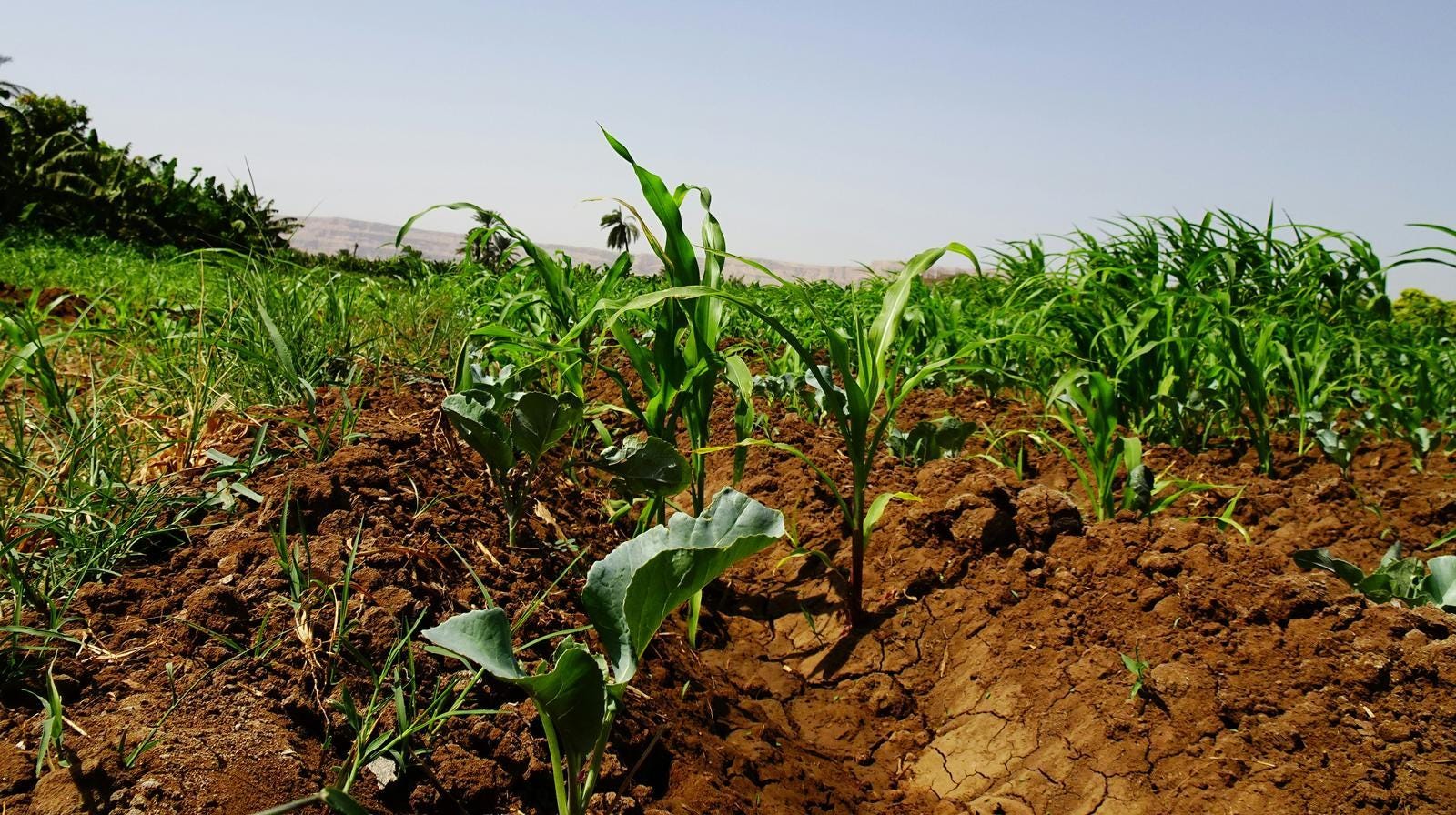
Stunted crops in Sertoni camp, Kabkabiya locality, North Darfur, September 2026. A displaced resident told Radio Dabanga that no more than 15 percent of the planting has succeeded this season. Photo: Radio Dabanga
Picture the fields around Sertoni camp in North Darfur, Sudan, in late September. The rainy season is almost over, and the crops stand barely a handspan tall and the ground cracked. This year the rain came only two or three times a month, and in August there were stretches with none at all. A displaced resident told Radio Dabanga that no more than 15 percent of the planting has succeeded. Across North Darfur, the rains came so late that many farmers could not plant until August, and the state is now seeing widespread crop failure. In seven areas of the state, famine is a real risk. That is the first loss. The second comes at the market, when families have to buy the food they could not grow. By July, sorghum and millet prices in Sudan were already more than double their three-year average. And the price those families pay is being set thousands of miles away, by a war on the Black Sea, a failing monsoon in India and a drought on the American Great Plains. This year, almost all of these are pushing prices up.
This fall you will hear a lot about a “global grain shortage.” That is not quite right, and the difference matters. There is no single grain market. There are four, and each one feeds different people. Follow each of them and the picture comes into focus: the world is not short of grain this year. It is short of grain in the right places, at a price poor countries can pay. And the world’s grain reserves, the cushion that keeps a bad harvest from becoming a famine, have stopped growing. Some are already shrinking.
So, will the grain in the wrong places cause hunger and famine in 2027? Two things will decide it. The first is the weather El Niño brings over the next six to 12 months, which will set how much grain the world has in 2027. The second is whether humanitarian aid reaches the people most exposed before their harvests fail. The first is up to the Pacific Ocean. The second is up to us, and the clock is already running.
The Grain Is Locked Away
Wheat feeds the cities of North Africa, the Middle East and Asia, and supplies the flour shipped to Sudan. The big exporters are growing less of it. The United States expects its smallest wheat crop since 1970-71,¹ the European Union’s wheat yields are down about 7 percent,² and Argentina’s crop is well below last year’s record.³ World production is forecast to fall 2.6 percent, although world wheat stocks are close to last year’s level.³
The trouble is where those stocks sit. Since late July, Russia and Ukraine have been attacking each other’s ports, grain terminals and ships. By August 19, the attacks had shut more than 97 percent of the two countries’ grain export capacity in the Azov and Black Sea basin, which last season shipped an average of 7.2 million tons of grain a month. Most of that capacity is shut rather than destroyed: Russia could restart about 80 percent of its terminals quickly if the attacks stopped.⁴ Ukraine has cut its grain export target to 38 to 40 million tons, and its agriculture ministry has warned that total farm exports could fall by more than half if alternative routes cannot be expanded. In September, Ukraine shipped only 1.5 million tons of grain, 37 percent less than a year earlier, and Russian exporters no longer expect Black Sea shipments to return to normal before 2027. Black Sea wheat loadings in September were down 78 percent from a year earlier, the lowest for that month since 2017, and Russia is now shipping a record share of its wheat through the Baltic.⁵ So wheat is piling up in Russia and Ukraine,⁶ while India, with a record harvest and record stocks, is forecast by USDA to export only about 2 million tons, less than 1 percent of world trade.⁷
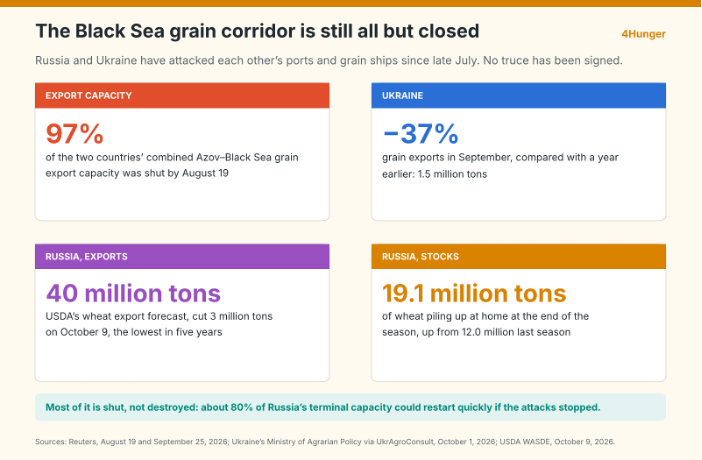
Russian and Ukrainian attacks on each other’s ports and ships have shut almost all of both countries’ grain export capacity in the Black Sea basin.
Add up the wheat trapped behind closed ports and the wheat locked in state reserves, and more than half of the world’s stocks are beyond the market’s reach. USDA’s October 9 report, the one every grain trader reads, barely changed its world wheat numbers: global ending stocks slipped by a quarter of a million tons, to 276 million. That steady headline hides what is happening underneath. USDA cut Russia’s export forecast by another 3 million tons, to 40 million, the lowest in five years, and added the same 3 million tons to Russia’s stocks. That is grain piling up behind the blockade, it is not grain reaching anyone.⁸
Look instead at the six exporters the world can count on (our own grouping, which leaves out Russia and Ukraine): the United States, the European Union, Canada, Australia, Argentina and Kazakhstan. Their combined harvest this year is 279 million tons, down from 323 million tons last year, a 13.7 percent drop. Their combined ending stocks, the buffer the rest of the world can actually buy from, are falling twice as hard, by 28.8 percent, from 63.8 million tons to 45.5 million, because all six kept exporting and feeding their own people even as their harvests shrank.⁹
Set that shrinking buffer against the grain the market cannot reach at any price. China holds 119.2 million tons of wheat, 43.2 percent of all the wheat in storage on earth. China is a net importer, and its reserves essentially never leave the country, so none of that wheat is for sale. Russia’s stockpile has grown to 19.1 million tons and Ukraine’s to 6.1 million, both trapped behind the same blockade. Together, China, Russia and Ukraine hold 144.4 million tons, 52.3 percent of the world’s wheat stocks, up from 51.5 percent in September and 50.7 percent in August.⁹ What is left for every other buyer is that 45.5-million-ton buffer, about 2.6 months of world wheat trade.
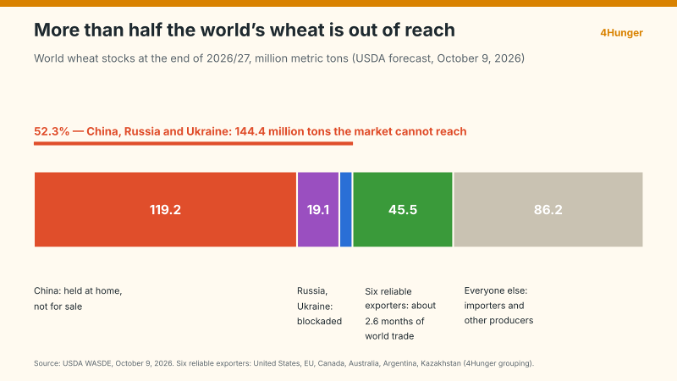
China, Russia and Ukraine hold more than half of the world’s wheat stocks, and almost none of it can reach the market.
Maize is the staple of Southern Africa, East Africa and Central America. It is the grain reserves the world is eating into. In September, USDA cut its forecast of world maize stocks to 272.1 million tons, below the 277.5 million it had said in May would already be the lowest since 2013-14.
On October 9, a much bigger American harvest than expected pushed the forecast back up to 280.4 million tons. That eases the squeeze without ending it. After a small surplus last season, the world is still on course to use about 27 million tons more maize than it grows, and world stocks are set to fall by about 9 percent. Outside the United States, the news got worse: USDA cut the European Union’s crop again, from 50.6 million tons to 48 million. And the American crop, although bigger than expected, is still smaller than last year’s record.¹⁰
White maize, the kind people eat, trades mostly within regions, so local failures bite hard. In Honduras, maize prices are up 67 percent from a year ago.¹¹ Southern African countries normally lean on South Africa for maize when their own harvests fall short. After the last great El Niño, South Africa had to import a record 2.2 million tons of maize in 2016-17, and although it kept shipping maize to its neighbors, they had to buy much of what they needed from outside the region. This year South Africa starts from strength, with a record summer harvest that includes 17.4 million tons of maize.¹²
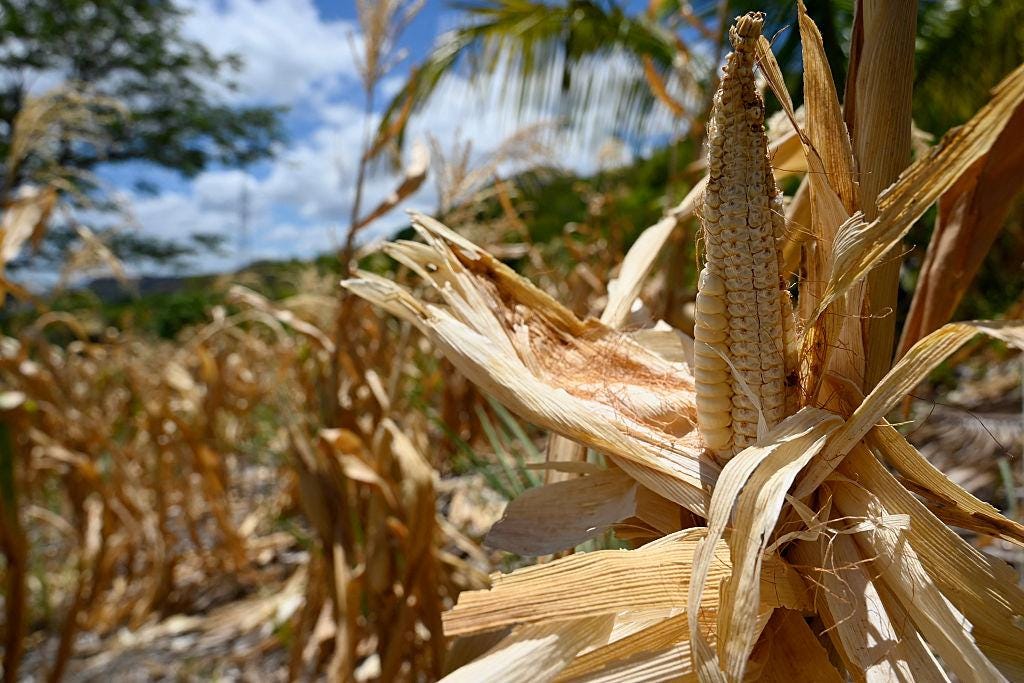
Failed maize crops in Honduras’s Dry Corridor, maize with never produced ears of corn. Photo credit: El Heraldo, Alex Pérez.
Rice feeds more people directly than any other grain. Only about a tenth of the world’s rice is sold across borders. Most is eaten in the country that grows it, so small changes in exports move prices sharply. FAO expects world rice production to fall 2.4 percent this year,⁶ and Indian export prices have been rising since late May.¹³ The biggest cushion sits in one country, and that country’s harvest is now shrinking. India holds record rice stocks, but a weak monsoon could cut its crop by about 10 million tons. In June, before the monsoon faltered, USDA forecast that India would export a record 25 million tons. On October 9, it cut that forecast to 24 million tons, citing lower shipments of broken and white rice, as Indian export prices kept rising on limited supplies. In 2023, during the last El Niño, India banned most rice exports and world prices hit a 12-year high.¹³
Sorghum and millet feed Sudan and the Sahel. Very little of these crops crosses borders, so a failed harvest usually cannot be replaced by imports. Families switch to imported wheat or rice instead, which is how a failed sorghum crop in North Darfur Sudan ends up tied to a wheat harvest in Kansas and a rice decision in New Delhi. International sorghum prices jumped 13.7 percent in September.¹⁴
El Niño Is Already Taking Its Share
Not all of this is El Niño. The drought that cut this year’s American wheat crop began before El Niño formed, climate change made Europe’s drought more severe, and two wars have disrupted the Black Sea and the Strait of Hormuz.¹⁵ But El Niño has already taken its own share of the world’s grain, from the people least able to replace it.
India’s monsoon ended the season nearly 13 percent short, its weakest since 2015 (The year of a big El Niño), and rice exporters expect the harvest to fall by around 10 million tons, the biggest drop since 2009-10. USDA has cut its forecast for India’s maize as well.¹⁶
Thailand had a dry start to the year, with 57 percent less rain than normal through mid-April.
The Philippines warns that a strong El Niño could cut its rice harvest by as much as 700,000 tons, and in Indonesia, retail rice prices hit a record in September.¹⁷
In Central America’s Dry Corridor, an Oxfam and Action Against Hunger assessment found that nearly eight in ten maize-growing households had lost 75 to 100 percent of the year’s first harvest.¹¹
In Kenya’s North Rift and Western regions, the country’s breadbasket, USDA’s office in Nairobi reports that close to half of the maize area planted has been wiped out.
In Uganda’s Karamoja region, the number of people in crisis or emergency hunger has risen by more than 40 percent in the last few months.
In Gedaref, one of Sudan’s main sorghum-growing states, planting was not finished until mid-August, and FAO reports severe drought stress on up to 70 percent of the state’s cropland.¹⁸
In Australia’s northern grain belt, dry soils have cut the forecast for New South Wales’s winter crop by 30 percent and for chickpeas, which Australia exports mainly to South Asia, by more than half.
El Niño threatens a dry finish just as those crops need rain to fill. The Bureau of Meteorology’s October 1 outlook favors a dry October in the north-east, although for October through December it gives roughly equal odds of above- or below-average rain across much of eastern Australia.¹⁹
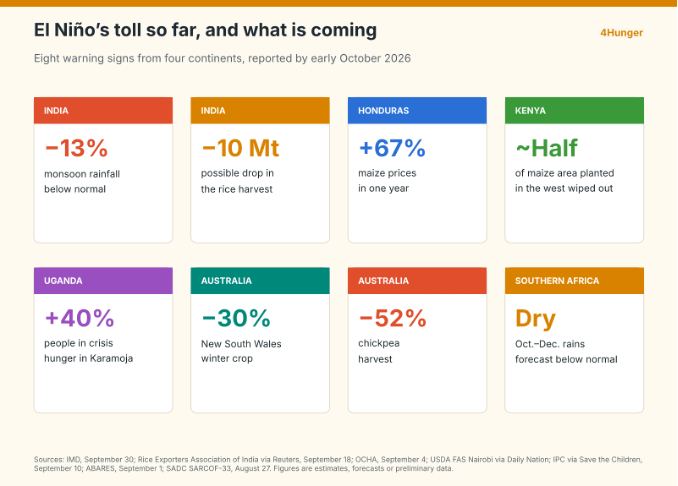
El Niño’s toll so far, and what is coming.
Any one of these losses would be manageable in a normal year. This is not a normal year. El Niño is taking harvests at the very moment war has shut the Black Sea, the Hormuz crisis has made fertilizer scarce and uncertain, and drought has shrunk the crops of several of the biggest exporters. The buffers that usually absorb an El Niño are already stretched thin.
“Wheat is stuck in the wrong places, and the world’s spare rice sits largely in one country. The world is eating into its maize reserve, and maize is what Southern Africa, East Africa and Central America eat.”
Why a Bad Year Could Become a Hungry One
Add the four grains together and the world’s grain reserves have stopped growing. FAO’s October 2 forecast puts world cereal stocks at the end of the 2026/27 seasons at 950 million tons, broadly unchanged from where they started, and expects world cereal trade to fall 3.5 percent, mainly because of Black Sea shipping constraints.⁶ Prices are already moving. FAO’s cereal price index rose 5.1 percent in September alone and now stands 17.2 percent above a year earlier.
World wheat prices reached their highest level since August 2023, and maize prices their highest in more than three years.¹⁴
Futures traders, for now, are betting that the squeeze will ease. Chicago wheat futures closed at about $7.82 a bushel on September 1, slipped below $7 in late September and closed at $6.71 on October 9, the day of USDA’s report. The physical shortage has not eased. What moved the market was talk: of a Turkey-brokered truce, of a U.S.-proposed three-way meeting, and of the Kremlin saying on September 25 that one “could happen soon.” By October 8, Russia’s deputy foreign minister said there were “currently no plans” for such talks. Nothing has been signed, and ships are still being hit. In mid-September, Russian strikes on two cargo ships in six days killed both ships’ captains. In early October, the attacks reached the waters of NATO members Romania and Bulgaria. A drone strike sank a Turkish-owned ship carrying Ukrainian corn off Romania, killing two seafarers, including the captain, and the next day drones sank one cargo ship and set a wheat carrier on fire off Bulgaria. Ukraine and a maritime security firm blame Russia; Bulgaria has not named the attacker. A Russian strike also killed a crew member on a ship at a port near Odesa. Seafarers are literally dying to move this grain. SovEcon’s Andrey Sizov has called most market participants “too complacent.”
The Council on Foreign Relations warned on September 24 that, “barring rapid de-escalation,” the Black Sea crisis “will materially increase global food prices and, in turn, could drive millions into acute food insecurity.”²⁰
Fertilizer adds to the price of every grain discussed here. The war that began on February 28 all but closed the Strait of Hormuz, a route that normally carries about a third of the world’s seaborne fertilizer trade, and urea prices rose 80 percent between February and April. A ceasefire let some ships through from mid-June to mid-July, and urea prices fell back over the summer.
But fertilizer shipments through the strait have been close to zero since mid-July, and phosphate prices remain high.²¹ Governments are protecting their own supplies, mostly of fertilizer. China and Russia have restricted fertilizer exports, while new food export bans have been few, and India lifted its wheat export ban in August.²² All of this falls hardest on the countries that depend on imports. Egypt and Indonesia trade the title of the world’s largest wheat importer back and forth. Egypt buys more than half the wheat it eats from abroad, and Indonesia, which grows almost none, imports nearly all the wheat its people need.²³
The Next Six Months
This year, the problem is getting wheat and rice delivered at a price poor countries can pay, and finding enough maize for the countries that must import it. Next year, the problem could be that there is not enough wheat, rice or maize to feed the world. The countries holding much of the world’s grain reserves (India with its wheat and rice, Australia with its wheat and South Africa with its maize) are exactly the ones El Niño has hurt in the past.
A hot, dry end to India’s winter wheat season could turn the holder of record wheat stocks into a cautious seller, or even a buyer competing in the global market, and India’s weather office expects below-normal rain over most of the country from October through December.¹⁶
Australia’s southern crops are in excellent condition, and its national winter harvest is still forecast to be the fourth largest on record, but the north is dry and October looks dry in the north-east.¹⁹
Southern African countries plant their main maize crops between October and December, and the regional forecast calls for below-normal rain over most of South Africa and its neighbors during those months. On October 8, NOAA said a strong to very strong El Niño is likely to last through January to March 2027, covering the whole planting season, and put the chance that it will be the strongest since records began in 1950 at 83 percent for October through December.²⁴
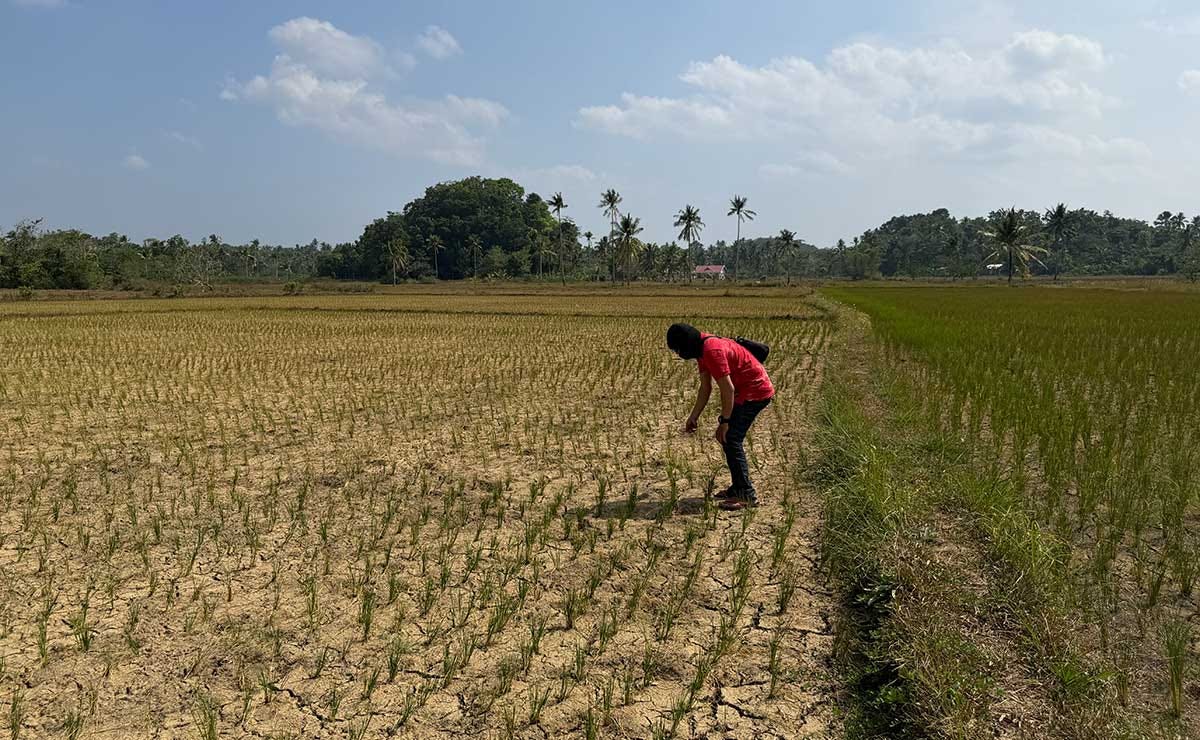
Cracked rice fields in Sagbayan, Bohol, Philippines on September 5, 2026 show the effects of intense heat and a prolonged dry spell gripping the province. Photo credit: Leo Udtohan
The disruption is also reaching into next year’s crop. By mid-September, Russian farmers were sowing winter grains at the slowest pace since 2013, about 25 percent behind the five-year average. In a survey of roughly a thousand of them, 26 percent said they planned to skip winter wheat entirely and 32 percent planned to cut back, citing, in SovEcon’s words, “a shortage of funds for fuel, seed, fertilizers.” In some regions, farm-gate prices have fallen below the cost of production because the wheat farmers already grew cannot be shipped.
Ukraine’s agriculture ministry warned on August 28 that the same export constraints “would affect autumn planting, particularly winter wheat.”²⁵
American farmers are behind as well. By October 4, they had planted 36 percent of the U.S. winter wheat crop, 10 points behind the five-year average, and Kansas, the biggest winter wheat state, had planted only 24 percent, against an average of 40 percent.²⁶
None of that has happened yet. The 2027 shortage is a forecast, not a fact. A forecast is a warning that governments can still act on.
“El Niño will decide how much grain there is. People will decide whether any shortfall becomes suffering, hunger and famine.”
Five Things Leaders Must Do Now
1. Fund early humanitarian aid now. When FAO and WFP launched their joint appeal on June 18 to protect 8.8 million people before harvests fail, $167 million of the $202 million it sought had yet to be raised.²⁷ That is a small sum next to the cost of a famine. Every family the appeal helps to plant and harvest a good crop this season is a family that will not have to buy grain next year at 2027 prices, or wait in line for emergency food when its harvest fails.
2. Keep humanitarian grain moving. In 2022, WTO members agreed not to restrict exports of food bought by the World Food Programme for humanitarian purposes.²⁸ They should restate that promise now and extend it to food bought in advance of a crisis, so aid agencies can buy before prices peak, not after.
3. Get the countries holding the grain reserves to commit now to keeping grain flowing. In 2023, when India banned most rice exports, world rice prices jumped to a 12-year high,¹³ and every importer and aid agency paid more for every ton of grain it bought. A clear commitment from India now that humanitarian and regional sales will continue would prevent that kind of panic at almost no cost.
4. Keep markets calm and open. The G20 created the Agricultural Market Information System in 2011 so that the countries that grow and buy most of the world’s grain would share their data and coordinate before a real or perceived shortfall turns into panic. Its Rapid Response Forum met in March over the Gulf crisis.²⁹ It should meet again now, before the first export ban turns a tight grain market into a crisis.
5. Help poor importers buy while they can. For maize importers in Southern and East Africa, the cheapest grain of the coming year may be the grain bought this fall, but only if they can afford it. After the 2022 food price shock, the IMF opened a temporary Food Shock Window of emergency loans for countries struggling to pay for food imports. It closed in March 2024. In April, the heads of the IMF, the World Bank and WFP warned that the Middle East war would drive up food prices and hit poor, import-dependent countries hardest, and pledged to “coordinate the use of all available tools.” On October 7, IMF Managing Director Kristalina Georgieva said the Fund is “getting ready” to support vulnerable countries if El Niño hits them, but she named no facility. Getting ready is not enough. With El Niño now on top of the war, the IMF should reopen the Food Shock Window at its Annual Meetings in Bangkok this week, before prices climb further.³⁰
What You Can Do
Call Congress. Dial the Capitol switchboard at (202) 224-3121 and ask for your representative, then call back for each of your two senators. Tell them the United States should help fund early action against El Niño hunger now, including the FAO and WFP appeal, and should press the IMF to reopen its Food Shock Window. It takes five minutes.
Pass it on. Most people have never heard that the strongest El Niño on record is colliding with a grain market that is already stretched. Share this piece with someone who will make the call too. Major news outlets are barely covering this, so it is up to us to spread the alert.
Will the grain in the wrong places cause hunger and famine? El Niño will answer part of that question over the next six to 12 months, in India’s wheat fields, Australia’s spring and Southern Africa’s planting season. The rest of the answer belongs to people with power: presidents and prime ministers, finance ministers, members of Congress, and the boards of the IMF and the World Bank. If they work together, and if aid arrives before the harvests fail in low-income countries, a hard year for grain does not have to become a year of acute hunger and famine. If cooperation and aid arrive only after the crops fail, the result will be a humanitarian crisis.