

The turkey costs $3.70 more, and most families can manage that. The trip home, with gas at about $4 a gallon (up nearly 30 percent), the winter heating bill ($370 more for homes that heat with oil) and Congress’s December 11th shutdown deadline that may delay SNAP benefits during the holidays are what roughly 78 million Americans cannot absorb.
Mark W. Roberts · 4Hunger.org · November 17, 2026
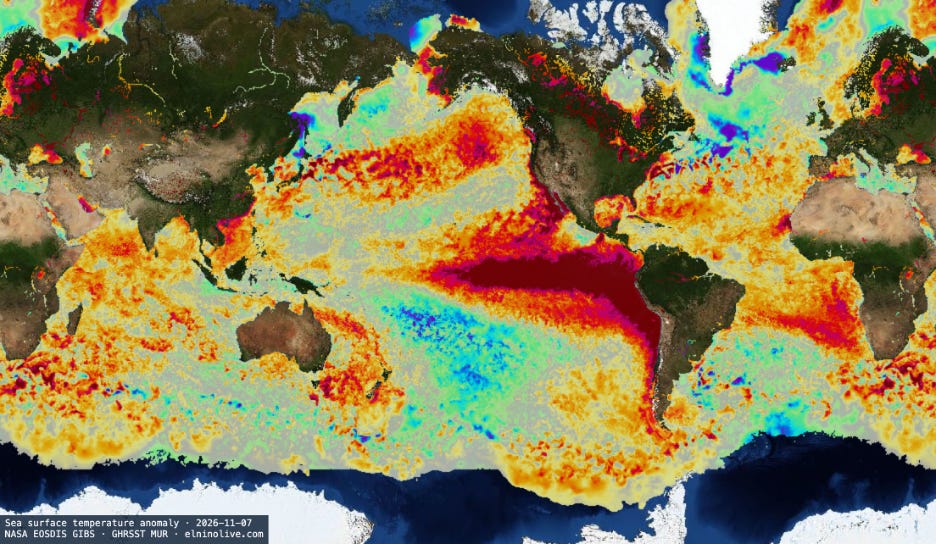
Sea surface temperature anomalies from NASA satellites· snapshot of November 7, 2026.
The Storm Is Already Here
This year’s frozen turkey will cost about $3.70 more. That’s the good news. The drive to Grandma’s costs a third more in gas than last year, the heating oil bill that peaks at Christmas is up 21 percent, and three in ten American adults could not cover a $500 emergency from savings. Meanwhile, a weather system some scientists have nicknamed the Godzilla El Niño is just getting started.1
NOAA’s winter outlook, released October 15, favors a wetter winter across the southern United States, from California through the Southeast and up the East Coast. Peruvian fishermen named El Niño for the Christ child because the warm water usually peaks around Christmas, and this one is expected to peak in December, too. California is not waiting. On September 21, Governor Gavin Newsom proclaimed a statewide emergency to get ready for the storms before they arrive.2
The West Coast is already flooding. Laguna Beach, Dana Point and Carlsbad declared local emergencies in September, and on October 27, Newsom signed orders to speed up flood work and protect Highway 1. Around San Francisco Bay, El Niño has warmed and expanded the ocean, and tides have run about a foot above forecast since October. On November 13, the season’s first big storm arrived on a tide of about 7½ feet. Seawater backed up storm drains, flooded the Embarcadero near Pier 14 and closed access to Highway 101 in Mill Valley. Those were not yet the “King Tides.” The year’s highest tides land right on both holidays, November 24–26 and December 23–25, and forecasters warn of possibly record-breaking flooding.3
“Wetter” is only partly good news. Atmospheric rivers in late October and early November filled reservoirs, but they also flooded parts of Arizona, Utah, New Mexico and Colorado. Two people were found dead in Flagstaff, and Arizona Gov. Katie Hobbs declared a statewide emergency. Drought still grips much of farm country. By the end of September, 84 percent of the Southern Plains was in drought, the most since 2022, and exceptional drought has spread across southern Arkansas.4
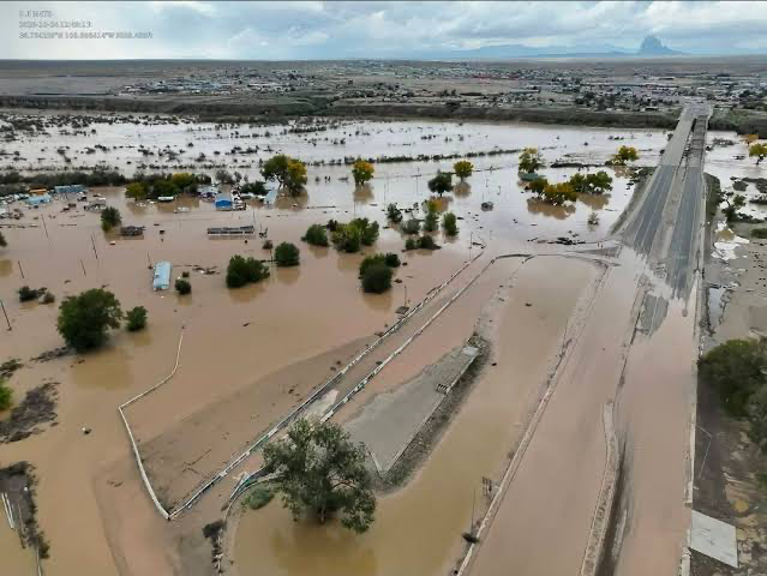
Devastating flooding in Shiprock, New Mexico on October 25, 2026. Photo Credit: Chase Thomason, Navajo Police Department
The same ocean heat is drying out farms in Asia, Africa and Latin America, and some of those crops usually end up in American kitchens. Americans will feel this El Niño at the checkout line and at the food bank, at Thanksgiving and again at Christmas. They also have a say in how bad it gets. The lame-duck session of Congress can decide food aid at home and abroad. Its first deadline is December 11th, when current government funding runs out. Congress can roll back SNAP cuts and states’ shares in SNAP processing. The new Congress has another chance when it is sworn in early in January to revisit both America’s safety net and international humanitarian aid.5 Now is the time to reach out to both your current and your new Senators and Congresspeople.
Your Coffee, Your Chocolate, Their Rice
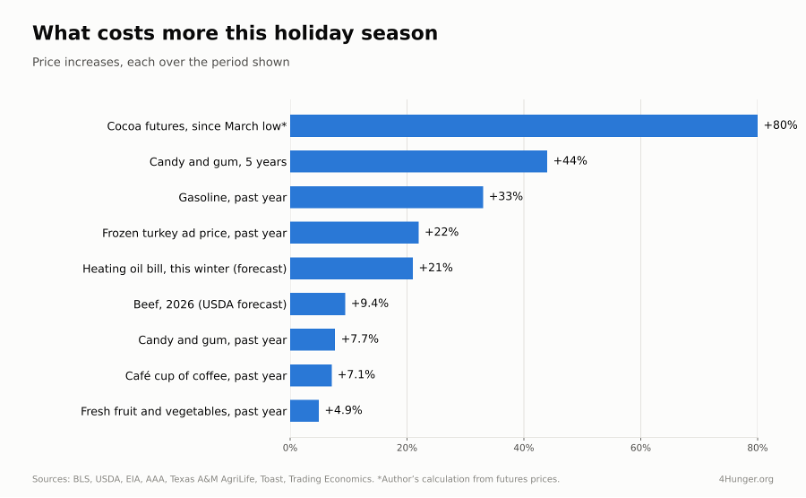
Arabica futures were about $2.80 a pound on November 6. Retail ground coffee averaged $9.33 a pound in September, close to April’s record of $9.72, according to the Bureau of Labor Statistics. The median café cup of regular coffee cost $3.79, up 7.1 percent in a year, and a bag of specialty whole-bean coffee sold online averages $19.99, according to one private index.6
Chocolate is worse. Candy and gum prices rose 7.7 percent in the year to September, twice the overall inflation rate, and 44 percent over five years. Hershey’s prices rose about 11 percent last quarter, while the amount it sold fell about 10 percent. Americans are paying more for chocolate and buying less of it. Cocoa futures are up about 80 percent from their late-February low, even after a recent dip, partly on fears that El Niño will dry out Ivory Coast, the world’s largest grower of cocoa. 7
“Americans are paying more for chocolate and buying less of it.”
Staples are next. FAO chief economist Maximo Torero told CNN that El Niño has already cut production forecasts. A weak monsoon shrank India’s rice harvest, and Australia’s wheat crop is expected to come in below normal. If India limits rice exports, world prices will rise. Grain price increases can lift the price of many staples and other foods made from grains and vegetable oils across the spectrum.8
The Turkey Is the Bargain if You Look For It
The turkey will cost a little more, but there are deals. Frozen turkeys averaged $1.26 a pound in grocery ads in early November, up from $1.03 a year ago, so a 16-pound bird runs about $20, roughly $3.70 more than last year. Many stores sell frozen birds at a loss to bring in shoppers. Walmart had Butterball at 97 cents a pound, and Tops in western New York had turkeys at a bargain 58 cents. A conventional fresh turkey will probably run $2 to $2.50 a pound, or $32 to $40 for a 16-pound bird. Antibiotic-free and organic birds will likely cost $4 a pound or more, $64 and up for the whole bird. Prices usually drop as Thanksgiving nears, so families who wait or buy frozen will pay the least.9
There will be plenty of birds. Turkey production is up nearly 6 percent, and although bird flu hit ten Minnesota flocks in September, AgriLife says the outbreaks are too few to dent holiday supplies.10
The pie is where the weather begins to show. In Floyd County, the “Pumpkin Capital of Texas,” extreme drought cut pumpkin yields 30 to 40 percent. However, Illinois, which grows most of the nation’s canned pumpkin, had a wet season and a slightly lighter but good-quality crop. Wisconsin growers say their cranberry crop is down about a third after a dry summer and wildfire smoke that kept bees from pollinating, but prices were locked in by contracts last summer, so shoppers should not feel it this year, but maybe next year.11
Families who serve roast beef for Christmas dinner face a different problem. Years of drought forced ranchers to shrink their herds, and the national cattle herd stood at 86.2 million head on January 1st, the lowest in 75 years. Then, on June 3rd, USDA confirmed the first case of New World screwworm in U.S. livestock since 1966. As a result, cattle imports from Mexico have been blocked since July 2025, and USDA’s sterile fly plant in Texas to deal with this threat will not be fully running until 2027. USDA forecasts beef prices up 8.7 percent this year, and they are unlikely to ease anytime soon.12
The salad bowl depends on the desert. Yuma County, Arizona, grows about 90 percent of the nation’s winter leafy greens. Lettuce production usually shifts there and to the Imperial Valley in the far southeastern corner of California in mid-November, so Thanksgiving salads, celery for stuffing and broccoli all ride on desert weather, and heavy rain can keep growers out of the fields. Fresh fruit and vegetable prices were already 4.9 percent higher in September than a year earlier. Forecaster Drew Lerner of World Weather, Inc. expects El Niño rain could lift produce prices in the middle or later part of winter, though he sees the damage as localized.13
Christmas Gets the Bigger Bill
Thanksgiving will cost a little more because of drought, disease and fuel. Christmas will cost more still. El Niño peaks in December, and its bigger produce bill arrives between December and March, just as families shop for holiday dinners and treats. Much of it carries further into 2027.14
• Mangoes. Ecuador’s mango shipments are projected to fall about 52 percent from last year, and Peru’s growers expect output up to 60 percent lower. Shortages are expected from November through February, possibly into March.15
• Grapes and berries. USDA forecasts Peru’s table grape exports to fall 13 percent, and heavy rain in northern Peru could leave a gap in supply this winter. Chile is expected to cut its grape forecast after El Niño rains. Peruvian blueberries are coming in smaller and scarcer, with the worst expected from January to March. Chile’s cherries, a Christmas favorite, face rain that cracks the fruit.16
• Strawberries. Heavy winter rain is the threat. Last winter, late-2025 rain cut California strawberry shipments 27 percent, and strawberry grower prices jumped 32 percent in January. 17
• Greens. Lettuce prices jump every November, when harvests move south from Salinas to the desert around Yuma and the Imperial Valley. Last year, iceberg lettuce rose from $1.73 a pound in September to $1.99 in November. Then heavy rain, followed by unusually warm weather, cut yields in the desert, and iceberg prices climbed through January and February. California celery fields were hit by storms in November and again during Christmas week, with up to six inches of rain over four days. This year’s desert season begins in early to mid-November on about the usual acreage. An El Niño winter that NOAA expects to be wetter across the southern United States could bring the same disruptions and price rises.18
• Bananas. Cheap now, at about 66 cents a pound. But Chiquita’s chief executive expects the industry to sell fewer bananas in 2027, probably at higher prices, as heavy rain threatens Ecuador and Peru.19
• Chocolate. Dry Harmattan winds intensified by El Niño could shrink the Ivory Coast cocoa crop and keep Christmas candy and cocoa prices high into 2027.20
Peru alone could lose $1.5 billion in farm exports across 2026 and 2027, according to Preciso Consultoría. The United States buys 52 percent of Peru’s table grape exports.21
Gas and Heat: The Iran War Comes Home
For many families, the bigger holiday cost is getting there. AAA’s national average for regular gas was $3.98 on November 10, compared with $3.08 a year earlier.22
Then comes the heating bill, which peaks in the weeks around Christmas. The Energy Information Administration expects households that heat with oil to have to spend about 21 percent more this winter, an average of $2,115 from November through March. Homes heated with natural gas should pay about 9 percent less.23
LIHEAP, the federal program that helps low-income families pay energy bills, had about $4 billion in fiscal 2026. The administration has again proposed eliminating it. The National Energy Assistance Directors Association says states need about $3 billion more to cover this winter’s higher oil and electricity prices.24
The war also reaches next year’s harvests. About a third of the world’s fertilizer trade normally passes through the Strait of Hormuz, and fertilizer exports from the Middle East have fallen by roughly 70 to 75 percent, according to the data firm Kpler. Phosphate, which crops need to grow roots and set seed, has taken a double hit. Making it takes sulfuric acid, and nearly half of the world’s sulfur exports pass through Hormuz. By August, sulfur topped $1,000 a ton, up more than 130 percent since January. China, which shipped about 5.3 million tons of phosphate fertilizer in 2025, has exported almost none in 2026, keeping its supply for its own farmers.25
Diammonium phosphate, the most common phosphate fertilizer, rose 28.4 percent in the first nine months of 2026, and in October the World Bank’s benchmark price reached its highest level since 2022. American farmers paid about $950 a ton in early November. Phosphate is now the least affordable of the major fertilizers, according to the price agency Argus, and some farmers are already using less. That puts 2027 yields at risk, here and abroad, including in poor countries where El Niño already threatens the harvest.26
Three in Ten Americans Cannot Cover a $500 Emergency
The holidays test a household budget in a way an ordinary week does not. In the Federal Reserve’s latest survey of household finances, 30 percent of adults, roughly 78 million people, said they could not cover a $500 emergency using only their savings. Eighteen percent could not cover $100, and 12 percent could not pay a $400 expense by any means, even by borrowing.27
The gap follows income. Four in ten adults earning under $50,000 could not cover even a $100 emergency from savings. For the poorest fifth of households, food alone takes a third of their income, compared with 12 percent for the middle fifth and about 6 percent for the top fifth, according to USDA.28
Many already buy food on credit. In an Urban Institute survey taken in December 2025, 8.9 percent of working-age adults used buy now, pay later loans for groceries, and more than a third of them missed a payment.29
What a Missing $500 Means for the Holidays
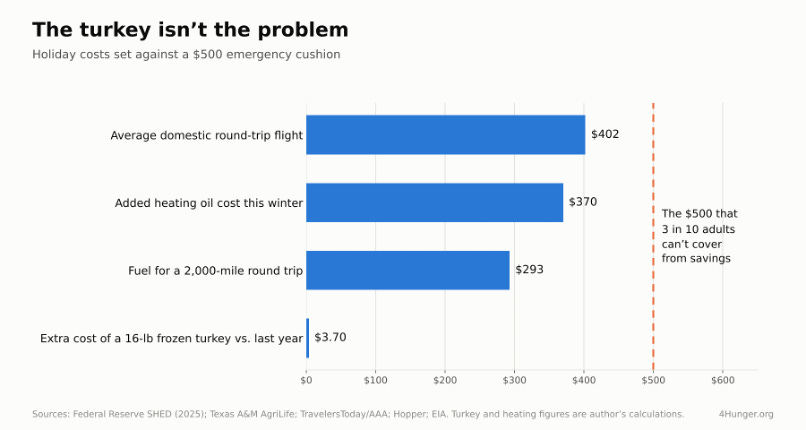
For someone who cannot raise $500, the holiday dinner itself is not the hardest part. The Farm Bureau’s classic dinner for 10 cost $55.18 last year, and Aldi is selling a meal for 10 for under $39 this year. The turkey costs about $3.70 more than last year. A family can stretch that.30
The trouble is everything around the dinner.
The turkey isn’t the problem. Everything around your Thanksgiving and Christmas dinner is.
• The trip home. At about $4 a gallon, a 2,000-mile round trip costs about $293 in fuel, more than half of a $500 cushion. A domestic round-trip flight averages about $402, according to Hopper. Families with no savings will stay home and skip the visit.31
• The heating bill. For a family heating with oil, spending of about $2,115 this winter is roughly $370 more than last winter. That is most of a $500 cushion, and the bills keep coming through March.32
• A broken car or a doctor’s visit. In the year before the Fed survey, 59 percent of adults had a major unexpected expense, most often a car repair. When there is no cushion, the cost comes out of the grocery budget or goes on a card.33
• A government shutdown. If funding lapses after December 11th, SNAP households with no savings would have little to fall back on but food banks. During last year’s 43-day shutdown, millions of families did not get their November SNAP benefits on time.34
• Debt that outlasts the holidays. A Thanksgiving meal or Christmas presents bought with a buy now, pay later loan or a credit card come due in December, January and February, the coldest and costliest months.
In practice, families without a cushion make trades. They host a smaller dinner, skip the trip, turn the heat down, or line up for a food bank turkey, then face the same choices again at Christmas.
One caution. The Fed’s figures come from a survey taken in October 2025, before this year’s jump in gas and heating oil prices. The 2026 numbers will not be out until next May. The problem is thin cushions, not a collapse.35
Fewer Turkeys at the Food Bank
Food banks are heading into the holidays with more people in line and less food on the shelves. The Helping Neighbor Food Pantry in Jonesboro, Arkansas, does not have enough turkeys for every client this year. Visits to the Food Bank of Delaware’s pantries rose 22 percent this summer over last summer. In Tucson, the Community Food Bank of Southern Arizona reports rising demand, falling cash donations and higher prices for the food it buys.36
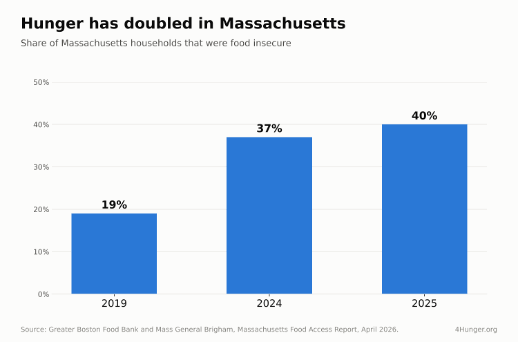
In Massachusetts, the Greater Boston Food Bank, New England’s largest hunger-relief organization, plans to hand out 54,000 turkeys to its partner pantries this holiday season. A record 40 percent of Massachusetts households were food insecure in 2025, up from 19 percent in 2019. 56 percent of those households now rely on charitable food which is also a record. The food bank’s supply is shrinking as need grows. It reported in April that USDA food deliveries had fallen nearly 36 percent since October 2025, and in September it said its fuel costs had risen more than 30 percent in a year because of record diesel prices.37
The national picture points the same way. An NBC News survey of 48 large food banks found nearly three-quarters saw more visitors over the past year. Linda Nageotte, president of Feeding America, said food insecurity is at its highest level since the Great Recession.38
Part of the hunger gap comes from Washington. In March 2025, USDA canceled $500 million in food bank deliveries under The Emergency Food Assistance Program, known as TEFAP. In August 2025, USDA announced $230 million in other purchases for food banks.39
Fewer People on SNAP, Not Fewer Hungry People
SNAP used to be the first line of defense against grocery prices. It now reaches far fewer people. The cuts to SNAP have increased hunger in America dramatically. The Center on Budget and Policy Priorities found that participation in SNAP food assistance fell by 5.5 million people, or 13 percent, from July 2025 to July 2026, including an estimated 2 million children. That left about 36.1 million people on SNAP, the lowest level in 17 years.40
The drop follows the 2025 budget law, the One Big Beautiful (sic) Bill Act (OBBBA), which widened work requirements to adults up to age 64, veterans, homeless people and parents of teenagers and otherwise cut SNAP benefits. Supporters say people are moving into work. Federal data cannot yet show how many people who left SNAP found jobs that keep them fed, and how many lost benefits over paperwork. Food banks report many more people are making visits, not fewer.41
Because of the 2025 budget law, SNAP reaches 5.5 million fewer people than it did a year earlier. Food banks report more visits, not fewer. More hunger, not less.
The maximum monthly SNAP benefit for a family of four went up about 3 percent, to $1,023. Under OBBBA, USDA cannot raise benefits again until October 2027, even if food prices jump.42
The law also shifts the cost of running SNAP to states. Since October 1, states pay 75 percent of administrative costs, up from 50 percent, just as the new work rules pile paperwork onto state caseworkers. In Massachusetts, the strain showed even before the cost shift. Monthly reports from the Department of Transitional Assistance (DTA), the agency that runs SNAP in the state, show that about three in four calls trying to reach a caseworker this summer got a “high call volume” message instead: roughly 74 percent in June, 78 percent in July and 77 percent in August. A lawsuit filed in September by the Massachusetts Law Reform Institute says the line automatically disconnected 74 to 81 percent of incoming calls on average in the first half of 2026.43
Starting October 1, 2027, many states will also pay up to 15 percent of the benefits themselves, based on their error rates. States that cannot pay their share of SNAP may cut access and the American safety net, meaning that hungry people cannot get the food they need.44
That fight is live in the lame duck session of Congress. The Senate’s Farm Bill passed the Agriculture Committee 12 to 11 along party lines on September 16. It would delay the benefit cost share by one year, but not the higher administrative costs states already pay. The Congressional Research Service says it would also raise the most a high-error state could owe, from 15 percent to 20 percent, starting in fiscal 2031. Democrats want a two-year delay for all states, with no new SNAP cuts to pay for it. The full Senate has not voted on the bill.45
We may never know how many Americans went hungry this holiday season. USDA has ended its Household Food Security report after about 30 years. The last one found that 47.9 million people lived in households that had trouble getting enough food in 2024. Food bank counts and private surveys are now the main gauges, and they point toward more need and that more people in America are hungry.46
Zimbabwe’s Harvest Runs Through Washington
An American family facing a pricier grocery bill has SNAP, food banks and neighbors. A farmer in Zimbabwe whose maize dries up and dies in January has far fewer options. The World Meteorological Organization expects this El Niño to peak around December. It warns that Southern Africa faces drier conditions from November, the normal start of the rainy season, when farmers plant their single maize crop.47
America’s main tool for addressing international hunger is a program called Food for Peace, which buys U.S. crops and ships them overseas. Congress funded it at $1.2 billion for fiscal 2026, down from fiscal 2025. The House bill for 2027, passed in June, would cut it to $900 million. The President asked to completely end the program, continuing his war on the global poor.48
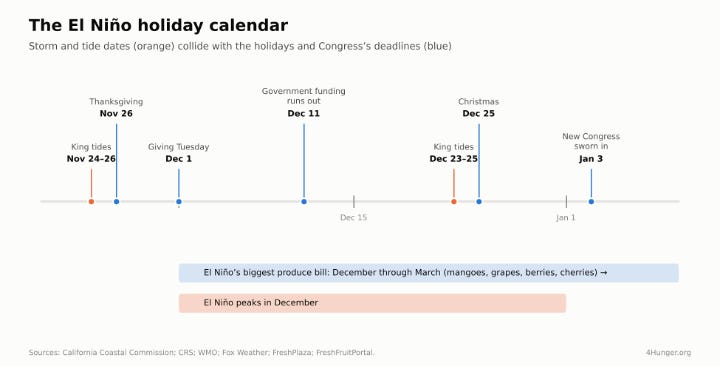
The calendar is tight. The current stopgap funding runs out on December 11th. If Congress passes neither its spending bills nor another stopgap, a shutdown affecting SNAP and Food for Peace could begin on December 12th, two weeks before Christmas. Democrats, who won both chambers in the November 3 midterms, are unlikely to negotiate a full year of funding before the new Congress is sworn in, CNBC reports, which leaves another stopgap or a shutdown likely. Last year’s 43-day shutdown left millions of families waiting for their November SNAP benefits.49
What You Can Do This Holiday Season
1. Give cash to your local food bank. Food banks buy in bulk at reduced prices, so money goes further than if you buy and donate canned goods.
2. Call your Representative and both Senators. The U.S. Capitol switchboard, (202) 224-3121, will connect you. Ask for five things before Congress adjourns.
a. Keep the government open past December 11, with no lapse in SNAP benefits.
b. Delay the SNAP benefit cost share for two years for every state, with no new SNAP cuts to pay for it.
c. Fund Food for Peace at least at its fiscal 2025 level, as El Niño hunger lands around the globe.
d. Add emergency LIHEAP funding to cover this winter’s heating oil prices.
e. Get El Niño food aid moving now, before the worst months arrive.
3. Plan your Giving Tuesday gift. On December 1, a gift to groups working ahead of El Niño harvests can stop hunger before it starts. If you are wondering which groups: UNICEF, World Food Programme, Save the Children, Oxfam, International Rescue Committee, Doctors Without Borders. There are more. Do not forget your local food bank, too.
4. Waste less at your own table. ReFED estimated that Americans threw out about 320 million pounds of food on Thanksgiving last year, worth about $550 million. Plan portions for both holidays, freeze leftovers, and give untouched food to a food bank.50
The storms will make the headlines this winter. The hunger will come more quietly. From Thanksgiving through Christmas and into the new year, at home and abroad. Congress has until December 11th to keep the government open and to decide how much of domestic and international hunger and suffering we prevent. Our new Congress can hit the ground running with a strong El Niño hunger package to respond to the slow train wreck of hunger and suffering that this El Niño is causing around the world.
Great notice, Mark! In the season of thanking and caring we gotta care to stop the hunger