

The Land That Feeds the World Is Thirsty
As of this week, 51.35% of the United States that is and than 61% of the contiguous Lower 48 is currently under drought conditions. One hundred and fifty-three million Americans are living inside the perimeter of a slow-moving disaster. Not a hurricane that arrives with wind and fury and then slowly recedes. Not a flood that crests, causes water damage and then slowly seeps away. A drought arrives quietly, invisibly, in the gap between the rain that fell and the rain that did not. It announces itself not in the sky but in the soil, in the cracked clay of an Oklahoma wheat field, in the depleted column of an aquifer under the High Plains, in the skeletal silence of a Nebraska rangeland where there should be cattle but.
The drought that has gripped the United States since 2024 is not a weather event. It is a regime change.
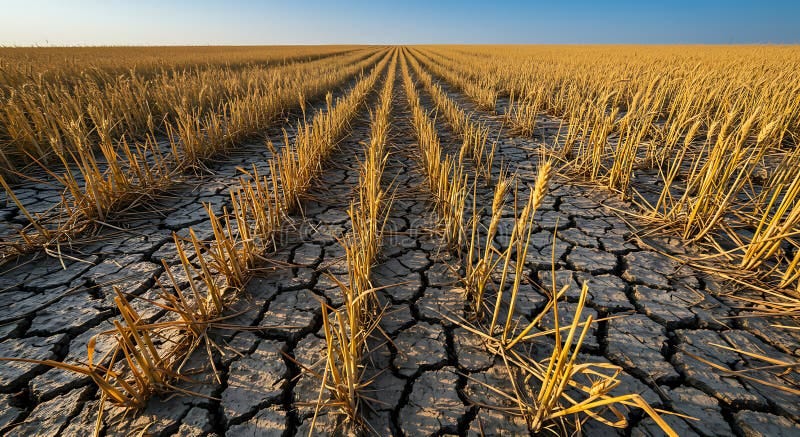
Photo credit: ID 365236816 © Azaria Design | Dreamstime.com
In the two years ending May 2026, the American agricultural sector has absorbed losses that no single metric can fully capture. The national cattle herd has fallen to 86.2 million head, the smallest since herd in America since 1951, the year Harry Truman was President, and the Korean War was less than a year old. The U.S. wheat crop is on track to be the smallest since 1972. Florida’s citrus industry, which once yielded 225 million boxes of oranges a season, but due to disease brought on by climate change is projected to produce 12 million a 95% collapse in a single generation. The American Farm Bureau Federation estimates total net agricultural losses will exceed $50 billion over the three years ending in 2026.
These are not abstractions. They are the preconditions of hunger. they will first be felt in higher grocery bills by American families, and simultaneously be felt most acutely by the 47 million Americans who were already food insecure before the drought cracked open the first acre of crop land.
A Map of Catastrophe
To understand the geography of this drought is to understand why it has proven so devastating. This is not a regional drought. It is a national one, with particular intensity in the breadbaskets and range lands that feed the rest of us.
The Southern Plains including Texas and Oklahoma have now endured six consecutive years of drought stress. Six years of watching the sky and watching the forecasts and watching the yields come in below the cost of production. This is not a run of bad luck. It is a permanent alteration of the agricultural calculus for dryland farming in one of the most productive wheat-growing regions on earth.
The High Plains, and Nebraska in particular, tell a parallel story. By mid-2026, 88% of Nebraska was classified as being in drought. Nebraska’s Sandhills region is the beating heart of the American cow-calf industry. In the spring of 2026, record-breaking wildfires tore through those Sandhills, destroying the grazing infrastructure on which an entire livestock economy depends.
The Southeast, not historically synonymous with drought, recorded moisture levels in Georgia, North Carolina, and South Carolina at their lowest since 1895, followed by a historic February freeze that compressed disaster into a single brutal season. The brutal frost caused by the generational storm was unlike the typical freeze events that Florida growers have faced in a generation. Temperatures fell below 30°F throughout the state from Jan. 31 to Feb. 2, which was lower than some records dating back to 1909. Further complicating matters were the cold temperatures arriving right after record-high temperatures, he says, adding that the state experienced a nearly 50-degree temperature swing in 48 hours. According to the Florida Department of Agriculture and Consumer Services, production losses reached approximately 90% of the crop, resulting in an estimated $78.5 million in damages.
The mechanism of destruction for this national drought is not only the absence of rain. It is what climatologists call “evaporative demand.” As temperatures rise, even the rain that does fall is extracted back from the soil and from plant tissue more quickly than before. “Flash droughts,” which is a rapid onset or intensification of drought conditions, developing over a few days to weeks rather than months. It is characterized by quickly depleting soil moisture, often driven by lower-than-normal precipitation combined with high temperatures, high winds, and low humidity, which cause excessive evaporation. [1, 2, 3] Flas droughts are becoming more common. They arrive too fast for crop insurance adjusters, too fast for disaster declarations, and far too fast for federal aid to catch up. By the time the paperwork is filed, the crop is gone.
The Wheat That Wasn’t
There is a number that sits at the center of the 2026 grain crisis, and it deserves to be repeated until it lands with the weight it carries: 1.561 billion bushels is the U.S. total wheat production forecast for 2026. It is the smallest wheat harvest in 54 years. It represents the compounding of years of climatological assault on the Hard Red Winter wheat belt that stretches across Kansas, Oklahoma, and Texas, and that produces the flour in the bread on your table and in the aid packages bound for Yemen and Sudan.
In the Southern Plains, the Hard Red Winter crop has been devastated. Production is pegged at 515 million bushels that represents a 36% drop from 2025 in a single season. In Texas and Oklahoma, nearly 32% of planted acres will not be harvested at all. Crop scouts in northern Kansas reported average yields of 38.3 bushels per acre, against a prior-year average of 50.5. Those missing 12 bushels per acre are not a rounding error. They are the difference between a farm that makes money and one that doesn’t. They are the grain that does not reach the global market. And in a global food system where U.S. wheat is a reference price, their absence is felt from Cairo to Kampala.
The season-average farm price for wheat is projected to jump to $6.50 per bushel — a 30% increase from 2025. Higher prices, in theory, benefit farmers. In practice, they benefit farmers who have a crop to sell. For the third of producers who will harvest nothing from their winter wheat fields this year, the higher price is irrelevant.
The drought hasn’t just destroyed this year’s harvest. It has destroyed the confidence on which rebuilding the next crop depends.
The Cattle That Were Sold
The livestock story is, in some ways, the most structurally significant chapter of the drought’s consequences because the decisions being made today in ranching country will determine the supply and cost of American beef not just this year but through at least 2028.
When drought destroys rangeland, ranchers face an immediate and brutal choice: purchase expensive supplemental feed to keep their herds alive or sell the animals, including the breeding cows whose calves would have been next year’s and the year after’s supply. Over the last two years, in ranch after ranch across the Southern Plains and the Southeast, producers chose to sell of their herds including the breeding cows.
The beef cow herd now stands at 27.6 million head, its lowest point since 1961. The total cattle inventory 86.2 million head is the smallest herd in America since the Eisenhower administration. And here is the critical structural point: cattle herds take years to rebuild. A heifer kept today won’t produce her first calf for two years. That calf won’t reach market weight for another year and a half. The liquidation decisions being made today because of this drought will constrain beef supply and keep prices elevated through the end of this decade.
A metric called the Female Slaughter Ratio tells the story in a single number. When the ratio rises above 48%, it means producers are still in liquidation mode. In the first quarter of 2026, that ratio stood at 49.9%. Even with steers selling at over $240 per hundredweight which is a record price, ranchers in the Southern Plains are still unwilling to bet on a heifer whose survival depends on rain that may not come so they are slaughtering the future of cattle herds.
The consequences ripple outward. Major meatpackers like Tyson Foods, after years of record profits, are now scrambling to source the limited livestock that is available. Tyson closed its facility in Lexington, Nebraska which is a clear signal that the industry expects the cattle supply shortage to persist. Walmart has seen the writing on the walls and has begun building its own processing infrastructure to guarantee a supply of beef for its stores in a market where the guarantee of readily available beef cattle has evaporated.
Ground beef is no longer a staple. It is becoming a luxury.
Florida’s Last Orange
Orange juice from Florida used to be a breakfast staple. Now, it’s starting to look more like champagne, a luxury item for special occasions. As climate change intensifies, Florida’s orange market is caught in the turmoil. Since the 1990s, the state’s orange production has fallen 92.5%, dropping from 244 million boxes to just 12.15 million boxes by this year. The decline has many asking: How did a once-dominant powerhouse for the fruit end up here?
Thirty years ago, Florida’s orange groves produced 225 million boxes of fruit a season. The forecast for 2026 is 12 million boxes. That is not a typo. Climate change has brought a 95% collapse in citrus production across a single generation of growers, driven by the convergence of drought, disease, freeze events, and the slow attrition of agricultural land to development.
The February 2026 freeze that arrived on top of the worst drought in 25 years cost the Florida citrus industry $700 million in immediate damages. It cost the broader Florida agricultural sector over $3.1 billion: $1.15 billion in sugarcane losses, $307 million in strawberry losses, $78 million in blueberries, and $240 million in greenhouse and nursery crops. Ninety percent of Florida’s 2026 blueberry crop was lost in a single event.
Florida is typically known for its hot, steamy, sunny climate with frequent thunderstorms, but as climate change continues, its conditions become hotter and steamier, and its storms are more frequent and severe, harshly impacting the state’s national fruit. The frequency of such intense conditions has made the fruit vulnerable to citrus greening disease: a bacterial disease spread by tiny, sap-sucking insects called psyllids (pronounced sill-ids).
The growers who remain are a dwindling cohort, of aging, financially exhausted producers who are spending $43,000 to $45,000 per acre to build screen houses that protect their trees from the psyllid insect that carries citrus greening disease. These structures are not hurricane-proof. They require constant maintenance. They are not a solution. They are a way of not giving up, which is a different thing.
Climate change did not cause citrus greening disease, it is caused by a bacterium spread by the invasive Asian citrus psyllid. However, warming temperatures and more severe weather caused by climate change have significantly worsened the crisis, accelerating the spread of the disease and devastating Florida’s citrus groves. [1, 2, 3] The combination of this incurable disease and climate-exacerbated natural disasters has brought the Florida citrus industry to historic lows. Several key factors define how climate change impacts the epidemic: [1, 2]
· Faster Insect Breeding: Warmer temperatures create a more hospitable environment for the Asian citrus psyllid. The heat accelerates their breeding cycles, enabling them to multiply and spread the bacteria at a much faster rate.
· Increased Vulnerability: Hotter and more extreme weather patterns weaken the trees’ natural defenses, leaving them highly susceptible to infection.
· Extreme Weather Compound: Climate change has amplified the frequency and intensity of hurricanes in Florida. Repeated storms—such as Ian and Milton—have physically destroyed orchards, flooded fields, and further stressed surviving trees. [1, 2, 3, 4, 5]
·

An example of citrus greening on oranges
During warmer weather months, the insects feed on young citrus shoots and leaves, injecting bacteria that cause citrus greening disease (HLB). The disease causes trees to produce bitter, small, misshapen fruit that appear about 2-3 years after contamination, making it significantly difficult to detect. The insect thrives under warm conditions. Historically, freezing temperatures in winter would kill HLB. As Florida is having more and more milder winters, psyllids are enabled to continue reproducing and feeding on the plant all winter long. Frequent severe storms and hurricanes only exacerbate the problem, carrying the insects into new groves and regions just to spread the disease more. Since first hitting in 2005 and the presence of back-to-back hurricanes from 2021 to 2024, the disease has spread to every citrus-growing county in Florida, putting the orange belt on the brink.
In Ruskin, Florida, this past year brought nearly a month’s worth of extra days above 90°F, with average temperatures running more than 2 degrees hotter than normal. Cold snaps, which once helped keep pests like psyllids in check—have completely disappeared. The chart below shows how climate risk has spiked alongside these hotter, steamier conditions, creating the perfect environment for citrus greening to spread.
·

Figure 1. Climate risk in Florida groves is climbing fast. The chart shows the percentage of days rated “high-risk” (red) through 2025–26. Spikes in spring
The Florida citrus collapse is a warning of what happens when climate stress exceeds the limits of adaptation. The drought didn’t create the fragility. It revealed it.
The Cost That Doesn’t Stop
The farm margin crisis of 2026 is a story told in two directions simultaneously: commodity prices rising, and input costs rising faster.
The disruption of trade through the Strait of Hormuz which is a chokepoint for an estimated 30% of global fertilizer shipments sent nitrogen prices soaring in early 2026. See Fertilizer Famine [hyperlink] Urea prices jumped 47% in a single month following the start of the conflict, the largest single-month percentage increase in the commodity’s history. A full run of a single tractor now costs an additional $350 per day in fuel. For the farmer who could not lock in fertilizer contracts before the season, the exposure is total.
The per-acre production cost for corn has reached $890. For rice, $1,336. For cotton, $965. These numbers, matched against projected commodity prices and realistic drought-affected yields, produce something that should disturb anyone who eats: most of American agriculture is currently unprofitable. The AFBF estimates net losses exceeding $50 billion across the sector. The latest agricultural census showed the loss of 140,000 farms between 2017 and 2022 and this is a trend every analyst expects to accelerate.
In the lowest income 1/5 of American households, food already consumed nearly 30% of total expenditure before the drought began. Every percentage point of food price inflation is a meal that doesn’t get made, a bill that doesn’t get paid, a child who goes to school without breakfast. Beef prices are projected to rise 6.3% in 2026. Fresh vegetables 4.8%.Sugar and sweets, 8.1%. The drought that started in the fields ends up on the grocery receipt.
The Time for Half-Measures Is Over
The federal government has taken some steps. The American Relief Act of 2025 delivered $30.78 billion in farm relief, and the Supplemental Disaster Relief Program has put $6.7 billion into the hands of producers with existing insurance records. An extension of the 2018 Farm Bill has kept core programs from lapsing entirely. These actions represent a floor, only a minimum response to a maximum crisis. These small actions are not a solution to the huge problems that climate change is causing to American agriculture.
The 2026 Farm Bill is the single most important legislative tool available to address this crisis but remains stalled in the Senate, held hostage to partisan battles over SNAP funding, climate provisions, and budget offsets. Every month it sits unfinished is another month that uninsured and specialty crop producers wait for Stage 2 disaster relief. Another month that the High Plains Aquifer drains without a funded federal strategy to slow it. Another month that 153 million Americans living in drought-affected regions face rising food prices without an adequate safety net beneath them.
The data demands a reckoning. The Southern Plains have been in continuous drought stress for six years. The cattle herd will not rebuild before 2028. Florida’s citrus industry will not recover in any meaningful sense at all. The AFBF estimates net agricultural losses exceeding $50 billion. And in the lowest-income American households, food already consumed nearly 30% of total expenditure before the drought began, before beef prices rose 6.3%, fresh vegetables 4.8%, and sugar and sweets 8.1%.
What is required now is not incremental adjustment. It is dramatic, sustained, and coordinated action on four fronts.
First, Congress must pass a strong 2026 Farm Bill – now! A bill that funds Stage 2 disaster relief for uninsured and specialty crop producers, invests aggressively in water infrastructure for the communities most dependent on the High Plains Aquifer, and backs the science-proven agricultural adaptations including drought-resistant crops, precision irrigation, diversified rotations, actions that can actually build long-term resilience. The partisan paralysis over this legislation is not a political inconvenience. It is costing farmers their land, their herds, and their futures. It is costing America its position as one of the major sources of food for the country and the world.
Second, the Trump Administration must give up its vision of drill-baby-drill” and confront climate change as the agricultural emergency it is. Continuing to prop up the fossil fuel industry while climate-induced disasters strip America’s farmers and ranchers of their livelihoods is not an energy policy - it is a surrender of the American food system the natural disasters and diseases brought on by climate change. The droughts, the floods, the unpredictable seasons destroying crops from the Oklahoma Panhandle to the Florida groves are not anomalies. They are the predicted, documented consequences of a warming climate. Ignoring that is not a political position. It is a dereliction of duty to every farmer, rancher, and hungry poor and working class family in this country.
Third, SNAP and nutrition programs must be protected and expanded, not cut. When food prices rise this fast and this broadly, SNAP is not a discretionary program, it is the primary buffer between food price volatility and mass hunger among the working poor, the elderly, veterans, and children. Reducing SNAP eligibility or benefits in the middle of an agricultural crisis that is driving food prices to record levels would be a moral and economic catastrophe. It would be condemning millions of Americans to hunger, choosing between eating, taking their medicine, and a decent life. Congress must recognize that the same crisis hitting farmers at the farm gate is hitting families at the checkout counter and at the kitchen table, and that both require massive and immediate federal protection.
Fourth, the pace and scale of disaster relief must match the pace and scale of disaster. Payments arriving two or more years after losses have occurred are not relief, they are condolences. Farmers cannot carry two years of debt waiting for federal assistance while also being asked to purchase new insurance as a condition of receiving it. The complexity of county-level calculations cannot be allowed to delay aid indefinitely for the producers who need it most. The insurance has to be restructured so that it protects small and mid-sized farms and diversified agriculture as well as Big Agricultures monocrops.
American agriculture is not simply an economic sector. It is the foundation of national food security, rural community, and the everyday lives of hundreds of millions of people who depend on affordable, available food. The rancher in the Oklahoma Panhandle selling his breeding stock, the citrus grower in central Florida spending $44,000 an acre to protect the last of his trees, the single mother in a low-income household watching her grocery bill climb every week and no longer being able to feed her children - none of them chose this crisis. But all of them are paying for it. Government at both the federal and state levels has both the authority and the obligation to respond to this crisis at the scale the evidence demands.
The last two years were not an anomaly. They were a preview. The question is whether Congress and the Trump Administration have any decency, and whether they will act on that reality with the urgency it demands or whether they will continue take billions from the fossil fuel industry and their lobbyists and fail to manage a collapse of America’s agriculture that was, and remains, preventable. We must act to make sure that the needed change occurs and both federal and state governments recognize the crisis and take action!