

The major media headlines says global hunger is falling. Third year in a row. The number from the 2026 Global Report on Food Crises they are quoting describes last year’s rate of hunger, rests on the thinnest data in a decade (eighteen countries and territories aren’t even included: Burkina Faso, the Republic of Congo, and Ethiopia alone accounted for more than 27 million acutely food-insecure people in 2024 and are missing from the totals), and does not include the acute hunger of two famines, the four countries on the edge of famine (South Sudan, Mali, Haiti, Yemen), or the millions whose rations were drastically cut in 2025. The new UN Hunger Report’s conclusion is an accurate statistic being used to tell a false story and will contribute to poor policy decisions with deadly consequences.
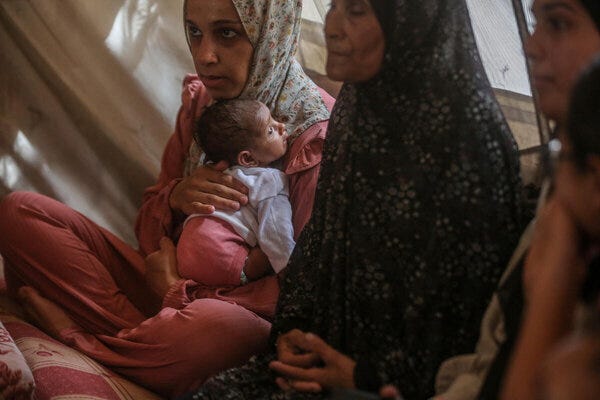
Gaza’s Children Can’t Afford to Wait: All children of the Gaza Strip under 5, more than 320,000 children, are at risk of becoming acutely malnourished. When a child becomes acutely malnourished, the body enters a cascade of survival responses that, if not interrupted, progressively shut down its systems leading to death. It’s worth understanding because it explains both why acute malnutrition kills so fast and why it’s so treatable when food aid and medical treatment arrive in time. Photo credit: World Food Programme
Comforting Global Hunger Number Arrived from the U.N. at the Worst Possible Moment
On July 21, five UN agencies released the 2026 edition of The State of Food Security and Nutrition in the World, and the sentence that traveled among the major media was a soothing one: global hunger had declined for a third straight year, to about 645 million undernourished people in 2025, some 14 million fewer than the year before.1 The head of the FAO gave the wires their quote: “We can bend the hunger curve” and within hours the headline was set, in near-identical stories, across dozens of outlets: global hunger is easing.2
Here is what the good news headline sat next to, in the same month, from the same agencies:
1) two famines were confirmed in a single year for the first time in modern times, in Gaza and Sudan;
2) four countries are at risk of famine right now: South Sudan, Mali, Haiti, Yemen;
3) A record 266 million people are in acute, life-threatening hunger;
4) And the sharpest humanitarian funding collapse in a generation helped create this new acute hunger and push global hunger numbers to their records.3
The comforting number did not just miss that suffering; it is being used to deny it.
“An accurate number, stripped of its date and its caveats, is not information. It is politically useful cover for the people and governments defending recent aid reductions.”
This is not a complaint about a statistic. The statistic is sound. It is a warning about what is being done with it because a headline that says hunger is falling is the most useful thing in the world to anyone who wants the aid cuts made when USAID was dismantled and other European donor countries joined in cutting foreign aid to look painless. These reductions in foreign aid are not painless. This piece is about the people the number leaves out, and about why leaving them out is a choice with consequences. Hunger is a policy choice, and donor governments have enacted policies that leave tens of millions with less humanitarian assistance and extreme hunger and other humanitarian disasters.
The People the Headline Cannot See
The falling number is a measure of chronic hunger, that is the slow, structural kind of hunger, estimated from food-supply balance sheets and surveys that arrive a year or more late. It is the wrong instrument for the emergency now underway. That does not make the measure wrong—it makes it unsuitable as a description of today’s emergency; it is pointed at the wrong year, 2025. The emergency is acute hunger, the kind that kills within a season, and it is not falling - it is at a record high and climbing.3
Behind that record are people with names and coordinates. In El Fasher and Kadugli, the two Sudanese towns where the Famine Review Committee confirmed famine, people starved under siege while the world’s attention followed this cheerier statistic and ignored the hunger crisis.4 Across Sudan, nearly 4.2 million cases of acute malnutrition are expected in 2026, including more than 800,000 severe cases of acute malnutrition among children where it is the deadliest.5 In South Sudan, one of four countries at risk of famine, aid is being rationed so tightly that agencies can only reach those already in catastrophe, leaving millions in crisis to slide toward famine untouched.6 None of these people are in the 645-million headline, because the instrument that counts them is a different one, and the press quoted the headline that looks away from today’s global hunger crisis.
The Cuts Are the Cause, and We Can Prove It
The good-news framing treats hunger as a problem quietly solving itself. The truth is that the fastest-moving force in global hunger right now is a policy decision: the abrupt dismantling of humanitarian and food aid and its fingerprints are on the record in a way that is hard to ignore or wave away.
Start with the funding. After the January 2025 executive order suspending U.S. foreign aid and the dismantling of USAID that followed, the World Food Programme expects to run on roughly 40 percent less funding or about $6.4 billion, down from $10 billion in 2024 to deal with increasing humanitarian crises.7 The June 2026 hunger warning came against a 59 percent drop in food-aid funding.8 That is not a rounding error. It represents the removal of one of the principal safeguards standing between for tens of millions of people and severe hunger and famine.
Now the effect. In Nigeria, funding shortfalls forced WFP to scale down so far that it could reach only 72,000 people in February 2026, down from 1.3 million during the 2025 lean season, while malnutrition in several northern states deteriorated from “serious” to “critical.”9 Across Uganda, Kenya, and Bangladesh, rations were halved or suspended for millions of refugees which occurred alongside documented deaths in Kenyan refugee camps, according to Refugees International.10
Perhaps the strongest field evidence comes from Mali. In Mali, WFP ran what amounts to a natural experiment: where in some parts of the country families kept receiving full rations, (the number of calories and nutrients recommended by public health research) acute hunger fell 34 percent. In other parts of the country where not all of the aid was received and as a result, rations were cut, acute hunger surged 64 percent. While not a randomized trial, the comparison offers unusually strong real-world evidence under humanitarian conditions. These rates of hunger were in same country, same season, opposite outcomes, split primarily by whether adequate levels of survival rations of food arrived.11 This is as close to a causal relationship available of causation as field data ever gets, and it points in one direction: the foreign aid cuts made by the United States and European countries have substantially increased hunger in many affected regions around the world.
“Same country. Same season. Where the food arrived, hunger fell by a third. Where it was cut, hunger surged by two-thirds. That is not a correlation. That is evidence strongly consistent with causation.”
The human toll of the cuts has been estimated through modeling, and the numbers are staggering even at the low end. The Center for Global Development puts humanitarian and food-aid cuts at the potential for roughly 490,000 lives lost per year, part of a wider toll it places near 1.6 million annually; a Lancet study projects more than 14 million additional deaths by 2030, 4.5 million of them children, if the U.S. and European aid defunding is not reversed.12These are models, with real uncertainty. But they are consistent with the same reality the Mali experiment measures directly, and they do not describe a world where hunger is quietly easing.
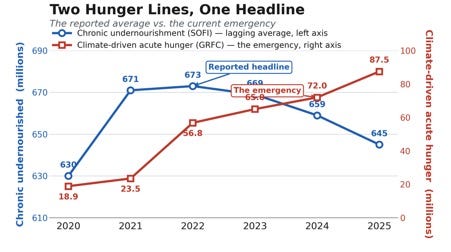
Figure 1. The two hunger lines the coverage collapsed into one. In blue, the headline: chronic undernourishment, easing to about 645 million in 2025 (left axis) a lagging average. In red, the climate-driven slice of acute hunger, up nearly fivefold since 2020 to 87.5 million (right axis) the current emergency. Much of the media coverage emphasized the blue line while giving comparatively less attention to the red one. Sources: SOFI 2026 (FAO/IFAD/UNICEF/WFP/WHO); GRFC 2020–2026 (GNAFC). Chronic values for 2022-24 approximate.
The Data Is Vanishing Along with the Aid
There is a second cruelty folded into the first. The same budget cuts that are deepening hunger are also defunding the systems that count how many people are hungry, which means the reassuring number is not only late, but also built on the thinnest evidence in a decade according to the 2026 Global Report on Food Crises and will miss more hungry people as time passes.
The Global Report on Food Crises said so plainly: funding cuts and blocked access produced the lowest availability of food-security data in ten years.13 In 2025, 18 countries and territories lacked comparable data, including Burkina Faso, the Republic of Congo, and Ethiopia, which together had more than 27 million acutely food-insecure people in 2024 who are simply missing from the totals.14 A number can fall because fewer people are hungry; it can also fall because fewer people are counted. When the counting is being dismantled in the same act that the aid to feed hungry people is being dismantled a headline that reported the decline has mistaken a blind spot for good news may be cited by the people and governments defending aid reductions as evidence that current policies have not significantly worsened hunger and potentially to keep cutting aid even as tens of millions of people are in desperate hunger.
How an Accurate Number Tells a Lie
It is worth naming exactly how the distortion works, because it will happen again with next year’s report unless it is called out now. Nobody fabricated anything. The issue is not fabrication. It is framing. The lie is assembled from true sentences, in four moves.
● The date is dropped. “Hunger fell in 2025” becomes “hunger is falling,” and a year-old average is passed off as a live trend.
● The instruments are swapped. The chronic-hunger number stands in for the acute-crisis number, so the falling line covers the rising one where millions are in the worst stages of hunger.
● The caveats are cut. The report’s own warnings including the data gaps, the regional reversals, data limitations, the lack of fertilizer, the excluded El Niño and other qualifying context rarely survive the trip to the headline.15
● A hope is printed as a fact. “We can bend the curve” is a plea for action; it gets reported as a description of progress.
The result is a story true in every particular and false in its total effect. This is the hardest kind of misinformation to correct, because every sentence passes a fact-check while the whole misinforms. In this year, the false impression is doing political work: it is being used by the people and countries defending recent aid reductions to suggest the humanitarian consequences have been limited, at the exact moment the famines say otherwise. By definition, famine represents the most extreme stage of food insecurity, a famine is “an extreme and widespread shortage of food that causes severe malnutrition, starvation, and death.” [1, 2]
What Is Actually True
None of this means burying the SOFI number. It means telling the whole truth which it is only a part of all of which is available from the very same reports:
Chronic hunger, on a lagging estimate, edged down for a third year, a real, slow, statistic carried by a few countries with revised data. Although the simultaneous decline in comparable data warrants caution when interpreting long-term trends, at the same time, acute hunger is at a record: 266 million people, two confirmed famines, four more countries at risk of famine. The improving line od chronic hunger describes the past; the worsening one describes the present acute hunger and with El Niño coming the near future. Both rest on the sparsest data in a decade. One major factor driving the worsening acute crisis is a choice Western Donor Countries made to cut the aid, which the Mali evidence suggests can be substantially mitigated where adequate food assistance is restored tomorrow, because where the food still arrives, hunger still falls.
That is not despair. It is the report, read to the end, with the people left out the frame. Much of the major media coverage emphasized the opening finding while giving comparatively little attention to the report’s discussion of acute hunger, data gaps, and humanitarian funding. They ran the just ran the first sentence and stopped.
What You Can Do About It
This is the rare humanitarian catastrophe that is being measured in advance, in public, in detail. Many of the deaths that may follow are foreseeable and mostly preventable through different policy choices. The window to change the decision is open now, and it does not require heroics. It requires refusing the comfortable version of the story and acting on the true one where aid cuts are making people hungry all over the world. The reduction in crops from the fertilizer that never arrives is being modeled and mapped in advance. The OECD–FAO Outlook projects reduced fertilizer use cutting cereal harvests in low-income countries, and satellite systems like the FAO’s GIEWS and the EU’s ASAP track where those losses are concentrated. The hunger this will cause is being forecast even now; the only thing missing is the will to act on the forecast. An El Niño is forecast six to twelve months ahead, the single most predictable pattern in the climate system, tracked instrumentally for about 150 years. And where its droughts will harden into hunger is charted in advance, region by region, by the early-warning systems built for exactly that purpose. Famine is on the calendar before it happens. Now it is a question of whether the world humanitarian organizations will have the funding to prepare for what we know is coming.
Restore the funding, this budget cycle. The single most direct lever is restoring the humanitarian and food-aid that collapsed in 2025. The Mali comparison illustrates the central argument: where the rations arrive, hunger falls. Tell your representatives, both state and federal, that reversing the cuts is not charity, it could substantially influence whether famine conditions worsen or are contained, and whether anticipatory funding is in place for southern Africa’s planting season and the four famine-risk countries which cannot wait for a distant or even the next fiscal year.
Challenge misleading headlines. When you see a major media outlet report that “global hunger is falling,” challenge them which hunger and which year. Share the acute hunger numbers alongside the chronic ones. Tell people that aid reductions are worsening humanitarian food crises and increasing famine risk in multiple countries meaning people will starve to death from lack of food. A public that knows the difference between a lagging average and a live famine is much easier to encourage into action.
Fund the counting, not just the feeding. The vanishing data is its own emergency. The monitoring systems called the IPC, FEWS NET, the crisis reports are what make famine foreseeable and therefore preventable. Modern famine early-warning systems expanded after the devastating famines of the 1980s, reflecting a growing recognition that timely data saves lives. Defending them is cheap and critical for understanding what is happening with global hunger.
“The famines were forecast. The cuts were chosen. The headline was optional. Every one of those is still ours to change but only if we stop mistaking a year-old average for the end of the emergency that has just started and is only going to get worse as more aid is withheld.”
Check It Yourself
Every figure here is public and free, released by the same agencies whose headline this piece disputes. Hold both the report and its coverage to account:
● The chronic number, in full: the SOFI 2026 report and the agencies’ launch release. Please read past the headline into the caveats.
● The acute crisis: the Global Report on Food Crises 2026 for the 266-million figure, the climate driver, and the data-gap warning.
● The famines, live: the IPC country analyses for the formal classifications and the FAO–WFP Hunger Hotspotsoutlook.
● The cuts and their toll: Refugees International’s tracking of the aid-cut impact and the Lancet defunding study.
● Hunger in near-real time: WFP’s HungerMap Live and FEWS NET, this system could correct any number a year out of date if they were operational.
The Sentence That Should Have Traveled
There was a true headline available, and it fit: “Chronic hunger inched down on a year-old estimate, even as acute hunger hits a record high, two famines were confirmed, and the aid cut driven humanitarian crises are still deepening.” It is less comforting than “hunger is falling,” but it has the advantage of being true and not leaving out the people dying of starvation or the tens of millions of people who have been made hungry due to the aid cuts.
The child in El Fasher, the family in northern Nigeria whose ration was cut from a program that once reached 1.3 million and now reaches 72,000, the refugee in Kenya who died after the food basket was halved, neither of them are in the 645-million headline, and all of them are in the world it claims to describe. They are not a rounding error in an improving trend. They are the trend; in the places where the trend is measured honestly and the humanitarian alarm bells are ringing. A press that reports the average and skips the emergency has not lied. It has done something quieter and, this year, much more deadly: it has handed the people and countries who cut the aid a headline that says nobody got hurt and let the rest of us believe it.
Donate to international humanitarian aid agencies now!
Where to Give: Top-Rated Humanitarian Organizations
Every group below is active in the hunger and famine responses described above and earns top marks from independent watchdogs (Charity Navigator, Candid/GuideStar, or CharityWatch). Ratings and details were current as of July 2026; confirm at each organization’s site before giving.
World Food Program USA — 4-star Charity Navigator; Platinum Transparency (Candid)
Web: wfpusa.org | Donate: wfpusa.org/give
Phone: (202) 627-3939
1750 H Street NW, Suite 500, Washington, DC 20006
Mail donations: P.O. Box 96316, Washington, DC 20090-6316
Oxfam America — Long-standing famine-relief organization (name originates in the 1942 Oxford Committee for Famine Relief)
Web: oxfamamerica.org | Donate: oxfamamerica.org/donate
Phone: 1-800-77-OXFAM (1-800-776-9326)
26 Causeway Street, 5th Floor, Boston, MA 02114
International Rescue Committee (IRC) — 4-star Charity Navigator (96%); Platinum Seal (Candid)
Web: rescue.org | Donate: rescue.org/donate
Donor services: 1-855-9RESCUE (1-855-973-7283) | DonorServices@Rescue.org
122 East 42nd Street, New York, NY 10168
Save the Children — Top-rated; emergency nutrition and child-hunger programs
Web: savethechildren.org | Donate: support.savethechildren.org
Phone: 1-800-728-3843
501 Kings Highway East, Suite 400, Fairfield, CT 06825
CARE — Top-rated for humanitarian and hunger relief
Web: care.org | Donate: my.care.org
Phone: 1-800-521-CARE (1-800-521-2273)
151 Ellis Street NE, Atlanta, GA 30303
Doctors Without Borders / Médecins Sans Frontières (MSF-USA) — 4-star Charity Navigator; Gold Seal (Candid)
Web: doctorswithoutborders.org | Donate: give.doctorswithoutborders.org
Donor services: (888) 392-0392 | donations@newyork.msf.org
40 Rector Street, 16th Floor, New York, NY 10006
Mail donations: P.O. Box 5030, Hagerstown, MD 21741-5030
Action Against Hunger USA — 4-star Charity Navigator; Platinum Seal (Candid); $0.90 of each dollar to programs
Web: actionagainsthunger.org | Donate: actionagainsthunger.org/take-action/donate
Phone: (212) 967-7800
One Whitehall Street, 2nd Floor, New York, NY 10004
Mercy Corps — Highest watchdog ratings (Charity Navigator, Candid, CharityWatch)
Web: mercycorps.org | Donate: mercycorps.org/donate
Phone: (888) 842-0842
45 SW Ankeny Street, Portland, OR 97204
Before giving, you can check any charity’s current rating at charitynavigator.org or charitywatch.org.
I shared it where You know we are; with this introduction and a recommendation dear MArk. T H A N K Y O U ! : " D I G G I N G
D E E P E R / I N / T H E / D I R T
A N D / A S K I N G / W H Y ?
H U N G E R / I S / A / F A C H T -
A N D / W E / H A V E / A / C H O I S E !
" The new UN Hunger Report’s conclusion is an accurate statistic being used to tell a false story and will contribute to poor policy decisions with deadly consequences. "
There are an incredibly amont of funds; headed in the exact wrong direction. Towards Wars, while only adding to the War on all vulnerable species and humans.
I am disiilusioned once again. This must be politically motivated; yet I can not find A N Y winners here.
Only outstarved loosers. Why does United Nations whoom I admire for their solid work and peacefilled wide positive contributions in all areas that matters to both Humans, Nature, Biodiverstity and Peace; bias a report of this importance?
Are they bowing to the premises of their ignorant memebr states in denial and war ? I do not know. But I highly recommend this fine and scientifically based article from 4Hunger.Org; Mark Roberts.
Earth, Science and I declare Climate Emergency