

A Law, a Deadline, and a Disconnected Phone Line
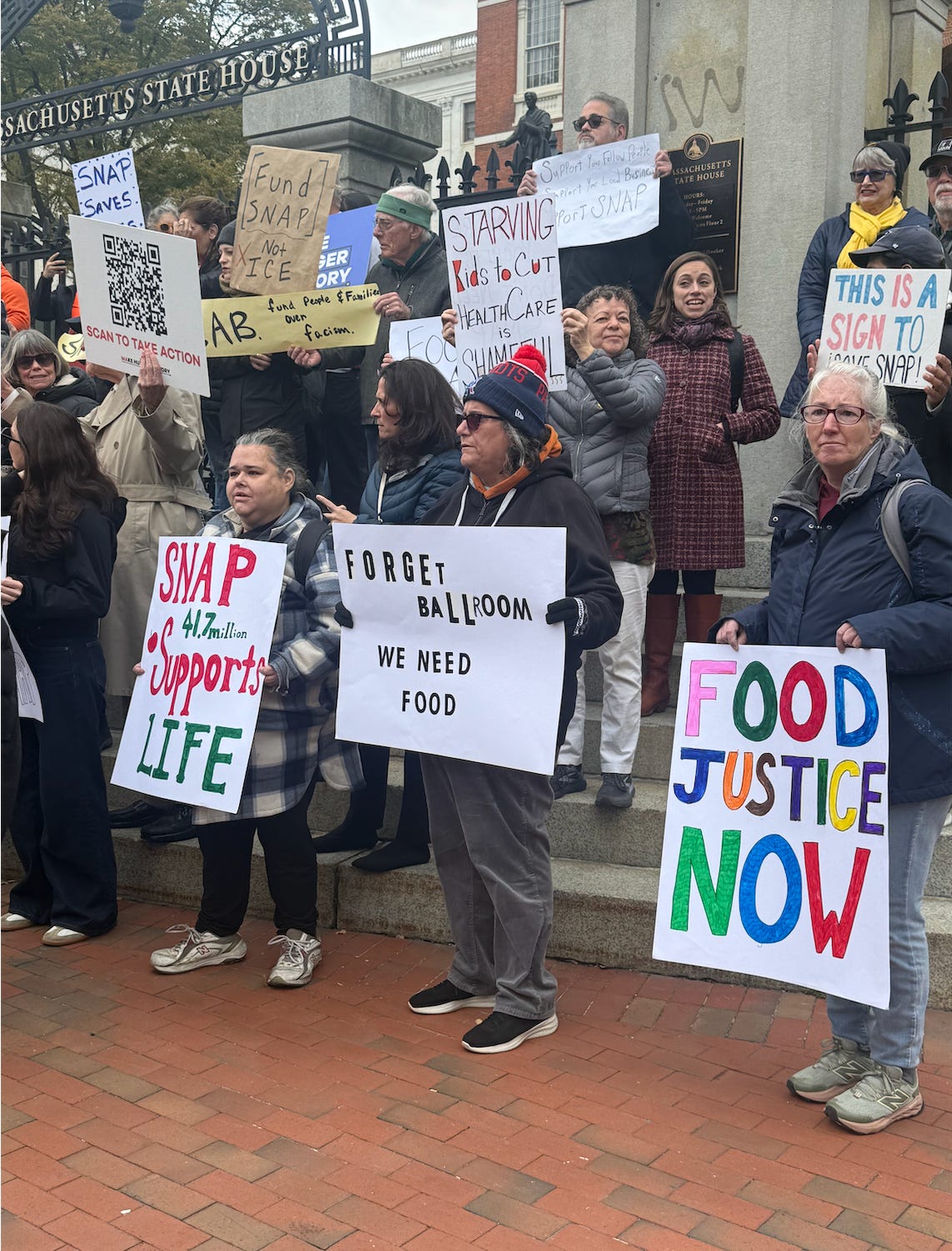
Nearly a year after President Trump signed the “One Big Beautiful Bill” into law on July 4, 2025, its consequences are no longer theoretical for Massachusetts families.1 They show up as a busy signal. They show up as an expired document nobody can resubmit in time. They show up as a mother standing in a food bank line who, months ago, had a working SNAP card.
Nationally, more than 4 million people have dropped off SNAP since the law’s enactment, that’s nearly 10% of the entire caseload gone in under a year.2 Massachusetts is not merely keeping pace with that national unraveling. It is outpacing it.
In the twelve months ending this past March, roughly 155,000 people fell off Massachusetts’ SNAP rolls, including an estimated 54,000 children.3 A separate accounting, drawn from state data obtained by the Massachusetts Law Reform Institute, found the decline moving at nearly double the national rate - an 80,000-household collapse that includes close to 50,000 children, among them families who never should have lost their benefits at all.4
The system meant to catch them is instead the thing failing them. Massachusetts’ SNAP hotline now fields an average of 20,000 calls a day, answered by just 645 caseworkers.5 More than three out of every four of those calls are disconnected before anyone can pick up.6
“Because of policies passed by President Trump and Congress, thousands of Massachusetts residents are being kicked off SNAP.”
— Spokesperson, Massachusetts Department of Transitional Assistance⁷
The Machinery Behind the Collapse
This is not a single glitch. It is several federal changes, arriving at once, each one tightening the same door.
Work requirements have expanded to groups never covered before. Adults 55 to 64. Parents of teenagers 14 and older. People who, a year ago, were exempt and are now required to document 20 hours of work a week or lose benefits after three months.8
Immigrants are being removed outright. Massachusetts has already begun cutting off SNAP for up to roughly 10,000 legally present immigrants who have lawful status but now are now locked out of a program that once served them.9
The state is being handed the bill. Beginning in fiscal year 2027, Massachusetts must absorb a dramatically larger share of SNAP’s administrative costs, rising from 50% to 75% and, for the first time in the program’s history, states will owe a share of benefit costs tied to their payment “error rate.”10 That error rate overwhelmingly reflects paperwork mistakes, not fraud. Every dollar the state fears owing is a dollar of pressure pushing eligibility workers to find reasons to say no.
Recertification now happens twice as often. Many households must renew their eligibility every six months instead of once a year. this is doubling the number of interviews, documents, and chances for the system to drop them.
Trump administration officials, including Agriculture Secretary Brooke Rollins, have credited the falling caseloads to a stronger economy and reduced fraud.11 Harvard public health policy professor Sara Bleich rejects that framing outright: the economy has not measurably improved since the law passed, she notes, and the real drivers are the law’s new eligibility hurdles and the administrative wall states can’t staff fast enough to meet.12
The Human Cost of a Busy Signal
Merideth Lively did everything right. A routine recertification. A scheduling mix-up. A caseworker’s error in the paperwork. What followed was two months of unanswered calls, a malfunctioning app, and repeated hours-long visits to a DTA office before benefits were finally restored.13 “It was like a process that should have been totally normal and simple,” Lively said. “I never should have been cut off.”14
This is happening against a backdrop already stretched thin. An estimated 40% of Massachusetts households experienced food insecurity in 2025 before the deepest cuts had even taken hold.15 Roughly 7,200 adults newly subject to strict work rules are at risk of losing SNAP this spring alone if they cannot reach DTA in time to prove they qualify.16 Advocates at the Massachusetts Law Reform Institute estimate that as many as 100,000 residents statewide could ultimately be at risk under the eligibility changes now working their way through the system.17
“We can’t have people who are struggling to put food on the table and eligible for this program losing access to it simply because they can’t get through.”
— Massachusetts anti-hunger advocate¹⁸
MassHealth: The Larger Blow Still Coming
If SNAP is the crisis unfolding now, MassHealth is the crisis on the calendar. And Massachusetts, of all fifty states, is positioned to be hit hardest.
A joint analysis by the Robert Wood Johnson Foundation and the Urban Institute found that once new Medicaid work requirements and more frequent eligibility checks take full effect, between 99,000 and 202,000 Massachusetts residents could lose MassHealth coverage.19 No other state is projected to lose a larger share of its Medicaid rolls. Even the most conservative estimate in the report projects a 33% drop in expansion enrollment.20 MassHealth’s own internal projection, delivered by chief operating officer Elizabeth LaMontagne, lands even higher than outside estimates: roughly 175,000 residents are expected to eventually lose coverage.21
The mechanism mirrors what has already gutted SNAP. Starting January 1, 2027, MassHealth members age 19 to 64 in the Medicaid expansion group must work, volunteer, or attend a work program for at least 80 hours a month — or show at least $580 in monthly earnings — unless they qualify for an exemption such as caring for a young child or living with a disability.22 Eligibility will be rechecked every six months instead of annually. Retroactive coverage, the safety net that once covered care received before a member’s paperwork was finalized, will shrink to as little as one month for many adults.23 Separately, up to 2,500 MassHealth members — refugees, asylees, and other lawfully present immigrants — are expected to lose comprehensive coverage this October because of their immigration status alone.24
Massachusetts’ own demographics make the state especially exposed. Researcher Katherine Hempstead points out that the state’s Medicaid expansion population skews toward adults without children, who are less likely to qualify for exemptions, and that the state’s comparatively high minimum wage already pushes many workers just over the income line that would let them keep coverage under the new rules.25 MassHealth is racing to link its systems to wage, veterans’, and student-enrollment databases to automate compliance checks, and the state has proposed roughly $30 million to build that infrastructure and hire additional staff.26 Even so, officials concede plainly: not everyone will be automatically confirmed. Some members will have no choice but to track down and submit their own documentation, on their own initiative, or lose coverage.27
Hospitals are watching nervously. If patients lose coverage and remain uninsured, the emergency care they still need doesn’t disappear — it just shifts onto hospital balance sheets, particularly at facilities serving low-income patients. UMass Memorial Health has already scaled back some services in anticipation of what’s coming.28
“We are really committed to implementing these changes in the most thoughtful way that minimizes impact to the members and coverage, while, of course, maintaining that federal compliance.”
— Elizabeth LaMontagne, MassHealth Chief Operating Officer²⁹
A State That Shows the Nation What’s Coming
Massachusetts built one of the country’s more generous social safety nets that includes broad MassHealth eligibility, a robust ConnectorCare program, a SNAP system designed to reach more of the people who qualify for it.30 That generosity is precisely why the “Big Beautiful Bill” is hitting the state so hard: the more people a state successfully enrolled before the law passed, the more people it now stands to lose.
What is happening in Massachusetts today faster-than-average SNAP losses, a disconnected hotline, a Medicaid program bracing for the steepest proportional drop of any state is not an aberration. It is a preview. As more of the law’s provisions phase in through 2027 and 2028, every state faces the same bind Massachusetts is living through right now: absorb the new administrative and benefit costs itself or let eligible families fall through the cracks of a system it cannot staff fast enough to run.
The question is whether the state, and the federal government that wrote these rules, can respond at the scale the moment demands with enough caseworkers, enough funding, and enough urgency to keep children fed and families insured while Washington shifts the bill onto the states least equipped to absorb it. The busy signal Adamary Olivas and Merideth Lively heard is still ringing in kitchens and DTA offices across Massachusetts tonight. Whether anyone in power picks up remains, as it always does, a choice.
Project Bread and the Make Hunger History Coalition are working with Governor Healy’s Hunger Task Force to respond to these federal cuts. They could use your help and your support.
Endnotes
1. Harvard Kennedy School (2026). Explainer: Understanding the SNAP program — and what cuts to these benefits may mean. HKS, Cambridge, MA.
2. Marketplace (2026, July 2). A year since Trump’s big tax bill, SNAP enrollment has fallen dramatically. Citing Ed Bolen, Center on Budget and Policy Priorities.
3. GBH News (2026, May 28). With new federal rules, state is struggling to help people stay on SNAP.
4. Boston Globe (2026, May 1). SNAP recipients in Massachusetts lose food assistance. Citing Massachusetts Law Reform Institute data.
5. Boston Globe (2026, May 1). SNAP recipients in Massachusetts lose food assistance.
6. Boston Globe (2026, May 1). SNAP recipients in Massachusetts lose food assistance.
7. GBH News (2026, May 28). With new federal rules, state is struggling to help people stay on SNAP. Department of Transitional Assistance spokesperson statement.
8. Harvard Kennedy School (2026). Explainer: Understanding the SNAP program — and what cuts to these benefits may mean.
9. Boston Globe (2026, May 1). SNAP recipients in Massachusetts lose food assistance.
10. Harvard Kennedy School (2026). Explainer: Understanding the SNAP program — and what cuts to these benefits may mean.
11. PBS NewsHour (2026, June). Millions lose SNAP benefits as One Big Beautiful Bill’s stricter requirements kick in.
12. PBS NewsHour (2026, June). Millions lose SNAP benefits as One Big Beautiful Bill’s stricter requirements kick in. Interview with Sara Naomi Bleich, Harvard T.H. Chan School of Public Health.
13. GBH News (2026, May 28). With new federal rules, state is struggling to help people stay on SNAP.
14. GBH News (2026, May 28). With new federal rules, state is struggling to help people stay on SNAP. Quoting Merideth Lively.
15. GBH News (2026, May 28). With new federal rules, state is struggling to help people stay on SNAP. Citing Greater Boston Food Bank report.
16. Boston Globe (2026, May 1). SNAP recipients in Massachusetts lose food assistance.
17. WWLP (2025, October 15). Massachusetts faces potential SNAP cuts due to new bill. Citing Vicky Negus, Massachusetts Law Reform Institute.
18. GBH News (2026, May 28). With new federal rules, state is struggling to help people stay on SNAP.
19. Boston Globe / Health Care For All (2026, March 27). Over 200,000 people could lose MassHealth under coming federal changes, report says. Citing Robert Wood Johnson Foundation and Urban Institute analysis.
20. Boston Globe (2026, March 27). Over 200,000 people could lose MassHealth under coming federal changes, report says.
21. Boston Globe (2026, March 27). Over 200,000 people could lose MassHealth under coming federal changes, report says. Citing Elizabeth LaMontagne, MassHealth Chief Operating Officer.
22. Mass.gov (2026, March 31). Federal changes affecting MassHealth members.
23. Mass.gov (2026, March 31). Federal changes affecting MassHealth members.
24. Mass.gov (2025, November 26). MassHealth Federal Updates and Impact.
25. Boston Globe (2026, March 27). Over 200,000 people could lose MassHealth under coming federal changes, report says. Citing Katherine Hempstead.
26. Boston Globe (2026, May 21). Massachusetts preps for Medicaid work requirement: 300K at risk.
27. Boston Globe (2026, May 21). Massachusetts preps for Medicaid work requirement: 300K at risk. Quoting Elizabeth LaMontagne.
28. Boston Globe (2026, March 27). Over 200,000 people could lose MassHealth under coming federal changes, report says.
29. Boston Globe (2026, March 27). Over 200,000 people could lose MassHealth under coming federal changes, report says. Quoting Elizabeth LaMontagne.
30. KFF (2026, June 29). Tracking Implementation of the 2025 Reconciliation Law: Medicaid Work Requirements.