

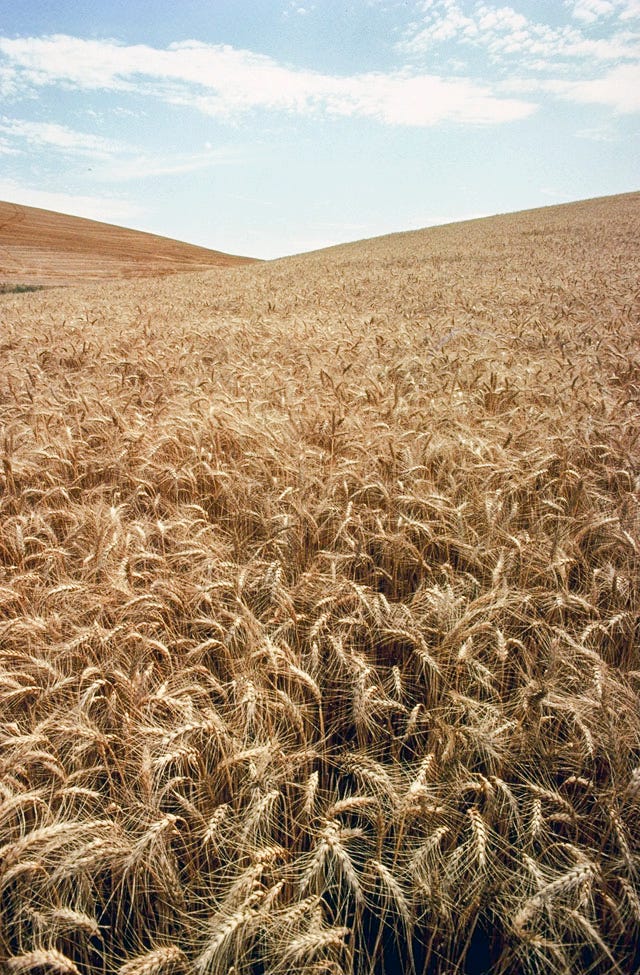
Photo: Doug Wilson / USDA Agricultural Research Service
A Nation Cooking on Both Land and Sea
The United States rang in its 250th birthday under a heat dome that would not move. By the Fourth of July weekend, more than 160 million Americans were living under heat alerts, with the National Weather Service placing over 165 million people across the Midwest and East at risk of “major” or “extreme” heat-related illness.1
The records fell fast. Central Park hit 100°F for the first time in nearly 14 years.2 Washington, DC reached 102°F, breaking a high-temperature record that had stood since 1872.3 By the time the heat dome finally began to loosen its grip, the 2026 North American heat wave had been blamed for at least 23 deaths, strained power grids to a record demand level, and forced the cancellation of Independence Day parades in Washington, Philadelphia, and beyond.4
That single, headline-grabbing heat dome was only the visible peak of a much longer season. Since March, a string of overlapping heat waves and drought events has been quietly rewriting the numbers for American agriculture. And a thousand miles offshore, a marine heatwave has spent nearly a year warming the waters of the West Coast, threatening to repeat a disaster that has already reshaped a major American fishery once this decade. Together, the two events show how thoroughly heat, on land and at sea, has come to define what growers and fishing communities are up against in 2026.
Increase in the percentage of the global population exposed to heat stress from the 1970s to the last 10 years (2015–2024).
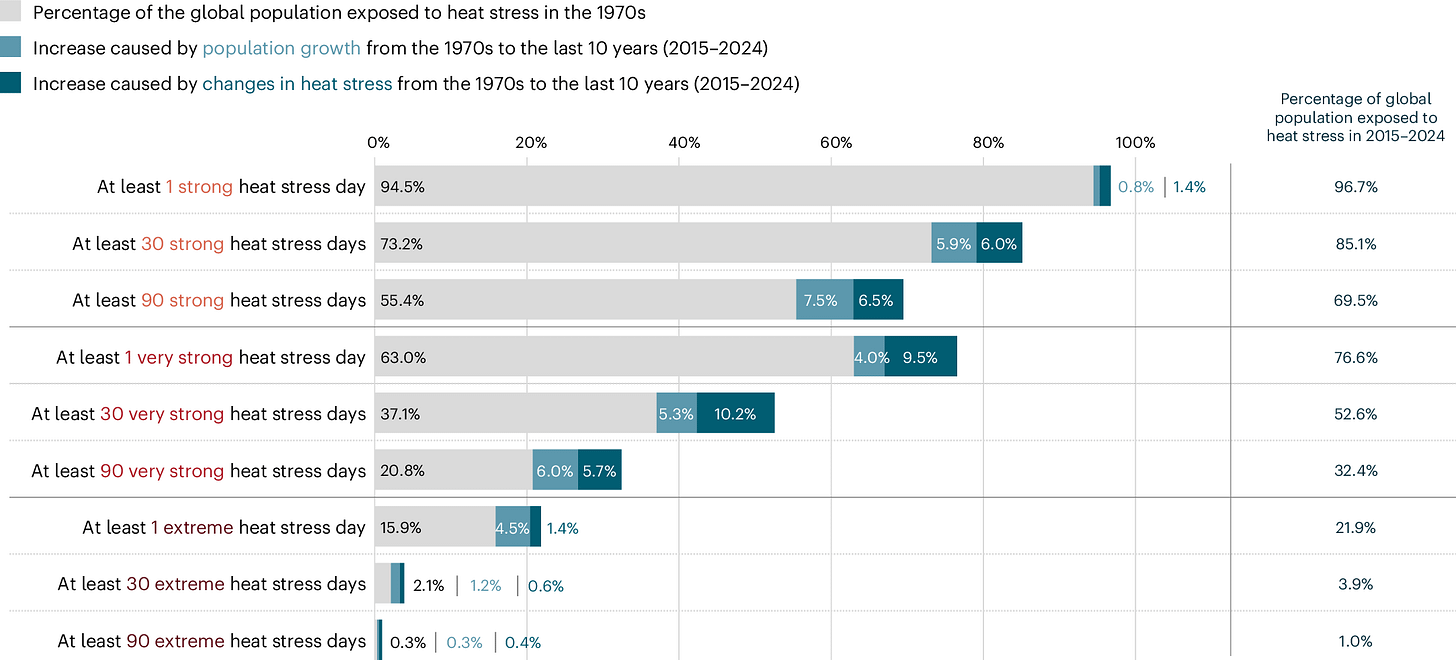
Nature Climate Change (Nat. Clim. Chang.) ISSN 1758-6798 (online), ISSN 1758-678X (print)
The Geography of Loss: Wheat, Drought, and a Season Without Relief
Unlike a single dramatic heat dome, the damage to American farming this year has accumulated in layers, one weather system at a time.
It started early. Between March 15 and 21, an unseasonable heat wave shattered hundreds of daily temperature records across the western and central states, with readings nearing 110°F in the desert Southwest. The early heat accelerated evapotranspiration, deepening soil moisture deficits and driving up irrigation demand in regions already dependent on shrinking snowpack.5 By late March, temperatures were running more than 10°F above normal across much of the West and Plains, the USDA reported, and the Sierra Nevada snowpack, a critical source of irrigation water for California, had dropped below 20% of normal, creating a serious threat to the state that grows more than a third of the nation’s vegetables.6
By mid-May, the toll on the country’s wheat crop was becoming clear. USDA data showed that 32% of US winter wheat acreage would go unharvested in 2026, the second-highest abandonment rate since the Dust Bowl era, as extended heat and drought stress pushed fields past the point of recovery.7 Extreme to Exceptional Drought covered half of Nebraska by June, with Colorado, Oklahoma, Wyoming, New Mexico, and South Dakota all reporting severe moisture stress.8 Even with the U.S. crop shrinking, several major competitors still posted historically large harvests: Russia had its fourth-largest crop ever, while Australia, Canada, and Kazakhstan all had smaller crops that remained historically large. Record global carry-in stocks also gave the market a buffer against the U.S. shortfall which kept prices low, so the U.S. wheat producers that could harvest crops got a lower price than normal. The 2025/26 season-average U.S. farm price was projected at just $5 per bushel, with December 2025 futures hitting $4.88 in October 2025 which was a multiyear low.
The heat kept coming through the growing season. A USDA report from early June described extreme heat across the Plains compounding with severe thunderstorms and worsening dryness in the South, even as Corn Belt states pushed on with planting; more than 90% of intended corn acreage was in the ground in nearly every Midwestern state by early June.9 Then came the July heat dome itself, which drove up irrigation and energy costs for the specialty crops, fruits, and vegetables that depend on it most, adding new pressure to farm margins already squeezed by input costs.1
Livestock producers have faced a parallel squeeze. Heat stress hits animals at lower temperature thresholds than it hits crops, and pigs and poultry, which cannot cool themselves as efficiently as cattle, are especially vulnerable, according to a joint 2026 report from the UN Food and Agriculture Organization and the World Meteorological Organization. The consequence: reduced growth, lower dairy yields, and in severe cases, organ failure.10
“Extreme heat is increasingly defining the conditions under which agrifood systems operate.” — WMO Secretary-General Celeste Saulo
The Ocean Also Boils: A Marine Heatwave Off the West Coast
While the heat dome was making headlines on land, a separate and less visible heat event has been building at sea. A marine heatwave has dominated the waters off the US West Coast since the summer of 2025, and NOAA scientists say it is only the third time on record that such a large stretch of coastal ocean has stayed unusually warm for so long, through an entire winter, without being linked to an El Niño event.11
At its peak in September 2025, the heatwave rivaled the size and surface temperatures of the infamous 2013–2016 event known as “the Blob,” and the northeast Pacific briefly reached its highest average temperature ever recorded, about half a degree warmer than any prior measurement.12 The current event has raised West Coast waters roughly 3 to 4°F above normal.11
The immediate worry for fisheries is not the warm water itself, but what it can trigger: harmful algal blooms. These blooms can sicken marine mammals and force the closure of shellfish fisheries, particularly recreational ones, hitting coastal economies directly. A bloom in 2025 arrived unusually early and killed hundreds of California sea lions, dolphins, and seabirds, and NOAA scientists are watching closely for a repeat.11 So far, this heatwave has not penetrated as deep into the water column or lingered as close to shore as the original Blob, limiting its ecological damage, and NOAA’s forecasts suggest the warm water may dissipate in the coming months as it mixes with cooler water below.11
History gives that watchfulness some weight. The 2013 Gulf of Alaska marine heatwave restricted Pacific cod spawning habitat so severely that the cod population fell by roughly 100 million fish; when the population still hadn’t recovered by 2020, the federal government closed the commercial fishery for the first time in its history.13 More recently, a 2023 West Coast marine heat wave caused such a sharp drop in albacore catch rates that authorities declared a fisheries disaster and the industry sought federal relief for that season’s losses.14
The Mechanisms Beneath the Numbers
The headline statistics: abandoned wheat acreage, a warming Pacific, only hint at what is actually happening inside plants, animals, and the ocean itself. A growing body of research from federal agencies, international bodies, and peer-reviewed journals lays out the underlying physiology, and it helps explain why heat this persistent does more damage than a single hot afternoon ever could.
Crop Biology: The Nighttime Temperature Penalty
Daytime heat is not the whole story for crops. A large and growing body of research points to nighttime warming as an especially destructive force, because it prevents plants from resting. Warm nights accelerate a plant’s “dark respiration,” the metabolic process that burns through the sugars and starches a plant has built up during the day, leaving less available for grain and seed development. A recent peer-reviewed synthesis of wheat trials found that grain yield has been measured to fall by roughly 1.9% for every 1°C rise in nighttime minimum temperature, with some studies reporting penalties as high as 10% per degree in spring wheat and 12.9% per degree in winter wheat.17 Field trials in Australia went further: raising nighttime temperatures from 15°C to 20°C during the reproductive stage of wheat produced up to a 40% yield loss, driven by higher floret sterility and lower grain weight.18
The mechanism is well documented at the cellular level: elevated night temperatures increase respiratory carbon loss, depleting the non-structural carbohydrate reserves that crops depend on to fill grain, a dynamic described in a peer-reviewed synthesis on respiratory control of crop yield under heat stress.19 Layered on top of that is the drought dynamic the USDA has already flagged this season: when soil moisture runs short, plants lose their main defense against heat, transpirational cooling, which can push leaf and canopy temperatures still higher and compound the damage.8
Livestock: When Nights Don’t Cool Down
Livestock face a related but distinct problem: unlike people, pigs cannot sweat, and both pigs and poultry rely heavily on panting to shed body heat, a far less efficient cooling mechanism. The USDA’s Agricultural Research Service estimates that heat stress already costs the US swine industry roughly $481 million a year in lost revenue, even before accounting for the kind of extended, multi-week heat this season has brought.20 For poultry, research compiled by the European Food Safety Authority and cited in recent agricultural engineering studies puts the ideal temperature range at 20–25°C, with production losses beginning above roughly 30°C.21
USDA-ARS researchers who study livestock heat stress have long emphasized that the ability of animals to recover overnight is what determines whether a heat event becomes dangerous, and threshold temperature limits for swine, cattle, and sheep are central to how ARS models predict risk.22 When overnight lows stay elevated, as they have through much of this season’s heat domes, that recovery window narrows or disappears. The production consequences are measurable: an Australian study of dairy cattle found that as heat stress intensity rose, daily milk production dropped by as much as 14%, alongside rising respiration rates and body temperatures.23
The Ocean’s Version of Heat Stress: Oxygen and Range Shifts
Marine heatwaves inflict a version of the same nighttime-recovery problem, but through ocean chemistry rather than animal physiology. Warmer water simply holds less dissolved oxygen, and NOAA Fisheries scientists on the West Coast track a hypoxia threshold of roughly 1.4 milliliters of oxygen per liter, below which bottom waters become lethal to many fish and invertebrates; hypoxia of this kind is already a recurring summer feature of the shelf off Oregon and Washington.24 In 2021, NOAA-supported researchers measured near-bottom hypoxic water spanning nearly half the continental shelf inshore of the 200-meter line, the most extensive event on record, and found a long-term trend toward lower oxygen levels dating back to 1950.25
For fish, the physiological bind is direct: warmer water raises their metabolic oxygen demand at the same time that less oxygen is available, a mismatch that peer-reviewed research on marine heatwaves describes as a key driver of die-offs and reduced thermal tolerance in affected species.26 The longer-term response for mobile species is to leave. A NOAA Fisheries-funded study published in PLOS ONE projected that hundreds of US fish and invertebrate species, including economically significant ones such as lobsters, will continue shifting northward as the ocean warms, a process NOAA scientists say is already underway at different rates in different regions.27 For fishing fleets, that migration collides with a management system built around fixed geographic quotas, forcing longer transits, higher fuel costs, and, in cases like Atlantic mackerel, international disputes over who gets to catch a stock that has moved into someone else’s waters.28
A Strained Nexus: Water, Energy, and Food Compete for the Same Resource
Heat does not stress agriculture, energy, and water systems separately, it stresses all three at once, through what researchers call the food-energy-water nexus. Thermoelectric power plants require large volumes of water for cooling, the same reservoirs and rivers that irrigation-dependent farms are drawing down harder this season, and the US Department of Energy has long identified this competition as a growing vulnerability under climate stress.29 The strain runs in both directions: research on the water-electricity nexus in the Midwest has found that a 1°C rise in cooling water temperature can reduce a power plant’s generating capacity by roughly 0.15% to 0.5%, precisely when demand for air conditioning is peaking.30
It is this compounding, cross-sector pressure, on crops that cannot cool at night, on livestock that cannot sweat, on fish running out of oxygen, and on a power grid competing with farmers for the same water, that is pushing discussions in Washington toward a Farm Bill with stronger climate resilience provisions and modernized crop insurance frameworks, even as the current bill remains unfinished.7
Who Pays When the Weather Turns
The costs of a hot season like this one land unevenly. Irrigation-dependent specialty crop growers face rising energy and water bills on top of already elevated input costs. Ranchers face the prospect of higher feed costs if pasture quality keeps declining. Wheat farmers who abandoned nearly a third of the nation’s winter wheat acreage face tightening supply and a growing reliance on crop insurance and federal disaster support just to stay solvent through the season.7
On the coast, the exposure is different but no less real: recreational and commercial shellfish operators face the possibility of sudden closures if a harmful algal bloom takes hold, and communities built around fisheries like Pacific cod and albacore have already seen, within the last several years, how quickly a warm ocean can turn into a declared disaster.1314
The human toll of the July heat dome itself was also concrete and immediate: at least 23 deaths, emergency rooms reporting “extremely high” rates of heat-related visits, and hundreds of thousands of homes without power at points during the event, as the grid strained under record demand for air conditioning.154
What Comes Next
The USDA’s outlook, as of its most recent Agricultural Weather Highlights, calls for above-normal temperatures to persist across much of the West and Deep South, with cooler-than-normal conditions offering some relief to the northern Plains, Midwest, and Northeast.5 At sea, NOAA’s forecasts suggest the marine heatwave may weaken in the coming months as surface waters mix with cooler water from below, though scientists caution that whether enough warm water and nutrients persist to fuel another harmful algal bloom remains an open question.11
None of this guarantees smooth sailing. As one farm economist put it during an earlier heat-driven scare, growers are still “living off surface moisture, rain by rain, week by week,” and the same could now be said of a fishing industry watching the Pacific for the next bloom.16
What is clear is that 2026 has not delivered a single heat wave so much as a season defined by heat: on the plains, where wheat cracked and went unharvested; in the reservoirs and snowpack that irrigation depends on; and in an ocean that has now spent the better part of a year running warmer than it should. The story of American food this year is being written twice over, once in the fields and once beneath the waves, by the same rising temperatures.
Climate change is hitting America’s food production and it is time that we pay real attention because lower crop yields and fisheries captures result in higher prices and push more Americans into food insecurity just as the government dismantles America’s safety net.
Really insightful - I live in a rural area and am very near farms. One topic I am observing is how the use of some of these GM hybrid seeds reduces resilience as the farmers have so much invested in seeds that can fail outside of a narrow bank of conditions. I do not know how to research that hypotheses, but it seems to seems to me that this monoculture of cash crops and nutrient starved soil is a multiplier in the situation of heat and drought.
Thanks for this detailed and thoughtful rundown of the broader effects of sustained heat on critical systems (and all the species and life forces within them). As someone who is trying to pay attention to what my senses tell me about the plants, creatures, weather and water in my yard and environs, this is the second time I comment with this word this week: sobering. It’s difficult to read about the ways sustained heat and insufficient nocturnal cooling affects natural processes we count upon, and can so easily take for granted. But we need this kind of information to comprehend the complexity of the predicament we’ve created for ourselves and for all beings on the planet. 🙏🏻