

A CLIMATE & AGRICULTURE FIELD REPORT UPDATED JULY 11, 2026

A drought-cured wheat field stands under wildfire smoke — the season’s defining image on both sides of the Atlantic. (Illustration)
A fire does not have to reach the field to take the harvest.
—
The United States crossed into its 2026 wildfire season already on fire. By the second week of July, the National Interagency Fire Center reported that more than 38,500 wildfires had burned over 3.4 million acres nationwide which is a pace running roughly a third above the ten-year average, with the West’s peak months still ahead.1 The Mediterranean was burning too, with fires active simultaneously from Portugal to Greece, a span of well over a thousand miles: across the European Union, satellites had already mapped more than 155,000 hectares of scorched land by early summer, well above the twenty-year norm, in a year following the worst fire season Europe has ever recorded.5 6
The headlines, as always, follow the flames with headlines alarming the evacuations, the lost homes, the walls of orange advancing on a ridgeline. But the deeper story of a bad fire year is written more quietly, in the places that grow and raise our food. Fire does not need to reach a field to damage what grows there. It scorches rangeland that livestock depend on, smothers vineyards in smoke that ruins a vintage without singeing a single vine, drives the farmworkers who bring in the harvest indoors, and burns through the olive groves and animal pens that anchor rural economies. In 2026, on two continents at once, wildfire has become an agricultural event as much as a forest one and this article traces how this happens.

PART I · THE AMERICAN WEST
Rangeland, Smoke, and the Grapes That Absorb It
The American fire season opened not in the forests but on the grasslands. Much of the acreage burned early in 2026 was in the southeastern United States and the Plains of Nebraska, Kansas, Oklahoma where fast-moving grass fires raced across landscapes primed by a winter of drought and thin mountain snowpack.3 The 2025 drought had peaked at 36.65% of the country in D1 (moderate) drought or worse in late November, and the West entered 2026 in severe snow drought. On December 7, 2025, snow cover across the West was the lowest for that date in the 24-year satellite record leaving little of the snowmelt that normally keeps forests from igniting through the summer.4 Wildfire experts warned the nation was entering the season as a tinderbox.3
For agriculture, grass fires are livestock fires. They burn the rangeland and pasture that cattle and sheep graze, along with the fences, corrals, barns, and hay stores that ranching depends on. When fire tore through the Texas panhandle earlier in the season, the USDA moved quickly to open its disaster toolbox including the Livestock Indemnity Program for animals lost beyond normal mortality, emergency grazing authorizations on conservation land, and cost-share programs to replace fencing and haul feed and water to surviving herds.7 Those programs exist precisely because a rangeland fire’s damage outlasts the flames: a rancher who loses grazing ground and infrastructure faces a difficult year of bought feed and rebuilt fence line long after containment.
History sets the scale. In California’s recent mega-fire years, blazes ripped through national forests used for grazing and across the rangeland that ranchers manage, killing cattle and forcing producers to euthanize animals too badly burned to survive; a state legislative analysis documents destroyed fencing, structures, and livestock across those seasons.8 The individual losses are devastating even when, as economists note, a single state’s cattle inventory is too small a share of the national herd to move grocery prices.
The vineyard problem: damage without a flame
No crop illustrates wildfire’s indirect reach better than wine grapes. Grapevines themselves rarely burn since they are irrigated and green. In fact, vineyards often act as firebreaks, and even a smoke-affected vine recovers with no carryover to the next season.13 The threat is smoke taint: volatile phenols released when wood burns are absorbed straight through the grape’s permeable skin, then bind to sugars inside the berry. Months later, in the acidic medium of finished wine, those bonds can hydrolyze and release compounds that experts describe as tasting “like licking an ashtray.”9 10 11 A vineyard can stand untouched by fire and still lose its entire harvest to a plume that drifted overhead for a day.
“Without question, the threat of wildfire in many different ways is the greatest challenge of the day for the industry.”
— John Aguirre, President, California Association of Winegrape Growers(11)
The North Coast fires of 2017, 2019, and 2020 caused substantial grape losses in Sonoma, Lake, and Napa counties and made up the bulk of California’s agricultural fire losses in those years.12 In Napa, lost vineyard acreage can average around $100,000 an acre, and smoke-affected red grapes that might have fetched close to $10,000 a ton often were not worth harvesting at all, according to a California legislative analysis.8 The USDA’s Agricultural Research Service now funds a sustained program of smoke-exposure research in wine grapes. This work that has, for example, identified grape-microbiome bacteria able to break down the taint compound guaiacol.9 At the same time, crop-insurance standards still lean on older laboratory markers, leaving a gap between what science can now detect and what growers can be compensated for.12
The people who bring in the harvest
There is a human dimension that rarely makes the fire maps. Peer-reviewed research finds that farmworkers face disproportionate wildfire-smoke exposure while performing heavy outdoor labor when the PM2.5 air-quality index turns “unhealthy,” often with underlying health risks and limited health-care access. To respond to this, California made permanent a Cal/OSHA rule requiring employers to supply NIOSH-approved respirators once the AQI passes 150.14 In 2024, CDC’s NIOSH issued the first federal hazard review devoted to wildland-fire smoke among farmworkers and outdoor workers, and the American Lung Association notes agricultural workers are far more likely than other workers to die of heat-related illness, a risk that compounds with smoke.15 16 Lost workdays ripple into lost harvest, and one of wildfire’s larger effects on agriculture may simply be the difficulty of assembling the workforce a food system needs.
For direct field damage, the picture is more nuanced than headlines suggest. A peer-reviewed review of smoke-aerosol impacts finds that thin smoke can slightly increase corn photosynthesis by scattering light into the canopy, while heavier or sustained smoke and the ozone that wildfires generate reduces yields. Ozone from wildfires alone is estimated to cut U.S. corn, wheat, and soybean output by several percent.17 Recent work points both ways: a Kansas State analysis linked smoke to reduced soybean yields on the northern Plains, while Purdue researchers found a small corn benefit under certain conditions.17 The lesson is that not every smoky summer is a catastrophe for the Corn Belt, and precision matters as much as alarm.
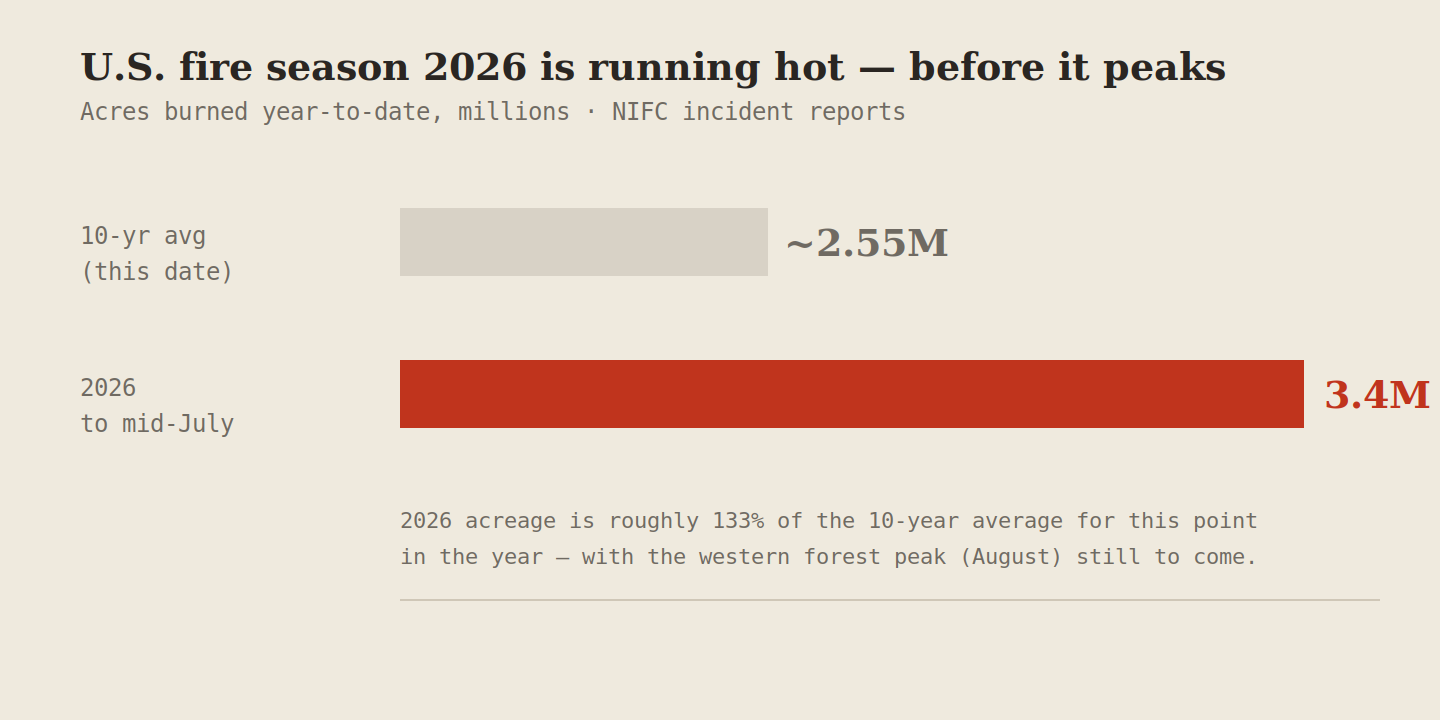
Source: National Interagency Fire Center, National Fire News, July 2026.1 Ten-year-average figure is implied from NIFC’s reported ratio and shown for scale.
PART II · THE MEDITERRANEAN
Olive Groves, Herds, and Bees Turned to Ash
Europe enters 2026 in the shadow of a record. The 2025 season was the EU’s most destructive fire season ever recorded: more than one million hectares burned within the bloc, nearly double the long-run average, with Germany, Spain, Cyprus, and Slovakia all setting all-time records, and roughly 39% of the burned area falling inside the Natura 2000 network of protected sites.6 2026 has picked up where that left off. By early July, hundreds of firefighters were battling blazes in Portugal, Greece, Spain, and France simultaneously; more than 10,000 people were evacuated as a single wildfire tore through southern France, and Spain alone had recorded 14 “major” fires of over 500 hectares according to EFFIS and Spain’s environment ministry.18 19
In the Mediterranean, farmland and fire are woven together. Much of what burns is the mosaic of olive groves, orchards, pasture, and small livestock farms that defines the rural south. The Hellenic Fire Service estimates that about 85% of Greece’s wildfires are caused by human negligence, including sparks thrown by agricultural machinery, discarded cigarettes, and outdoor fires.18 Fire is not only a threat to farming here; farming is one of the ways fire starts.
A single fire, an entire farm
The toll from fires in Europe is best measured up close. When a wind-driven wildfire swept through Akraifnio in the Boeotia region of central Greece in late June 2026, it destroyed a major livestock farm in minutes: an entire cattle pen was consumed, the farm’s machinery lost, and a herd of roughly 60 calves and a flock of sheep killed. The same blaze burned through extensive olive groves and pistachio orchards, deepening the economic wound to local farmers already living at the margins.20 “The fire moved incredibly fast,” a resident told a local agency. “Many olive trees and pistachio trees burned.”20
THE COMPOUNDING LOSS
Farm fires cascade beyond the visible damage. After earlier Mediterranean fires, one Greek regional authority calculated an urgent need to feed 44,000 surviving animals whose pasture had burned, and to sustain 21,000 beehives whose entire foraging landscape was gone. A beekeepers’ association warned that if bees couldn’t forage to prepare for winter, “we will have no bees in the spring.” This will be a pollination gap that reaches into next year’s harvests across the region.21
Older Mediterranean fire years show how far the losses run. Reporting on recent seasons documents a single Limassol-district blaze in Cyprus in 2025 that killed roughly 100 livestock across 14 farms and destroyed thousands of hectares of agricultural land, and fires in Turkey’s productive olive-growing provinces that reduced well over a hundred thousand hectares of forest and farmland to ash.24 The pattern is structural, not anecdotal: peer-reviewed fire-risk modelling of Mediterranean landscapes finds that as unmaintained and abandoned farmland expands, the modelled burn probability of both settlements and permanent crops such as olive orchards rises with it.23 And olive groves are not annual crops that regrow in a season, a mature grove destroyed is a generation of income and heritage gone at once.
“Extreme heat is increasingly defining the conditions under which agrifood systems operate.”
— Celeste Saulo, Secretary-General, World Meteorological Organization
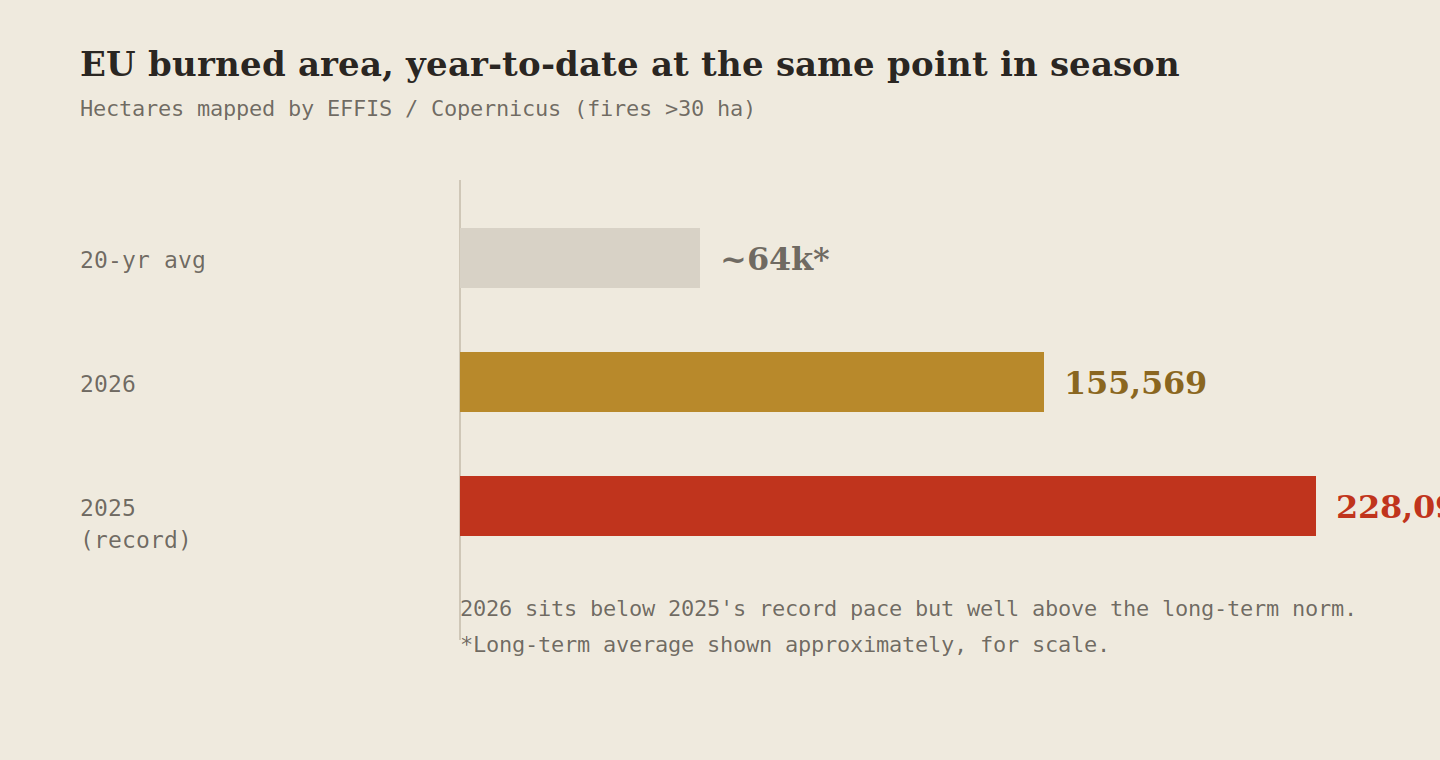
Source: European Forest Fire Information System (EFFIS), Copernicus Emergency Management Service / JRC, current-situation data, 2026.5 Figures cover fires larger than 30 hectares including forested area.
PART III · THE MECHANISMS
Why a Fire You Never See Still Reaches Your Plate
Strip away the flames and four distinct pathways connect a distant wildfire to the food supply. Understanding them explains why “the fire didn’t reach the farm” is rarely the end of the story.
Direct destruction. Wind-driven fire burns crops, orchards, pens, barns, fences, irrigation lines, and the animals themselves. Even irrigated crops offer no guarantee according to a legislative analysis of California’s fires documents blazes burning through orchards and vineyards and destroying rangeland fencing and structures, with tree- and vine-crop losses valued per acre far above annual row crops.8 For tree and vine crops, a burned grove or vineyard is a capital loss measured in decades, not one lost harvest.
Smoke and taint. Wine grapes are the clearest case, absorbing volatile phenols through their skins to produce ashy, unsellable wine from vineyards fire never touched.9 10 The science of detecting and treating smoke damage is now advancing faster than the insurance rules meant to cover it.12
Rangeland and forage collapse. Grass fires destroy the grazing land and stored feed that livestock depend on, forcing ranchers to buy feed, relocate herds, or cull animals, this is the reason USDA disaster programs center on forage, fencing, and livestock indemnity.7 8 In the Mediterranean, the same dynamic strands surviving herds and bees without pasture or forage the moment a landscape burns.21
Labor and logistics. Smoke drives farmworkers to reduce or halt outdoor work. California’s mandatory respirator rule and CDC/NIOSH’s federal hazard review are a start at dealing with this health hazard, but do not deal with the lack of workers needed during a fire. A harvest that can’t be picked, moved, or processed on time is a loss even if every plant survives. In addition, burned rural roads and destroyed processing and storage cut farms off from markets.14 15
A NOTE ON PROPORTION
Not every smoky summer is a catastrophe for food. Peer-reviewed work finds thin Corn Belt smoke can even modestly aid corn by diffusing light, with the clearer yield penalties coming from heavier smoke, ozone, and soybeans rather than a uniform collapse.17 The serious, documented damage clusters in specific places such as rangeland in a fire’s path, vineyards downwind of heavy smoke, olive groves and livestock farms in the Mediterranean fire zone, rather than spreading evenly across all of agriculture. Precision matters more than alarm.
● WATCH IT BURN — LIVE
Track the 2026 fires in real time
Authoritative, publicly available windows into active wildfires and their smoke on both continents. Up to date fires on live satellite maps, official incident feeds, and air-quality trackers. Open any to see the fires as they move right now.


PART IV · WHAT COMES NEXT
Living Fire Season by Fire Season
The forecasts offer only guarded relief. NIFC’s outlook keeps above-normal fire potential across much of the West through the summer, with lightning ignitions expected to give way to human-caused starts as the season wears on.2 In Europe, EFFIS warns of very extreme fire-danger conditions across a broad band of the west and center of the continent, precisely where the season’s worst damage tends to concentrate.5 Peer-reviewed research increasingly frames the Mediterranean crisis less as a failure of firefighting than as a slow-building failure of land management including rural abandonment and the decline of grazing leaving fuel to accumulate on hillsides that farmers and herders once kept in check.22
What is clear is that 2026 has not delivered a single wildfire so much as a season defined by fire, and that its reach extends well past the burn scar, into rangeland that can’t feed a herd, vineyards downwind of a plume, olive groves generations in the making, and the workers who bring in what survives. The damage is uneven and often indirect, which is exactly why it is so easily missed: a fire can leave a farm standing and still take its harvest, its herd, or its year.
As wildfire settles into a permanent feature of summer on both continents, the tools above are how growers, workers, and eaters alike can watch it coming and how the rest of us can understand that when the West and the Mediterranean burn, some of what is lost is the food they grow leading to crop loss and adding to global hunger.
Sources & Notes
Every mechanism and aggregate figure in this article is anchored to a peer-reviewed study, a government agency, or an established NGO. Tags mark each source type — [PEER-REVIEWED], [GOV], [NGO], or [NEWS]. News sources are used only for time-stamped, event-level facts (specific fires, evacuations, official statements) that no journal or agency report would yet cover.
1. [GOV] National Interagency Fire Center — National Fire News & Statistics (3.4M acres / 38,541 fires; ~133% of 10-yr average).
2. [GOV] NIFC / NICC — National Significant Wildland Fire Potential Outlook (above-normal potential; large-fire activity; ignition-cause shift).
3. [NEWS] Inside Climate News (2026) — Why Wildfire Experts Are So Worried About This Year’s Fire Season (SE/Plains grass fires; “tinderbox”; 50+ large fires per NIFC).
4. [GOV] NOAA / NIDIS Drought.gov (2026) — Drought in 2025 in 14 Graphics (36.65% D1+ peak, Nov. 2025; record-low Dec. 7 western snow cover). Corrects an earlier draft’s unsupported “69%” figure.
5. [GOV] European Commission JRC / EFFIS (2026) — Current wildfire situation in Europe (155,569 ha; 2026 vs. 2025 pace; 20-yr average; fire-danger forecast).
6. [GOV] EFFIS / JRC (2026) — 2025 was the EU’s most destructive wildfire season on record (>1M ha in EU; national records; ~39% Natura 2000).
7. [GOV] USDA Farm Service Agency (2026) — Disaster Assistance to Producers in Texas Impacted by Wildfire (LIP, ELAP, emergency grazing, ECP).
8. [GOV] California State Assembly Committee on Agriculture — Economic Impacts of Recent Wildfires on Agriculture in California(rangeland/fencing losses; Napa vineyard values; per-ton grape losses).
9. [PEER-REVIEWED / GOV] Castro, C. et al. (2025). Bacteria isolated from the grape phyllosphere capable of degrading guaiacol… PLOS One (USDA Agricultural Research Service) — smoke-taint mechanism; economic losses; ARS research.
10. [PEER-REVIEWED] (2024). Exploring Variation in Grape and Wine Volatile Phenol Glycoconjugates… American Journal of Enology and Viticulture — smoke-taint markers and glycoconjugates.
11. [NEWS] KQED Science (2024) — Wildfire Smoke the ‘Greatest Challenge’ Facing California Wine Industry (Aguirre quote; “ashtray” descriptor; industry scale).
12. [NEWS] North Bay Business Journal / Press Democrat (2026) — Wine ‘smoke taint’ science advancing faster than crop-insurance standards(insurance gap; ARS funding as reported; 2017/2019/2020 losses).
13. [GOV / academic extension] UC Davis Viticulture & Enology — Wildfire Impact on CA Grapes and Wine (vine resilience; no season-to-season carryover of taint).
14. [PEER-REVIEWED] Marlier, M. et al. (2022). Exposure of agricultural workers in California to wildfire smoke… Environmental Research Letters (Cal/OSHA §5141.1; NIOSH respirator thresholds; worker vulnerability).
15. [GOV] CDC / NIOSH (2024) — Draft Hazard Review: Wildland Fire Smoke Exposure Among Farmworkers and Other Outdoor Workers — first federal authoritative review on the topic.
16. [NGO] American Lung Association (2025) — Farmworkers on the Front Lines of the Climate Crisis (PM2.5 health effects; agricultural-worker heat-death risk).
17. [PEER-REVIEWED] Review of wildfire-smoke aerosol impacts on radiation, crops, and air quality (2025), ScienceDirect (diffuse-light and ozone effects; ozone-driven crop losses); with Western Producer (2025) summarizing Kansas State (soybean) and Purdue (corn) findings.
18. [NEWS + GOV data] Associated Press via CP24 (2026) — Europe 2026: Wildfires rage in Portugal, Spain and Greece (Hellenic Fire Service 85%-negligence statement; multi-country response).
19. [NEWS + GOV data] Euronews (2026) — Spain 2026 wildfires: by the numbers (14 major fires, per EFFIS & Spain’s Miteco); IQAir (2026) — Southern Europe Wildfires (France evacuations; EU cross-border deployment).
20. [NEWS] Athens Times / To Vima (2026) — Boeotia Wildfire Destroys Farm, Livestock, Orchards — event-level eyewitness reporting.
21. [NEWS] The Greek Herald — Greece wildfires burn 60% of Evros olive groves (regional-authority figures: 44,000 animals; 21,000 beehives; beekeeper pollination warning).
22. [PEER-REVIEWED] Bacciu, V. et al. (2022). Spatial Patterns and Intensity of Land Abandonment Drive Wildfire Hazard and Likelihood in Mediterranean Agropastoral Areas Land (MDPI) — abandonment raises fuel load, burn probability, and modelled burned area.
23. [PEER-REVIEWED] Assessing landcover/land-use change on wildfire exposure and risk to communities and olive orchards in Mediterranean landscapes (2024), Science of the Total Environment / ScienceDirect — unmaintained farmland raises modelled burn probability of settlements and permanent crops.
24. [NEWS] Event-level reporting on recent Mediterranean seasons: Olive Oil Times — Wildfires Devastate Agricultural Land in Turkey, and Associated Press / EFFIS season coverage (Cyprus/Limassol livestock and farmland losses). Figures as reported in press accounts.
A fine, balanced assessment and great illustration of how many of the impacts of global heating/climate change are indirect, brutal, unrelenting and increasingly widespread.
The fires and heat we're experiencing will continue to increase even if we halt burning FFs tomorrow. CO2 stays in the atmosphere for hundreds of years. I wonder when the insurance side of this crisis hits farms? Rates will become unaffordable or insurers will pull out entirely and the USDA cannot build back indefinitely. At the same time working conditions are becoming impossible for field workers, and Trump is locking them up. Agricultural and economic collapse will happen together. Never mind the fertilizer crisis of the Iran debacle.