

Feeding America’s Elevating Voices survey, published on September 29, 2026, found that 48 percent of people facing food insecurity had delayed paying bills such as rent or medical expenses to afford groceries, and 52 percent had relied on credit cards, loans or borrowed money to keep food on the table.19

Approximately 40% of Massachusetts households (1.1 million total) experienced food insecurity in 2025, up from 19% in 2019. Photo Credit: Greater Boston Food Bank.
The El Niño that 4Hunger.org has tracked since spring, it is now official, on September 21, the daily Niño 3.4 anomaly broke the record set in 2015–16, and by October 3 it had reached 3.28°C.2 Forecast models put it on track to be the strongest El Niño on record, peaking near 4.0°C in December, the strongest El Niño ever recorded.3 El Niño winters tilt the odds toward rain across drought-stricken California, the Southwest and the Gulf Coast, but that rain does not arrive until at least December, and it peaks between January and March 2027.4
Even then, rain is not food. The winter wheat now going into dry ground will not be harvested until next summer, and the same El Niño threatens the rice, sugar, cocoa and coffee harvests abroad that stock American shelves.5
Americans cannot wait that long for relief, because they are facing four shocks at once. A two-year drought has produced the smallest winter wheat harvest in decades and shrunk the U.S. cattle herd to a multi-generational low. The war with Iran pushed diesel, the fuel on which every truck, tractor and food bank depends, to a record price and drove up gasoline and fertilizer with it. Tariffs are being passed through to grocery shelves. And the 2025 reconciliation law, the One Big Beautiful Bill Act (OBBBA), has begun cutting the Supplemental Nutrition Assistance Program (SNAP) and Medicaid, the two programs that stand between a price shock and an empty table. Each of these pressures was forecast, and each can now be measured.
The Squeeze, Measured
The OBBBA, signed on July 4, 2025, cut federal SNAP spending by almost $187 billion over ten years. The Congressional Budget Office (CBO) found that the law as a whole will leave the poorest tenth of households about $1,200 a year worse off, while the richest tenth gain about $13,600 a year, mainly through tax cuts.6 CBO also estimated that it would reduce SNAP participation by roughly 3 million people in an average month, most of them through expanded work requirements,7 which now reach adults up to age 64 and parents whose youngest child is 14 or older, and no longer exempt veterans, people experiencing homelessness or young adults leaving foster care.8
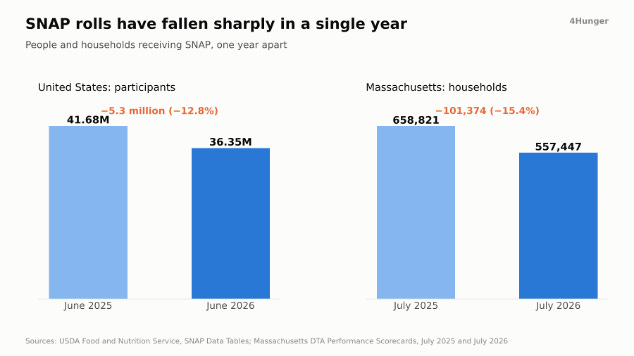
The real decline has been larger. SNAP participation fell from 41.68 million in June 2025 to 36.35 million in June 2026, a drop of 5.3 million people, or 12.8 percent, in a single year,9 running ahead of CBO’s estimates.10 In Massachusetts, the number of SNAP households fell 15 percent, and a class-action lawsuit alleges that the state’s SNAP assistance line, which automatically disconnected 74 to 81 percent of calls in the first half of 2026, is cutting off eligible people.11 The Greater Boston Food Bank reports that a record 40 percent of the state’s households, about 1.1 million, experienced food insecurity in 2025.12 In North Carolina, where SNAP rolls have fallen by 110,129 people, a Guilford County food nonprofit reports demand up 20 percent from last year.13 The OBBBA is shifting people in need off federal food aid and onto charity, which makes clear that how much hunger there is in America is a political choice.
The next phase began on October 1, when states became responsible for 75 percent of SNAP’s administrative costs, up from 50 percent. Starting October 1, 2027, states will also pay up to 15 percent of benefit costs, depending on their payment error rates.14 With federal Medicaid cuts landing on state budgets at the same time, the incentive is to tighten enrollment rather than expand it. Massachusetts, with a 12.5 percent error rate, would owe the maximum share, an estimated $213 million a year, yet its fiscal 2027 budget cuts caseworker funding by about $21 million.15
Health cuts compound the harm. KFF, a nonpartisan health policy research organization, puts the law’s federal Medicaid reductions at $911 billion through 2034, with 10 million more people uninsured; Medicaid work requirements are scheduled to begin on January 1, 2027.16 In Massachusetts, 99,000 to 202,000 people could lose MassHealth coverage by 2028,17 in a state that had the nation’s lowest uninsured rate, 2.8 percent, in 2024. These cuts come on top of a drop of roughly 8 million in Medicaid, CHIP and marketplace enrollment since early 2025.18 For a household on the margin, a medical bill and a grocery bill come out of the same budget.
A Population Without Slack
American households with the bottom 50% in income entered 2026 with almost no financial buffer. Sixty percent of the people in Feeding America’s survey do not feel financially stable,19 and only 30 percent of all Americans could pay a $1,000 emergency expense from savings.20
Policymakers are now flying blind. On September 20, 2025, USDA terminated its annual Household Food Security report, calling it “redundant, costly, politicized, and extraneous.”21 The final edition found 47.9 million people food insecure in 2024.22 The Urban Institute found that 24.2 percent of adults reported household food insecurity in December 2025, although the two surveys are not directly comparable.23 Just as the largest benefit cuts in SNAP’s history, cuts to Medicaid and subsidies for ACA health insurance take effect, the federal government has stopped publishing the report designed to show their consequences – how hungry are people in America.
Drought in the Meat Case and the Bread Aisle
Grocery inflation overall has been moderate: food-at-home prices rose 2.2 percent in the twelve months to August 2026.24 The drought’s damage is concentrated in protein. USDA’s Economic Research Service (ERS) forecasts beef and veal prices to rise 9.4 percent in 2026, after rising 10.6 percent in the 12 months to June 2025.25 Repeated droughts made feed expensive and withered pastures, forcing ranchers to sell breeding stock, and the beef cow herd is now the smallest since 1961.26 Rebuilding it takes years.
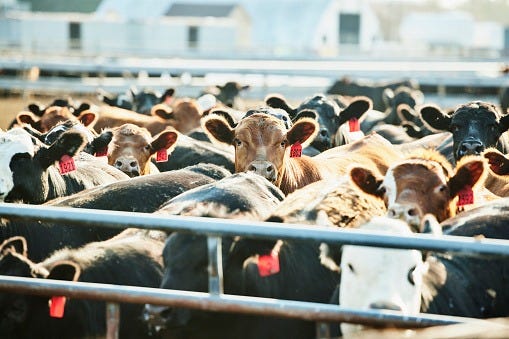
Photo Credit: Thomas Barwick
Grain tells the same story. U.S. winter wheat production fell 27 percent this year, to 1.02 billion bushels, and harvested area fell to a record low.27 Roughly a third of planted acres were never harvested, including about half in Oklahoma and seven in ten in Texas.28 USDA projects that wheat stocks will fall 22 percent this marketing year and that the price farmers receive will rise from $5.06 to $6.40 a bushel.29 The 2027 crop is now going into dry ground, where seed that sprouts after a light shower can die if dry weather returns.30
War at the Pump: The Cost of Moving Food
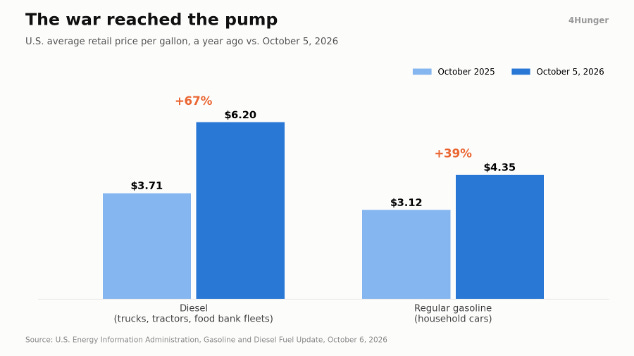
The second shock is geopolitical. The U.S. and Israeli strikes on Iran that began on February 28, 2026, led to what the U.S. Energy Information Administration (EIA) called a “de facto closure of the Strait of Hormuz,” through which about 27 percent of globally traded oil and up to 30 percent of global fertilizer trade passed in 2024. Brent crude nearly doubled in the first quarter, from $61 to $118 a barrel.31 Diesel reached a record $6.53 a gallon on September 21 and, at $6.20 on October 5, was still 67 percent higher than a year earlier.32
Food banks run on diesel trucks, and every extra dollar spent on fuel comes out of the money for food. Houston Food Bank’s diesel price rose 69 percent between January and April,33 and food banks in Alabama and Virginia report fuel costs up 68 to 70 percent from last year.34 “If I am spending more on fuel, I can’t buy as much food,” said Cheryl Schondek, the Greater Boston Food Bank’s chief operating officer.35 The Food Bank of Iowa estimates that its higher diesel bill costs it the equivalent of more than 8,000 meals a month.36
Households are paying at the pump as well. Regular gasoline averaged $4.354 a gallon on October 5, about 39 percent more than a year earlier.32 “Most typically, they’re having to pull it from the grocery budget,” Amy Breitmann, of Golden Harvest Food Bank in Augusta, Georgia, told NPR in May.37
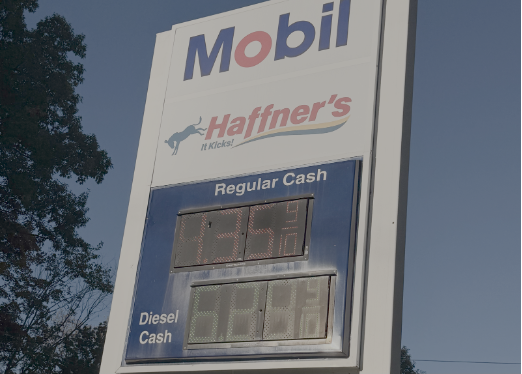
Gas station in Hudson, MA October 6, 2026, Photo Credit Mark W. Roberts
Fertilizer is where the war reaches the next harvest. By April, the World Bank reported, urea prices had climbed above $850 per metric ton, up 80 percent since February.38 In late September, anhydrous ammonia was still 25 percent more expensive than a year earlier,39 and ERS projects that farm fertilizer expenses will rise 15.3 percent this year and fuel expenses 28.8 percent.40
Tariffs and the Shrinking Federal Pantry
The third pressure, tariffs, lands on a food supply already weakened by federal cuts. Since March 2025, USDA has cancelled the Local Food for Schools ($660 million) and Local Food Purchase Assistance ($420 million) programs, halted about $500 million in food deliveries to food banks41 and terminated the Regional Food Business Centers that helped small and mid-sized farms reach buyers such as food banks.42 Each cut removed both a market for farmers and food that stretched pantry budgets. Texas food banks have absorbed $88.4 million in federal funding cuts and 40 percent fewer federal commodities this year,43 and the Greater Boston Food Bank lost nearly $2.3 million in emergency food resources to USDA reductions in 2025.44
Food banks are now buying replacement food just as wholesale prices rise. In September, Campbell’s and Conagra announced price increases, citing tariffs alongside energy, fertilizer, diesel and crop costs.45 The Yale Budget Lab estimates that the tariffs now in force will cost the average household about $1,100 a year.46
The Farm Ledger
All four pressures converge on farmers themselves. Chapter 12 farm bankruptcy filings rose 46 percent in 2025, to 315,47 and April 2026 produced the highest monthly total since February 2020.48 Filings are on pace to rise again this year.49 ERS forecasts net farm income down 5.5 percent after inflation and farm debt at a record $605.1 billion, with government payments supplying about 30 percent of net farm income.50 Distress is rising fastest in the same Southern Plains and southeastern regions where the drought is deepest. A farm that fails this autumn plants nothing next spring.
Washington’s own decisions have cut both ways. The 2025 tariff war cut soybean growers off from China;51 purchases resumed after a truce in late October 2025, but a 10 percent Chinese retaliatory duty still limits sales.52 U.S. tariffs on imported farm inputs collected $958 million through October 2025.53 With the Iran war layered on top, a Farm Bureau survey of more than 5,700 farmers in April found that 70 percent could not afford all the fertilizer they needed for their 2026 crop.54
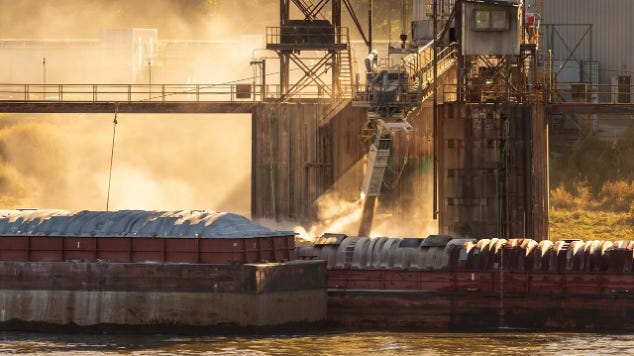
Grain barges on the Mississippi River. Photo credit: Getty Images
The government has paid farmers to absorb much of the damage, through higher reference prices,55 $12 billion in Farmer Bridge Assistance56 and a plan for new fertilizer capacity that will not come online for 12 to 18 months.57 Most of that money flows to the largest operations. Only about 40 percent of farms grow crops eligible for reference-price payments, and the top 10 percent of those farmers have collected nearly three-quarters of all those payments.58 The law raised the annual payment limit from $125,000 to $155,000,59 and bridge payments grow with every acre planted.60 Market concentration deepens the squeeze: four companies control more than 75 percent of the corn and soybean seed market.61
El Niño: Limited Relief on a Winter Schedule
Against these four pressures, El Niño offers one partial and delayed remedy. NOAA’s Climate Prediction Center (CPC) gives better than 90 percent odds of a very strong event through the winter.1 Its September 17 outlook gives 60 to 70 percent odds of above-normal precipitation across southern California and the Southwest from December through April, and 70 to 80 percent over southern Georgia and northern Florida, but only 40 to 50 percent over the Southern Plains, where the drought is deepest.4 CPC expects the effects to “increase slowly at first before quickly ramping up during the core winter months.”62
The forecast has not failed. It has simply not yet arrived. As of September 29, drought covered 59 percent of the Lower 48 and affected 111.6 million people in 42 states.63 In Oklahoma, 99.8 percent of the state is in drought. Parts of Texas and Oklahoma would need 20 to 25 inches of rain over three months to end it,64 and on drought-hardened soil, heavy downpours run off as flash floods instead of soaking in. What the wheat needs is steady rain, week after week, through the winter.65
That deficit matters now because the 2027 wheat crop is being planted now. As of October 4, 36 percent of U.S. winter wheat was in the ground, against a five-year average of 46 percent. Oklahoma was 14 percent planted, and more than half its topsoil was short of moisture.66 Seed sown into dry soil in October establishes poorly, no matter what rain falls in February.
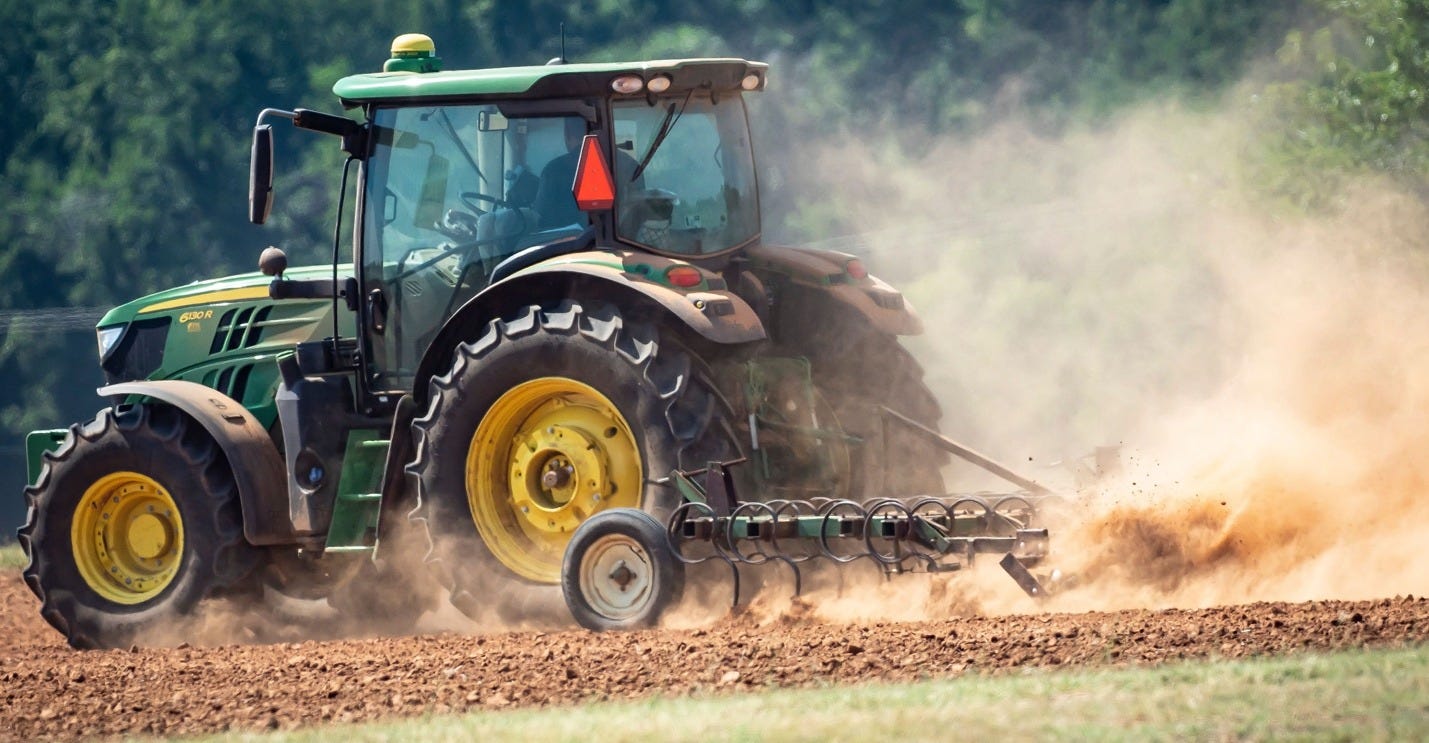
Dust flies as a tractor prepares a dry field for wheat to be seeded. (Photo by Todd Johnson, OSU Agricultural Communications Services)
The Calendar
Set side by side, the policy calendar and the climate calendar run in parallel, not in sequence:
October 1, 2026. States begin paying 75 percent of SNAP administrative costs.14
October 2026. Winter wheat planting continues across the Southern Plains into topsoil that is predominantly short of moisture.66 CPC’s next ENSO update is due October 8.
December 2026. CPC’s El Niño precipitation signal begins to emerge across the southern tier.4
January 1, 2027. Medicaid work requirements take effect.16
January–March 2027. The El Niño precipitation signal peaks across California, the Southwest and the Southeast.4
October 1, 2027. States begin paying up to 15 percent of SNAP benefit costs, depending on their payment error rates, for the first time in the program’s history.14
Throughout this period, no federal survey will measure American household food insecurity.21
Who Bears the Burden of These Four Price Shocks?
The burden of a price shock depends on the share of income spent on food. The wealthiest fifth of households spend less than 6 percent of their income on food; the poorest fifth spend 33 percent.67 Those households are not evenly distributed. In 2024, 24.4 percent of Black households, 20.2 percent of Hispanic households and 30.9 percent of American Indian and Alaska Native households were food insecure, compared with 10.1 percent of white, non-Hispanic households.68 In Massachusetts, 63 percent of Hispanic households and 51 percent of Black households were food insecure in 2025, and 78 percent of SNAP households received less than $300 a month in benefits.12
Four Shocks, Four Choices
None of these four shocks requires new science to answer. Each requires a policy decision by people who already have the data and the power to act.
The drought: protect next year’s harvest now. The latest extension of the 2018 Farm Bill expired on September 30, and Congress has not agreed on a replacement.69 It should pass one in the lame-duck session that directs help to the small and midsized farms of the Southern Plains and the Southeast, not ever-larger checks for the largest operations. The Fair Seeds for Farmers Act, introduced by Sen. Elizabeth Warren and Rep. Jim McGovern of Massachusetts, belongs in that debate, too.61
The war: keep the trucks rolling and the fields fertilized. Emergency fuel assistance for food banks and restored USDA purchases for The Emergency Food Assistance Program cost far less now than after food banks have had to cut their delivery. Farmers need help with fertilizer this season, not in 12 to 18 months.57
The tariffs: stop taxing the grocery cart. Food, and the fertilizer, chemicals and machinery farmers need to grow it, should be exempt from import tariffs, and USDA should restore the local food purchasing programs that bought from small farms and supplied food banks and schools.41
The cuts: stop shifting hunger onto states and charities. Congress should defer the October 2027 SNAP cost shift, pause the expanded work requirements while it examines why participation is falling faster than CBO projected,10 and delay the Medicaid work requirements. Massachusetts can and must fund the caseworkers, and phone lines its own SNAP system needs.15
Restore the measurement. Reinstating USDA’s food security report would cost little.21 A government that stops counting the hungry does not reduce their number; it only hides it.
El Niño’s rain is still coming, and it may yet rescue next year’s wheat. But no storm will restore a SNAP benefit, refill a food bank’s fuel tank, repeal a tariff or reopen a farm that has already gone under.
The drought is the only one of these four shocks that nature can end. The war, the tariffs and the cuts were set in motion by decisions in Washington, and decisions can be changed. Ask your members of Congress where they stand on each of these four choices before Election Day on November 3.