

As the Atlantic hurricane season opens, Haiti faces it without a safety net. For the first time in its history, the World Food Programme has entered the season with no prepositioned food stocks in the country, no contingency reserve to feed survivors in the days after a storm. The buffer is simply gone not only in Haiti but across the world, stripped away by funding shortfalls, at the exact moment when climate change has made it needed most. Haiti is now the only country in the Western Hemisphere, and one of just five on Earth, where people are living in catastrophic, famine-like hunger. More than half its population cannot reliably eat.
A famine in the Americas should stop us cold. That it barely registers tells you how numb we have become to the acts of the Trump Administration and how quietly this crisis has been engineered.
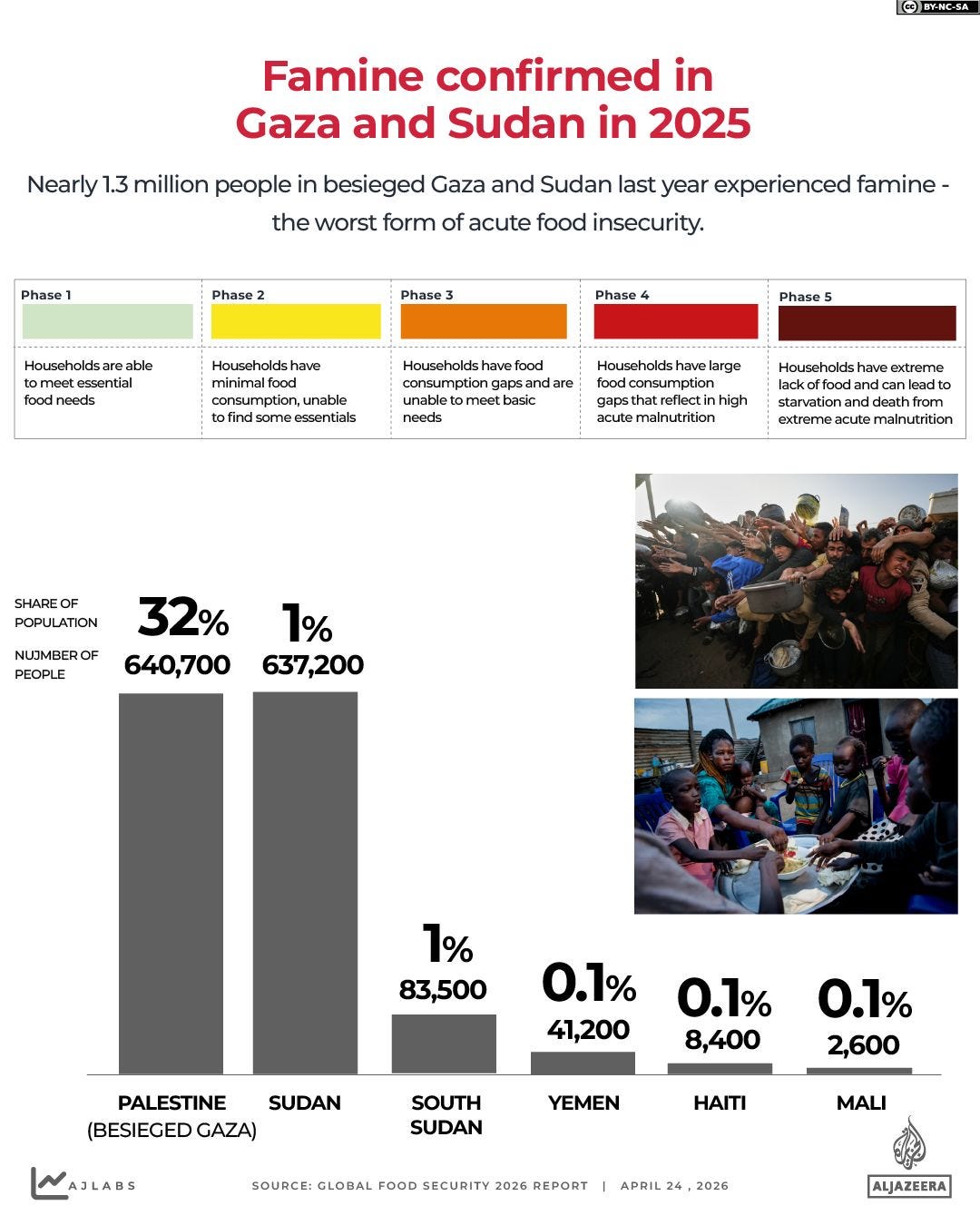
Because it has been engineered. The hunger now deepening from Port-au-Prince to Khartoum to Cox’s Bazar is not a story of failed rains alone, or of war alone. It is the product of two forces colliding: the largest collapse of foreign aid ever recorded, and the most punishing climate shocks in a generation. Neither would be as lethal on its own. Together they are killing people who would otherwise still be alive.
Start with the collapse. In April, the OECD reported that official development assistance from the world’s wealthy donors starting with Donald Trump’s cancellation of UAID fell 23.1 percent in 2025. This is the steepest single year drop on record, dragging global aid back to where it stood a decade ago. The United States drove roughly three-quarters of that decline, cutting its own assistance by 57 percent as it dismantled USAID. Humanitarian aid specifically fell by more than a third.
This is not an accounting abstraction. Aid is load-bearing infrastructure. It is the clinic that treats a malnourished child, the seeds a farmer plants before a drought, the early-warning system that sees famine coming in time to move food. Pull it out, and you don’t just remove charity, you remove the shock absorber standing between a fragile community, the next disaster and unnecessary deaths.
The death toll is no longer hypothetical. A study in The Lancet projected that the unwinding of USAID could cause more than 14 million additional deaths by 2030, a third of them young children. The dying has already begun by early 2026, one year into the cuts, independent trackers attributed more than 760,000 deaths to cuts in aid, over half of them children. That number has continued to climb higher.
Now layer on the climate. In Sudan, where war and aid withdrawal have converged into the world’s largest hunger crisis, famine was confirmed in 2025 and has since spread; by February 2026, two more areas of Darfur crossed the threshold into starvation, making Sudan the country with more territory in active famine than anywhere on Earth. Famine is the most extreme level of food insecurity, defined by a severe and widespread shortage of food that causes widespread acute malnutrition, starvation, and death. It represents a catastrophic collapse in a population’s ability to access sufficient, nutritious food.
In the Horn of Africa, a failed rainy season has pushed nearly 26 million people across Kenya, Somalia, and Ethiopia into extreme hunger. Extreme hunger caused by a lack of food is formally defined as severe food deprivation or starvation. It is the physical and psychological distress caused by consuming fewer than 1,800 calories per day, leading to malnutrition, tissue breakdown, and an inability for the body to sustain normal functions.
In Somalia, aid agencies project that close to half of all children under five will need treatment for acute malnutrition this year. In Afghanistan, child malnutrition is hitting record highs as the WFP, its budget collapsing, can reach only a fraction of the 17 million people who need food. Even the Rohingya refugees in Bangladesh, who are stateless due to the genocide in Myanmar, who are barred from working, confined onto one of the most cyclone-battered coastlines on the planet, have watched their food vouchers from the World Food Programme be cut from $12.50 a month toward as little as $6, as the relief operation that sustains them fell to under a fifth of its funding.
The pattern is always the same. Climate change supplies the shock. The aid cuts remove the defense. And the people who did the least to warm the planet and have the fewest resources to survive it are caught in between and pay with their lives.
There is a final, quieter cruelty in all this: the cuts have taken our eyes. The same freeze that gutted food programs also crippled the surveillance networks that watch for famine. When the world’s authoritative hunger report appeared this spring, its authors warned that the apparent leveling-off of global hunger was partly an illusion because the analysis rested on the fewest adequately measured countries in a decade, with whole nations, including Ethiopia and its tens of millions in dire states, going uncounted. We are not only starving the response. We are making it so no one knows what is going on.
None of this had to happen, and none of it is irreversible. The single most important step is also the simplest: reverse the humanitarian cuts, and fast. The WFP says it needs roughly $13 billion this year just to reach the hungriest 110 million people. That is reaching only a third of those people in need. The WFP currently expects the wealthy countries to fund barely half that. In a global economy measured in the trillions, the sum required to keep millions alive is a rounding error. What’s missing is not money. It’s will. It is the courage to stand up to the evil foreign policy of Donald Trump and other wealthy nations.
The rest follows. Rebuild the early-warning systems and shield them from political whim, so we can at least see the next famine coming. Shift climate finance toward grants rather than loans, so that nations already drowning in debt aren’t asked to borrow their way through disasters they did not cause. Treat food aid and climate adaptation not as generosity but as what they are: the cheapest insurance a stable world has ever been offered and the best way to stop chaos.
Hunger does not stay where we leave it. It drives displacement; displacement drives instability; instability reaches, eventually, the comfortable capitals that imagined themselves insulated. The famine spreading across the global South is a test of whether wealthy nations will recognize a catastrophe of their own making while it can still be stopped.
It is being made by subtraction, one cut, one failed harvest, one shuttered clinic at a time. It can be unmade the same way. But only if we choose to look and act.