

Part 2 of 2: What the Montreal Protocol, a treaty that worked can teach the climate summit to do the same to mobilize funding for El Niño hunger.
By Mark W. Roberts | November 5, 2026
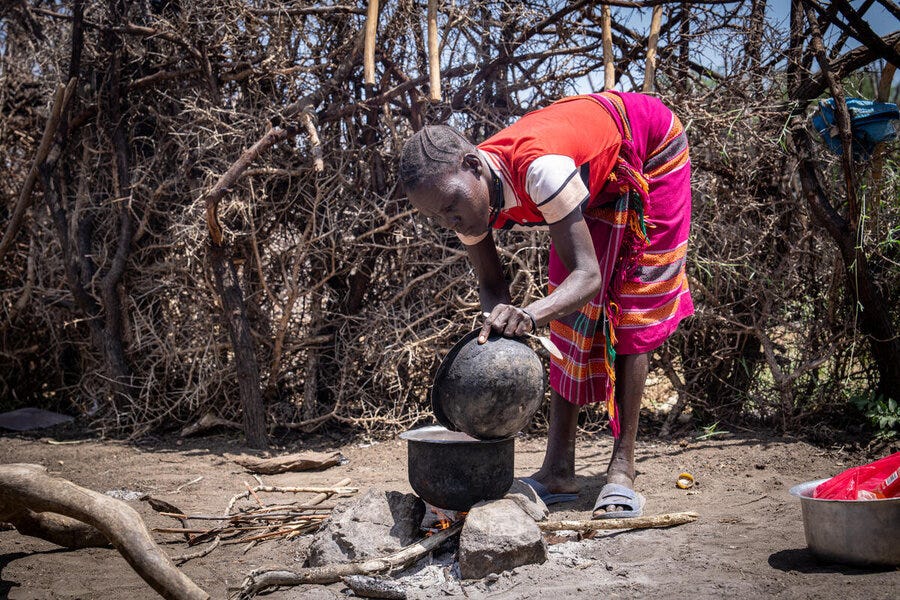
Paulina Awii and her family are receiving WFP’s early action food assistance after El Niño-linked drought shriveled her sorghum harvest. Photo: WFP/Daisy Masembe
Paulina Awii watches her young child finish a bowl of fortified porridge in the arid heat of Karamoja, Uganda, a small victory against a climate that has tested families here for generations. While regional forecasts warn of erratic El Niño rains and lingering dry spells, Paulina’s daily routine is defined by the fragile, stubborn work of keeping her household fed. Her struggle is a localized snapshot of a massive global crisis. By the time negotiators open the climate talks in Antalya, Türkiye, on November 9, El Niño will already have destroyed the sorghum crop that Paulina and her family depend on, withered corn and rice across the Philippines, weakened India’s monsoon and left South Sudan on track for its driest year on record.
The hunger that follows those crop and livestock losses has barely started. In Karamoja, families like Paulina’s have historically fought a narrative of chronic drought, food insecurity, and hunger. While specialized local porridge from World Food Programme (WFP) nutrition assistance initiatives has helped children regain health, the systemic funding needed to scale these protective operations before harvests fail remains critically absent. As shown in Part 1, The Forecast Worked. The Money Did Not., the world saw this El Niño coming months ahead, but the money to act on the forecast has not come from any major donor country.
FEWS NET expects that hunger to be at its worst in 2027.1 The June 2026 FAO and WFP appeal for $202 million to protect 8.8 million people was only about one-fifth funded by late September.2 Oxfam counts only about $450 million available worldwide, against a $5 billion appeal the last time an El Niño this size struck.3 The failure is built into the way humanitarian money is raised. Donations to fight El Niño hunger are voluntary, come one appeal at a time and arrive after the damage is done. A treaty solved the same problem once before. Its design can work again.
What El Niño Has Already Done to Crops
The losses are already coming in. In the Philippines, the Department of Agriculture put farm damage at ₱8.57 billion (US$134.81 million) in late October, with about 288,000 farmers affected. Corn took the worst of it, with 132,290 tonnes lost, followed by 71,408 tonnes of rice.4 India’s monsoon brought only 87 percent of its normal rain, the first deficient monsoon since 2015.5 U.S. Department of Agriculture forecasters expect India’s rice harvest to fall by about 7 million tonnes and Australia’s wheat crop by 14 percent. Australia’s own forecasters put the wheat drop at 17 percent.1 In Indonesia’s West Kalimantan, the Kapuas River has fallen so low that barges that carry palm fruit to the mills have run aground. Thirteen of the province’s 50 palm oil mills, which account for about half its processing capacity, have been affected, leaving smallholders with fruit rotting unsold.6
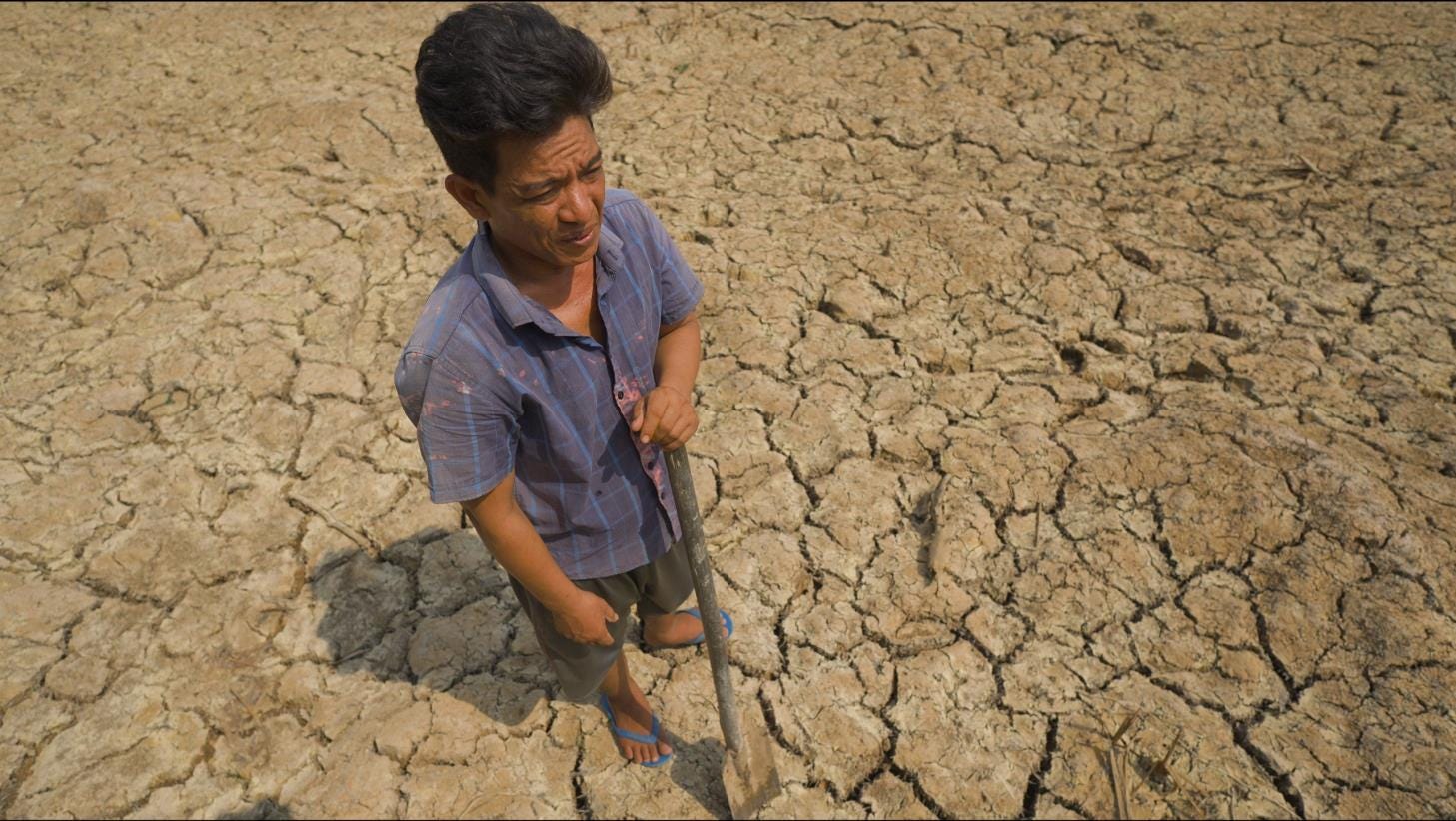
El Niño exit leaves a lasting impact on Southeast Asia’s agricultural systems, stressing the need for preventive measures. Photo Credit: FAO Regional Office for Asia and the Pacific.
In Africa, the rains failed where people could least afford it. Parts of northern Sudan got less than half their normal rain this season, and South Sudan and Uganda’s Karamoja region are on track for their driest year on record.1 WFP reports that crops are failing and yields are falling in South Sudan’s most fertile farming areas, where 7.8 million people already face high levels of acute hunger.7 Ethiopia’s main meher harvest will be smaller than usual. Across the Sahel, some places got 40 percent less rain than normal, and Chad’s crops and pastures were hit hardest.1
Across the Atlantic, drought in Central America’s Dry Corridor has cut both of this year’s maize harvests in Honduras, the Primera and the Postrera.8 In Panama, water shortages delayed rice planting by about a month and hurt early growth, and the expectation of more drought discouraged farmers from planting the main rice and maize crops.9 In Colombia’s La Guajira, farmers have lost crops and livestock.1
Livestock are suffering, too. In Karamoja, Chad and La Guajira, failed pastures have left animals weaker and less productive.1 In parts of the Horn of Africa, the danger is too much rain rather than too little. FAO and IGAD warned in August that heavy El Niño rains could create ideal conditions for Rift Valley fever, a mosquito-borne disease that kills young animals, causes abortions in sheep, goats and cattle, and can spread to people.10
Why the Worst Comes in 2027
The world as a whole will not run out of grain. The U.S. Department of Agriculture still expects the 2026/27 harvest of maize, wheat and rice to be the second largest on record, 2.7 percent below last year’s.1 The shortages will be local, in places where poor families and countries eat what they grow, and they will arrive late. Hunger follows the harvest, and the harvest comes months after the weather. A family that loses its crop this fall does not go hungry this fall. It goes hungry months later, when what little food it managed to harvest runs out and the next crop is still in the ground. FEWS NET warns that food stocks used up early bring an earlier and harsher lean season, and that the end of El Niño will not mean the end of its effects.1 It expects the worst hunger from March to August 2027 in Sudan, South Sudan and Ethiopia, and from March to September 2027 in West Africa.1
Southern Africa shows the delay most clearly. Farmers there are planting maize now, under forecasts of late rains and dry spells through March. The region has a cushion, because last season’s cereal harvest was nearly 10 percent above the five-year average.1 If this season’s crop fails, though, the shortfall will not show up until next year’s harvest. FEWS NET expects hunger there to peak from November 2027 to March 2028, more than a year from now.1
The three harvests that act as backstops for poor importing countries are holding, for now. South Africa brought in a record 17.69 million tonnes of maize this year, more than 5 million tonnes beyond what the country uses, and that surplus feeds its neighbors. Yet its farmers plan to plant 12.4 percent less maize for the 2027 harvest because of the dry outlook, the smallest area since 2019.11 Australia’s wheat crop is turning out better than feared after a kind winter in the south, at a forecast 29.9 million tonnes, though that is still well below last year’s.12 India holds rice stocks more than five times the government’s stock norms. Its new rice and maize crops are smaller, however, and the government has lowered its foodgrain target with more than half the country in dry or drought conditions.13 The cushion that protects poor importing countries this year will be thinner in 2027.
Prices lag, too. After the last two big El Niños, white maize prices (the maize people eat) in South Africa, the region’s breadbasket, peaked 10 to 20 months after the event began. If drought returns, FEWS NET expects the next peak between about April 2027 and early 2028.1 Each lean month also wears down what families can fall back on. A household that sells its livestock or eats its seed to get through this year has less to sell, and less to plant, next year. High fertilizer prices and a possible La Niña, which I return to below, add to the risk.
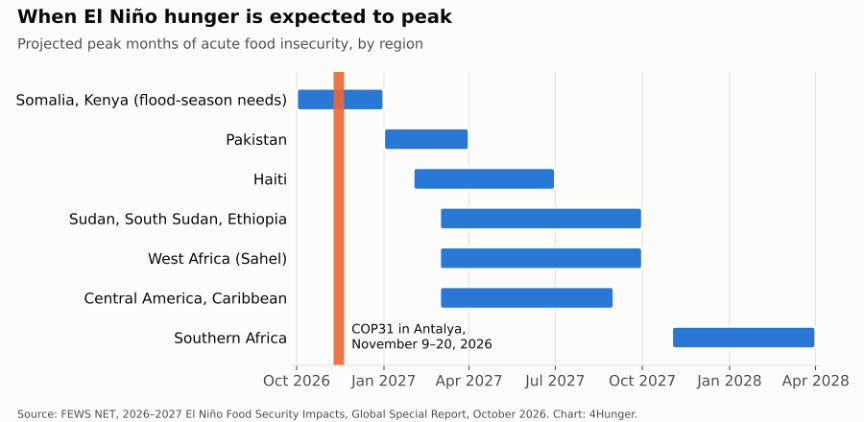
Figure 1. Most of El Niño’s hunger peaks months after the Antalya talks end. Source: FEWS NET, October 2026.
A Hotter World Makes This El Niño Worse
This El Niño is also striking a world that was already hot and dry. The European Commission’s Joint Research Centre points out that El Niño’s effects build on global warming and on the crises countries already face.14 The 2026 Lancet Countdown on Health and Climate Change, released on October 28 ahead of the Antalya talks, measures that starting point.15 In 2025, extreme drought struck 51.8 percent of the world’s land for at least a month, the second-highest share on record. Heat cost 573 billion potential work hours, 35 percent more than the 2006–2015 average, and $1.07 trillion in lost income. In 2023, heat was linked to a record 710,000 deaths, and climate change caused more than 70 percent of them.
Those numbers show up on farms. Where drought has already drained soils and reservoirs, a weak rainy season does more damage. Heat that keeps farmworkers out of the fields cuts their wages just as food prices climb. Heat during flowering and grain filling also cuts yields, which is why India’s wheat is at risk in February and March. The same warmth favors the mosquitoes that spread dengue. The Lancet Countdown finds that the climate’s suitability for dengue transmission rose 24 percent for the Asian tiger mosquito and 7 percent for Aedes aegypti between 1981–1990 and 2016–2025.15 Hungry people are more vulnerable to disease, and I will return to that link in a coming article.
Why This Is the Climate Convention’s Business
El Niño is a natural cycle, and this series has said plainly that climate change does not cause it. So why should a climate conference pay to prepare for it and to respond to the hunger it causes? There are three reasons, each grounded in the science or in treaties the delegates in Antalya have already signed.
The first is that warming makes El Niño’s damage worse, even where it does not change El Niño itself. When El Niño helped dry out the Amazon in 2023, World Weather Attribution found that it and climate change cut the rain by about the same amount. The extreme heat, though, came almost entirely from climate change, which made the drought about 30 times more likely.16 The mix is not the same everywhere. In Southern Africa’s 2024 drought, the same group found El Niño was the key driver and could not show a significant role for climate change.17 The difference matters. While crops are failing, nobody can sort a drought into natural and human-caused shares, and the Lancet numbers above show how much hotter and drier the starting point has become.
The second is that warming is expected to make El Niño’s swings in rainfall stronger. The Intergovernmental Panel on Climate Change found in 2021 that under intermediate and high emissions it is very likely that rainfall variability tied to El Niño and La Niña will increase by the second half of this century.18 The floods and droughts that El Niño brings to farms are the part of it that climate change is expected to intensify.
The third is that the climate treaties already cover this work. The 1992 UN Framework Convention on Climate Change (UNFCCC) commits every party to cooperate in preparing for adaptation and to plan for agriculture and for areas “particularly in Africa, affected by drought and desertification, as well as floods.”19 In the Paris Agreement, the parties recognized the importance of “averting, minimizing and addressing” loss and damage, and they listed early warning systems and emergency preparedness as areas for cooperation.20 The loss and damage fund the parties later created does only the third.
There is a practical reason as well. Every future El Niño will strike a warmer world, and so will every drought and flood in between. A fund that waits to learn how much of a disaster climate change caused before it pays will always pay late. This El Niño, forecast months ahead, is the cheapest place to learn how to pay early.
A Treaty That Solved Ongoing Funding Once
I spent years working inside the Montreal Protocol, the treaty that protects the ozone layer, and on the campaign that led its parties to agree in Kigali in 2016 to phase down hydrofluorocarbons (HFCs). The Protocol worked, and why it worked explains much of what is failing now.
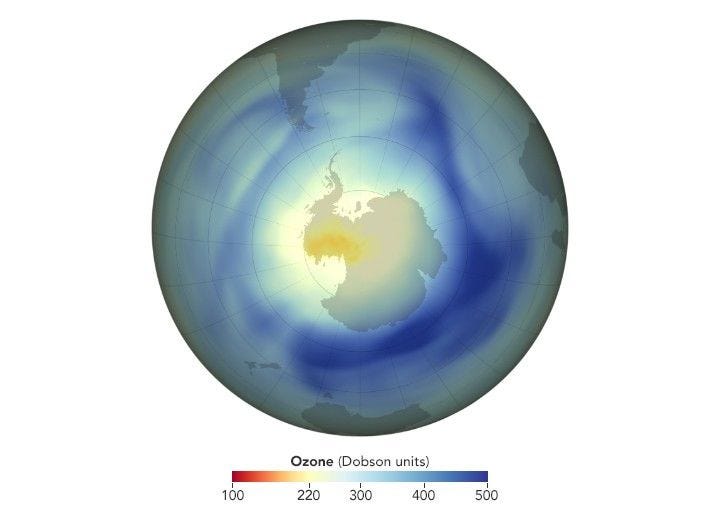
This series of images shows the size and shape of the ozone hole each year from 1979 through 2019 (no data are available for 1995). The measurements were made from 1979–2004 by NASA’s Total Ozone Mapping Spectrometer (TOMS) instruments; from 2005–2011 by the Royal Netherlands Meteorological Institute’s Ozone Monitoring Instrument (OMI) (which flies on NASA’s Aura satellite); and from 2012–2019 by the Ozone Mapping Profiler Suite (OMPS) on the NASA/NOAA Suomi NPP satellite. Red and yellow areas indicate the ozone hole.
When the Protocol’s parties asked developing countries to phase out ozone-depleting chemicals, they did not pass the hat. In 1990, they created the Multilateral Fund. Developed countries pay into it on an agreed scale, and the Fund is replenished every three years, so the money is known before the work begins. A committee split equally between developed and developing countries decides how it is spent. The treaty also tied developing countries’ obligations to the delivery of that money. If the finance did not arrive, the obligation to act could be revisited. Since 1991 the Fund has approved about $4.4 billion for projects in 144 developing countries. The CFCs and halons it first paid to phase out are gone, and the remaining ozone-depleting chemicals are being phased out on a fixed schedule.21
Three features made the difference. The money was agreed in advance. It was paid on a schedule rather than whenever a crisis caught donors’ attention. It was released against measurable commitments rather than headlines. Humanitarian finance has none of the three.
Common Responsibilities, Different Burdens
Climate negotiators call the idea behind the Montreal Protocol’s fund “common but differentiated responsibilities.” Every country shares the job of protecting the atmosphere, but those that did more to damage it, and can afford more, carry more of the cost. The phrase entered international law at the Rio Earth Summit in 1992, and the climate convention signed there lists it among its principles.22 The Montreal Protocol had been putting the idea to work for five years by then, and it did something the climate talks never have: it made payments mandatory for its developed-country parties.
The first difference in responsibilities is time. Under the 1987 treaty, developing countries that used less than 0.3 kilograms of the controlled chemicals per person each year could delay their compliance by ten years. The Kigali Amendment kept the same logic for HFCs. Developed countries began cutting in 2019. Most developing countries froze their use in 2024, and a group of very hot countries, including India, Pakistan and the Gulf states, will freeze theirs in 2028.23 All of them are headed for the same deep cuts, on different schedules.
The second difference is money, and it mattered more. A grace period alone did not bring the two largest developing countries into the Montreal Protocol. China and India refused to join until the industrialized countries agreed to pay the extra costs of switching away from ozone-depleting chemicals. The parties created the Multilateral Fund in London in 1990. China joined in June 1991, and India in June 1992.24 Under the treaty, the fund pays developing countries’ “agreed incremental costs,” the extra cost of moving to safer technology, and that money must come on top of other aid. Developed countries pay in according to the United Nations scale of assessments, the same formula that sets their UN dues, adjusted so that no country pays more than 22 percent. The total is set every three years from an expert panel’s estimate of what developing countries will need to meet their next deadlines. In 2023 the parties agreed on a record $965 million for the 2024–2026 period. This week in Kigali, on the tenth anniversary of the HFC deal, they are negotiating funding for the next three years.25
The third difference is written into the treaty itself. Article 5 says developing countries’ capacity to meet their obligations “will depend upon the effective implementation of the financial co-operation” the treaty promises. That sentence turned help into a condition. Rich countries could not insist that developing countries meet their deadlines while leaving the fund empty, and the parties restated the point when they adopted new controls.26
Control of the Multilateral Fund is shared, too. Its Executive Committee has seven members from developing countries and seven from developed countries. When it cannot reach consensus, a decision needs a two-thirds majority that includes a majority of each group, so neither group can outvote the other. Most of the money flows through national plans signed with that committee. Each plan sets yearly limits, and the committee releases the next installment only after the country shows it met its targets.27 Developing countries get money they can count on. Donors get evidence that the money paid for real cuts in CFCs and their substitutes.
The climate convention copied Montreal’s words but not its machinery. Its 1992 text promises developing countries their “agreed full incremental costs” and says their action “will depend on the effective implementation by developed country Parties of their commitments” on finance. The Paris Agreement says developed countries “shall provide” financial resources. Neither treaty tells any country what it owes. The finance goal agreed in Baku in 2024, at least $300 billion a year by 2035, assigns no share to anyone, and the loss and damage fund runs on voluntary pledges.28 Without an agreed scale of contributions, common but differentiated responsibility remains a principle. The Montreal Protocol turned it into a payment schedule.
The same division of labor would work for El Niño. Developed countries, which account for the largest share of the emissions warming the world, would pay into an anticipatory window on the UN scale. Vulnerable countries would keep plans and triggers ready and report what the money did, and their commitments would depend on the money arriving. A board split evenly between the two groups would decide how it is spent. Each of the steps I propose below borrows from that design.
What Exists Now, and Why It Falls Short
The pieces of a better system already exist. None of them is built to pay reliably before a harvest fails.
The UN’s Central Emergency Response Fund (CERF) can release money quickly. On October 21, UN relief chief Tom Fletcher said more than $50 million had been released to help 11 countries prepare, and that the next two weeks would be critical.29 But the fund itself is filled by voluntary contributions each year, and it serves every crisis in the world at once. The Red Cross and the Start Network run forecast-based funds that release money when agreed triggers are met. They show that the model works, but they are small next to this super El Niño.
The most important new piece is the Fund for responding to Loss and Damage, made operational at the Dubai climate summit in 2023. Its first call for grants closed in June with 176 requests from 119 countries, seeking $2.8 billion, more than eleven times the $250 million set aside. In July, its board raised the start-up pot to $342 million but put off its first funding decisions until its December 15–18 meeting, after the conference in Antalya.30,31 Governments have pledged $822 million to the fund, but only about $449 million had been paid in by April, against needs that researchers put in the hundreds of billions each year.30 The fund was designed to pay after the damage. Its governing instrument points it toward “ongoing and ex-post action,” such as recovery and reconstruction, and the first activity it lists is support that complements humanitarian aid “immediately after an extreme weather event.” Its start-up phase can also pay for national response plans and better climate data. Nothing in its rules releases money when a forecast says a loss is coming. Its first response to a single disaster shows the pattern. On October 22, two months after an ice and rock avalanche set off floods in Nepal, the fund set aside $21.6 million, which still needs board approval in December.32
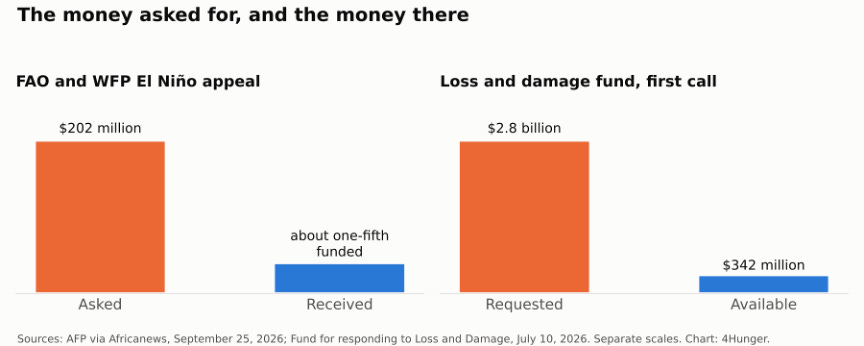
Figure 2. Requests for help far outrun the money on hand. Sources: AFP via Africanews; Fund for responding to Loss and Damage.
In November 2025 in Belém, the parties to the climate convention agreed to triple adaptation finance by 2035.33 That is money meant to help countries prepare. But a pledge to triple a number over a decade does not tell anyone how much will be released this November, for which planting season, on what signal.
So there is money meant to respond after disasters, money meant to prepare over years, and small funds that act on triggers. What is missing is the piece in the middle: money agreed in advance and released automatically when a forecast crosses an agreed threshold, in time for the next planting deadline.
What the Negotiators in Antalya Should Decide
The next UN climate conference, COP31, meets in Antalya, Türkiye, from November 9 to 20, with Türkiye as president and Australia leading the negotiations.34 Climate finance is at the top of its agenda, and climate-resilient agriculture is on its action agenda. The World Meteorological Organization expects the strongest El Niño on record to peak toward the end of the year, so it will be at or near its peak while the delegates meet.29
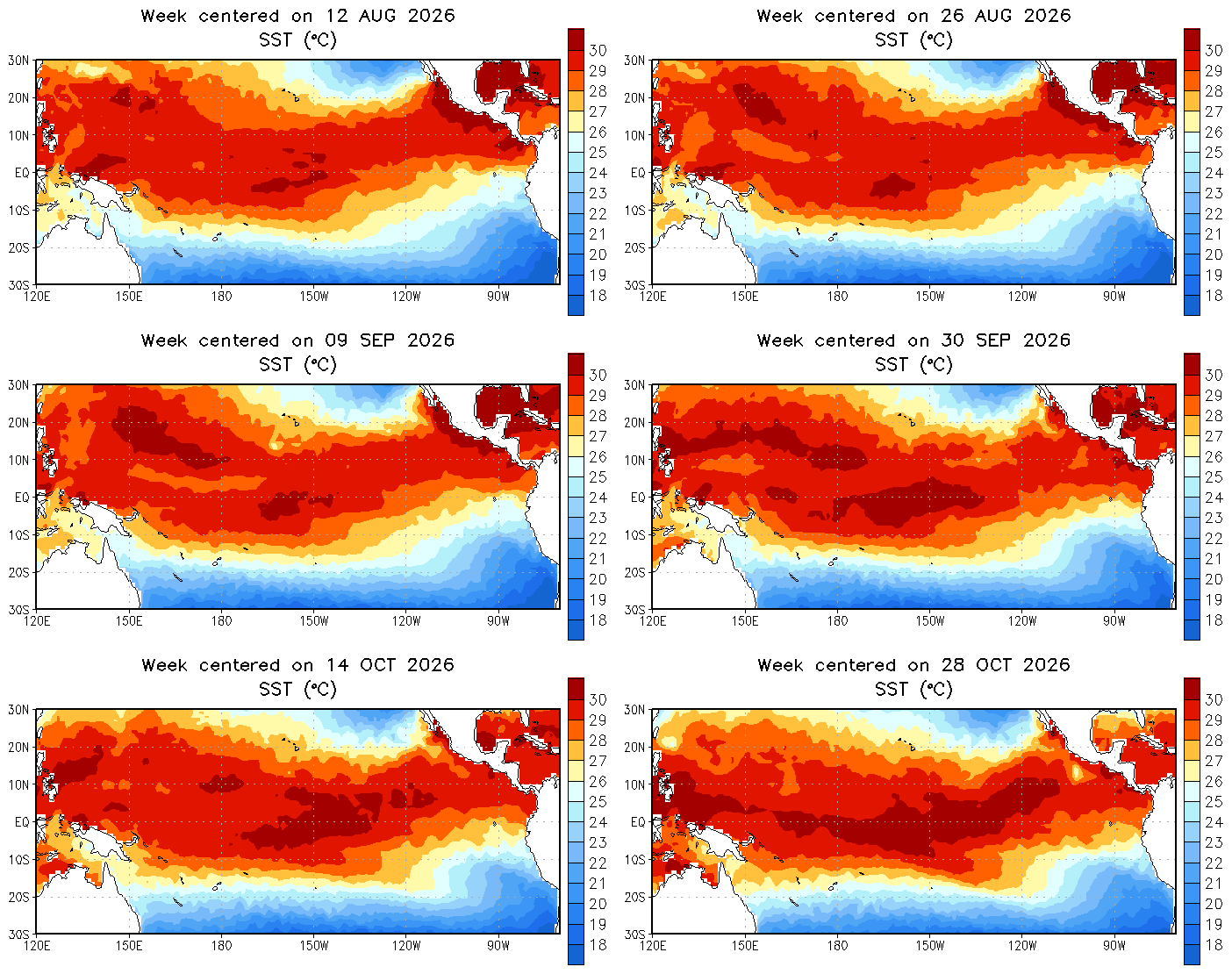
Weekly averaged sea surface temperatures (top, °C) and anomalies (bottom, °C) for the past twelve weeks. SST analysis is the optimum interpolation (OI) analysis, while anomalies are departures from the adjusted OI climatology (Reynolds and Smith 1995, J. Climate, 8, 1571–1583). Image credit: National Weather Service, Climate Prediction Center.
The delegates will meet near the start of this El Niño’s damage, not the end, and most of its deadlines fall after Antalya. Drought threatens Southern Africa’s main maize season from December through February and the Philippines through April. Saltwater intrusion is expected in Vietnam’s Mekong Delta from January, heat threatens India’s wheat as the grain fills in February and March, and hunger in Chad will peak from March through August.35 Peru’s El Niño commission expects its coastal El Niño to stay at its highest category, “extraordinary,” through January.36 Big El Niños are often followed by La Niña, which tends to reverse the pattern, and for farmers that can mean two bad seasons in a row.37
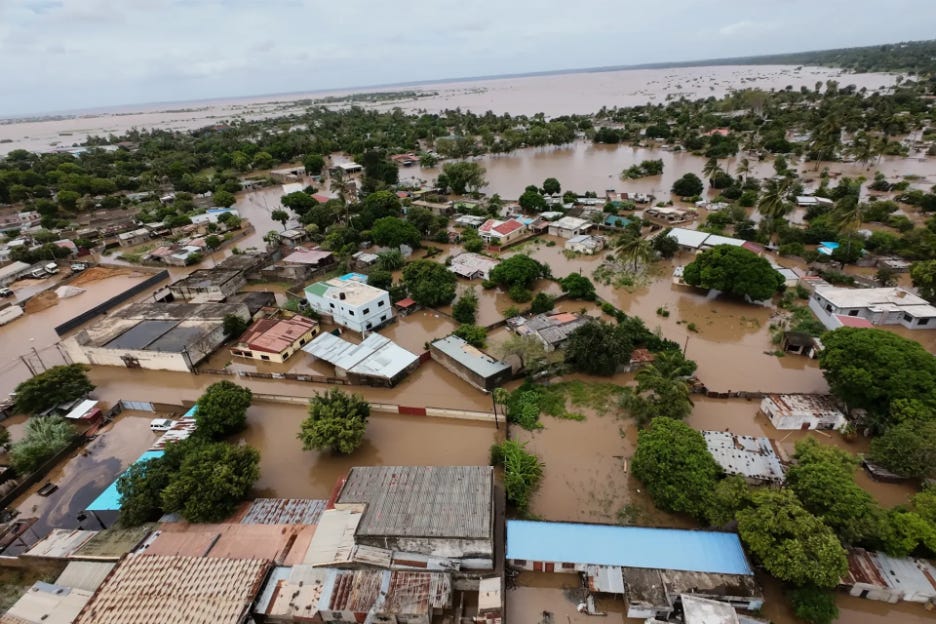
In late 2026, more than 347 million children in nearly 100 countries and territories live in areas where El Niño is forecast to bring unusually wet or dry conditions. Photo credit: UNICEF and Save the Children.
Wars make every one of those deadlines more expensive. Fighting has disrupted shipping through the Strait of Hormuz, the Red Sea and the Black Sea, what WFP calls the “triple chokepoint,” driving up food, fuel and fertilizer prices.38 Before the disruption, about a third of the world’s traded urea, the most widely used nitrogen fertilizer, passed through Hormuz,39 and the World Bank projects fertilizer prices 31 percent higher on average in 2026.40 Fertilizer that is not applied this season shows up as a smaller harvest next year. In Sudan, the war is what turns a drought into a famine risk.41
My proposal for what the parties should decide borrows directly from the Montreal Protocol and has six parts.
First, set the money aside in advance. Create a dedicated window for anticipatory action, inside the loss and damage fund or alongside the new adaptation finance, with contributions pledged on an agreed scale and replenished on a fixed cycle. Prevention should not have to compete with the evening news.
Second, write the triggers down. Release pre-agreed amounts automatically when official forecasts cross agreed thresholds, such as an El Niño declaration by the World Meteorological Organization or NOAA, or seasonal rainfall forecasts above or below set levels for named regions. The money goes to plans that have already been approved, like the FAO and WFP plans that have been ready since June. Triggers should also include market signals, such as spikes in fertilizer, fuel or staple grain prices, because this year conflict moved prices before the weather moved harvests.
Third, tie the money to the calendar. Every trigger should carry a deadline set by the crop calendar, the last point at which money still buys seed, water and time rather than food aid and body bags. Money that arrives after the deadline should count as a failure of the system. The window should also run for the life of the event, through 2027, not for one appeal cycle.
Fourth, make it visible. Require a public funding page for every anticipatory appeal, updated weekly, showing what has been pledged, what has been paid and what has been released. The next journalist who goes looking should find a number instead of nothing.
Fifth, report back. At every climate conference, the parties should hear which triggers were met, how much money moved, and whether it arrived before the deadlines.
Sixth, keep food and fertilizer moving. In 2022, WTO members agreed not to restrict exports of food bought by the World Food Programme for humanitarian purposes. That commitment should be restated now and extended to anticipatory purchases, so aid agencies can buy before prices peak. Early action in conflict zones also needs access agreed in advance. Sudan shows that a forecast alone cannot get help through.42
None of this requires inventing new science or a new institution. The forecasts, the plans and the accounting already exist. What is missing is an obligation, agreed in advance, to spend the money when the forecast says so.
“Every planting deadline on this El Niño’s calendar was public months in advance. What the system lacks is rules and a fund that can move money before those deadlines pass.”
The Law Is Moving in the Same Direction
There is also a legal argument that did not exist a few years ago. In July 2025, the International Court of Justice gave its advisory opinion on the obligations of states in respect of climate change. The Court found that states have binding obligations under international law to protect the climate system, including duties of due diligence and cooperation, and that breaching them can carry legal consequences.43 An advisory opinion does not order anyone to fund an appeal. But it changes the frame. When harm is foreseeable, forecast months ahead and published for free, the argument that nothing could have been done gets harder to make.
The Montreal Protocol worked because its parties accepted that a shared problem required a shared, predictable way to pay for solutions. Climate-driven hunger is the same kind of problem. The difference is that the ozone layer could wait for a replenishment cycle. A child in a family whose harvest failed cannot.
This El Niño Is the Test
WFP estimates that this El Niño could push almost 49 million more people into acute hunger by the end of 2027.44 Some of the deadlines to protect them have already passed. Others are passing now, as the short rains begin in East Africa and Southern Africa plants its main maize crop of the year. So far, governments have handled it the old way, with a small appeal that is only about a fifth funded,2 and the worst is still to come.
The delegates in Antalya cannot change the forecast. They can change what happens after it. If they leave with money set aside, triggers written down and a public page that shows whether the money moved, then this El Niño will be the last one handled the old way. If they leave with another pledge and no rules, the next forecast will be just as accurate, and the money will arrive just as late.
The drought and the floods came when the forecasts said they would. In Antalya, governments can decide that next time the money will, too.