

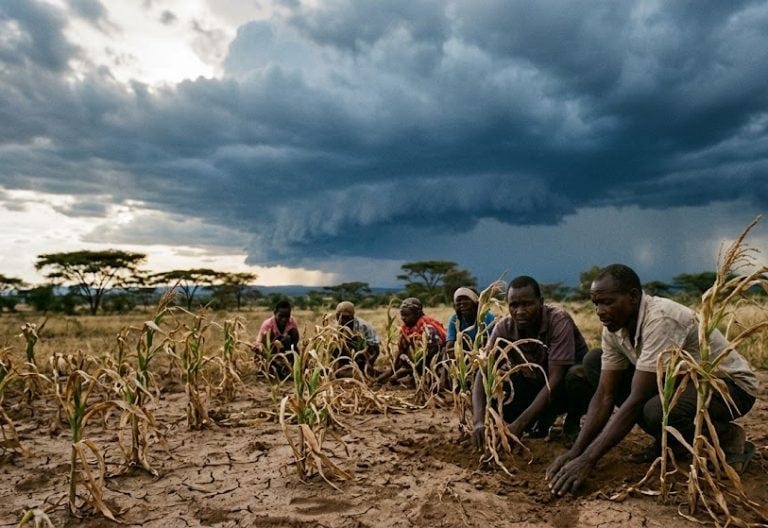
Farmers tend drought-stressed, withered crops as they brace for El Niño rains and floods. Photo credit: Aloys Michael, People Daily
The Hungry Lost Twice at COP31 in Antalya, Türkiye. Our Governments Failed to Provide El Niño Relief Finance, So We Must Act
COP31 had two chances to protect the people who will go hungry because of El Niño in 2027 and in the years after. It took neither.
The first chance was to provide direct relief for the victims of this El Niño. The head of the World Meteorological Organization told COP31 delegates that the WMO had announced a 100% probability that El Niño would last until at least February 2027, with the tropical Pacific forecast at 3.8 degrees above normal, more than seven times the threshold for declaring an El Niño. She called it the strongest El Niño since 1950, when the modern record begins.1 Governments had months of notice. UN agencies came to Antalya warning that this El Niño could push at least 49 million more people into acute hunger, and they asked for humanitarian relief funding. Not a single country at the summit answered with a pledge of El Niño aid, either to act before the harvests fail or to respond after they do.
Where has the world’s humanity gone?
The second chance was to address climate change itself. Every degree of warming cuts the crops the world eats, and the warming we keep adding magnifies El Niño’s damage. Yet the final draft of the summit’s main decision did not even mention coal, oil or gas.2 It contained no call to transition away from fossil fuels, no attempt at binding commitments to cut greenhouse gas emissions and no way to verify that countries are doing what they promised.
Heat hurts crops at their weakest moments. In the United States, corn yields rise with temperature up to about 29°C, then fall steeply.3 Heat at flowering leaves fewer grains, and warmer nights rush the plant through grain filling, so the grains that form are smaller.4 Without adaptation, each 1°C of global warming cuts average yields of maize by about 7%, wheat by 6% and rice by 3%.5
That draft never became a decision. On Sunday, November 22, 2026, two days past the scheduled close, the European Union, the United Kingdom, Panama, the Marshall Islands and others refused to accept a text that left out fossil fuels, and COP31 ended without an overarching decision. It was the first UN climate summit since Copenhagen in 2009 to close without one, and the longest on record. “We will not compromise our future to benefit fossil fuel interests,” said Kathy Jetnil-Kijiner, the Marshall Islands climate envoy.6
Before COP31 opened, we wrote that the forecast had worked and the money had not, and that COP31 in Antalya could fix the part that failed. It did not, and its collapse makes the next failures of finance more likely.
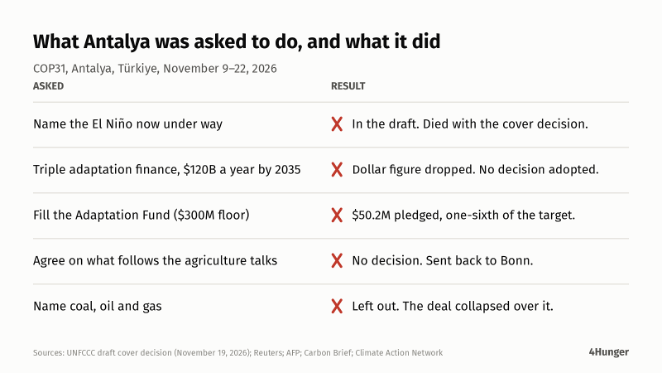
What Antalya was asked to do, and what it did.7
Despite Warnings About El Niño Hunger, COP31 Did Not Act
El Niño and hunger were a constant theme in Antalya, from the pavilions to the press briefings, and the UN agencies came with stark numbers.
• The World Food Programme projected that this El Niño could push at least 49 million more people into acute food insecurity by the end of 2027. It expects the event to peak between October and December 2026, with effects on harvests and food prices lasting into early 2028.8
• IFAD President Alvaro Lario said El Niño could cost the global economy up to $11 trillion in lost income over the next few years.9
• UNDP Administrator Alexander De Croo said protecting vulnerable households now would cost about $36 billion, while waiting until after the damage is done would cost about $73 billion. He called inaction “the most expensive climate policy.”10
• UNHCR warned that refugees face a “double injustice,” fleeing conflict only to meet extreme weather, while the agency itself is only one-third funded this year.11
• CGIAR and partners launched a report on turning early warnings into timely decisions for farmers, warning that a seasonal forecast helps only if advice and the means to act reach farmers before the hard season.12
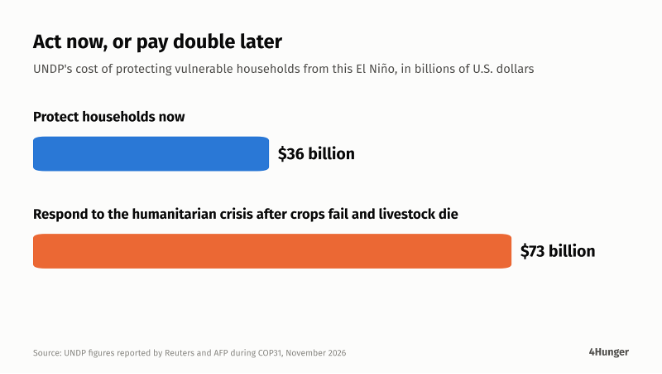
Act now or pay double later.13
The negotiators noticed too, at least on paper. The November 19, 2026, draft of the cover decision “expresses concern over the potential of the ongoing El Niño event, compounded by long-term climate change” to worsen droughts, floods and extreme heat. It called for early warning systems covering everyone on Earth by 2027 and named “anticipatory action” among the steps countries should strengthen.14
None of that survived. Those lines were in the cover decision, which was never adopted, so the one text that named the El Niño now under way died in the fight over fossil fuels. Even on paper, it never mentioned food, agriculture or hunger. Carbon Brief noted that “food systems,” a term in the presidency’s early outline, had already disappeared from the draft cover text published on November 16, 2026.15
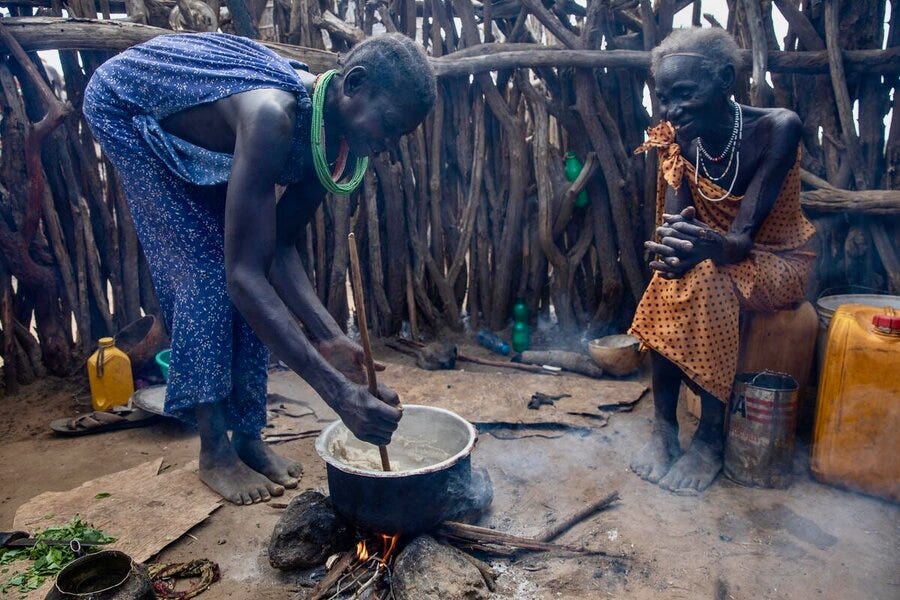
WFP’s anticipatory cash assistance in South Sudan allowed thousands of people to buy food and other necessities, to cushion the fallout of drought-withered harvests. Photo: WFP/Gabriela Vivacqua
What Failed?
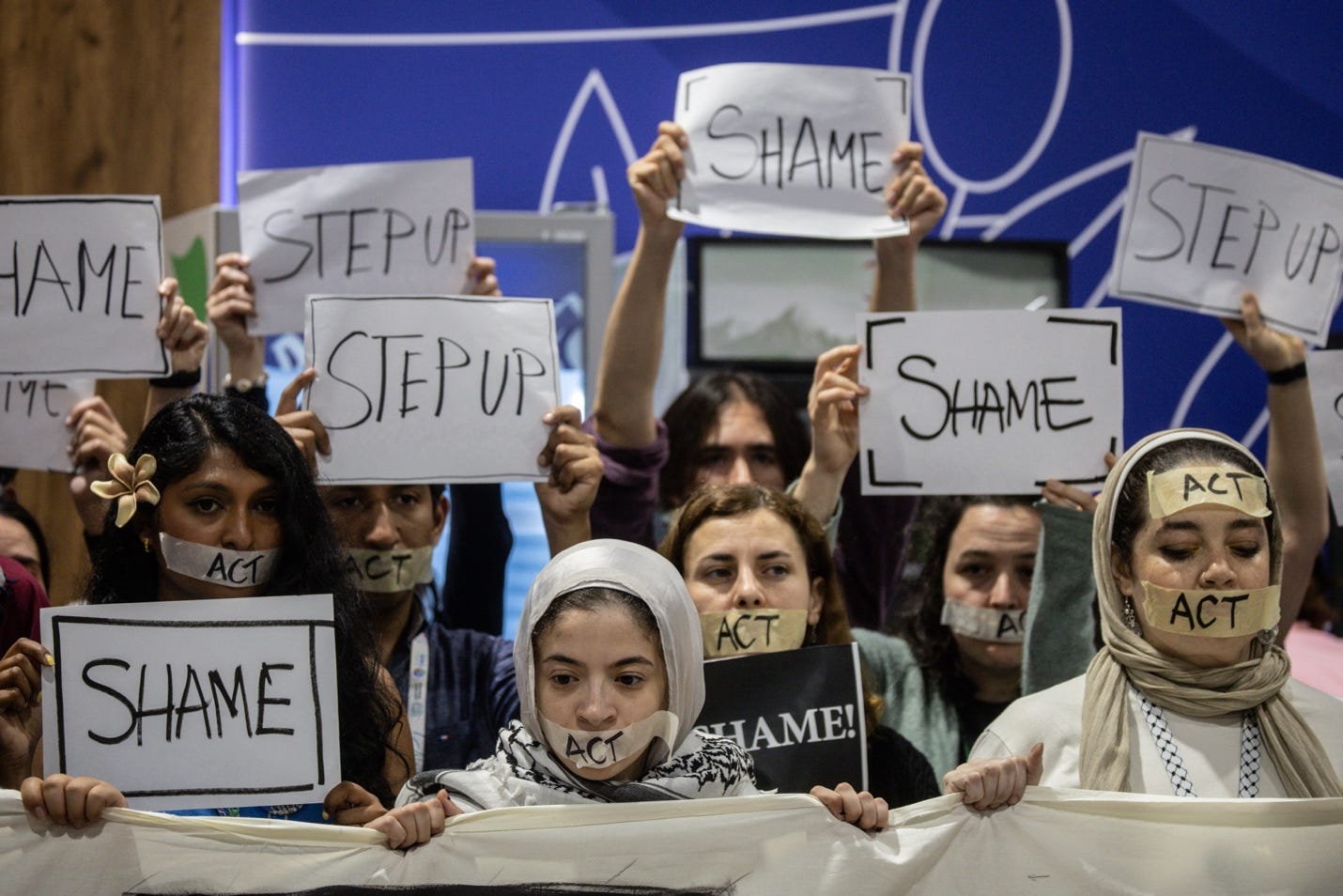
People protest outside the closing plenary on November 20, 2026, the scheduled final day of the COP31 climate conference in Antalya, Türkiye. Credit: Chris McGrath/Getty Images
On El Niño hunger, the gap between the warnings and the response showed up in four places.
1. Adaptation finance was kept off the agenda, then lost entirely. On the opening day, countries rejected the African Group’s request for a dedicated agenda item on tripling adaptation finance. The first draft of the cover decision spelled out what tripling meant, at least $120 billion a year by 2035. Later drafts dropped the number and kept only a call to “at least triple adaptation finance by 2035,” with no agreed baseline. When the cover decision failed, even that call went with it.16
2. The Adaptation Fund got one-sixth of its annual target. New pledges totaled about $50.2 million against an annual target of at least $300 million. Spain gave $27.8 million, followed by Germany and Ireland, with smaller amounts from Belgium, Portugal and Estonia. The United States, the United Kingdom, Canada, France, Italy and Australia made no new pledges, even though Australia was president of the negotiations. The Climate Action Network called the result “shamefully inadequate.”17
3. The scale of need was never in the room. Developing countries need about $300 billion a year for adaptation. In 2024, they received about $30 billion in public finance and roughly $6 billion from private sources. Secretary-General Guterres told reporters that even tripling adaptation finance would meet less than 30% of what is needed.18
4. Agriculture had no decision at all. The Sharm el-Sheikh joint work on agriculture and food security, the only UN climate work program devoted to food, reached the end of its four-year mandate in Antalya. Countries could not agree on what replaces it. Carbon Brief reported the agriculture talks were “once again” pushed to intersessional discussions in Bonn, with trade measures and adaptation finance as red lines.19
Meanwhile, the host country announced more than $26 billion in investment deals and plans during the conference, including a preliminary $15 billion renewable energy deal with China.20 Big money was available in Antalya, but very little of it was aimed at the farms and families El Niño will hit first.
Those four failures concern money for the El Niño already under way. The bigger failure concerns the warming that will keep breaking harvests long after this El Niño fades.
Failing on Climate Means More Failed Harvests in the Future
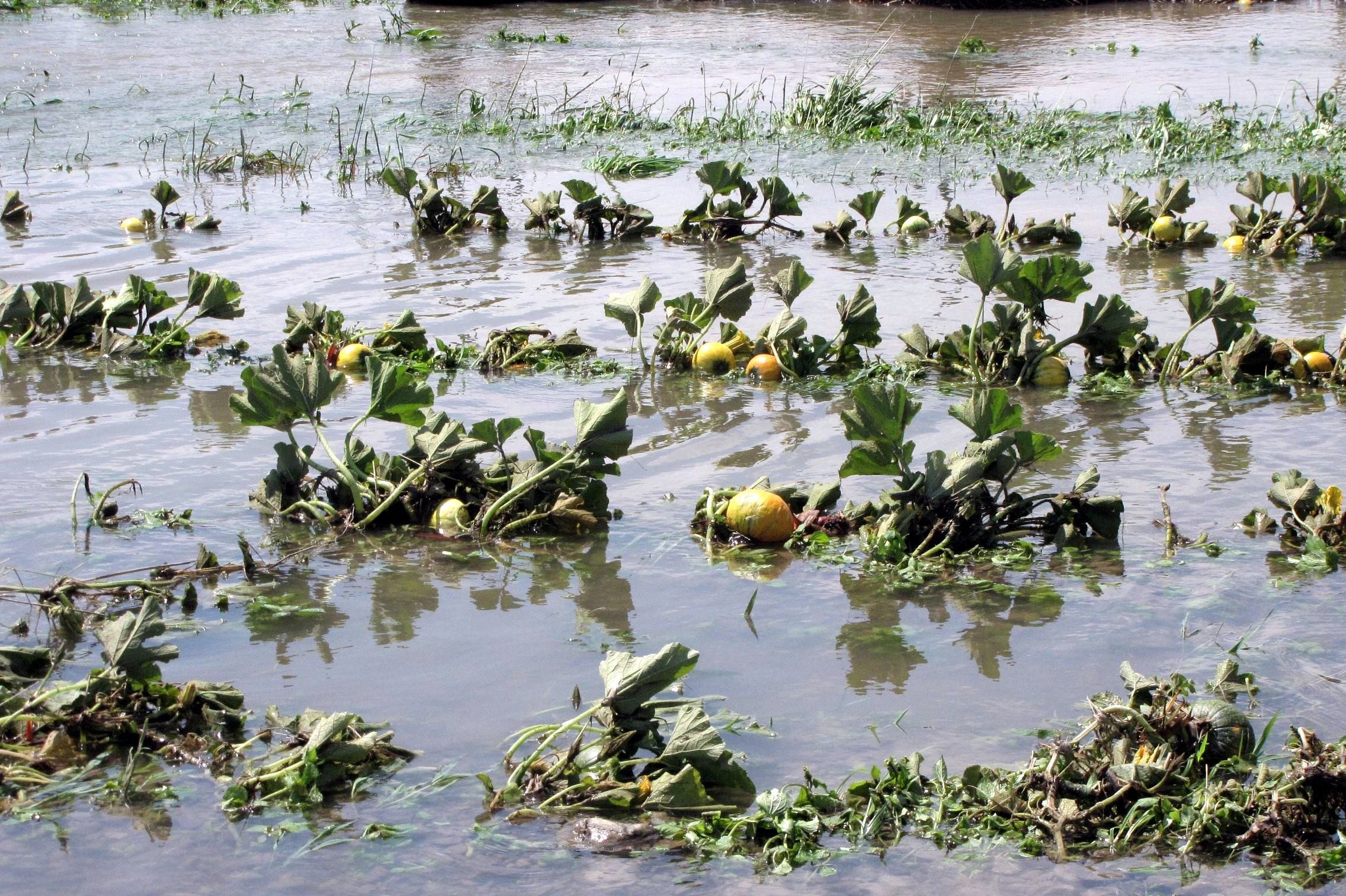
Climate change and El Niño cause droughts and floods. A flooded vegetable field at Hawthorne Valley Farm. Credit: Steffen Schneider, the farm’s director of operations, Inside Climate News
El Niño is a natural cycle that comes and goes, but climate change magnifies its impact. The longer-term threat to the world’s food is the warming from climate change itself, and on that, COP31 also failed to act.
UNEP’s Emissions Gap Report, released October 21, 2026, found that national climate pledges, even if fully delivered, would hold warming only to 2.6°C this century. Current policies point to 2.8°C. UNEP also found the chance of limiting warming to 1.5°C without overshoot has been lost, and that every five years of emissions at current levels raises peak warming by about 0.1°C.21
Warming has a direct cost in food production. A 2025 study in Nature, led by Andrew Hultgren of the University of Illinois, found that every additional 1°C cuts global food production by about 120 calories per person per day, or 4.4% of recommended daily consumption, even after farmers adapt, and adapting itself takes money. Under high emissions, the study projects global staple-crop calorie yields in 2100 about 24% lower than they would be without climate change. Co-author Solomon Hsiang said 3°C of warming would be “basically like everyone on the planet giving up breakfast.”22
No country is spared. The study found the world’s breadbaskets, including the U.S. Corn Belt, among the hardest hit, along with the poorest regions.23 Hunger from climate change will reach American tables too, through prices if not through empty fields, and cuts to America’s food safety net will make those impacts felt more directly.
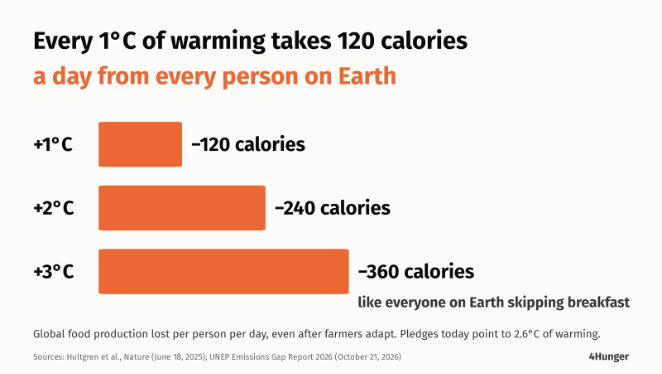
What each degree of warming takes from the world’s plate.24
Against that science, the final draft of the COP31 cover decision did not even mention coal, oil or gas, the primary sources of carbon dioxide causing climate change. Ireland’s climate minister, Darragh O’Brien, speaking for the EU presidency, said the bloc would not endorse a decision “that does not even mention fossil fuels.” Speaking for the Arab Group, Saudi negotiator Mohammad Ayoub defended keeping “all solutions on the table.”25 A summit that cannot name the main cause of climate change will not slow it. Each COP that fails to deliver concrete action away from fossil fuels adds to the crop failures our children and grandchildren will inherit.
The Hunger Caused by El Niño Won’t Wait for Addis Ababa in 2027
The next climate summit, COP32, meets in Addis Ababa, Ethiopia, in 2027. COP31 pushed the agriculture talks to Bonn in 2027, and fundraising for the two Global Environment Facility adaptation funds for the poorest countries now runs toward Addis Ababa.26 El Niño does not follow that calendar.
Southern Africa is planting now into a forecast of below-normal rain, and FEWS NET expects hunger and humanitarian needs there to peak from November 2027 through March 2028. Central America’s Dry Corridor is in its critical months right now. In Sudan, the IPC warns El Niño drought is accelerating famine risk in Darfur and Kordofan.27 The money to respond to the crop failures that El Niño’s droughts and floods have caused, and will cause, has to move in the coming weeks and months, not at the next COP a year from now.
That means three things.
1. Donor countries that stayed silent at COP31 must still pledge. A COP is not the only door. The Adaptation Fund, WFP and the other agencies that warned delegates of the coming El Niño hunger crisis accept money any day of the year.
2. Governments should fund the anticipatory action that nearly made it into the text. No COP decision is needed to fund the anticipatory action discussed at COP31. All it takes is a humanitarian commitment to help our fellow human beings as El Niño destroys crops and livestock and hunger rises. UNDP’s own numbers show that acting now costs about half as much as waiting until the hunger crisis hits in full in 2027 and 2028.
3. The tripling pledge discussed at COP31 needs a baseline. Without one, “at least triple” cannot be measured, audited or enforced. Bonn is the next chance to fix that. The baseline should be the $100 billion a year in climate finance that developed countries previously pledged. Emerging economies such as China, India, Russia, Brazil, Indonesia and the countries of the Middle East, all of which have benefited from fossil fuels and contributed to the climate crisis, should also contribute and increase annual adaptation funding for low-income countries.
Governments Have Failed. People Must Step In.
COP31 was the last big chance for governments to act before this super El Niño destroys more harvests and livestock and hunger spreads around the world. They did not take it. COP31 ended without an overarching decision. The Adaptation Fund got one-sixth of its annual target. The WFP plans to help fewer people next year, despite the added need from El Niño, because it does not have the funding to help everyone in need. On November 20, 2026, the WFP said its $13 billion appeal for 2026 is only half funded, and it launched a smaller 2027 appeal of $12 billion to help 91 million people, down from the 110 million it aimed to reach this year.28 Far more people are expected to need help than that, but donor countries are cutting their own taxes instead of helping their fellow men, women and children around the world.
When governments fail, people have to step in, in two ways. We can give, and we can make our governments give. Neither is enough alone. Our gifts can reach families this winter, before the next harvest fails, but only governments can move money on the scale this El Niño demands.
We know what people can do in a single day. On Giving Tuesday last year, 38.1 million Americans took part and gave $4.0 billion.29 That is about 20 times the entire $202 million FAO-WFP El Niño appeal, which went mostly unfunded.
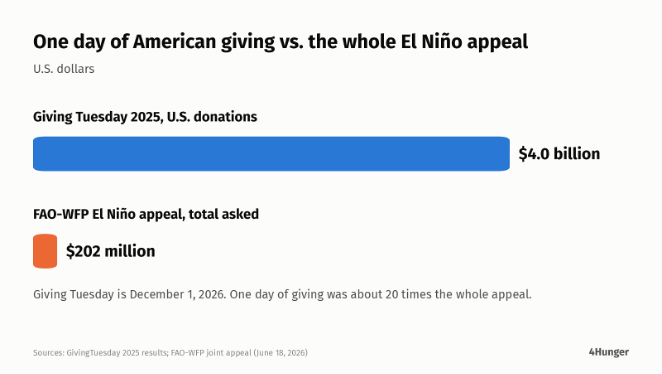
One day of American giving compared with the whole El Niño appeal.30
Giving Tuesday, December 1, 2026, Is Our Chance to Do What COP31 Didn’t!
Giving Tuesday falls on December 1, 2026, the Tuesday after Thanksgiving.31 COP31 showed that we cannot wait for governments to act on El Niño. On Giving Tuesday, each of us can show that we do not want others in our community and in our world to suffer from hunger. There is enough food for everyone, but many cannot afford it or even access it.
Giving before crops fail works, and the anticipatory action it funds costs less. After the 2023–2024 El Niño drought in Southern Africa, conservative estimates found that anticipatory investments delivered a 30% net benefit over the traditional disaster aid response and reached people 6 to 10 months earlier.32
So on Giving Tuesday, we ask you to give where the money moves before the harvests fail. Look for groups that pay for early action, like the World Food Programme, which runs an anticipatory action trust fund, and the aid groups of the Start Network, whose pooled Start Fund can release money ahead of a crisis.33 Many international groups are fighting hunger around the world, and they need our help now. These are among the best known:
• World Food Program USA, which raises money in the United States for the UN World Food Programme
• UNICEF USA
• Save the Children
• CARE
• Oxfam America
• International Rescue Committee
• Mercy Corps
• Action Against Hunger
• World Vision
• Heifer International
• Doctors Without Borders
And do not forget the food bank in your own community.
How to Move Our Governments
Our gifts matter, but they cannot replace the humanitarian aid that governments can mobilize. The governments that came to COP31 with empty hands can still act, if we make them.
Rich countries around the world have been pulling back on humanitarian aid. UNHCR is only one-third funded this year after a global retreat from overseas aid led by the United States.34 The United States, the United Kingdom, Canada, France, Italy and Australia made no new pledges to the Adaptation Fund at COP31 (see note 17).
In the United States, the next decision is already pending in Congress. The administration’s budget for fiscal 2027 would eliminate Food for Peace international food aid grants ($1.2 billion) and the McGovern-Dole school meals program ($240 million). The House-passed agriculture bill does not follow most of the administration’s largest proposed cuts.35 On November 18, 2026, Devex reported that the Senate Appropriations Committee had released a $50.11 billion foreign aid bill that keeps funding essentially flat and rejects the 6% cut in the House version. The two chambers now have to agree on a compromise.36
Here is how to make our voices count while those decisions are being made.
1. Call. The U.S. Capitol switchboard, (202) 224-3121, will connect you to your senators’ and your representative’s offices.37 Congressional staff tally the calls, emails and letters they receive each day, so say where you live and what you are asking for.38
2. Write and meet. Send a message through each member’s website, and ask for a meeting at the district office. Members of Congress have offices at home as well as in Washington, and Congress.gov will find yours by address.39
3. Go public. Write a letter to the editor or an op-ed for your local paper, and tag your members of Congress when you share it.
4. Bring others. Ask your congregation, food bank, school or civic group to sign one joint letter. Many voices from one district carry more weight than one.
5. Outside the United States, contact your member of parliament and ask your government to pledge to the World Food Programme and the Adaptation Fund before COP32.
Whatever the channel, ask for five things.
1. Close the El Niño funding gap now. Fund the World Food Programme and the UN’s emergency fund, CERF, before even more harvests fail.
2. Protect hunger relief at home. States already pay 75% of SNAP’s administrative costs, and under current law, states with payment error rates of 6% or more must start paying part of SNAP benefit costs on October 1, 2027. The Senate Agriculture Committee’s farm bill would delay that change by one year.40 Pass a farm bill that protects SNAP and restores the funds and programs gutted by the 2025 law its sponsors named the One Big Beautiful Bill Act, including programs that supplied the food banks families turn to when food runs short.
3. Fund food aid abroad and restore humanitarian aid. In the final fiscal 2027 bills, hold foreign aid at least at the Senate’s level and fund Food for Peace and McGovern-Dole, which feed hungry families and schoolchildren overseas. Hunger relief, refugee aid and climate adaptation finance are the right thing to do, and they strengthen America’s reputation abroad.
4. Agree on a baseline for tripling adaptation finance at the Bonn talks next year, so the promise can be measured. Start from the earlier pledge of $100 billion a year in climate finance.
5. Call for the elimination of fossil fuels at COP32 in Addis Ababa. A plan to combat climate change that cannot name the main cause of the climate crisis cannot stop it.
Then tell them why we need to fund El Niño aid now. UNDP’s numbers show that acting now costs about half as much as waiting, and every month of delay is paid for in hunger.
We will keep track of which of these happen. In January, we will audit the El Niño deadlines we have been following all fall, region by region, and report which governments and donors acted before the harvests failed and which did not.
The world’s hungry lost at COP31 twice, once on the El Niño already here and again on the climate change still to come. Now it is up to the countries that left with their wallets closed, and the governments that left without even a decision, to act before even more harvests fail. On Giving Tuesday, we can show them how. Give all you can!