

Climate Migration - The Crisis Without a Legal Name
I wrote this in 2022 but the same disaster is happening now with an even more people migrating. The World Bank Groundswell Report projects that up to 216 million people could become internal climate migrants across six major world regions if global emissions and climate adaptation efforts do not improve. When I started my Substack technology took my new writings and overwrote my writings on 4Hunger.org starting in 2019. This one popped out of the ethernet today totally unexpectedly. I will revisit this topic soon, but thought I’d share this because it is so close to true. The climate is in much worse shape, El Niño is coming and inequity has skyrocketed, but so much of this is still true.
Mark
Climate change is no longer a future threat to human settlement. It is an active, accelerating driver of forced displacement today. Floods, storms, droughts, rising seas, and extreme heat are uprooting hundreds of millions of people, and the numbers are growing sharply every year.[1] The populations bearing the greatest burden are overwhelmingly the world’s poorest even though they are the communities that contributed least to the emissions causing the crisis; but they are living in the regions most physically exposed to its consequences and with the fewest resources to adapt or relocate.
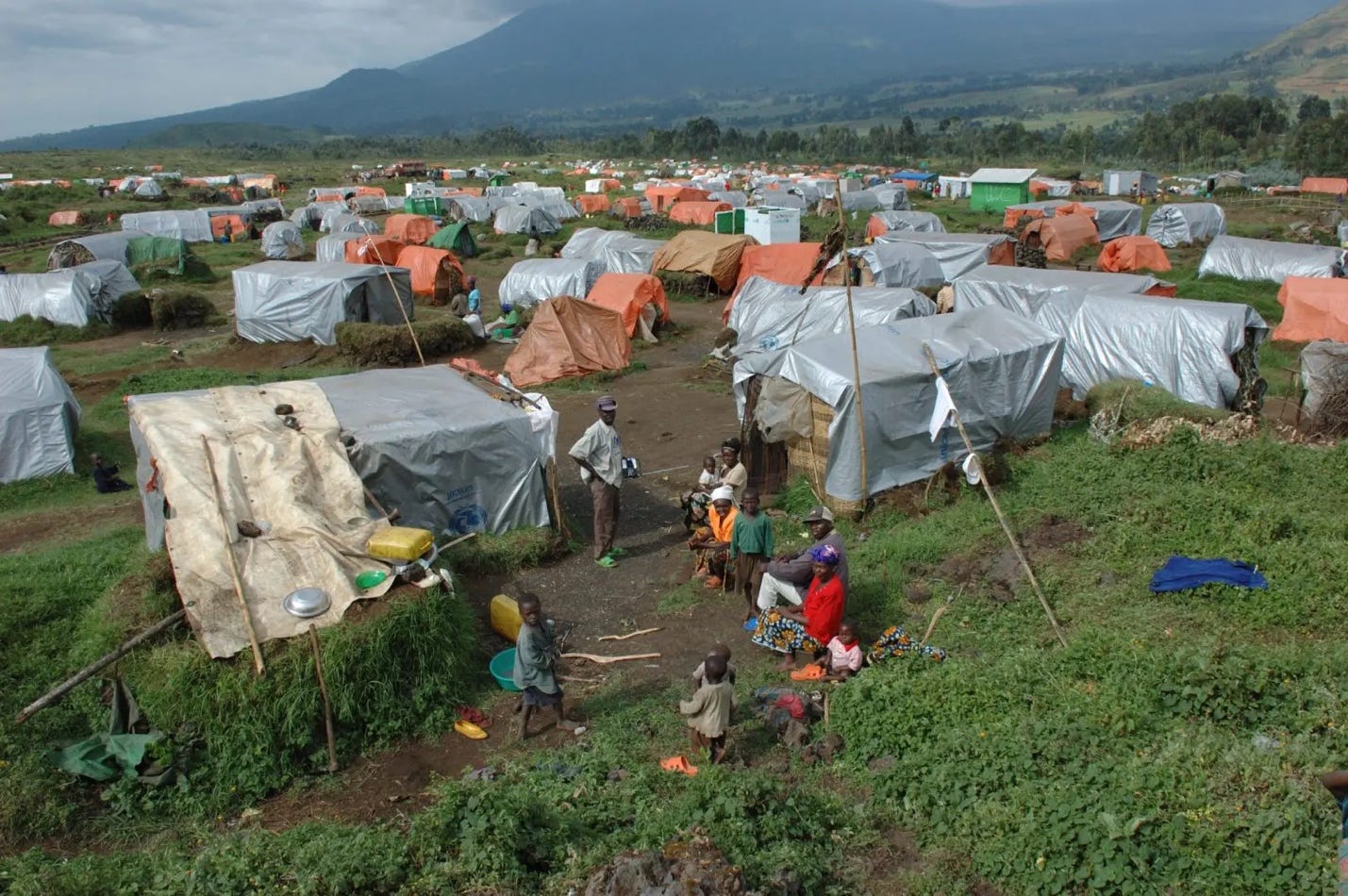
What makes climate migration a distinct equity crisis rather than simply a humanitarian one is the combination of scale, acceleration, and near-total legal invisibility. The people displaced by climate hazards today have no recognized status in international law, no guaranteed right to protection, no enforceable claim to assistance and no status to enter another country if that is where they need to go.[2] They are displaced by a crisis they did not cause, into a legal and political framework that does not acknowledge their existence. Understanding the gap between the scale of displacement and the inadequacy of the response is essential to any serious account of how climate change is exacerbating global inequity.
The Crisis is Already Underway
Measuring climate migration precisely is inherently difficult as the forces of climate intersect with poverty, conflict, and economic fragility, and people rarely move for a single reason. But the data that does exist points to a crisis of enormous and worsening scale.[3] Since systematic global tracking began in 2008, the Informatica Intelligent Data Management Cloud (IDMC) has reported 359 million internal displacements due to weather-related hazards, an average of 22.4 million per year.[4] That is the equivalent of the entire population of Australia being forced from their homes every single year.
The trajectory is unmistakable. In 2022, disaster displacements reached 32.6 million, which was a record, representing a 41% increase above the annual average of the previous decade.[5] In 2023, 26.4 million disaster displacements were recorded.[6] In 2024, that figure surged to 45.8 million new disaster displacements, nearly double the decade’s annual average and a new yearly record by a wide margin.[7] It bears emphasis that these figures count displacement events, not unique individuals: the same person may be displaced multiple times, and the overwhelming majority of these movements are internal displacements meaning people fleeing within their own country’s borders, not crossing into another country.
Who Is Being Displaced
The burden of climate displacement is profoundly unequal. The regions that have contributed least to greenhouse gas emissions are suffering most from the consequences.[1] In 2023, the five countries recording the highest numbers of new internal displacements from disasters were China (4.7 million), Türkiye (4.1 million), the Philippines (2.6 million), Somalia (2 million), and Bangladesh (1.8 million).[6] South and East Asia account for the majority of global displacement totals historically, driven by large populations in flood- and cyclone-prone zones. displacements in sub-Saharan Africa, particularly the Horn of Africa and the Sahel, is growing rapidly causing this area to become a displacement hotspot. Slow-onset desertification and drought compound the sudden-onset effects of increasingly intense storms causing crops to fail and forcing people off their traditional lands.
The inequity extends beyond geography to class. Climate displacement is not an equal-opportunity crisis within affected countries. The poorest households, those in informal settlements on flood-prone land, subsistence farmers with no savings buffer, renters with no land rights, and communities marginalized from political representation, face the highest displacement risk and the lowest capacity to recover.[8] Wealth plays an enormous role: rich cities in hot or flood-prone regions can sustain habitability through infrastructure for far longer than poor rural communities facing equivalent or lesser climate stress.[9] The Climate pressures that push some to move trap others in place. People in areas hit hard by climate change and its natural disasters who are too poor, too elderly, or too vulnerable to bear the cost and danger of relocation are often the most physically exposed and have no place or ability to go and no help to get out of their situation. As conditions worsen, the capacity to adapt in place will diminish for a growing share of the world’s population.
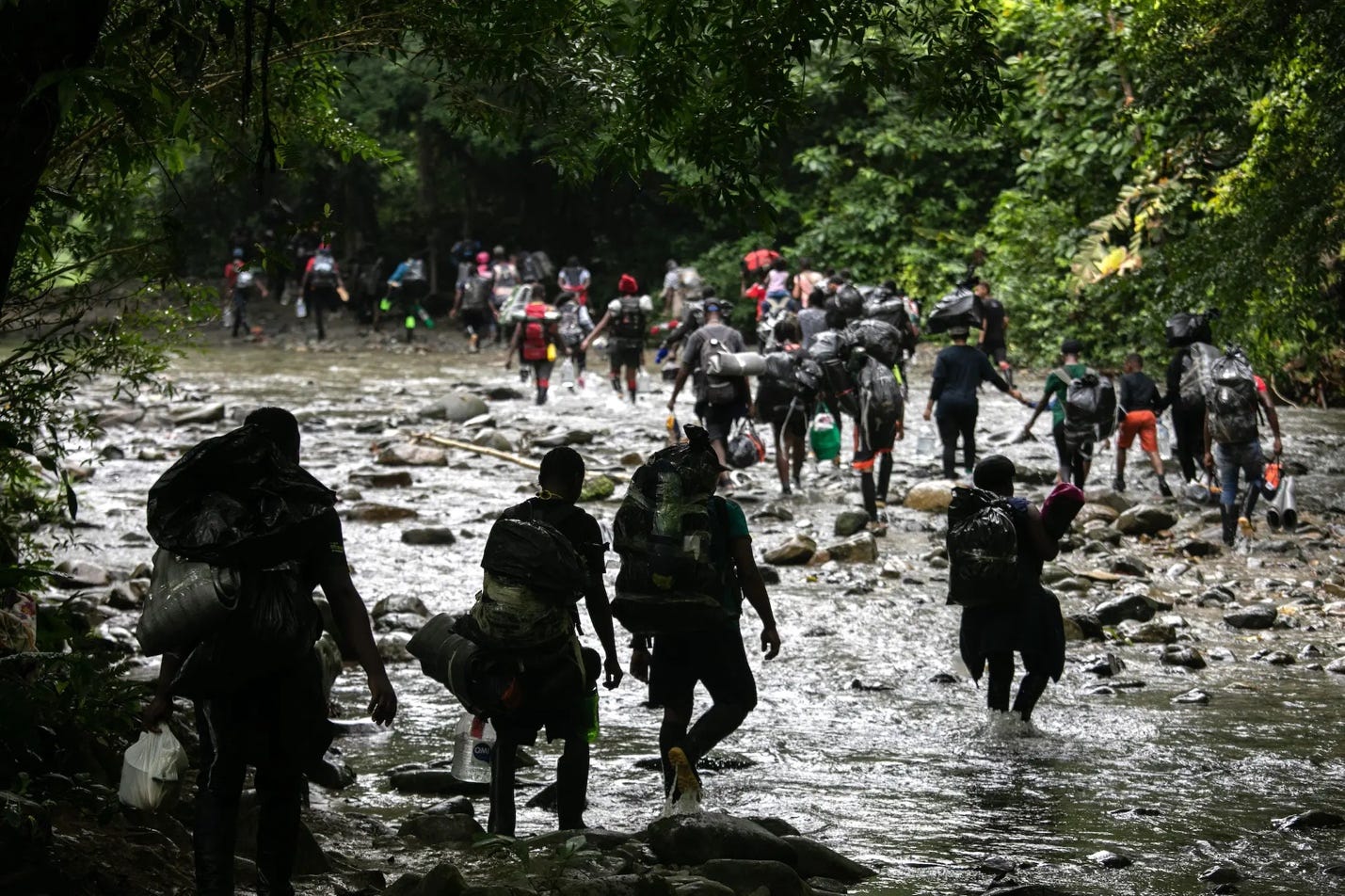
For some nations, climate migration is not a risk to manage, it is an existential threat to national survival. Kiribati, Tuvalu, the Marianas and the Marshall Islands are projected to become uninhabitable due to sea level rise, saltwater intrusion into freshwater supplies, and increasingly intense storm surges. Entire nations face eventual relocation a category of displacement with no precedent in modern international law and no established mechanism for managing it. [Ref: 10]
Compounding Hazards
Climate displacement is driven by several interconnected forces that increasingly compound one another, making each successive shock harder to recover from and raising the baseline level of vulnerability against which the next event strikes.
1. Extreme Weather Events
Floods, storms, cyclones, and wildfires are the dominant cause of displacement today, responsible for 99.5% of documented weather-related displacement events in 2024.[7] They destroy homes, infrastructure, and livelihoods rapidly and at massive scale, forcing sudden evacuation. The frequency and intensity of these events is increasing directly as a result of climate change.[11] Each event that displaces a community without enabling full recovery leaves that community more vulnerable to the next.
2. Rising Sea Levels
Coastal flooding and saltwater intrusion are making low-lying land permanently uninhabitable and contaminating freshwater supplies. The threat is slow in onset but irreversible in effect, bearing down on some of the world’s most densely populated places like the river deltas of Bangladesh, Vietnam, the Nile, and the Mekong as well as hundreds of coastal cities around the world.[12]Unlike sudden-onset disasters, sea level rise does not trigger emergency response systems. It erodes habitability gradually, invisibly, and without generating the international attention that follows a cyclone or flood.
3. Drought, Water Scarcity, and Agricultural Collapse
In 2023, drought displacement was substantial across the Horn of Africa, with the worst drought in 40 years triggering 2.1 million people to move in the region alone.[5] Prolonged drought destroys agricultural livelihoods and depletes drinking water, as seen across the Horn of Africa, Central America’s Dry Corridor of Honduras, Guatemala and El Salvador, and the Middle East. Water scarcity currently affects over two billion people who do not have ready access to safe potable water.[13] By 2050, more than half of the world’s population is projected to live in water-stressed areas.[14] As crop yields fail due to changed rainfall patterns, heat stress, and soil degradation, farming communities lose the livelihoods that anchor them to a place. Agricultural collapse is among the most powerful slow-onset drivers of displacement, and its effects fall almost exclusively on the Global South.
4. Extreme Heat and the Approaching Survival Threshold
Up to 2.8 billion people are projected to be exposed to dangerous heatwaves by 2090 under a high-warming scenario, according to the International Organization for Migration.[15] Parts of South Asia, the Persian Gulf, and Sub-Saharan Africa are already briefly exceeding the physiological survival threshold: a wet-bulb temperature of 35°C, at which even a healthy person in shade with unlimited water cannot cool their body through perspiration.[16] Once regions regularly exceed this threshold, outdoor activity becomes life-threatening and, without costly infrastructure unavailable to most of the world’s poor, the land becomes effectively uninhabitable.[17] This is not a distant scenario for the most exposed communities. It is a trajectory already underway in many parts of the world and starting to be seen regularly in others.
Climate Migration in the Future
If current emissions trajectories continue, the World Bank estimates between 44 million and 216 million people will migrate internally due to climate change by 2050.[9] Some researchers consider this a massive underestimate, for example a 2024 peer-reviewed analysis in the journal Sustainability concluded the figure could reach 500 million people migrating annually once sudden-onset disasters and compounding slow-onset factors are fully included.[18] The regional projections for 2050 are stark: Sub-Saharan Africa could see up to 86 million internal climate migrants; East Asia and the Pacific up to 49 million; South Asia up to 40 million; North Africa up to 19 million; Latin America up to 17 million.[9]
The longer-term picture is more severe still. Under high-emissions scenarios, the land surface currently experiencing conditions too hot for sustained human habitation could expand from 0.8% of Earth’s surface today to 19% by 2070, potentially affecting 30% of the global population.[19] Large swaths of northern South America, central Africa, India, and northern Australia are projected to become too hot for sustained human habitation. The human climate niche, meaning the “Goldilocks” band of temperature and rainfall conditions under which human civilization has historically thrived will shift dramatically northward, concentrating viable habitat in regions that are today mostly in the Global North.
2024 was the first calendar year on record to exceed 1.5°C above pre-industrial levels. The long-term multi-decadal average is now projected to breach 2.0°C, the highest threshold under the Paris Agreement in the early-to-mid 2030s, or even earlier if current warming rates continue. [Ref: 20] On current policy trajectories, the world is heading for approximately 2.6°C to >3°C of warming by 2100. [Ref: 21] By 2050, without significant climate action, an estimated 200 million people will require humanitarian assistance annually due to climate effects alone. [Ref: 22]
The Legal Gap: Displaced Into Invisibility
Perhaps the starkest dimension of the climate migration crisis is the near-total absence of legal protection for those climate change displaces. The 1951 Refugee Convention which is the cornerstone of international protection for forced migrants, applies only to people fleeing persecution based on race, religion, nationality, or political opinion.[2] Climate hazard is explicitly not recognized as a valid basis for refugee status as it was not a concern in 1951. This means that the hundreds of millions of people displaced by floods, drought, sea level rise, and extreme heat have no formal international legal status, no guaranteed right to protection in another country, and no enforceable claim to assistance from the international community.
This is not a technicality. It has direct consequences for the people it excludes. A family in the Maldives whose home has been inundated by rising seas, a Somali pastoralist whose livestock and water sources have been destroyed by successive droughts, a Bangladeshi farmer whose delta land is now permanently below the tideline all do not qualify for refugee protection under current international law. They are, in the words of the UN Human Rights Council, the world’s forgotten victims: displaced by a crisis they did not cause, excluded from the legal frameworks that were built precisely to protect people from forces beyond their control.[23]
The political dimension compounds the legal one. Climate migration has become deeply entangled with the broader politics of immigration in wealthy countries, where the primary policy impulse is to restrict movement rather than extend protection.[24]Europe’s reluctance to develop legal frameworks for climate-displaced persons, the United States’ contested policies toward Central American climate migrants, and the absence of any binding international instrument on climate displacement all reflect a structural failure of the global governance system to keep pace with the reality it is supposed to manage. The communities who need protection most have the least political power to demand it in their own countries, and in the international forums where the rules governing their situation are made.
Displacement is the Face of Climate Inequity
Climate migration is not a side effect of climate change. It is one of its most direct and most unjust expressions. The people being displaced today and the hundreds of millions projected to be displaced in the decades ahead are overwhelmingly those who bear the least responsibility for the emissions that have destabilized the climate. They have the fewest resources to adapt, but currently receive the least protection from the international systems theoretically designed to help them. In this sense, climate migration is not merely a humanitarian emergency, it is a precise measure of how climate change is reproducing and accelerating global inequity at the largest scale in human history.
Addressing it requires action on three fronts simultaneously. It requires reducing the emissions that are generating displacement in the first place and holding the world’s largest emitters to account. It requires dramatically scaling investment in adaptation and resilience in the most exposed communities which means finance flows that match the scale of the problem and not just the political convenience of donors. Further, it requires building the legal and institutional frameworks that recognize climate-displaced people as what they are: people forced from their homes by a crisis not of their making, entitled to protection, dignity, and the right to determine their own futures.
Bibliography
The following sources are cited in-text by bracketed superscript number. All sources are publicly accessible.
[1] Internal Displacement Monitoring Centre (IDMC). “Global Report on Internal Displacement 2025 (GRID 2025).” IDMC / Norwegian Refugee Council, 2025. https://www.internal-displacement.org/global-report/grid2025/
[2] UNHCR. “Convention and Protocol Relating to the Status of Refugees.” United Nations High Commissioner for Refugees, 1951/1967. https://www.unhcr.org/1951-refugee-convention.html
[3] Internal Displacement Monitoring Centre (IDMC). “Internal displacement in 2024: Monitoring the crisis, measuring progress.” IDMC, 2024. https://story.internal-displacement.org/internal-displacement-in-2024-monitoring-the-crisis-measuring-progress/
[4] Internal Displacement Monitoring Centre (IDMC). “Internal displacement in 2024: Monitoring the crisis, measuring progress — 359 million weather-related displacements since 2008.” IDMC, 2024. https://story.internal-displacement.org/internal-displacement-in-2024-monitoring-the-crisis-measuring-progress/
[5] Internal Displacement Monitoring Centre (IDMC). “Global Report on Internal Displacement 2023 (GRID 2023): Internal Displacement and Food Security.” IDMC / Norwegian Refugee Council, 2023. https://reliefweb.int/report/world/global-report-internal-displacement-2023-grid-2023-internal-displacement-and-food-security
[6] Internal Displacement Monitoring Centre (IDMC). “Global Report on Internal Displacement 2024 (GRID 2024).” IDMC / Norwegian Refugee Council, 2024. https://disasterdisplacement.org/resource/grid-2024/
[7] Internal Displacement Monitoring Centre (IDMC). “Global Report on Internal Displacement 2025 (GRID 2025) — 45.8 million disaster displacements in 2024.” IDMC / Norwegian Refugee Council, 2025. https://www.internal-displacement.org/global-report/grid2025/
[8] Clement, V. et al.. “Groundswell Part 2: Acting on Internal Climate Migration.” World Bank Group, 2021.https://documents1.worldbank.org/curated/en/540941631203608570/pdf/Overview.pdf
[9] World Bank. “Climate Change Could Force 216 Million People to Migrate Within Their Own Countries by 2050 (Groundswell Report press release).” World Bank, 2021. https://www.worldbank.org/en/news/press-release/2021/09/13/climate-change-could-force-216-million-people-to-migrate-within-their-own-countries-by-2050
[10] IPCC. “Climate Change 2022: Impacts, Adaptation and Vulnerability — Chapter 15: Small Islands.” Intergovernmental Panel on Climate Change, 2022. https://www.ipcc.ch/report/ar6/wg2/chapter/chapter-15/
[11] IPCC. “Climate Change 2021: The Physical Science Basis (AR6 Working Group I).” Intergovernmental Panel on Climate Change, 2021. https://www.ipcc.ch/report/ar6/wg1/
[12] IPCC. “Climate Change 2022: Impacts, Adaptation and Vulnerability — Chapter 10: Asia (sea level rise and delta cities).” Intergovernmental Panel on Climate Change, 2022. https://www.ipcc.ch/report/ar6/wg2/chapter/chapter-10/
[13] United Nations. “Water — at the center of the climate crisis.” United Nations Climate Action, 2023. https://www.un.org/en/climatechange/science/climate-issues/water
[14] Burek, P. et al.. “Reassessing the projections of the World Water Development Report — By 2050, more than half of the global population will live in areas facing water scarcity.” npj Clean Water / Nature, 2019. https://www.nature.com/articles/s41545-019-0039-9
[15] International Organization for Migration (IOM) Global Data Institute. “Up to 2.8 Billion People Possibly Exposed to Heatwaves Worldwide by 2090: New IOM Analysis.” IOM, 2023. https://www.iom.int/news/28-billion-people-possibly-exposed-heatwaves-worldwide-2090-new-iom-analysis
[16] Raymond, C., Matthews, T. & Horton, R.M.. “The emergence of heat and humidity too severe for human tolerance.” Science Advances, Vol. 6 No. 19, 2020. https://www.science.org/doi/10.1126/sciadv.aaw1838
[17] Sherwood, S.C. & Huber, M.. “An adaptability limit to climate change due to heat stress.” Proceedings of the National Academy of Sciences, 107(21), 2010. https://www.pnas.org/doi/10.1073/pnas.0913352107
[18] Pottier, A.. “International Climate Migrant Policy and Estimates of Climate Migration.” Sustainability, 16(23), 2024. https://www.mdpi.com/2071-1050/16/23/10287
[19] Xu, C., Kohler, T.A., Lenton, T.M., Svenning, J.-C. & Scheffer, M.. “Future of the human climate niche.” Proceedings of the National Academy of Sciences, 117(21), 11350–11355, 2020. https://www.pnas.org/doi/10.1073/pnas.1910114117
[20] Haarsma, R. et al.. “A year above 1.5°C signals that Earth is most probably within the 20-year period that will reach the Paris Agreement limit.” Nature Climate Change, 2025. https://www.nature.com/articles/s41558-025-02246-9
[21] Climate Action Tracker. “Warming Projections Global Update — November 2025.” Climate Analytics and NewClimate Institute, 2025. https://climateactiontracker.org/publications/warming-projections-global-update-2025/
[22] ICRC. “When Rain Turns to Dust: Understanding and Responding to the Combined Impact of Armed Conflicts and the Climate and Environment Crisis on People’s Lives.” International Committee of the Red Cross, 2020. https://www.icrc.org/en/publication/when-rain-turns-dust
[23] UN Human Rights Council. “Addressing the impacts of climate change on the full and effective enjoyment of human rights (Resolution 41/21).” United Nations Human Rights Council, 2019. https://documents.un.org/doc/undoc/gen/g19/248/56/pdf/g1924856.pdf
[24] UNHCR. “Global Trends: Forced Displacement in 2023.” United Nations High Commissioner for Refugees, 2024. https://www.unhcr.org/global-trends-report-2023