

By Mark W. Roberts, October 20, 2026
The strongest El Niño on record is arriving just after the hottest summer in U.S. history. 2027 is likely to be the world’s hottest year yet. Extreme heat is already the deadliest weather hazard in America, and it is killing far more people than the official count admits. As the world warms, mosquitoes, flies, midges, fungi and pests are moving out of the tropics, sickening people, livestock and crops at the same time. The science of One Health treats all of these as one crisis, with one solution.
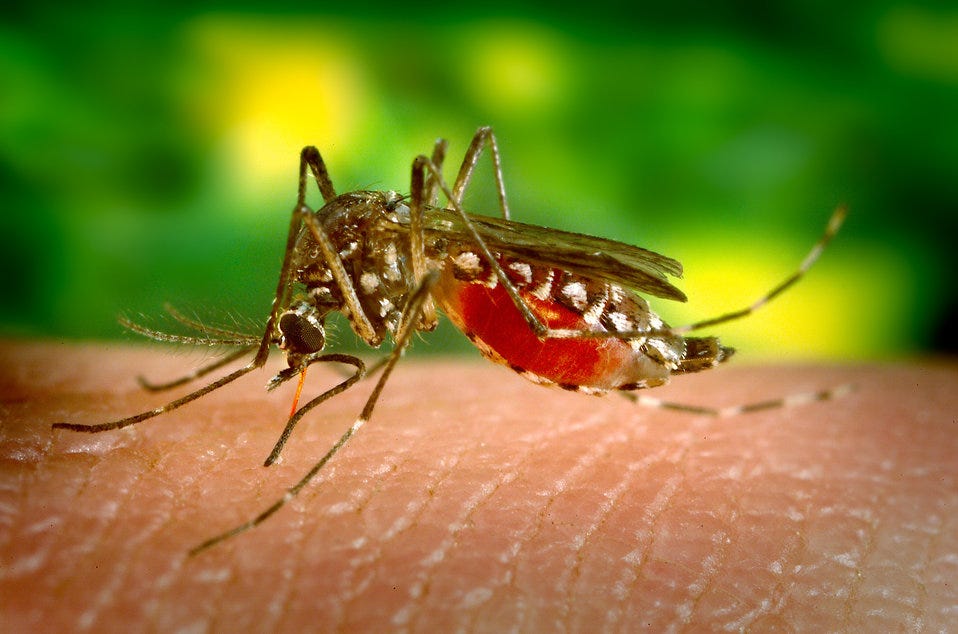
An Aedes mosquito, the primary vector for the spread of Dengue fever biting human skin. Photo Credit: CDC/James Gathany
In September 2026, Florida confirmed its first dengue death of this year’s outbreak, an 80-year-old woman bitten by a mosquito near her home in South Tampa. By early October, the state had recorded 296 locally acquired dengue cases, far above its previous record high of nearly 200 cases in 2023.¹ On June 3, 2026, U.S. Department of Agriculture (USDA) inspectors confirmed New World screwworm, a flesh-eating parasite that the United States declared eradicated in the 1960s, in a calf in Zavala County, Texas.² Off the coast of Peru, warm El Niño water has gutted the anchovy catch that feeds the world’s fish farms and livestock.³ In Kenya, veterinary teams are moving vaccines into 24 counties to protect herds from Rift Valley fever before the El Niño rains arrive.⁴
A woman in Tampa, a calf in Texas, a fishery in Peru and a herd in Kenya look like four different stories, but they are one. Scientists call the idea One Health: the health of people, animals, plants and the environment is linked, and a threat to one quickly becomes a threat to the others. About 60 percent of emerging disease outbreaks in people, and three-quarters of newly emerging human pathogens, come from animals.⁵ When climate-driven heat and El Niño push disease into new places, they strike people, livestock and crops at once, and through all three, the global food supply.
The World Health Organization (WHO) put it carefully in its El Niño analysis this year: El Niño “does not directly cause disease,” but it is a “risk modifier” that tilts the odds toward disease outbreaks.⁶ This super El Niño is tilting the odds hard.
Climate Change Loads the Dice
El Niño is a natural phenomenon, not a product of climate change. On June 2, 2026, the World Meteorological Organization said there is no evidence that climate change increases the frequency or intensity of El Niño events, but that warming “can amplify associated impacts because a warmer ocean and atmosphere increases the availability of energy and moisture for extreme weather events such as heatwaves and heavy rainfall.”⁷ This El Niño is arriving in the warmest years ever recorded, and Zeke Hausfather of The Climate Brink gives 2027 about a 95 percent chance of becoming the hottest year on record.⁸ The University of Chicago’s Climate Impact Lab projects that this El Niño’s heat could cause up to 451,000 additional deaths worldwide between June 2026 and February 2027, led by Nigeria, Indonesia and Sudan.⁹ *
A 2025 study of large climate-model ensembles found El Niño growing more frequent and more intense under human-caused warming and suggested the observed strengthening since the mid-20th century could be partly human-caused. Another 2026 study found that very strong El Niños more than double under very high emissions. These are projections, not proof, and with only about 75 years of measurements, it is too soon to tell chance from trend.⁷
Global heat tells a clearer story. The 11 warmest years on record are the last 11 years, 2015 through 2025. El Niño adds a temporary spike on top of that trend; each of the last three very strong El Niños set up a record-hot year: 1998, 2016 and 2024. Because the floor keeps rising, each spike reaches higher than the last. Even if El Niño never grows stronger, its droughts, floods and heat will do more damage in a warmer world.⁷
The verdict on what that warmth does to health is clear. The IPCC concluded in 2022, with very high confidence, that “climate change has adversely affected physical health of people globally,” and with high confidence that “the incidence of vector-borne diseases has increased” and that “animal and human diseases, including zoonoses, are emerging in new areas.”¹⁰ A 2022 review of the scientific literature found that 58 percent of the infectious diseases humanity has faced, 218 of 375, have at some point been made worse by climate hazards such as heat, floods and drought.¹¹
Climate change also makes the food system that protects people from disease more fragile. The 2025 Lancet Countdown linked the extra heatwave days and drought months of 2023 to 123.7 million more people facing moderate or severe food insecurity, and found that heat cost the world a record 639 billion potential hours of labor in 2024.¹²
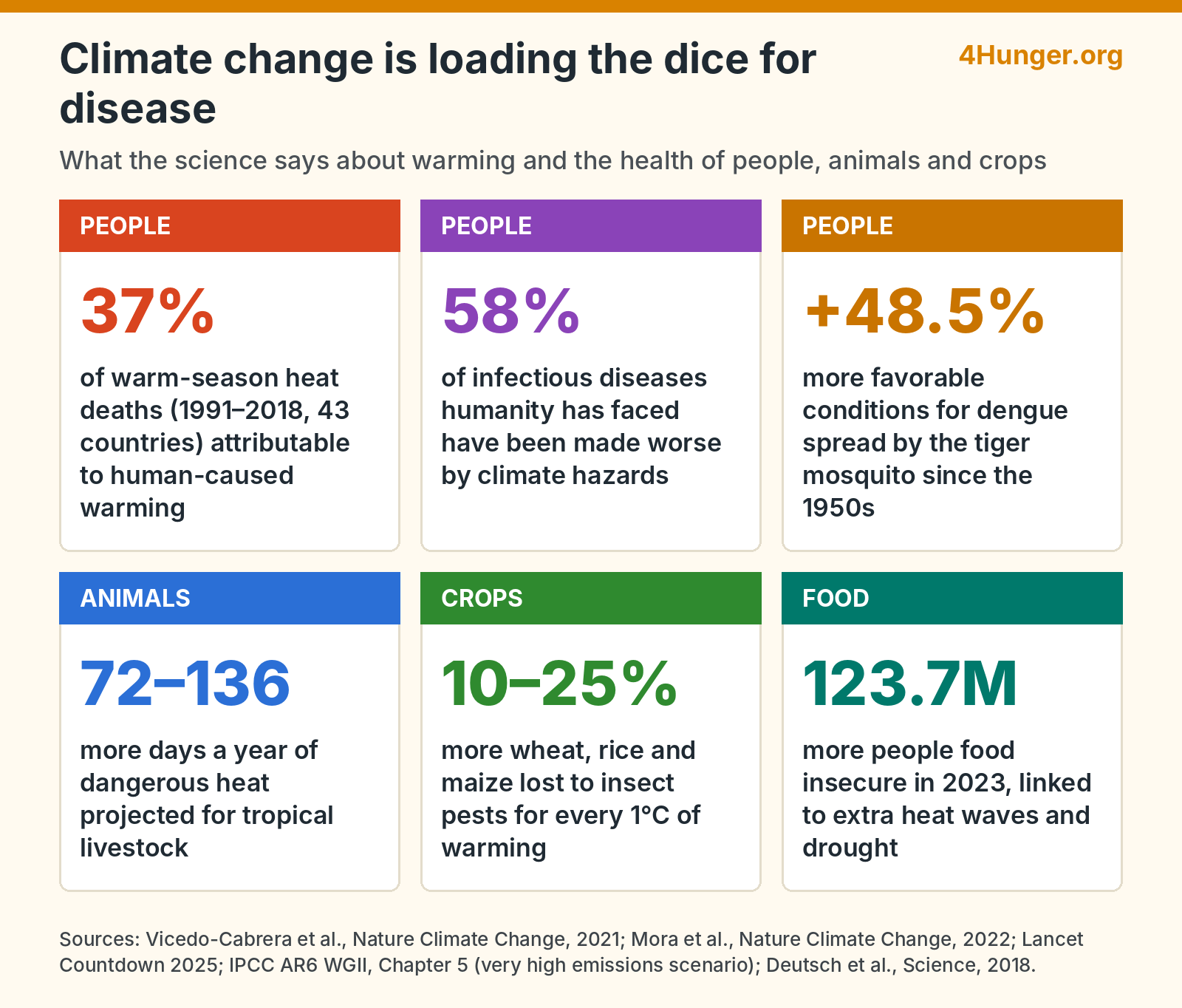
Climate change is loading the dice for disease in people, animals and crops.
The science also has limits. Heat, rainfall and humidity clearly shape many diseases, but not every outbreak is caused by climate change or by this El Niño. The bird flu epidemic in U.S. dairy herds, for example, has not been shown to be driven by warming. For many diseases, though, the evidence that climate change is making them worse is already very strong.
People: The Killer We Do Not Count
Heat: Climate’s Biggest Killer
The deadliest climate threat to Americans is heat, not mosquitoes. This was the hottest summer in U.S. history: the contiguous United States averaged 74.4°F from June through August, 3.0°F above the 20th-century average.¹³ By September 10, 2026, emergency rooms had logged more than 145,000 heat-related visits this year, and about 221 million Americans had lived through at least one day of major or extreme heat risk.¹⁴
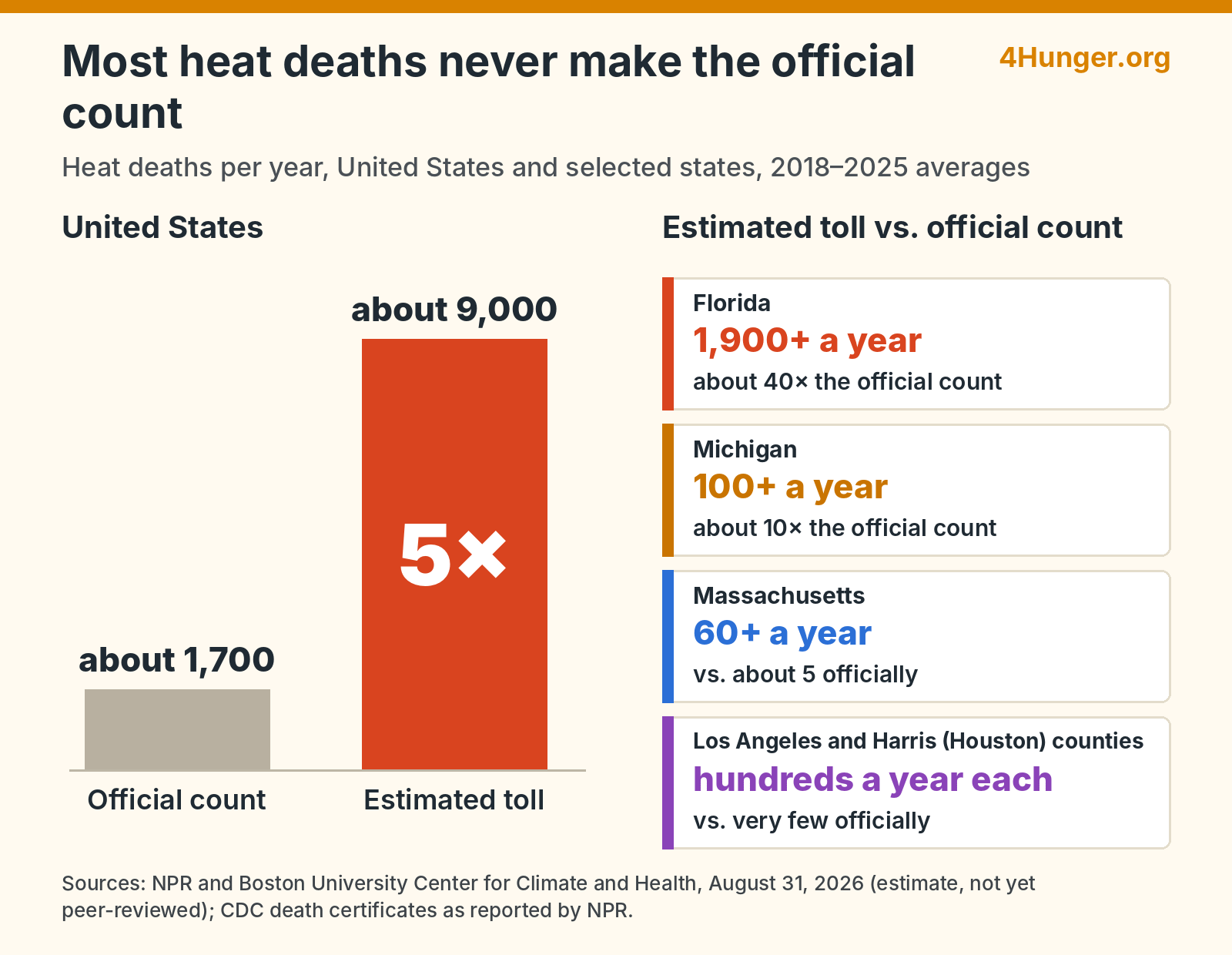
Most heat deaths never make the official count.
How many died? The official count, based on death certificates, was 2,391 in 2024, up from 1,069 in 1999.¹⁵,¹⁶ But on August 31, 2026, NPR and Boston University’s Center for Climate and Health estimated, from a two-year investigation of deaths in 530 counties, that heat contributes to about 9,000 American deaths a year, roughly five times the official average of about 1,700.¹⁷ That estimate is not yet peer-reviewed, but a Yale study also found more than 4,000 heat deaths a year from 2010 to 2020.¹⁸ A study of 43 countries attributed 37 percent of warm-season heat deaths from 1991 to 2018 to human-caused warming,¹⁹ and this year’s Fourth of July humid heat was about 1.5°C hotter than it would have been without climate change.²⁰
The official count misses most of these deaths because heat rarely kills alone. It pushes a weak heart into failure or overwhelms damaged kidneys, and the death certificate says “heart attack.” NPR and Boston University estimate that Florida loses more than 1,900 people a year to heat, about 40 times its official count.¹⁷ In Maricopa County, Arizona, which investigates heat deaths carefully, nearly half of last year’s 430 heat victims were homeless, and most of those who died indoors had an air conditioner that was broken or switched off.²¹
Heat kills unequally. Older adults make up the largest share of the official count.¹⁵ A Harvard study of 73.7 million Medicare beneficiaries found that heat waves killed nearly three times as many Black older adults as white older adults.²² Crop workers have long died of heat at about 20 times the rate of other workers,²³ and on September 8, 2026, a 24-year-old farmworker died of heat exposure harvesting sweet potatoes in Mississippi.²⁴ Yet no federal rule requires employers to protect workers from heat; one that OSHA proposed in August 2024 is still not final.⁷² Heat also threatens pregnancies: the odds of preterm birth rise about 5 percent for every 1°C increase in temperature.²⁵
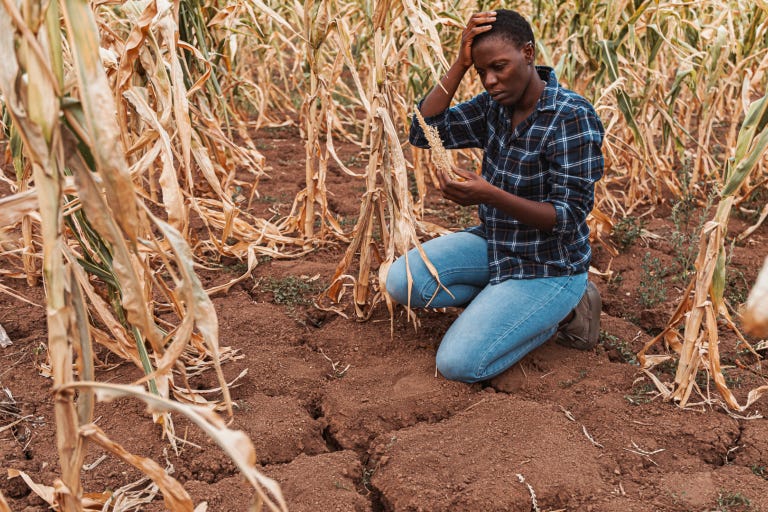
Crop workers have long died of heat at about 20 times the rate of other workers. Photo Credit: Food and Agriculture Organization of the United Nations (FAO) and the World Meteorological Organization (WMO)
Heat and drought also feed wildfires, whose smoke travels hundreds of miles. A 2025 study in Nature projects that under high warming, wildfire smoke could cause about 71,400 excess U.S. deaths a year by 2050, a 73 percent increase over the 2011–2020 average.²⁶ Another study attributes about 15,000 U.S. deaths from wildfire smoke between 2006 and 2020 to climate change.²⁷
Warmth also carries infection. In 2024, the world recorded more than 14.2 million dengue cases and more than 10,000 deaths, the highest ever. In Puerto Rico, children under 15 accounted for more than a quarter of dengue cases in the first half of 2025, and nearly half of all patients were hospitalized.²⁸ The Lancet Countdown estimates that climate conditions for dengue transmission by the Asian tiger mosquito have become 48.5 percent more favorable since the 1950s.¹² The mosquito is now established in 16 European countries. These mosquitos also caused a European record of 27 locally acquired chikungunya outbreaks.²⁹ Chikungunya is another mosquito-borne viral disease that causes sudden fever and often severe, debilitating joint pain.
Malaria cases rose to 282 million in 2024, with 610,000 deaths, three-quarters of them in African children under five.³⁰ In Ethiopia and Kenya, warming is pushing malaria into highlands where it was once rare. A Nature study this summer by Colin Carlson and colleagues found that since 1900, climate change has added on average only about one case per 1,000 children across sub-Saharan Africa, small next to the gains from bed nets and medicines, but more than eight per 1,000 in the Ethiopian highlands. By the end of the century, the Rift Valley and coastal southern Africa could see about 20 percent more childhood malaria.
Extreme weather is where malaria turns deadly. After Pakistan’s 2022 floods, malaria cases rose more than eightfold, to 4.3 million the following year. A second 2026 Nature study, by Symons and colleagues, estimates that if malaria control stays where it is today, climate change could add about 123 million cases and 532,000 deaths between 2024 and 2050, 93 percent of those deaths from floods, droughts and other extremes that knock out clinics and supply chains. Still, as Hannah Ritchie of Our World in Data concludes, “the size of the difference we can make through effective interventions and investments is far bigger.”³¹
Cholera, which thrives when drought fouls water supplies and floods spread sewage, sickened more than 614,000 people and killed nearly 7,600 in 33 countries last year, including more than 1,800 in Sudan.³²
At home, the warming water off the Gulf and Atlantic coasts is pushing Vibrio, a flesh-eating bacterium that kills about one in five people it infects, northward by about 30 miles a year.³³ Worldwide, the length of coastline warm enough for Vibrio reached a record 91,195 kilometers in 2024.¹²
California set a record for valley fever, a fungal lung infection that spreads after wet winters and dry, windy summers, with about 12,500 cases in 2024.³⁴ By October 6, 2026, the Centers for Disease Control and Prevention (CDC) had recorded 1,172 West Nile virus cases in 44 states this year.³⁵ And the heavy rains of the 1992–93 El Niño helped mice multiply before the 1993 Four Corners outbreak of hantavirus, a deadly lung disease spread by rodents.³⁶
Floods are the other half of the story. Sudden swings between very dry and very wet weather, “hydroclimate whiplash,” have become 31 to 66 percent more common worldwide since the mid-20th century. Parched ground can make the flood that follows worse. After flash floods killed 135 people in Texas on July 4, 2025, 116 of them in Kerr County, a researcher told CBS News Texas: “If it’s dry, like concrete, you cannot have water infiltrate.”³⁶
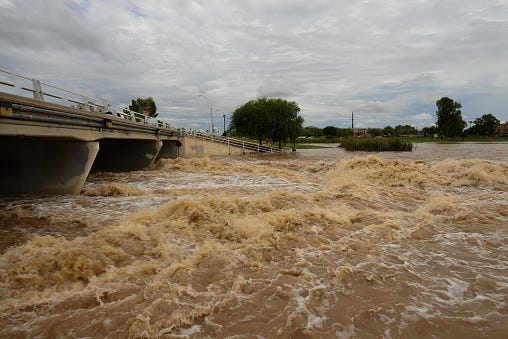
Flash floods killed 135 people in Texas on July 4, 2025, 116 of them in Kerr County. Photo credit Getty Images, David Robinson.
Floodwaters carry disease, and the harm outlasts the water. After about 12 inches of rain fell on Bangkok in late September 2026, the city declared a flood disaster, and on September 28, 2026, Thailand’s Department of Disease Control warned of leptospirosis, a bacterial infection spread through water contaminated by rodent urine.³⁶
When floods knock out power, more than 3 million Medicare beneficiaries who rely on electricity-dependent medical equipment at home are at risk. About 29 percent of flood survivors develop post-traumatic stress disorder, and CDC warns that homes that stay wet for more than 24 to 48 hours should be assumed to have mold.³⁶
Disease and hunger feed each other. Nearly half of all deaths among children under five are linked to undernutrition, and a severely wasted child is up to 11 times more likely than a healthy child to die of common illnesses such as diarrhea and malaria.³⁷ The United Nations Children’s Fund (UNICEF) says more than 347 million children in nearly 100 countries will be exposed to unusually wet or dry conditions from this El Niño between October and December.³⁸
Animals: Herds, Flocks and Fisheries Under Attack
For hundreds of millions of families, livestock are their savings accounts, the milk for the children and the insurance against a failed harvest. When animals sicken, families go hungry. The Food and Agriculture Organization of the United Nations (FAO) warns that a warming world will spread vector-borne animal diseases, including Rift Valley fever, bluetongue and West Nile, “to high elevations and higher latitudes.”³⁹ The IPCC projects that under very high emissions, livestock in the tropics will face 72 to 136 more days a year of dangerous heat and humidity, cutting meat and milk production.⁴⁰ A 2026 systematic review in The Lancet Planetary Health found that 73 percent of 33 long-term studies linked climate to greater animal disease risk.⁴¹
Rift Valley fever is the clearest El Niño disease. After the 1997–98 El Niño brought rains 60 to 100 times the seasonal average to Kenya and Somalia, an estimated 89,000 people may have been infected, and herders reported losing about 70 percent of their sheep and goats.⁴² This year, the Intergovernmental Authority on Development’s livestock center and FAO warned that El Niño rains could raise the risk of Rift Valley fever in eight East African countries, peaking from October to December.⁴³ Kenya has launched a $16 million livestock plan to pre-position vaccines and veterinary drugs.⁴ We need to do the same in the other seven countries and act before the disease outbreak occurs.
Screwworm is moving north. The parasite, whose larvae eat living flesh, spread from Panama through Central America into Mexico, where it was found less than 70 miles from the U.S. border in September 2025.⁴⁴ The United States closed its southern border to Mexican cattle, which normally supply more than 60 percent of U.S. cattle imports. Despite this dramatic action, in June the first U.S. animal case since eradication which was claimed in 1961, was confirmed. Cases have since been reported in Texas and New Mexico.² USDA broke ground in April on a $750 million sterile-fly plant in Texas to counter this threat, but it is not expected to operate until late 2027.⁴⁵ Fewer freezing days due to climate change may help the fly survive farther north.⁴⁶
Bird flu has infected more than 1,000 U.S. dairy herds in 19 states since March 2024,⁴⁷ and more than 175 million commercial poultry have been lost since 2022.⁴⁸ Scientists project that climate change may shift where and when migrating birds carry the virus.⁴⁹
Bluetongue, a midge-borne virus that can kill sheep, has now forced restrictions across all of England, Wales and Scotland, with more than 3,300 cases this season.⁵⁰ A Pirbright Institute scientist explained why: “midges are active earlier and continue their activity until later in the year due to climate change.”⁵¹
Heat and drought kill animals directly. At least 2,000 cattle died in a Kansas heat wave in June 2022.⁵² The last El Niño killed cattle by both drought and flood: with 2.3 million cattle at risk, at least 44,766 died in Zimbabwe’s drought in the 2024–25 season, and 17,257 cattle died in floods in Brazil’s Rio Grande do Sul in May 2024 that El Niño made about twice as likely. No one has counted the worldwide toll.⁵³ In Sertoni camp in North Darfur, displaced families told Radio Dabanga in September that scarce rain was killing their livestock and their crops at the same time.⁵⁴
Fish are not spared. Peru, which supplies about a fifth of the world’s fishmeal, opened its first anchovy season this year with the lowest quota in a decade and closed it early because warm El Niño water filled the catch with juvenile fish. The second season is likely to be canceled, putting up to 78,000 jobs at risk.³
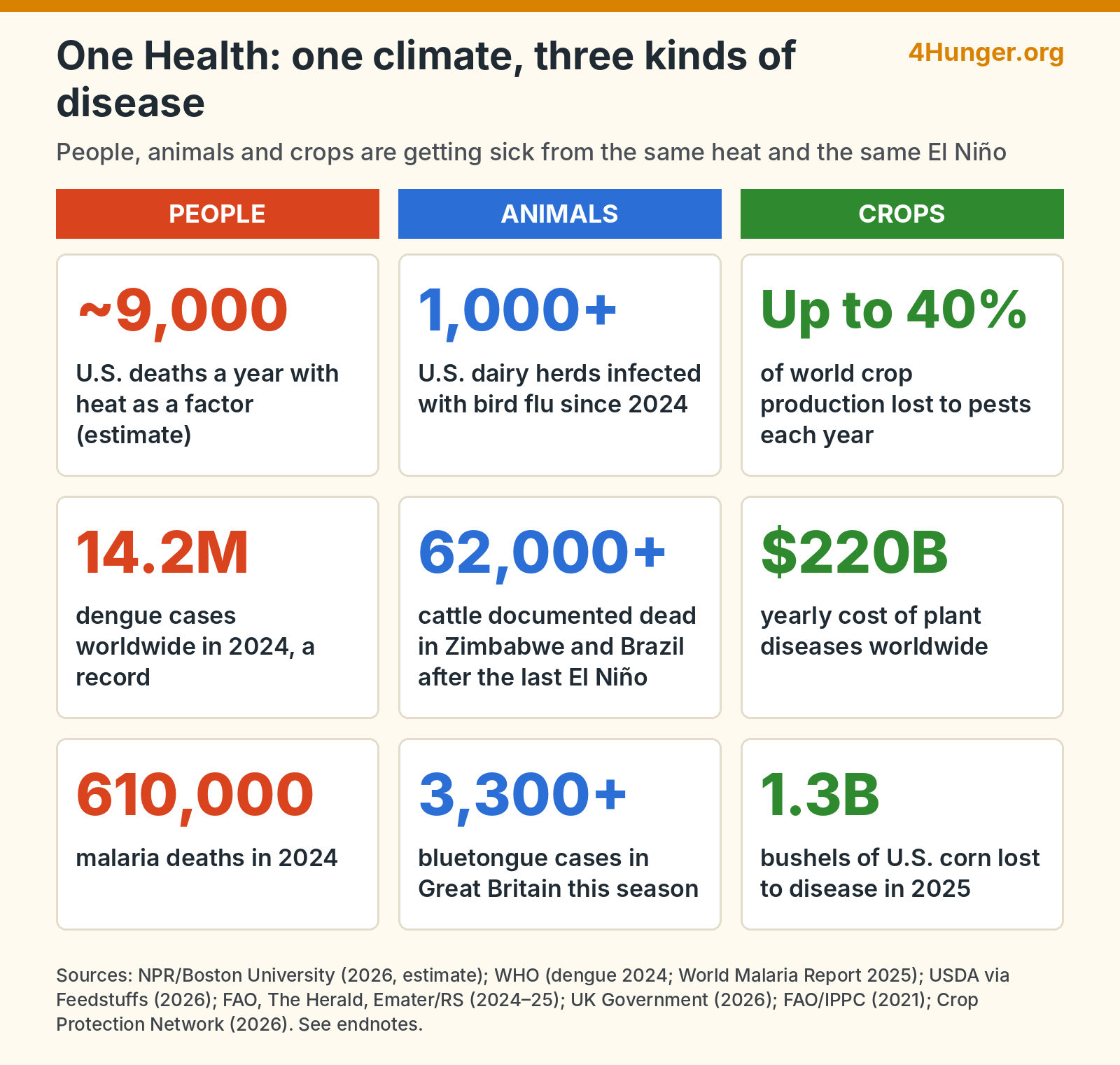
One weather system, three kinds of disease.
Crops: The Pests That Ride the Heat
FAO estimates that up to 40 percent of the world’s crop production is lost to pests each year, and plant diseases alone cost the global economy more than $220 billion a year.⁵⁵ A 2021 scientific review for the International Plant Protection Convention concluded that “due to the impact of climate change, plant pests that ravage economically important crops will continue to spread.”⁵⁶ Warmth speeds up insects’ metabolism and reproduction, and a 2018 study in Science projected that global losses of wheat, rice and maize to insect pests will increase 10 to 25 percent for every degree Celsius of warming.⁵⁷
Fall armyworm, first detected in Africa in 2016, was established in 44 African countries within two years and is causing major crop loss.⁵⁸ FAO is currently tracking a serious desert locust outbreak in Morocco, Algeria and Mauritania and says a strong El Niño is shaping its outlook.⁵⁹ Kenyan experts are warning farmers to watch for locusts, armyworms and fungal diseases during the El Niño rains.⁶⁰ A cassava virus once confined to East Africa could spread across a third of the continent as warmer, wetter weather lets its whitefly carrier move into the highlands.⁶¹
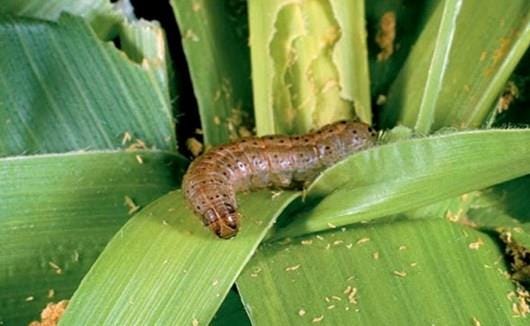
Fall army worm outbreak, a blow to prospects of recovery for southern Africa. Photo credit: Food and Agricultural Organization (FAO).
American farms are not immune. Diseases cost U.S. corn growers about 1.3 billion bushels in 2025, 7 percent of the crop.⁶² Warmer nights can make rice more vulnerable to bacterial panicle blight.⁶³ In September 2026, the Government Accountability Office (GAO) reported that invasive diseases and pests have cost U.S. agriculture and forestry at least $550 billion since 1960, that climate change is expected to expand the range of these invasive species, and that USDA has no nationwide assessment or strategy for climate-driven disease and pest risks. GAO recommended both; USDA has not yet acted.⁶⁴
Some crop diseases poison the food that survives droughts and floods of El Niño. Aflatoxin, a cancer-causing toxin made by molds, flourishes in maize and groundnuts stressed by drought and stored in damp conditions. In 2004, aflatoxin-contaminated maize killed 125 people in eastern Kenya.⁶⁵ A 13-year Kenyan study links past surges in contamination to El Niño weather,⁶⁶ and in September 2026, Kenyan experts warned that harvesting in the rain and storing grain wet both of which are expected due to the El Niño will raise the risk again this season.⁶⁷
The Vicious Circle
Here One Health becomes a hunger story. A failed crop or a dead herd means less food and less income. Hungry children are far more likely to die of malaria, cholera and diarrhea. Sick farmers and herders cannot work their fields or move their animals to water. A family that sells its last goats to pay for medicine has nothing left when the next drought comes. Each disease makes the others deadlier.
The warning systems that could break the circle of disease are being dismantled due to cuts in aid.
Cutting the Lifelines
Global health. About 80 percent of the global health awards with malaria activities from the U.S. Agency for International Development (USAID) were terminated last year, although an internal USAID memo estimated that permanently ending the President’s Malaria Initiative could cause 71,000 to 166,000 additional deaths a year.⁶⁸ The United States withdrew from WHO in January 2026, and as a result, WHO had to cut its base budget for 2026–27 by 22 percent.⁶⁹ In June 2025, the administration announced it would stop funding Gavi, the global vaccine alliance. A 2025 study in The Lancet projected that defunding USAID could cause more than 14 million additional deaths by 2030, over 4.5 million of the deaths will be children under five. Other wealthy donors in the EU and Japan are cutting too, and total aid from major donors fell 23 percent in 2025, the largest drop on record. If these cuts continue and deepen, 22.6 million more people could die by 2030, including 5.4 million young children.⁷⁰ The year 2030 is barely three years away.
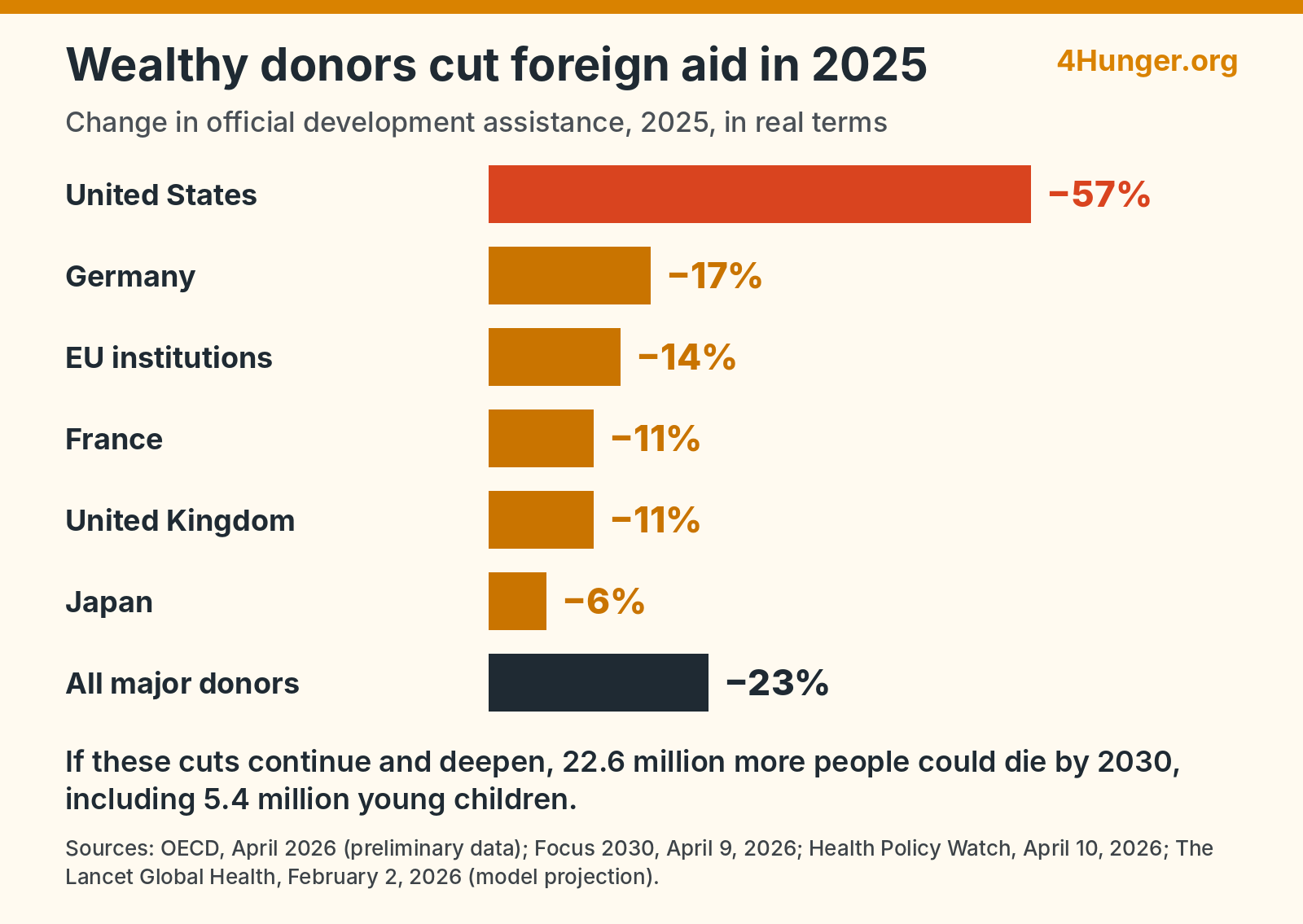
Wealthy donors cut foreign aid sharply in 2025, led by the United States.
Animal and plant health at home. In fiscal year 2025, USDA’s Animal and Plant Health Inspection Service (APHIS), the agency fighting screwworm and bird flu, lost 2,017 employees, more than a fifth of its workforce; its Agricultural Research Service (ARS) lost 1,932, and the Center for Disease Control (CDC) lost 2,499 employees.⁷¹
In February 2025, in the middle of the bird flu outbreak, USDA fired staff working on it, then moved to rescind the notices. USDA is also closing its largest research center, in Beltsville, Maryland, which studies crop disease, livestock pests and foodborne pathogens. On July 1, 2025, FoodNet, the CDC system that tracks foodborne infections, cut the pathogens states must report from eight to two, dropping Listeria, a genus of bacteria transmitted through contaminated food, responsible for the potentially life-threatening infections, and the warming-driven Vibrio, discussed above.⁷¹
Heat. OSHA proposed the first federal heat safety rule in August 2024. It would require employers to provide water, rest breaks and shade, train workers and plan for heat emergencies. Public hearings ended in July 2025, and OSHA now plans to release a revised proposal only by December 2026 with a final rule expected in October 2027. Workers face at least one more summer without federal heat protection.⁷²
The federal entire staff of the Low Income Home Energy Assistance Program (LIHEAP), which helps families pay cooling bills, was fired in April 2025, and the White House has asked Congress to eliminate the program for the second year running.⁷³
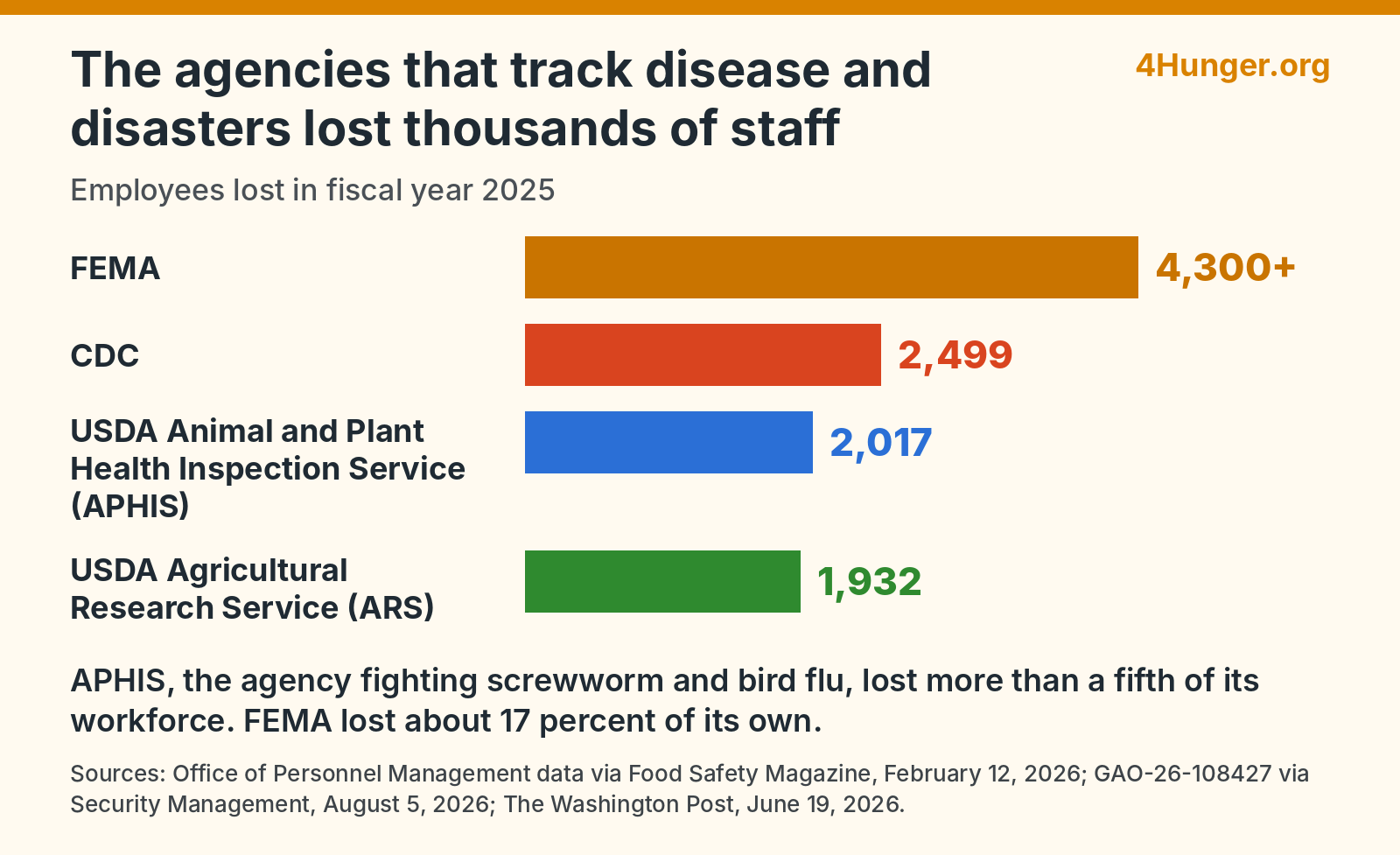
The U.S. agencies that track disease, pests and disasters lost thousands of staff in 2025.
Disasters. The National Oceanic and Atmospheric Administration (NOAA) stopped updating its database of billion-dollar weather and climate disasters in May 2025. Adam Smith, who ran this program for 15 years, rebuilt it at the nonprofit Climate Central, which counted 23 such disasters in 2025, the third-highest number since 1980, and 12 more in the first half of 2026. Not counting them, does not make them go away.
In April 2025, the Federal Emergency Management Agency (FEMA) moved to end its Building Resilient Infrastructure and Communities program, which pays to protect communities before disasters strike. A federal court ruled that ending the program was unlawful in December 2025. Nothing has been done to restore it. FEMA lost more than 4,300 employees, about 17 percent of its workforce, in fiscal year 2025. Three months after the July 2025 floods, more than half of Kerr County’s 3,228 household applications for federal aid had not been reviewed. Kerr County flooded again this July, and as of late September, federal aid for households was still pending.⁷³
What Works: Act Before the Outbreak
Disease, like hunger, is predictable, and acting early works.
FAO and the World Food Programme (WFP) say every dollar invested in early action before El Niño can save up to $7 in avoided losses and response costs.⁷⁴ When FAO helped Kenyan herders with feed, water, dewormers and vaccines before the 2016–17 drought, each dollar returned about $3.40 in benefits; in Ethiopia, the return was 6.9 to one.⁷⁵ In the Democratic Republic of Congo, $750,000 in UN anticipatory funding for cholera reached more than 450,000 people in 2023.⁷⁶ And global production of oral cholera vaccine has doubled since 2022, so preventive campaigns resumed this year, the first since 2022.⁷⁷
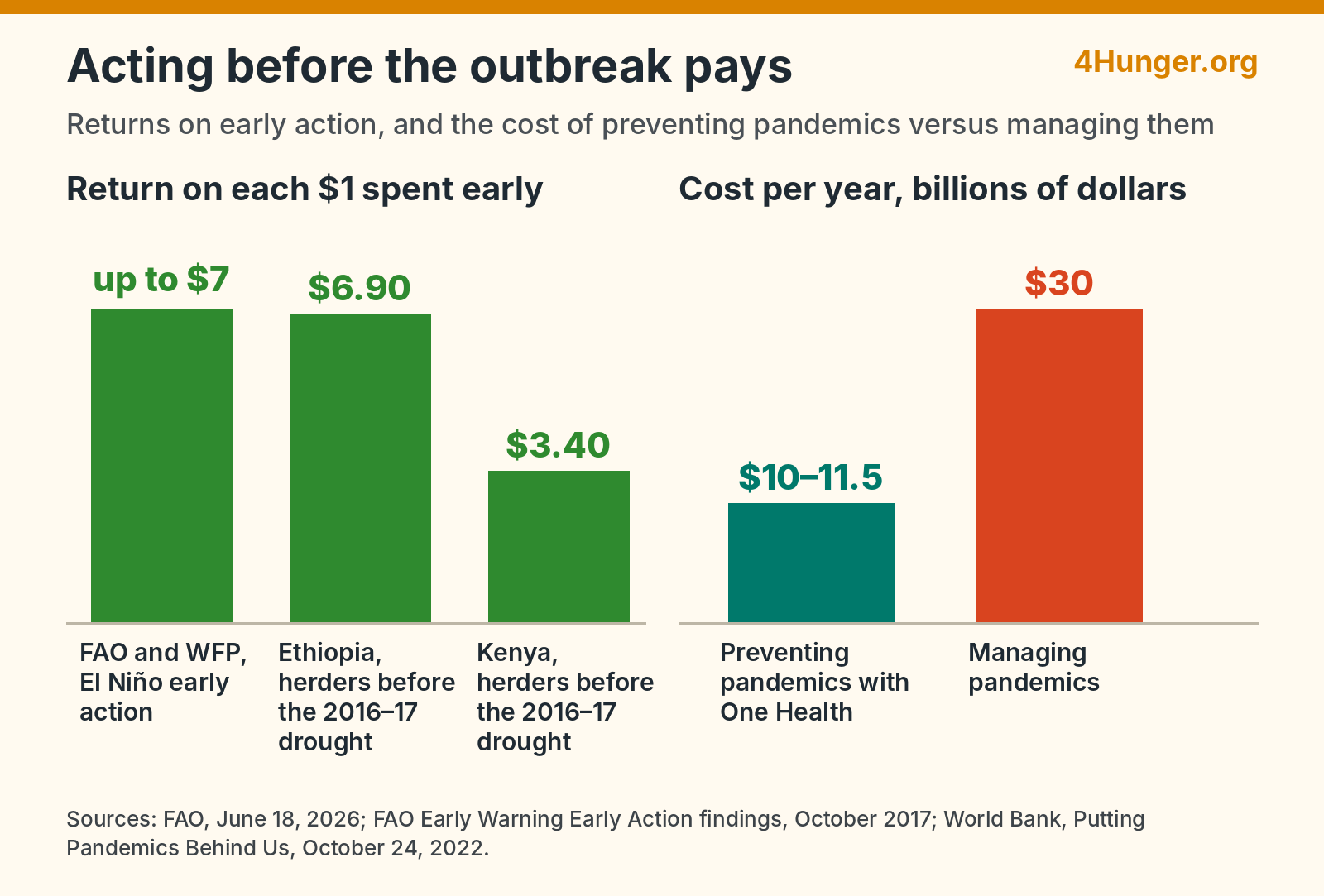
Acting early costs far less than responding after an outbreak.
WHO’s own El Niño guidance lists the proactive steps to be taken: vaccinate livestock against Rift Valley fever before the rains, keep bed-net coverage high and pre-position malaria medicines.⁶ None of this requires new science, only money, people and the will to act before outbreaks happen, not after. There is no sign of this happening before this super El Niño.
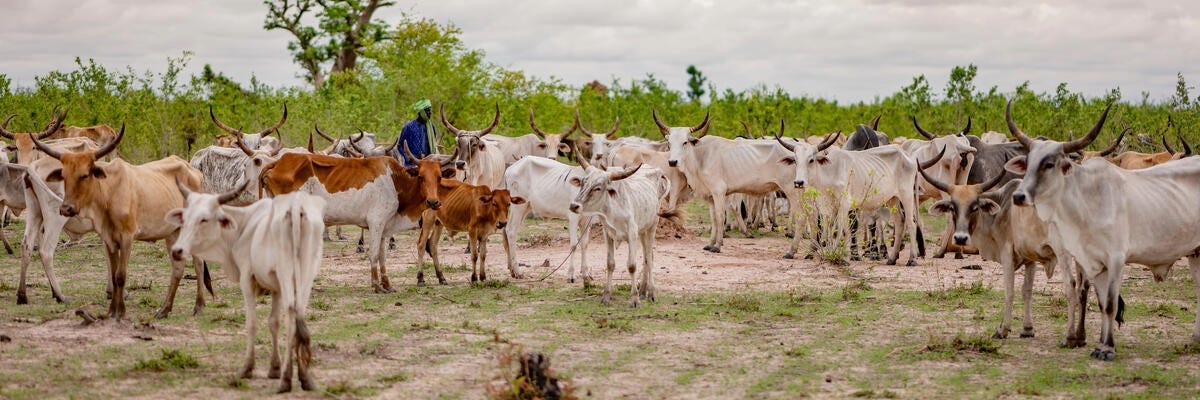
Rift Valley fever (RVF) is an acute, mosquito-borne viral disease that primarily affects domestic ruminants, especially sheep, goats, cattle, buffaloes and camels, and can also infect humans. Photo Credit: FAO
What Leaders Must Do Now
1. Fund early action for health. Close the gap in the FAO-WFP El Niño appeal, including its livestock protection, and fund cholera and malaria preparedness in the countries El Niño will hit hardest.
2. Restore global disease defenses. Congress should protect the President’s Malaria Initiative and the funds it has appropriated, and order that the United States rejoin the fight against preventable disease through WHO and Gavi.
3. Rebuild One Health surveillance at home. Restore the scientists and inspectors at APHIS, ARS and CDC who track screwworm, bird flu, dengue and crop disease, require the CDC to estimate heat deaths honestly, not just count death certificates, and have USDA carry out the nationwide climate risk assessment and strategy for crop and livestock diseases that GAO recommended.
4. Protect people from heat. Finish the OSHA heat rule, fully fund LIHEAP for cooling as well as heating, and ban utility shutoffs during heat emergencies.
5. Renew the global One Health plan. The UN’s One Health Joint Plan of Action, agreed by FAO, the United Nations Environment Programme, WHO and the World Organisation for Animal Health, runs through 2026.⁷⁸ It should be renewed and funded. The World Bank estimates that a One Health approach to preventing pandemics would cost about $10 billion to $11.5 billion a year, roughly a third of the $30 billion a year that managing pandemics costs.⁷⁹
What You Can Do
Call your members of Congress. Dial the Capitol switchboard at (202) 224-3121 and ask for your representative, then your two senators. Ask them to protect funding for malaria and vaccines, restore USDA and CDC disease surveillance, and fund LIHEAP to keep people cool during heatwaves.
Protect yourself and your neighbors. Check on older neighbors during heat waves, use insect repellent where dengue or West Nile is circulating, stay out of floodwaters, and keep your pets and livestock vaccinated.
Share this. One Health sounds abstract until a woman in Tampa, a calf in Texas and a herder in Kenya are in the same story. Share it on Facebook, X, LinkedIn, Bluesky or send it by email.
Subscribe to 4Hunger.org to stay informed.
Heat, mosquitoes, midges, molds and parasites do not respect the lines we draw between human medicine, veterinary medicine and agriculture. El Niño will test all three at once. We know where El Niño is likely to bring droughts and floods, and we know what to do. The only question is whether governments will act before the outbreaks or count the dead afterward. It is looking like we better start investing in body bags as time is running out for proactive actions.
Endnotes
1. WGCU, “Dengue fever cases on the rise in Florida,” October 9, 2026 (296 locally acquired cases through October 3); Associated Press, via Bay News 9, September 18, 2026 (first death; previous high of nearly 200 cases in 2023); WUSF, “Hillsborough, Pasco and Pinellas counties declare states of emergency to battle dengue fever,” September 24, 2026 (80-year-old woman bitten near her South Tampa home).
2. National Pork Board Swine Health Information Center, “USDA confirms New World screwworm detections in Texas and New Mexico in June 2026,” citing USDA APHIS (first case confirmed June 3, 2026, Zavala County, Texas); Congressional Research Service, Insight IN12558, June 2, 2025 (Mexico supplies more than 60 percent of U.S. cattle imports); USDA APHIS, New World screwworm current status.
3. SeafoodSource, June 12, 2026, and October 8, 2026 (first 2026 season quota of 1.9 million metric tons, lowest in a decade; second season likely cancelled; up to 78,000 jobs at risk; Peru supplies about 20 percent of the world’s fishmeal).
4. Citizen Digital, “Govt rolls out Ksh2.1b livestock plan ahead of El Niño rains,” September 10, 2026 (KSh 1.5 billion to pre-position vaccines and veterinary drugs, including against Rift Valley fever, in 24 counties).
5. Jones KE, et al., “Global trends in emerging infectious diseases,” Nature, 2008 (60.3 percent of 335 emerging disease events, 1940–2004, were zoonotic); Taylor LH, Latham SM, Woolhouse MEJ, Philosophical Transactions of the Royal Society B, 2001 (75 percent of emerging human pathogens are zoonotic).
6. World Health Organization, Global Public Health Situation Analysis: El Niño 2026.
7. World Meteorological Organization, “El Niño/La Niña phenomena”; WMO, “El Niño set to become very strong, raising risks of extreme weather into 2027,” September 3, 2026. WMO, “WMO: Prepare for El Niño,” June 2, 2026. IPCC, Climate Change 2021: The Physical Science Basis, Working Group I, Chapter 4, Executive Summary. Cai W, et al., “Increasing frequency of extreme El Niño events due to greenhouse warming,” Nature Climate Change 4, 111–116, January 19, 2014. Coquereau A, Sévellec F, Huck T, Fedorov AV, “Increase in ENSO Frequency and Intensity Under 20th and 21st Century Warming: Insights From CMIP6 Large Ensembles,” Geophysical Research Letters 52(22), e2025GL116541, November 2025. Environment and Climate Change Canada, Canada’s Changing Climate Report 2026, Chapter 4, “Large-scale atmosphere-ocean processes affecting climate,” September 3, 2026 (Key Message 4.11: ENSO-related year-to-year fluctuations larger since 1950 than in the previous century, medium confidence; “low confidence that this change is due to human-caused climate change”). Adibi P, et al., “Intensity-dependent changes in ENSO frequency and lifecycle characteristics under future climate change,” Climate Dynamics 64, 341, published online July 24, 2026 (13-model ensemble; no robust change in total ENSO event frequency; very strong El Niño events rise from 3.8 to 8.0 per period under SSP5-8.5). NOAA Climate Prediction Center, ENSO Diagnostic Discussion, October 8, 2026 (83 percent chance the current event exceeds the strength of all El Niño events since 1950). World Meteorological Organization, “WMO confirms 2025 was one of warmest years on record,” January 14, 2026 (2015–2025 are the 11 warmest years in all eight datasets; 2025 began and ended under La Niña). Carbon Brief, “State of the climate: Strong El Niño puts 2026 on track for second-warmest year,” April 21, 2026 (1998, 2016 and 2024 were record-setting years following strong El Niño peaks).
8. Ben Noll, The Washington Post, August 13, 2026, reporting Zeke Hausfather’s analysis.
9. Climate Impact Lab (Michael Greenstone, Tamma Carleton, Genevieve Maricle and Emily Grover-Kopec), “451,000 at Risk: Where Action Can Save Lives During the Super El Niño,” September 2026 (deaths compared with a 1996–2025 baseline; methods forthcoming in a peer-reviewed journal).
10. IPCC, Climate Change 2022: Impacts, Adaptation and Vulnerability, Summary for Policymakers, paragraph B.1.4.
11. Mora C, et al., “Over half of known human pathogenic diseases can be aggravated by climate change,” Nature Climate Change 12, 869–875, August 8, 2022.
12. Romanello M, et al., “The 2025 report of the Lancet Countdown on health and climate change,” The Lancet, October 29, 2025.
13. NOAA National Centers for Environmental Information, National Climate Report, August 2026, released September 9, 2026.
14. CDC, Morbidity and Mortality Weekly Report, September 17, 2026.
15. CDC, MMWR QuickStats, “Heat-Related Deaths, 2024,” September 3, 2026: 2,391 deaths with heat listed as an underlying or contributing cause; the largest age group was 65–74.
16. Howard JT, et al., “Trends of Heat-Related Deaths in the US, 1999–2023,” JAMA, 2024;332(14):1203–1204.
17. Alejandra Borunda, “NPR spent 2 years tracking deaths from heat. We found a staggering hidden toll,” NPR, August 31, 2026, with Boston University’s Center for Climate and Health (analysis forthcoming in a scientific journal).
18. Chu L, Dubrow R, Chen K, JAMA Network Open, November 7, 2025.
19. Vicedo-Cabrera AM, et al., “The burden of heat-related mortality attributable to recent human-induced climate change,” Nature Climate Change 11, 492–500, May 31, 2021 (732 locations in 43 countries).
20. World Weather Attribution, “Fossil fuels are heating America’s 250th birthday,” July 3, 2026 (rapid analysis of June 30 to July 4 humid heat; not peer-reviewed).
21. Maricopa County Department of Public Health, 2025 Heat-Related Deaths Report, April 2026 (430 deaths; 49 percent among people experiencing homelessness; air conditioning present in 94 percent of indoor deaths and not functioning in 72 percent of those).
22. Healy JP, Schwartz J, et al., The Lancet Planetary Health, 2026; Harvard T.H. Chan School of Public Health, March 16, 2026 (16.50 versus 5.85 excess deaths per 10,000 per heat wave among Black and white Medicare beneficiaries).
23. CDC, MMWR, “Heat-Related Deaths Among Crop Workers — United States, 1992–2006,” June 20, 2008.
24. Mississippi Today, “Farm worker, 24, dies of heat exposure in north Mississippi,” October 1, 2026.
25. Chersich MF, et al., “Associations between high temperatures in pregnancy and risk of preterm birth, low birth weight, and stillbirths: systematic review and meta-analysis,” BMJ 2020;371:m3811.
26. Qiu M, et al., Nature, published online September 18, 2025 (71,420 annual excess deaths by 2050 under SSP3-7.0; 95 percent confidence interval 34,930–98,430).
27. Communications Earth & Environment, 2025, as reported by the Associated Press, May 7, 2025.
28. World Health Organization, Weekly Epidemiological Record, vol. 101, no. 29, 2026. Puerto Rico Department of Health, Weekly Arboviral Disease Surveillance Report, epidemiological week 29, 2025, Table 4 (cases by age group, January 1 to July 22, 2025: under 1 year, 12; ages 1–4, 50; ages 5–9, 150; ages 10–14, 368; 2,154 total cases; 1,038 hospitalizations).
29. European Centre for Disease Prevention and Control, July 1, 2025, and August 20, 2026 (Aedes albopictus established in 16 countries); ECDC, World Mosquito Day 2025, August 20, 2025 (27 chikungunya outbreaks, a record).
30. World Health Organization, World Malaria Report 2025, December 4, 2025.
31. Carbon Brief, “Malaria resurgence feared in Ethiopia amid El Niño and climate change,” 2023; Kenya Ministry of Health, KEMRI, Kenya Meteorological Department and AMPATH, webinar on preventing malaria epidemics associated with El Niño, 2026. Carlson CJ, et al., “The past and future impact of climate change on childhood malaria in Africa,” Nature, 2026, doi:10.1038/s41586-026-10840-w, as reported by Carbon Brief, July 29, 2026. Symons TL, et al., Nature, 2026, and WHO, World Malaria Report 2024 (Pakistan), both as summarized in Hannah Ritchie, “What impact will climate change have on malaria?” Our World in Data, October 5, 2026.
32. World Health Organization, Multi-country outbreak of cholera, External Situation Report no. 33, January 27, 2026 (614,828 cases and 7,598 deaths in 33 countries in 2025; Sudan 72,716 cases and 1,830 deaths).
33. CDC Health Alert Network, HAN 00497, September 1, 2023 (about 1 in 5 Vibrio vulnificus patients die; the northern range of cases has moved about 48 km a year).
34. KQED, “California valley fever cases on track for record high,” August 15, 2025.
35. CDC West Nile virus current-year data, as reported October 13, 2026 (provisional).
36. Engelthaler DM, et al., “Climatic and environmental patterns associated with hantavirus pulmonary syndrome, Four Corners region, United States,” Emerging Infectious Diseases 5(1):87–94, 1999. Hydroclimate whiplash: Swain DL, et al., “Hydroclimate volatility on a warming Earth,” Nature Reviews Earth & Environment 6:35–50, published online January 9, 2025; Desert Research Institute news release, January 2025 (three-month whiplash up 31–66 percent since the mid-20th century; could more than double at 3°C). Texas floods: Office of the Governor of Texas, July 17, 2025 (135 deaths statewide, 116 in Kerr County); CBS News Texas, July 7, 2025 (Feifei Pan). Bangkok: Associated Press, via CP24, September 26, 2026; Khaleej Times, September 27, 2026; Al Jazeera, September 27, 2026; AFP, via Oman Observer, September 29, 2026; The Thaiger, September 28, 2026 (Department of Disease Control leptospirosis warning). Flood aftermath: U.S. Department of Health and Human Services, HHS emPOWER Program (over 3 million Medicare beneficiaries rely on electricity-dependent medical equipment); Golitaleb M, et al., Frontiers in Psychiatry, June 23, 2022 (meta-analysis of 23 studies; pooled post-flood PTSD prevalence 29.48 percent); CDC, clinical guidance on asthma and mold after disasters, reviewed August 28, 2026.
37. World Health Organization, Malnutrition fact sheet, March 1, 2024; UNICEF, Child Alert: Severe Wasting, May 2022.
38. UNICEF, “Fast facts: Over 347 million children in nearly 100 countries will be exposed to one of the strongest El Niño events,” October 6, 2026 (UNICEF notes these are exposure figures, not estimates of impact).
39. FAO, “Livestock Diversity and Climate Change.”
40. IPCC, Climate Change 2022: Impacts, Adaptation and Vulnerability, Chapter 5, Executive Summary (very high emissions scenario, SSP5-8.5; medium confidence). Wageningen University & Research, “Five questions about heat and its impact on livestock,” July 14, 2022 (pigs and chickens are unable to sweat; cows can sweat but breathe faster first; heat-stressed animals eat and move less); Felix Uchenna Samuel, “Heat Stress Relief in Sheep and Goats,” Alabama Cooperative Extension System, August 7, 2026 (sheep and goats have few functional sweat glands; panting is their primary cooling mechanism).
41. Lavarello-Schettini A, et al., “Climate change and animal infectious diseases: a systematic review of emerging evidence,” The Lancet Planetary Health 2026;10(8):101524.
42. CDC, MMWR, “Rift Valley Fever — East Africa, 1997–1998,” 1998.
43. Dawan Africa, “El Niño raises fresh Rift Valley fever threat across East Africa,” August 10, 2026, reporting an IGAD Centre for Pastoral Areas and Livestock Development and FAO advisory.
44. The Cattle Site, “Screwworm case confirmed near US-Mexico border,” September 2025 (Sabinas Hidalgo, Nuevo León).
45. High Plains Journal, “Officials break ground on new Texas sterile fly production facility,” April 18, 2026; USDA APHIS, sterile fly production and dispersal.
46. Environmental Health News / Grist, “USDA cuts climate links as deadly livestock parasite spreads north,” May 29, 2025.
47. Feedstuffs, “HPAI confirmed in 2 Washington dairy herds,” October 9, 2026, citing USDA (19 states); The Cattle Site, August 28, 2026.
48. Center for Poultry Industry Forum, “U.S. poultry losses to avian flu since 2022 tops 175 million birds,” citing WATT and USDA data.
49. Tian H, et al., “Climate change suggests a shift of H5N1 risk in migratory birds,” Ecological Modelling, 2015.
50. UK Government, “Bluetongue: latest situation,” updated October 12, 2026 (3,338 cases in the 2026–27 season).
51. World Organisation for Animal Health, “Bluetongue in Europe: how climate change is shifting disease patterns,” November 5, 2024, quoting Dr. Christopher Sanders of the Pirbright Institute.
52. Associated Press, via PBS NewsHour, June 17, 2022.
53. FAO, “Zimbabwe’s Agriculture Minister and FAO call for urgent release of any emergency funds to save livestock from starvation death,” September 13, 2024 (over 2.3 million cattle at risk); The Herald (Zimbabwe), “Zimbabwe averts mass cattle deaths despite severe drought,” April 9, 2025 (44,766 cattle lost in the 2024–25 summer season, citing the Ministry of Lands, Agriculture, Fisheries, Water and Rural Development); Emater/RS-Ascar, Impactos das chuvas e cheias extremas no Rio Grande do Sul, May 2024 (14,806 beef and 2,451 dairy cattle killed); npj Natural Hazards study on the role of El Niño and climate change in the 2024 Rio Grande do Sul rainfall, as summarized by Princeton’s Brazil LAB, January 13, 2026.
54. Radio Dabanga, “Scarce rainfall causes livestock deaths and crop failure in Sertoni, North Darfur” (Arabic), September 22, 2026.
55. FAO and IPPC Secretariat, news release, June 1, 2021.
56. IPPC Secretariat, Scientific review of the impact of climate change on plant pests, FAO, 2021.
57. Deutsch CA, et al., “Increase in crop losses to insect pests in a warming climate,” Science 361, 916–919, August 31, 2018.
58. International Institute of Tropical Agriculture, “Fall armyworm has reached the Indian subcontinent,” August 4, 2018.
59. FAO Locust Watch, Desert Locust situation updates, June–July 2026.
60. The Star (Kenya), “Farmers urged to step up pest surveillance during El Niño,” September 22, 2026.
61. Ecofin Agency, March 5, 2026, reporting a study in the East African Journal of Science, Technology and Innovation, January 16, 2026.
62. Crop Protection Network, Corn Disease Loss Estimates From the United States and Ontario, Canada — 2025, March 6, 2026.
63. Ghimire S, et al., “Understanding Rice Responses to the Combination of Bacterial Panicle Blight and High Night Temperatures,” Rice 19:42, May 12, 2026.
64. U.S. Government Accountability Office, Agricultural Diseases and Pests: Nationwide Assessment and Strategy Needed to Enhance the Climate Resilience of Farms and Forests, GAO-26-106756, publicly released September 10, 2026.
65. CDC, MMWR, “Outbreak of Aflatoxin Poisoning — Eastern and Central Provinces, Kenya, January–July 2004,” September 3, 2004.
66. Frontiers in Sustainable Food Systems, January 9, 2026 (13-year aflatoxin surveillance study in Kenya).
67. The Star (Kenya), “Experts sound alarm over aflatoxin risk in Kenya’s maize,” September 24, 2026.
68. KFF, “The Trump Administration’s Foreign Aid Review: Status of the President’s Malaria Initiative,” updated September 22, 2026.
69. World Health Organization, May 20, 2025 (2026–27 base budget of $4.2 billion, down from $5.3 billion); STAT, January 22, 2026 (U.S. withdrawal effective).
70. NPR, June 25, 2025. Cavalcanti D, et al., “Evaluating the impact of two decades of USAID interventions and projecting the effects of defunding on mortality up to 2030,” The Lancet, 2025 (more than 14 million additional deaths by 2030 under the defunding scenario, including more than 4.5 million children under five); ISGlobal, July 1, 2025. OECD, “International aid fell sharply in 2025,” April 2026 (preliminary data; ODA down 23.1 percent in real terms, the largest annual drop on record); Focus 2030, April 9, 2026 (real-terms changes: United States −57 percent, Germany −17 percent, France −11 percent, United Kingdom −11 percent, Japan −6 percent); Health Policy Watch, April 10, 2026 (EU institutions −13.8 percent). ISGlobal researchers (study coordinated by Davide Rasella), “The Impact of Two Decades of Humanitarian and Development Assistance and the Projected Mortality Consequences of Current Defunding to 2030,” The Lancet Global Health, February 2, 2026, and Rockefeller Foundation release, February 2, 2026 (22.6 million deaths, 5.4 million children under five, severe scenario; 9.4 million, mild scenario). These figures are total development aid, not health aid alone, and the mortality figures are model projections.
71. Food Safety Magazine, February 12, 2026, citing Office of Personnel Management data for fiscal year 2025. Isaac Arnsdorf and Lena H. Sun, The Washington Post, June 19, 2026, via The Spokesman-Review (APHIS lost nearly 2,000 employees in 2025, more than 20 percent of its workforce; many senior officials left and successors had less than a year on the job). NPR, February 19, 2025 (USDA statement: “Although several positions supporting HPAI were notified of their terminations over the weekend, we are working to swiftly rectify the situation and rescind those letters”). KCUR, September 21, 2026, and NPR, October 5, 2026 (Beltsville Agricultural Research Center closure; a judge paused the closure until October 2, with a hearing set for September 29; 2019 Kansas City relocation). Western Growers, “CDC narrows scope of FoodNet,” 2025, and HealthDay, August 29, 2025 (as of July 1, 2025, FoodNet surveillance reduced from eight pathogens to Salmonella and Shiga toxin-producing E. coli; Campylobacter, Cyclospora, Listeria, Shigella, Vibrio and Yersinia no longer required).
72. OSHA, “Heat Injury and Illness Prevention in Outdoor and Indoor Work Settings,” proposed rule, 89 Fed. Reg. 70698, August 30, 2024 (RIN 1218-AD39; Docket No. OSHA-2021-0009). OSHA, heat rulemaking page (informal public hearing June 16 to July 2, 2025; post-hearing comments closed October 30, 2025). Office of Information and Regulatory Affairs, 2026 Regulatory Plan and Unified Agenda, published July 3, 2026, as reported by J. J. Keller, July 6, 2026, and ISHN, July 15, 2026 (supplemental proposed rule by December 2026; final rule October 2027). Ogletree Deakins, April 8, 2026.
73. National Low Income Housing Coalition, April 2025; American Public Power Association, June 2026. Disasters: CNN, May 8, 2025 (NOAA retires its billion-dollar disaster database; archived, not updated beyond 2024); eNCA, “Scrapped by Trump, revived US climate-disaster database reveals record losses,” October 22, 2025 (Adam Smith, who led the database for 15 years, resigned from NOAA in May and rebuilt it at Climate Central using the same sources and methods); NBC Palm Springs, January 8, 2026 (Climate Central: 23 billion-dollar disasters in 2025, about $115 billion in damages, third-highest count since 1980); Climate Central, Climate Matters mid-year billion-dollar disasters update, July 29, 2026 (12 billion-dollar disasters January–June 2026, at least $31.9 billion in damages and 183 deaths; data through July 15, 2026); Congressional Research Service, Insight IN12609 (BRIC termination announced April 4, 2025; ruled unlawful December 11, 2025; compliance ordered March 6, 2026); The Texas Tribune, October 16, 2025 (Kerr County applications as of October 11, 2025), and September 2, 2026; U.S. Government Accountability Office, FEMA Workforce: Staff Reductions and Lack of Planning May Impact Mission Readiness, GAO-26-108427, as reported by Security Management (ASIS), August 5, 2026 (more than 4,300 separations, about 17 percent of the workforce, in fiscal year 2025); FOX 9, September 13, 2026 (U.S. District Judge Susan Illston ruled the plan to cut FEMA’s workforce by 50 percent unlawful); Office of the Governor of Texas, September 25, 2026 (Public Assistance approved for 23 counties including Kerr; Individual Assistance request for 30 counties “remains pending”).
74. FAO, “Bracing for El Niño: FAO and WFP launch joint appeal to protect 8.8 million people from extreme weather events,” June 18, 2026.
75. FAO, Early Warning Early Action return-on-investment findings, Resilience Evidence Forum, October 2017.
76. OCHA Centre for Humanitarian Data, “How anticipatory action in the DRC is saving lives from cholera.”
77. World Health Organization, “Preventive cholera vaccination resumes as global supply reaches critical milestone,” February 4, 2026.
78. FAO, UNEP, WHO and WOAH, One Health Joint Plan of Action (2022–2026), launched October 17, 2022.
79. World Bank, Putting Pandemics Behind Us: Investing in One Health to Reduce Risks of Emerging Infectious Diseases, October 24, 2022.
* The Climate Impact Lab analysis has not yet been peer-reviewed.
Shocking and powerful post!