

In April, the United Nations released its annual map of global hunger, and the most telling thing about it was what was missing. The 2026 Global Report on Food Crises rested on the thinnest data in a decade, with eighteen of the poorest and most climate impact countries, among them Ethiopia and its tens of millions, left unclassified for lack of information. Its authors warned that the world’s apparent progress against hunger was a mirage produced in part by the termination of hunger monitoring systems so we are no longer being able to see.
They were not exaggerating. As they wrote, famine was spreading across Sudan, which by February had more land in active starvation than anywhere on Earth. A different failed rainy season was driving nearly 26 million people toward catastrophe across Kenya, Somalia, and Ethiopia. Afghanistan’s child-malnutrition caseload was climbing to a record high. And in the Western Hemisphere, Haiti had entered hurricane season, for the first time in its history, with no emergency food stocks at all, its safety net gone at the very moment the climate charged storms returned.
These look like separate disasters. They are not. They are symptoms of a single, deliberate convergence: the largest termination of foreign aid ever recorded, colliding with the most punishing climate shocks in a generation. Neither force would be as lethal alone; together they are manufacturing famine, not as an accident but as the predictable result of choices made by Donald Trump and in wealthy capitals. This is how this famine machine was built, and how it can still be dismantled before millions of people die..
The Annihilation
On 30 January 2025, a website went dark.1 The Famine Early Warning Systems Network, also known as FEWS NET had been created by Ronald Regan and for forty years it did one thing: it told the world where the next famine would arrive before it did. It was built by USAID in 1985, in the long shadow of the Ethiopian famine that killed roughly a million people, after a U.S. president demanded to know why no one had warned him.1
For four decades it read rainfall, soil moisture, crop yields, livestock prices and conflict across some thirty of the world’s most fragile countries and turned that data into eight-month forecasts accurate enough that aid could be put in place before children starved.When it predicted drought in Ethiopia in 2016, food was moved into place in advance and, in a country that had once buried a generation, almost no one died.1 Then, in the opening days of 2025, the system that watches for hunger was switched off by Donald Trump.
The chokepoint is a budget line. In a single year, five of the world’s wealthiest Western governments carried out the steepest withdrawal of foreign assistance in the history of the modern aid system, and they did it at the exact moment the climate they had spent two centuries destabilizing with CO2 emissions from fossil fuels was producing its most punishing droughts, floods, and crop failures in a generation. The two shocks did not just happen together. The aid collapse of 2025 reveals something quiet and cruel: how the deliberate removal of a safety net, layered onto the climate emergency which the poorest did nothing to cause, converts chronic poverty into acute famine.
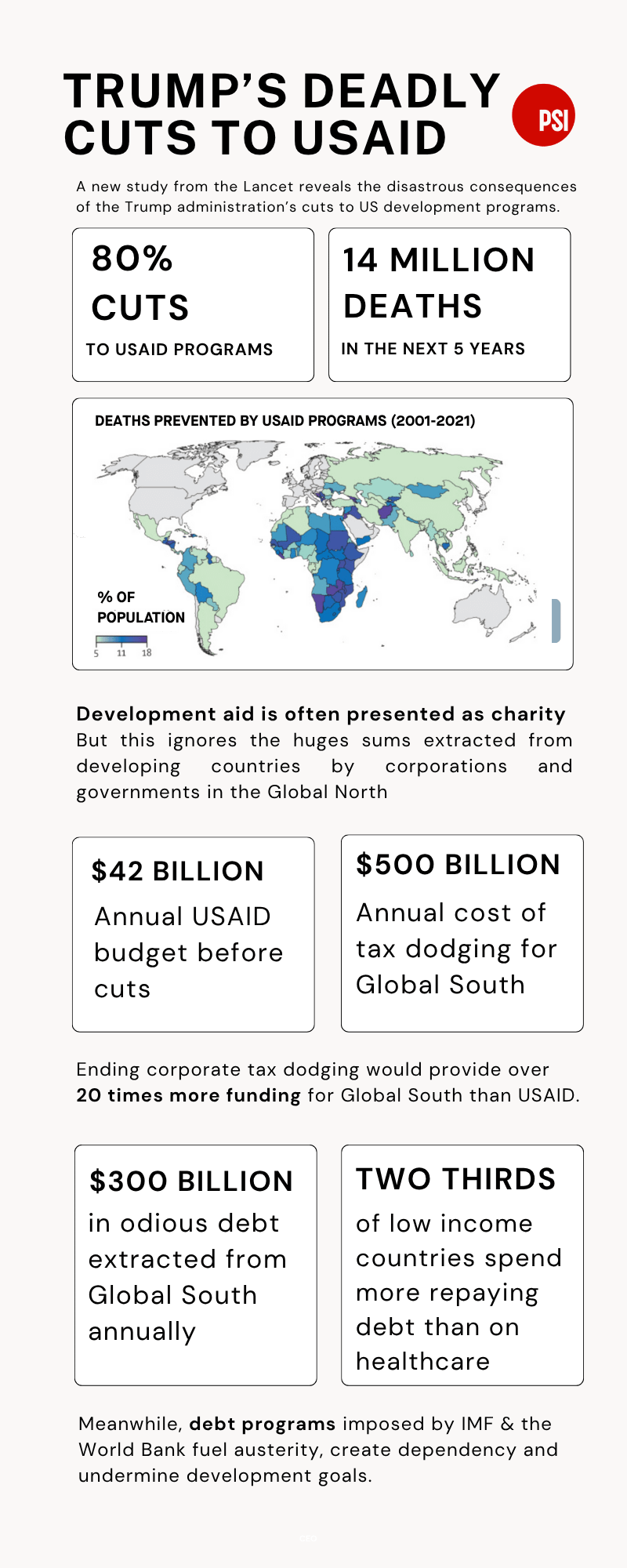
The numbers are not subtle. Official development assistance from the world’s established donors fell 23.1 percent in 2025, to $174.3 billion, that is the largest annual drop ever recorded, dragging global aid back a decade to where it stood in 2015.3 The United States and Donald Trump alone drove three-quarters of the drop, slashing its own assistance by 56.9 percent as it dismantled USAID, terminated roughly 83 percent of its programs, and withdrew from the World Health Organization.3,4 For the first time on record, the five largest donors: the United States, Germany, the United Kingdom, Japan, and France, all cut their aid in the same year.3Humanitarian assistance specifically fell 35.8 percent.3 A peer-reviewed forecast in The Lancet estimated that the USAID cuts alone could produce more than 14 million additional deaths by 2030, including 4.5 million children under the age of five.4 A later modelling study, accounting for the cascade of European cuts that followed, increased the figure to 9.4 million additional deaths by 2030 and sizeable loss of life thereafter.5 And the toll is no longer only a forecast. By early 2026, one year into the dismantling of USAID, independent trackers modelling the cuts attributed more than 760,000 deaths to them already, over half of them children, a number that has gone on climbing through the first half of 2026.
“The rich world did not simply stop helping. It removed the buffer between the climate crisis and the people least able to survive it and then looked away as the two collided.”
The Aid Pipeline and What Happens When It Breaks
Foreign assistance is not charity in the sentimental sense. In dozens of fragile economies, foreign aid is the load-bearing infrastructure, the difference between a bad season and a mass grave. It funds the departments of health, the clinics that treat a malnourished child, the rations that bridge a failed harvest, the water well boreholes that hold off a drought, the surveillance networks that catch a disease outbreak, and the early-warning systems that tell everyone else where to look. Pull that pipeline and you do not merely subtract a service. You remove the shock absorber that stood between these countries and the next climate hazard barreling toward them.
This is where the second crisis enters. Climate change does not act alone in these countries; it acts as a risk multiplier, amplifying every existing weakness in food, water, health, and public finance.6 And the multiplier is arriving at an increasing rate with increasing ferocity just as the donor countries make the buffer disappear.
The UNEP Adaptation Gap Report for 2025, aptly titled Running on Empty,[i] found that developing countries will need between $310 and $365 billion a year to adapt to a warming world by 2035, against the roughly $26 billion in international public adaptation finance actually delivered in 2023: a gap of at least twelvefold, now widening as donor budgets shrink.6 The cruelty deepens in conflict zones. The International Rescue Committee found that seventeen of the world’s most conflict-affected, climate-exposed countries saw their development assistance fall by more than 40 percent between 2013 and 2023, even as climate shocks intensified, while capturing only 12 percent of the adaptation finance flowing to the developing world.7 Afghanistan and Yemen alone face losses of more than 10 percent of national income from the anticipated aid cuts.7
Beneath all of this runs a deeper, slower mechanism: the climate debt trap. When a drought, flood, or storm strikes a poor country, it has to borrow to rebuild, and public debt that averaged 68 percent of GDP in the disaster year climbs to roughly 75 percent within three years.8 The interest on that borrowing then crowds out the very services that protect against the next shock. By 2023, forty-eight countries were spending more on external debt service than on the health of their own citizens, up from thirty-five a decade earlier.9 Into this doom loop climate damage is feeding debt, debt is starving public services, hollowed-out services invite the next disaster. The wealthy world has now evilly added the further shock of aid withdrawal. Climate hazards depress local credit and erode sovereign fiscal buffers across the Global South;10 when international assistance is pulled at the same moment, countries are left with empty treasuries and dismantled public services exactly when the physical costs of a warming planet demand unprecedented investment.
The path to hunger is direct, and it runs like this. Aid funds the food rations needed by climate refugees and the projects needed to adapt to climate change. Cut the aid and the rations shrink while the boreholes go unbuilt. A climate shock such as a failed rainy season, a flash flood, a heat-blasted harvest then lands on a community with no buffer left. Crops and livestock die. Food prices spike in local markets. Families cut meals, then cut them again. Children stop growing, then start stunting and then dying. None of this moves at the speed of a headline. It moves at the speed of a growing season. But it moves, reliably, from the cruel spreadsheet in a donor capital to the empty bowl of a child in a displacement camp.
Afghanistan: Total Safety-Net Dissolution
In the most fragile states, the interaction between environmental collapse and aid dependence is at its most deadly and nowhere more than Afghanistan, where the United States had supplied more than 40 percent of humanitarian support before the cuts.11 The country was already caught in chronic, climate-driven water scarcity: severe drought, failed and irregular rains, and flash floods that had been steadily crippling food production and emptying the countryside.11 Onto that, in late 2025, fell two devastating earthquakes and the forced return of millions of Afghans expelled from Iran and Pakistan.11 And then the foreign aid buffer vanished.
When Washington terminated its Afghanistan programs which amounted to more than $560 million slated for 2025, the health system buckled almost overnight.11 The number of closed health facilities surged from 188 in February to over 420 by the end of the year, cutting roughly three million people off from basic health care.11 Nearly 300 nutrition centers shut their doors. The World Food Programme, stripped of U.S. funding, had to collapse its programs from feeding 5.6 million people in the winter of 2024 to barely one million a month in 2025. WFP was forced, in the words of its own officials, to turn away three of every four acutely malnourished children for lack of money.11 For the first time in four years, the number of hungry Afghans rose, to 17.4 million, with seven provinces nearing famine.11 By the first half of 2026 the picture had darkened further: child malnutrition was projected to reach a record 4.9 million, and with its Afghanistan budget collapsing from about $600 million in 2024 toward a projected $200 million, the WFP could reach only around two million of the 17.4 million in acute hunger, still turning away three of every four malnourished children. When the next drought or flood strikes these un-buffered districts, there are no clinics, no early-warning teams, no food stocks, and no nutritional safety net left to turn to. The collapse will be total.
The Horn of Africa and Kenya: Drought Meets the Vanishing Ration
In East Africa, climate change has warped the rhythm of the seasons into something violent and unpredictable, swinging between multi-year droughts and catastrophic, disease-breeding floods. The region is now gripped by yet another failure of the rains. By the close of 2025, FEWS NET, back online but operating at a fraction of its former capacity, estimated that 20 to 25 million people across Somalia, Ethiopia, and Kenya needed humanitarian food assistance, with drought the primary driver for more than half of them.12 In the pastoral north of Kenya, milk production fell by roughly a third, livestock that survived the 2020–2023 drought began dying again, and staple maize prices in counties such as Kitui ran nearly 20% above their five-year average. By early 2026 the crisis had deepened sharply: after the October–December short rains failed across the region, among the driest such seasons on record, the number in extreme hunger across Kenya, Somalia, and Ethiopia climbed toward 26 million; in Somalia alone the figure facing crisis hunger nearly doubled to 6.5 million, and the IPC projected that close to half of all Somali children under five would need treatment for acute malnutrition by the middle of 2026, even as Somalia’s response plan went barely a tenth funded and Washington withheld support entirely.12 More than 800,000 Kenyan children were projected to need treatment for acute malnutrition in 2026.12
800,000 children needing treatment for acute malnutrition will, even if they survive, carry the consequences of this event for the rest of their lives. These 800,000 children will experience lasting harm: stunted growth and shorter adult height that early nutrition can never fully restore; impaired brain development during the critical first years, translating into lifelong deficits in memory, attention, language, and learning; a heightened lifetime risk of diabetes, high blood pressure, and heart disease as bodies adapted to scarcity later struggle with normal diets; weakened immunity and a months-long window of elevated mortality even after they leave treatment; and lasting damage to their guts and other organs. At the population level, these losses compound into diminished education, lower lifetime earnings, and a cycle that passes from malnourished girls to the low-birthweight children they will one day bear, a quiet, permanent toll that outlasts the famine that caused it. If they experience multiple periods without food, the impacts compound.
These 800,000 children needed emergency treatment for acute malnutrition just at the moment the rations evaporated. As OECD aid contracted at its fastest rate in history, the World Food Programme which had already cut rations for three-quarters of East Africa’s refugees in earlier funding crises was forced into deeper retreat.12 Kenya hosts hundreds of thousands of refugees in camps such as Kakuma and Dadaab, where populations have been swollen by climate displacement from across the region.12 When climate shocks spoiled local crops and the simultaneous rollback of food aid forced host families to absorb new survival costs, the result was not only hunger but fracture: as documented in longitudinal studies of refugee-hosting communities, the erosion of support wears down the willingness of host populations to take in the displaced, driving local backlash and regional instability in exactly the zones where there is the greatest need to help.13
“Where drought leads, hunger is never far behind. What is new is that the world has now intentionally dismantled the very system built to see the drought coming and provide aid before the famine comes.”
Uganda: The Refugee-Hosting and Drought Nexus
Uganda carries a burden few countries match: it hosts nearly two million refugees, the largest such population in Africa, even as shortening growing seasons and intensifying drought tighten the screws on its own farmers.13 The country has long relied on external frameworks to manage that pressure, the agricultural adaptation programs, the sanitation systems, the managed water distribution that allowed displaced populations to survive seasonal shocks rather than be destroyed by them.
Then the funding collapsed. USAID programs in Uganda absorbed a loss on the order of $307 million, a roughly 66 percent programmatic reduction.14 Academic assessments of frontline settlements such as Nakivale documented what followed: the elimination of USAID-funded agricultural adaptation, sanitation, and water infrastructure left displaced populations entirely exposed to the next climate shock.14 Without managed water distribution, a localized drought no longer slowed at the edge of the camp, it turned directly into food shortage while public-health infrastructure collapsed.14 The buffer that converted a hazard into something survivable was simply gone, and the climate hazard arrived anyway and people died.
South Africa: Dismantling the Scientific Frontline
· Not every casualty of the foreign aid withdrawal starves. Some of the damage is to the machinery that keeps hunger and disease from spreading in the first place. As temperatures climb across Southern Africa, the geographic range and transmission windows of vector-borne and infectious disease that impact people, livestock and crops such as tuberculosis, malaria, waterborne outbreaks, Foot-and-Mouth Disease, Tick-Borne Diseases, Lumpy Skin Disease, Maize Lethal Necrosis (MLN) and Vector Transmitted Viruses, Transboundary Plant Pests, are shifting to new countries and to new latitudes, placing new strain on public-health governance exactly as the systems to track them are being dismantled.15
On 26 February 2025, the United States terminated roughly 90 percent of the USAID-administered PEPFAR projects in South Africa, stripping more than $400 million from a country at the epicenter of the global HIV pandemic.16 Some 8,000 health workers were fired; clinics across 27 priority districts shed staff or shut entirely.16 A parallel mandate barred the National Institutes of Health from issuing foreign sub-awards, threatening dozens of research sites and the clinical trials, surveillance networks, and field data collection that the world relies on to understand how a warming climate redraws the maps of diseases.16,17 South African institutions stood to lose a substantial share of research income, triggering job cuts that ripple outward through sanitation, food security, and governance programs the same grants once cross-subsidized.17 The point is not that South Africa will starve.
Nor did the damage stop at human medicine. The same freeze tore through the region’s “One Health” surveillance, the joined-up tracking of human, livestock, and zoonotic disease that is built to catch an outbreak before it can jump the species barrier. Integrated animal-human monitoring programs run with bodies such as the South African Veterinary Association were dismantled, leaving officials blind to pathogens mutating between wildlife and livestock. The defunding of the UN Food and Agriculture Organization, whose emergency veterinary network had drawn roughly 90 percent of its funding from Washington, collapsed the transboundary animal-disease system that had spanned more than fifty countries and shut down the checkpoints that screened livestock in transit, allowing diseases such as foot-and-mouth to cross borders undetected. Broader freezes on agricultural and food-security grants halted field research as well, leaving farmers without the diagnostic pipelines to track the invasive, climate-driven blights now spreading through their crops.17 The point, again, is not that South Africa will starve. It is that the tools humanity built to watch climate-driven hunger and illness coming, the surveys, the trials, the data needed to track these disasters were switched off at the same time as the early-warning system itself.
Sudan: Famine in the Dark
Sudan is where the two crises meet their most catastrophic expression, and where the result of the blackout is no longer theoretical. Famine has been confirmed in Sudan: first in the Zamzam displacement camp in Darfur, then in Al Fasher and Kadugli, with the risk of famine declared across more than twenty additional areas. In October 2025 the Rapid Support Forces overran Al Fasher after an eighteen-month siege, killing civilians as they fled and driving more than a million people from the city; by February 2026 famine had spread to two further areas of North Darfur, Um Baru and Kernoi, where more than half of small children were acutely malnourished, making Sudan the country with more territory in active famine than anywhere else on earth.18 Twenty-five million people, half the country’s population, face acute hunger; the World Food Programme reaches an average of 4.2 million a month, including 1.8 million in famine or famine-risk zones, while warning of imminent food and other aid pipelines break.18
And in Sudan, the early-warning system has gone almost entirely dark. FEWS NET data disappeared in the freeze; the government had already suspended its cooperation with the U.N. classification system; and the NGOs that feed the global hunger-monitoring framework with field surveys have been forced to scale back as their own U.S. funding evaporated.1,18 In Sudan, a country sliding into the worst famine of the decade, the world is being asked to respond to a catastrophe it can no longer fully see. As one senior early-warning analyst put it as the system collapsed due to the indifference of the U.S. and other western donors, the global aid and the parallel detection services were pulled at the very moment the risk of multiple simultaneous famines had never been higher.1
Bangladesh: A Halved Ration in the Cyclone Belt
If Afghanistan shows what total dissolution looks like, Bangladesh shows the same machinery turned on the largest stateless population on earth. Nearly 1.2 million Rohingya, driven out of Myanmar by a campaign the United States itself called a genocide and pushed across the border again by renewed fighting in 2025, are confined to the camps of Cox’s Bazar, barred from working and almost wholly dependent on aid to eat. They are also penned onto one of the most cyclone- and flood-battered coastlines on the planet, where the storms come every year and the camps, stripped of trees and packed onto bare hillsides, dissolve into mud and landslides when they do.
The United States had been the largest single donor to the Rohingya response, supplying more than half of it, roughly $300 million, in 2024. As that money vanished, the World Food Programme cut the monthly food voucher from $12.50 to as little as $6, less than nine cents a meal, and the wider relief effort, only about half funded in 2025, fell to barely 19 percent funded in 2026 which will result in even more drastic cuts to food supplements and more hunger.19
The pattern is by now familiar: in an earlier round, families lost their shelters to a cyclone only weeks before a funding shortfall forced their rations down. Malnutrition in the camps has climbed to its worst level since the exodus of 2017, with the number of children needing treatment for acute malnutrition rising by more than a 25% in a single year.19 And as the ration shrinks, the desperate take to the sea, where hundreds of Rohingya drown or vanish each year on smugglers’ boats bound for Malaysia. The buffer between a stateless people and the next storm has been folded up and put away by Donald Trump and other Western donors.
Haiti: No Stocks Left for the Storm
In the Western hemisphere, the same story has a single, stark address. Haiti is the only country in the Americas, and one of just five on earth, where people are enduring catastrophic, famine-like hunger; 5.8 million Haitians, more than half the population, can no longer reliably eat.20 A decade of gang violence, political collapse and economic ruin had already hollowed the country out when, in late 2025, Hurricane Melissa tore into the island.
Here the removal of the buffer is almost literal. For the first time in its operations there, the World Food Programme entered hurricane season with no prepositioned food stocks at all, the funding shortfall having stripped away the contingency reserves it had always kept to feed survivors in a storm’s first days.20 The cupboard was bare at the moment it was most needed. The same shortfalls forced the agency to suspend hot meals for displaced families and to halve the rations of those already at emergency hunger, while Haiti’s 2025 humanitarian plan stood barely 8 percent funded at midyear and a spike in fuel prices, driven by conflict in the Middle East, pushed food still further out of reach.20 The lesson runs north as well: across the Central American Dry Corridor, the drought-cracked belt through Guatemala, Honduras, El Salvador and Nicaragua, failed harvests had by early 2026 left one in six Guatemalans short of food and were driving families toward the United States border, even as the very programs built to keep them fed and rooted were switched off.20
Famine by Subtraction: A War on the Poor
Step back from the individual countries and a single structural reality comes into focus. The hunger now spreading across the Global South is not, in the main, being caused by a sudden absence of food in the world. It is being manufactured by subtraction, the deliberate removal of global aid, in a single budget cycle. Likewise, the deliberate removal of the systems that stood between a warming climate and the people least equipped to endure it. This is famine by subtraction, and it has a chillingly clear arithmetic.
Begin with the rations. The World Food Programme expects that it received 40 percent less funding in 2025 than in 2024, about $6.5 billion against $9.8 billion. This aid reduction held even as global acute food insecurity stayed near its record at 318 million people, 41 million of them at emergency levels.21 The agency calculates that its cuts alone could push 13.7 million people from crisis into emergency hunger, a one-third increase, and notes that the number of people in famine or catastrophic hunger has doubled in two years to 1.4 million.21 The world Food Programme expects to expects to receive ~$6.4 billion in 2026 compared to the ~$13 billion it needs to reach the 110 million people in desperate need. Across its operations the math is brutally concrete: in South Sudan, every recipient is now on a half-to-two-thirds ration with key foods running out; in the Democratic Republic of the Congo, planned support was slashed from 2.3 million people to 600,000; in Haiti, hot meals stopped and rations were halved.19 This means millions of people will die and millions of children will suffer from stunting and have life long medical problems because they don’t get enough to eat.
Look more directly at these children. Malnutrition already underlies 45 percent of all deaths globally among children under five, and the main tool against it, the ready-to-use therapeutic food, the peanut paste that pulls a wasting child back from the edge used to run through the exact supply chains that the USAID and other foreign aid cuts broke.22 UNICEF warned that stocks of that therapeutic food were running short in seventeen countries, leaving up to 2.4 million severely malnourished children at risk of going without.23 In one of the era’s defining images, enough food to feed 3.5 million people for a month, some $98 million worth, including thousands of tonnes of therapeutic paste capable of saving hundreds of thousands of children was left by the Trump Administration to rot in four U.S. government warehouses, some of it destined for incineration or conversion to animal feed, while children starved in Sudan, South Sudan, and beyond.23
Finally, the aid cuts have subtracted our eyes. The gutting of FEWS NET, which was brought back after its shutdown, but only in a diminished form, and shifted to State Department control, together with the simultaneous strain on the data networks that feed the international hunger-classification system, mean that the cuts have blinded the response as well as bankrupting it.1 When the Global Report on Food Crises appeared in 2026, its authors warned that the apparent leveling-off of world hunger was partly an artifact of the data: the report rested on the fewest adequately measured countries in a decade, with eighteen left unclassified, among them Ethiopia, where some twenty-seven million people went uncounted meaning hunger most likely had not leveled off. A response that is both poorer and blinder is the structural recipe for the thing the world spent forty years learning to prevent: famine that is seen too late, because it was happening in places where, without aid, and without anyone still watching.
“The food rotted in the warehouse. The clinic closed its doors. The satellite kept watching the drought, but no one was left to read the warning. This is not scarcity. It is an evil decision not to provide international aid - creating hunger and starvation like this around the world is a political choice, it is a war on the poor.”
What Must Change: Policy Changes Proportionate to the Crisis
Donor governments must reverse the humanitarian cuts first, and fast. Humanitarian assistance is the thinnest, most time-sensitive layer of the safety net, these are the ration that prevents a hungry season from becoming a fatal one. Unfortunately, humanitarian aid has absorbed the deepest proportional cut of all.3 Restoring it is not a long-term development question; it is a question of who eats this year and who will starve? The scale is now plain: the World Food Programme says it needs roughly $13 billion in 2026 just to reach 110 million of the hungriest, a third of those in need. Every month humanitarian aid cuts are maintained converts a reversible funding gap into an irreversible death toll that the peer-reviewed literature has already counted in the millions.4,5
Climate adaptation finance must be protected as the buffer it is and delivered as grants rather than debt. Pouring loans into climate-vulnerable countries only tightens the debt trap that is already crowding health and food spending out of national budgets.8,9The evidence on prevention is overwhelming: every dollar spent on early risk reduction saves up to fifteen in post-disaster recovery.7A world that cannot find $40 billion a year for adaptation will spend many multiples of that on the famines, displacement, and instability that the absence of adaptation funding guarantees.
The early-warning architecture must be rebuilt and shielded from political whim. A famine-monitoring system that can be switched off in a single executive order at the exact moment of maximum risk and maximum need is not a system; it is a liability. FEWS NET and the data pipelines that feed the international classification framework are global public goods, and they should be funded and governed as such because a hunger crisis that no one can see is one that no one can stop.
And the wealthy world must recognize that providing humanitarian aid funding is strategy for global stability, not idle generosity. Food insecurity drives displacement, displacement drives instability, and instability drives the conflicts that close shipping lanes, collapse governments, and ultimately reach the donor nations that imagined themselves insulated. Protecting food aid and adaptation finance is not charity. It is the cheapest insurance policy a stable world has ever been offered, and it is being canceled in real time.
A Warning Without a Warning System
The wealthy nations of the world have told themselves a comforting story about foreign aid: that it was wasteful, that it was optional, that its absence would be absorbed somewhere far away by someone else. That story is being rewritten, season by failing season, by a climate that does not respect national budgets and by the arithmetic of millions of empty food bowls in refugee camps and millions of unnecessary deaths. The aid withdrawal of 2025, which has been mostly maintained since then, adding to the deliberate removal of the global safety net at the precise hour the climate emergency is demanding the increased responses.
The seventeen million Afghans now facing hunger did not dismantle their own health system.11 The families in the drought-cracked Horn of Africa did not vote to halve their rations.12 The children in Sudan starving in the dark did not switch off the system built to warn the world they were starving.18 But they are paying for all of it, in skipped meals and stunted growth and the quiet, countable emergency that famine always is. Four decades ago, a famine the world failed to see coming killed a million people and shamed a superpower and President Ronald Regan into building a system so that the world would never be blind to an impending starvation again. In 2025, that system was switched off on purpose. Now the consequences are being written on the faces and bodies of the people and children who are least responsible for climate change or the state of their countries. What is missing this time, is that there is no one in power who cares. We need to care and the world needs to restore humanitarian aid and adaptation resources before more of the world descends into chaos.
“In 1985, the world built a machine to make sure that a massive famine would never happen with no one seeing it coming. In 2025, the wealthiest nation in the history of the Earth lead by Donald Trump, and its allies turned the machine off and then defunded the food and other aid response that the machine existed to trigger in case of a famine disaster. People will die in huge numbers, and these wealthy countries will all bear the shame.”
Endnotes
1. Famine Early Warning Systems Network (FEWS NET): history, methodology, and 2025 shutdown. Created by USAID in 1985 following the 1983–85 Ethiopian famine; taken offline 30 January 2025 during the foreign-aid freeze and partially restored in June 2025. See FEWS NET (fews.net); NPR, “A respected U.S. famine warning system is ‘currently unavailable’” (21 Feb 2025); Devex, “USAID-funded famine early warning system goes offline” (30 Jan 2025); Devex Dish, “Will the world’s next famine go unseen?” (19 Mar 2025). The 2016 Ethiopia pre-positioning account is from D. Harden via NPR (2025). By 2026 the system had resumed only in reduced form, with management shifting to the U.S. State Department; see Devex, “FEWS NET, once USAID’s flagship famine warning system, is back online” (25 Jun 2025). On the resulting data blindness, see Global Network Against Food Crises, Global Report on Food Crises 2026 (24 Apr 2026), which recorded the fewest adequately measured countries in a decade, with 18 left unclassified, among them Ethiopia (~27 million people uncounted).
2. On the fertilizer-supply mechanism and food-price transmission, see the companion analysis of the Strait of Hormuz fertilizer shock and prior food-price crises; Headey, D. & Fan, S. (2010), Reflections on the Global Food Crisis, IFPRI Research Monograph 165.
3. OECD (2026). Preliminary 2025 ODA data: total ODA fell 23.1% in real terms to USD 174.3 billion, the largest annual contraction on record; the United States drove ~75% of the decline (−56.9%); humanitarian aid fell 35.8%; first year the five largest donors all cut simultaneously. OECD, “International aid fell sharply in 2025” (9 Apr 2026) and “A historic decline in foreign aid: preliminary 2025 ODA data.”
4. Cavalcanti, D., Ferreira de Sales, L., et al. (2025). Evaluating the impact of two decades of USAID interventions and projecting the effects of defunding on mortality up to 2030. The Lancet, 406:283–294. Projects >14 million additional deaths by 2030, including ~4.5 million children under five, across 133 countries; ~83% of USAID programs terminated.
5. Modelling study reported February 2026 projecting at least 9.4 million additional deaths by 2030 when accounting for compounding cuts by the UK, Germany, Canada and others. CNN, “One year on from dismantling of USAID” (4 Feb 2026). The Center for Global Development separately estimated 500,000–1,000,000 excess deaths in 2025 alone. On the documented toll to date, the Boston University–based ImpactCounter tracker attributed more than 762,000 deaths to the cuts by January 2026, over half of them children; see CIDRAP (21 Jan 2026).
6. UN Environment Programme (2025). Adaptation Gap Report 2025: Running on Empty. Developing-country adaptation needs estimated at USD 310–365 billion/year by 2035 (2023 prices) against ~USD 26 billion in international public adaptation finance in 2023; needs by 2035 at least 12 times current flows. On climate as a risk multiplier, see also Mohamed, A. A. (2026), Climate change as a macro-financial risk multiplier, Frontiers in Climate.
7. International Rescue Committee (2025). Navigating the Climate Crisis in a New Era of Aid. Seventeen conflict-affected countries saw development assistance fall >40% (2013–2023) while receiving only 12% of adaptation finance; Afghanistan and Yemen face potential losses exceeding 10% of GNI from aid cuts; every USD 1 in early risk reduction saves up to USD 15 in recovery.
8. International Monetary Fund analysis of major disasters (1992–2016): public debt rose on average from ~68% of GDP in the disaster year to ~75% three years later. See Eurodad, “A tale of two emergencies”; phys.org / The Conversation, “Climate disasters will send many countries into a debt spiral” (12 Nov 2025), citing Jamaica’s post-Hurricane Melissa exposure.
9. Down To Earth (2025), “Debt’s climate link.” By 2023, 48 countries’ external sovereign debt service exceeded government health expenditure as a share of GDP (up from 35 in 2013). On the “climate debt trap,” see WRI, “Developing Countries Won’t Beat the Climate Crisis Without Tackling Rising Debt.”
10. Mohamed, A. A. (2026). Climate change as a macro-financial risk multiplier: evidence from private-sector credit in fragile sub-Saharan Africa. Frontiers in Climate. Documents how climate variability depresses local private credit and erodes sovereign fiscal buffers.
11. Afghanistan: UN OCHA, Afghanistan Humanitarian Update (May 2025) and UN News (11 Dec 2025) — closed health facilities rose from 188 (Feb) to >420, cutting ~3 million from care; ~300 nutrition centers closed. WFP support fell from 5.6 million people/month (winter 2024) to ~1 million; ~17.4 million food insecure (first rise in four years), seven provinces nearing famine; ~4 million children acutely malnourished with three in four turned away (AP/ABC News, 19 Feb 2026). Refugees International (29 Jan 2026), “No One Cares About Us Anymore”: USAID cut >USD 560 million slated for 2025; crisis compounded by drought, two late-2025 earthquakes, and mass returns from Iran and Pakistan; U.S. previously supplied >40% of humanitarian support. On the 2026 deepening, see WFP, Afghanistan emergency page (2026): child malnutrition projected at a record ~4.9 million; WFP’s Afghanistan budget falling from ~USD 600 million (2024) to ~USD 300 million (2025) and a projected ~USD 200 million (2026), able to reach only ~2 million of the 17.4 million in acute hunger and turning away three of every four malnourished children (AP/Washington Post, 18 Feb 2026).
12. Horn of Africa / Kenya: FEWS NET East Africa Alert (Dec 2025) — 20–25 million across Somalia, Ethiopia, and Kenya needing assistance, drought the driver for 50–55%; maize prices ~19% above five-year average in Kitui; milk production down ~one-third in Mandera. Welthungerhilfe, Hunger Due to Drought in East Africa — ~810,900 Kenyan children requiring malnutrition treatment in 2026. JRC Global Drought Observatory (Feb 2026). On earlier ration cuts (rations cut for three-quarters of East Africa’s refugees), Migration Policy Institute (2026). On the 2026 escalation, see Oxfam (5 Mar 2026): failed October–December short rains pushed ~26 million across Kenya, Somalia, and Ethiopia into extreme hunger; Somalia’s IPC caseload nearly doubled to 6.5 million; the IPC projected nearly half of Somali under-five children needing acute-malnutrition treatment by mid-2026 (also Concern Worldwide); Somalia’s 2026 response plan ~13% funded, with the U.S. excluding Somalia from UN funding.
13. Uganda hosts ~2 million refugees, the largest population in Africa. On refugee-hosting dynamics and aid withdrawal, see MacDonald, M. (2026), Aid Cuts and the Politics of Refugee Hosting, Joint Data Center on Forced Displacement; and Lee, H. E. (n.d.), Global Aid Cuts and Local Health Consequences in Nakivale Refugee Settlement, Uganda (PMC).
14. Lee, H. E. (n.d.). Global Aid Cuts and Local Health Consequences in Nakivale Refugee Settlement, Uganda (PMC). USAID programs in Uganda absorbed a loss on the order of USD 307 million (~66% programmatic reduction), eliminating agricultural adaptation, sanitation, and water infrastructure and leaving displaced populations exposed to seasonal climate shocks.
15. On climate-driven shifts in disease transmission in Southern Africa, see Alawode, G. B. (n.d.), United States aid cut: alternatives for sustainable financing for health (PMC); and Shaikh, B. T. (2025), Global impact of the health funding cuts by the United States of America, Eastern Mediterranean Health Journal.
16. South Africa / PEPFAR: on 26 Feb 2025 the U.S. terminated ~90% of USAID-administered PEPFAR projects, cutting ~USD 400–420 million (≈17% of the national HIV budget) overnight; ~8,000+ health workers displaced; clinics across 27 priority districts affected. UNAIDS (Mar 2025); Physicians for Human Rights (2026), Wasted Investments, Looming Crisis; PBS/AP (2026).
17. Murray, L. W. (2025). The impact of United States Government cuts to funding on South African Healthcare and Research, SciELO. NIH ban on foreign sub-awards threatened dozens of research sites and ongoing clinical trials; institutions faced losses of a substantial share of research income, prompting retrenchments across cross-cutting programs. See also Auwal, A. R. (n.d.), The global implications of U.S. withdrawal from WHO and the USAID shutdown (PMC); and “The human cost of US foreign aid cuts: implications for HIV service delivery, research and innovation in South Africa,” AIDS Care (2025). On the animal-health and “One Health” dimension: the US provided roughly 90% of the funding for FAO’s Emergency Centre for Transboundary Animal Diseases (ECTAD), whose network spanned more than 50 countries; the cuts forced FAO to terminate dozens of projects and largely shut down transboundary animal-disease surveillance, raising the risk of animal-to-human spillover (around 75% of recent emerging infectious diseases are of animal origin). See K. Sumption (former FAO Chief Veterinary Officer) in Welthungerhilfe, Global Food Journal, “USAID cutoff boosts risk of animal infectious diseases” (2026); FAO, “Transboundary animal diseases pose urgent threat to global food security” (28 Nov 2025); and Physicians for Human Rights, Wasted Investments, Looming Crisis (2026).
18. Sudan: famine confirmed in Zamzam camp, Darfur (2024) and in Al Fasher and Kadugli (2025), with famine risk in 20+ additional areas; ~25 million people (half the population) in acute hunger, ~8.5 million at emergency level (IPC 4). WFP reaches ~4.2 million/month, including ~1.8 million in famine or famine-risk zones. IPC participation suspended and FEWS NET data unavailable during the freeze; MSF forced to suspend work in Zamzam. WFP (Oct 2025); ActionAid; Devex Dish (19 Mar 2025). The Rapid Support Forces captured Al Fasher on 26 October 2025 after an 18-month siege, with mass killings of fleeing civilians and >1.2 million displaced from the city; famine spread to Um Baru and Kernoi in North Darfur by February 2026, making Sudan the country with the most areas in active famine. See IPC/FRC (Nov 2025; Feb 2026); UNICEF/FAO/WFP (4 Nov 2025); Action Against Hunger (5 Feb 2026); Human Rights Watch, World Report 2026. Sudan’s 2026 humanitarian response plan (~USD 2.9 billion) was only ~5.5% funded in early 2026.
19. Bangladesh / Rohingya: the U.S. provided more than half (~USD 300 million) of the Rohingya humanitarian response in 2024; programs were ~50% funded in 2025 and ~19% in 2026 (NPR, 1 Apr 2026; Al Jazeera, 6 Mar 2025). WFP cut the monthly food voucher from USD 12.50 toward as low as USD 6 (Al Jazeera, 6 Mar 2025; Amnesty International, 17 Mar 2025). Cyclones (e.g. Mocha) and floods repeatedly compound the ration cuts; child acute-malnutrition needs rose ~27% year-on-year, the worst since 2017 (UNICEF; WFP, 7 Mar 2025). Roughly 1.2 million Rohingya remain in Cox’s Bazar, barred from work, with renewed Myanmar fighting in 2024–25 driving new arrivals.
20. Haiti / Central America: Haiti is the only country in the Americas (one of five globally) with people in catastrophic (IPC 5) hunger; ~5.8 million, over half the population, are acutely food insecure (WFP/IPC, 2025–26). Hurricane Melissa struck southern Haiti in late 2025; for the first time, funding shortfalls left WFP with no prepositioned hurricane-season stocks and forced the suspension of hot meals and the halving of rations; Haiti’s 2025 response plan was ~8% funded at midyear (WFP, 3 Jun 2025 and 15 Oct 2025). A U.S. Food for Peace contribution in April 2026 reached ~390,000 people. On the Central American Dry Corridor (Guatemala, Honduras, El Salvador, Nicaragua), see IPC/UNOCHA (2026): ~3 million Guatemalans (one in six) projected at IPC 3+ in February–April 2026, amid climate-driven crop failure and migration toward the U.S. border.
21. WFP (2025), A Lifeline at Risk: Food Assistance at Breaking Point, and “WFP warns six critical operations facing pipeline breaks” (15 Oct 2025): 2025 budget ~USD 6.4 billion, down ~40% from USD 10 billion in 2024; record 319 million in acute food insecurity, 44 million at emergency level; cuts could push 13.7 million from crisis (IPC 3) to emergency (IPC 4); people in famine/catastrophic hunger (IPC 5) doubled in two years to 1.4 million. Country ration figures: South Sudan, DRC, Haiti per the same WFP reporting and UN News (15 Oct 2025). Updated figures from WFP 2026 Global Outlook (18 Nov 2025) and Global Report on Food Crises 2026 (24 Apr 2026): ~318 million in acute food insecurity, ~41 million at emergency level; WFP raised ~USD 6.5 billion in 2025 and says it needs ~USD 13 billion in 2026 to reach 110 million people, a third of those in need.
22. World Health Organization: malnutrition underlies ~45% of deaths among children under five. Peer-reviewed: “Children at Risk: The Growing Impact of USAID Cuts on Pediatric Malnutrition and Death Rates,” Maternal & Child Nutrition (2025), 21(3):e70028.
23. UNICEF (late March 2025) warned ready-to-use therapeutic food (RUTF) stocks were short in 17 countries, putting up to 2.4 million children with severe acute malnutrition at risk of going without. Reuters / U.S. News (16 May 2025): food rations for ~3.5 million people for a month (~USD 98 million worth) stranded in four U.S. government warehouses, some slated for destruction; Edesia’s 5,000-tonne Plumpy’Nut stockpile (USD 13 million) idled. Micronutrient Forum / Standing Together for Nutrition policy brief (Mar 2025) on country-level SAM-treatment suspensions.